<?xml version="1.0" encoding="utf-8"?>
<feed xmlns="http://www.w3.org/2005/Atom">
    <title>TCLocal</title>
    <link rel="alternate" type="text/html" href="http://tclocal.org/" />
    <link rel="self" type="application/atom+xml" href="http://tclocal.org/atom.xml" />
    <id>tag:tclocal.org,2008-04-12://16</id>
    <updated>2013-04-04T12:01:08Z</updated>
    <subtitle>Planning for energy descent in Tompkins County</subtitle>
    <generator uri="http://www.sixapart.com/movabletype/">Movable Type 4.35-en</generator>

<entry>
    <title>Three Farmhouses: A Study in Passive Solar Design </title>
    <link rel="alternate" type="text/html" href="http://tclocal.org/2013/04/three_farmhouses_passive_solar.html" />
    <id>tag:tclocal.org,2013://16.6227</id>

    <published>2013-04-04T11:56:35Z</published>
    <updated>2013-04-04T12:01:08Z</updated>

    <summary>By Karl North Interest in passive solar design, once limited to a few engineers and tinkerers, expanded in the live-lightly-on-the-land movement of the 1970s and even spawned a literature on the subject. Since then, interest has waned to the point...</summary>
    <author>
        <name>Simon St.Laurent</name>
        <uri>http://simonstl.com/</uri>
    </author>
    
    
    <content type="html" xml:lang="en" xml:base="http://tclocal.org/">
        <![CDATA[<p>By Karl North</p>

<p>Interest in <a href="#Passivesolar">passive solar</a> design, once
limited to a few engineers and tinkerers, expanded in the
live-lightly-on-the-land movement of the 1970s and even spawned a
literature on the subject. Since then, interest has waned to the point
where most activity is not getting the public visibility that it
deserves.</p>

<p>This trend is unfortunate because as the energy descent from the oil
era deepens, the conventional sources of heat in residences will become
too expensive. The greater part of residential energy use, at least in
cool climates, is for heating for various uses &mdash; space heat, hot
water, cooking and drying, and cold season growing.  Heat from the sun
supplemented with wood heat can fulfill all these functions. To do so,
housing will need passive solar initial design or makeovers.</p>

<p>The need for these changes is not yet well understood. Human
consumption of planetary resources is now coming up against hard
physical resource limits, with the following implications for home
heating:</p>

<ul>

<li><p>All <a href="#Fossilfuels">fossil fuels</a> will gradually become
too scarce to be affordable for heating[1]</p></li>

<li><p>As human society returns to reliance
on <a href="#Biomassenergy">biomass energy</a> for many purposes, wood
and other forms of biomass will become scarcer as well</p></li>

<li><p>Unlike direct heat from the sun
or <a href="#Biomassburning">biomass burning</a>, other sources
including &ldquo;alternatives&rdquo; like wind or solar electric heating
require technologies that are expensive and energy conversions that
waste energy, which makes them too costly for most people</p></li>

<li><p>As fossil energy becomes more scarce, economies that currently
can produce resource-intensive alternatives will no longer have the
industrial capacity to provide these technologies at the necessary
scale. The only answer is to use lower cost technologies.</p></li>

</ul>

<p>The heroes of the old era were builders of the technologies with the
most power, regardless of how much of the earth&rsquo;s finite resources
they consumed. The heroes of the new era will be rebels against resource
depletion, people who build and share technologies that serve basic
human needs of food and shelter with the least consumption of the
earth&rsquo;s scarce resources.</p>

<p>The time is therefore right for renewed pursuit of passive solar
design, a low-technology heat source for the new era. Seeking a
relatively low-technology existence, in the last four decades I have
constructed or rebuilt three farmhouses using passive solar designs,
each adapted to different environments, available materials, and my
pursuit of low-input farming. This is an attempt to share my design
experiences in a way that helps people to find passive solar solutions
that fit their circumstances. By covering three projects that span forty
years of personal history, this saga exposes a learning process that may
help the general public think about how to make their heating costs more
affordable. While not intended to be a how-to manual, it hopefully will
persuade non-professionals that they can work out their own energy
solutions.</p>

<p>My account differs from many in several respects. First, it
emphasizes relatively inexpensive solutions, many of which are
accessible to amateur owner-builders. The first two projects were
achieved with little cash outlay. They are examples of models that are
increasingly valuable as the end of the era of cheap energy imposes a
search for simpler solutions to such basic necessities as food and
shelter. The fact that I have no training or experience as a
professional builder or architect may give encouragement to others who
consider this kind of building project. Second, other accounts, often
written by engineers, demand extensive mathematical calculation. In the
end their calculations still fail to capture the many considerations
that are specific to each building project. In my experience, beyond a
small number of critical dimensions and proportions that I cite in the
tables and text, a good understanding of the principles of passive solar
design and of the environmental conditions of the building site are
sufficient to guide design within the constraints of what the owner can
afford. Finally, this account reflects the potential, in a world where
everything is connected, to solve problems like home energy use by
designing elements to serve multiple functions as part of an integrated
whole. Thus the total effect of the essential elements of passive solar
design listed below will be limited by its weakest one. For example,
extra investment in high quality windows is justified only if all other
elements are built to the same standard.</p>

<h2>A Review of Design Essentials</h2>

<p>Here is a reminder of the main elements of effective passive solar
design to help the reader evaluate the relative success of each of the
construction projects to be described. A glossary at the end of this
account provides brief definitions of words underlined in the text but
does assume that the reader has an introductory knowledge of the
concepts of passive solar design.  I will cover details of the
principles involved as they apply differently to each house. The
essentials are:</p>

<ol>

<li><p>A landscape that shelters the house from prevailing
winds.</p></li>

<li><p>A compact house plan whose south side is roughly twice the area
of the east or west sides.</p></li>

<li><p>A high percentage of south-facing glass that combines insulating
value (<a href="#Rvalues">R value</a>) with high solar heat gain (e.g.,
double-paned uncoated thermopane).</p></li>

<li><p>Heavy insulation everywhere that heat could escape to the
outdoors.</p></li>

<li><p><a href="#Movableinsulation">Movable insulation</a> on windows to
limit heat escape in sunless times.</p></li>

<li><p>Sufficient <a href="#Thermalmass">thermal mass</a> to allow
capture and storage of excess heat for use in sunless hours.</p></li>

<li><p>Overhangs to shade windows from the summer sun.</p></li>

<li><p>Air-tightness and related controls of ventilation.</p></li>

<li><p>A means of heat redistribution throughout the living
space.</p></li>

<li><p>The most efficient and sustainable source of supplemental heat
possible (usually local firewood).</p></li>

</ol>

<h2>Project 1: Canaveilles, Pyr&eacute;n&eacute;es Orientales, France</h2>


<a href="/images/bigpics/threehouses-fig01-canaveilles.jpg">
<img src="/images/threehouses-fig01-canaveillesA.jpg" width="640px"/></a>
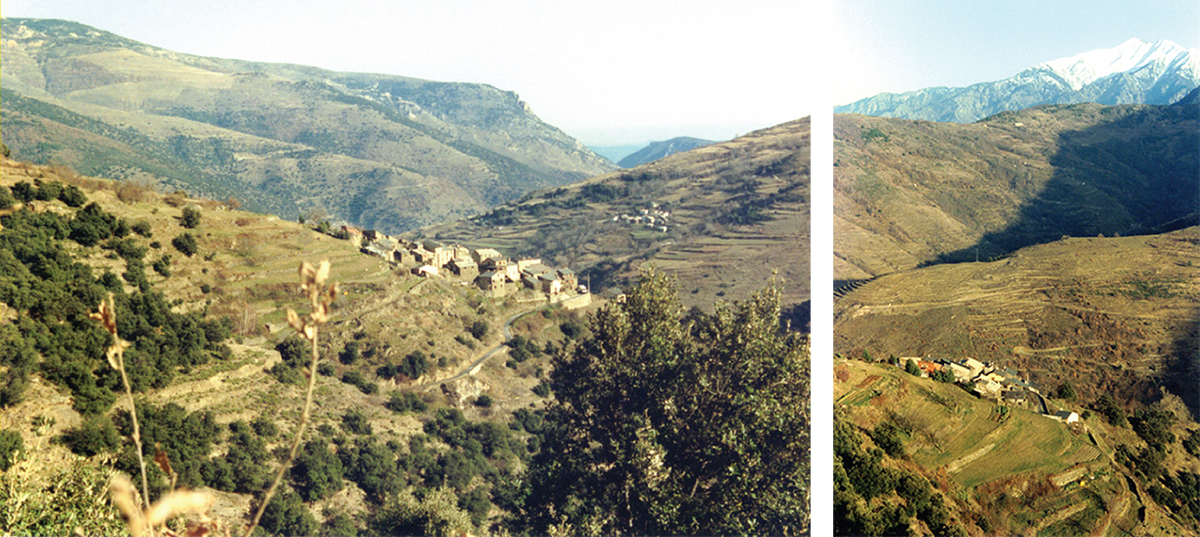
<blockquote><i>Figure 1. The Village of Canaveilles</i></blockquote>

<p>In the attempt to flee responsibilities of citizenship in a country
that had used weapons of mass destruction to commit genocide and
horrific environmental damage in poor, Third World countries of
Southeast Asia, in 1973 I left an academic career path and moved with my
wife and children to begin an agrarian life in a small village in the
mountains of French Catalonia. The houses of the region, with their
thick stone and clay walls and heavy slate roofs, are a testament to a
bygone age of heroic struggle and tenacity in an intensely sunlit but
difficult terrain, using primarily the simple materials that the
mountain offered in abundance. Nearly abandoned after centuries of
peasant subsistence farming, the village of Canaveilles, located at an
altitude of 3500 ft, offered one of these houses and a barn, all
attached to other houses in the clustered style of villages of old
Europe. We bought the house and barn next door and began to rebuild it
as we learned to farm the narrow terraces of the steep Mediterranean
mountainside.</p>

<a href="/images/bigpics/threehouses-fig02-southface.jpg">
<img src="/images/threehouses-fig02-southfaceA.jpg" width="640px"/></a>
<blockquote><i>Figure 2. South face of farmhouse in Canaveilles with
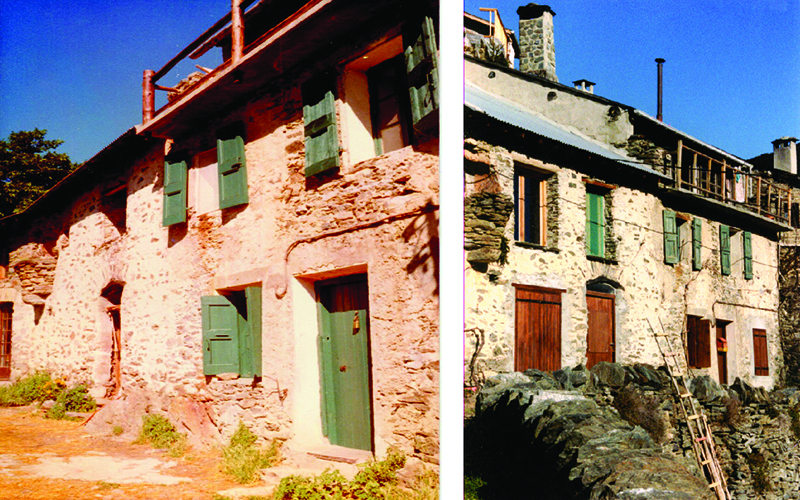
third storey reconstruction for passive solar heating</i></blockquote>

<p><b>Insulation and Thermal Mass.</b> The house offered some ideal
requisites of passive solar design. The front wall had full southern
exposure to the intense sun of the region, but being two feet thick, it
kept out the both summer heat and the freezing temperatures of winter
nights. The earth sheltered house has long been a favorite of energy
efficient house designers. This house, in fact the whole street, was as
if built to order. The north wall, chipped into the mountainside,
provided the insulation equivalent of an endless earth berm. The side
walls, shared with the neighbors, also supplied the high insulation
values that are necessary to passive solar design. The mountainside
behind the village sheltered it from the prevailing winds. All these
elements in combination with the forgiving Mediterranean climate
(shirtsleeve temperatures on cloudless winter days) reduced the solar
heat requirement and made our first design project easier.</p>

<p>Compared to recommendations for thermal mass in the passive solar
literature, the centuries-old, massive stone walls of this dwelling were
overkill. The experience taught us that no amount of excess thermal mass
hurts house performance. Our rule of thumb learned in practice has been
to cover as much of the south side of a house with glass as we could
afford, then build in enough heat storage to handle the solar capture
capacity of the south glass area.</p>

<p><b>Solar Glazing.</b> Traditional construction in the village had
minimized window area, partly because the local subsistence farmers
could not afford much glass, and partly because property was taxed
according to window area. So our main task was to increase the glass
area in the south face. Instead of the arduous task of tearing out thick
stone walls, we chose to raise the roof (which needed replacing) on the
third story garret and make that floor into our main living space,
solarizing it with glass all across the front and adding a balcony.</p>

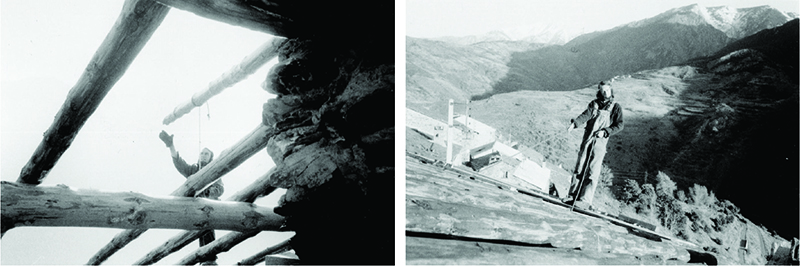
<p>Building the new living space was an exercise in the use of free and
salvage materials, for our finances were no better than those of the
remaining villagers. The river bank in the gorge below the village
supplied free sand for the mortar to raise the walls. Wall stone came
from ruins in the village. Rights as property owners gave us access to
timber for beams and rafters in the village communal forest.  Work
parties of volunteers from around the region helped place the big beams,
and helped with the heavy labor of removal of the old slate roof in
exchange for room and board. In an abandoned commercial building in the
region we found windows at salvage prices, but large enough to be used
as French doors, and installed them as the south wall of the living
space. I include these details because they illustrate a low-cost
approach to building (and to life) that will become increasingly
necessary in the post-petroleum era.</p>

<a href="/images/bigpics/threehouses-fig03-reconstruction.jpg">
<img src="/images/threehouses-fig03-reconstructionA.jpg" width="640px"/></a>
<blockquote><i>Figure 3. House reconstruction using trees from the
communal forest and personal labor</i></blockquote>

<a href="/images/bigpics/threehouses-fig04-finished.jpg">
<img src="/images/threehouses-fig04-finishedA.jpg" width="640px"/></a>
<blockquote><i>Figure 4. Finished reconstruction of third storey as main
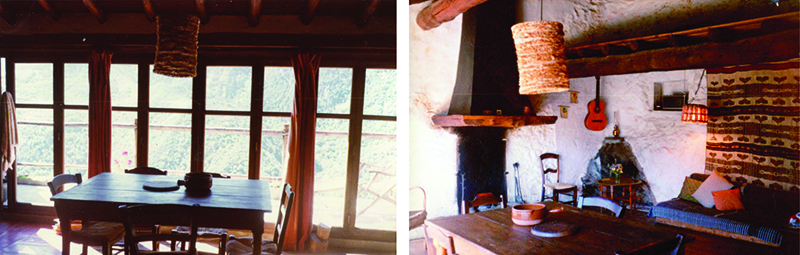
living space</i></blockquote>

<a href="/images/bigpics/threehouses-fig05-balcony.jpg">
<img src="/images/threehouses-fig05-balconyA.jpg" width="320px"/></a>
<blockquote><i>Figure 5. Author on balcony enjoying February
sun</i></blockquote>

<p><b>Heat Distribution.</b> We used a method that is common in passive
solar design for effective heat distribution &mdash; an open,
partitionless plan of the living space to serve multiple functions:
cooking, dining, sitting, and a loft as a guest sleeping
area. Supplementary heat came from a small wood-fired kitchen range at
one end of the space and a hooded fireplace in the local Catalan style
at the other. The thick stone walls kept temperatures in the lower
floors warm enough in winter and cool enough in summer for sleeping and
storage with no need for solar or other heating.</p>

<p>The weakest part of the design was the roofing, which had to be cheap
asphalt tiles, as we had not the consummate skill necessary to put back
the slate roof. We could not afford a plywood deck, so we used cheap
planks, which were not airtight, and no insulation. In a colder climate
these would have been major defects. The main problem with the new roof
in the climate of southern France was lack of protection from the summer
heat.</p>

<p>The climate in the Eastern Pyr&eacute;n&eacute;es is mild enough that
we could forego <a href="#Insulatingglass">insulating glass</a> and
movable insulation on the glass front. Instead it needed drapes and a
substantial roof overhang to protect the living space from the heat of
the summer sun. Despite freezing winter temperatures at night and on
cloudy days, the need for supplemental heating was low enough that
firewood could be sawed and split by hand. The huge thermal mass of the
house was more than sufficient to maintain warmth in winter and keep the
house cool in summer, but would have worked better had we been able to
insulate the roof, or reinstall the slate roof on a thick bed of clay,
in the tradition of the region. The experience taught us not to take
lightly centuries-old construction traditions.</p>

<p>Having been brought up in wooden houses, we found the experience of
living within the permanence, security, and quiet of massive masonry
walls unforgettable. Similarly, the feeling of being almost outdoors
that the wall of French doors conveyed, in combination with the balcony
just outside affording a spectacular panorama of a gorge rising to often
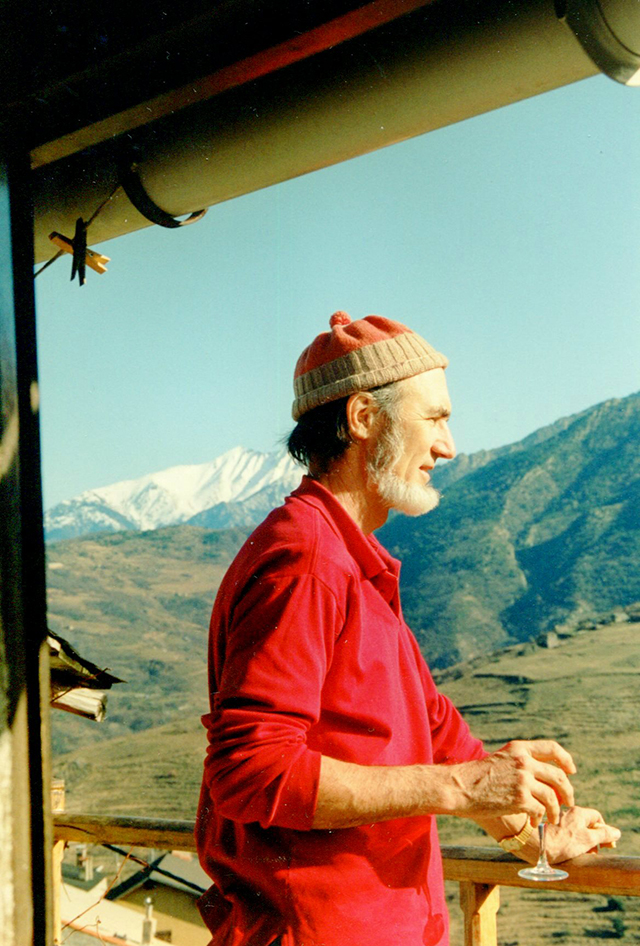
snow-capped peaks, made living in the renovated house in Canaveilles a
special experience. The French doors, the balcony, earth berms, and
masonry walls were design elements that we would try, with varying
success, to carry on to the next passive solar farmhouse project in
upstate New York.</p>

<h2>Project 2: Freetown Corners, New York</h2>

<a href="/images/bigpics/threehouses-fig06-nyfarmhouse.jpg">
<img src="/images/threehouses-fig06-nyfarmhouseA.jpg" width="640px"/></a>
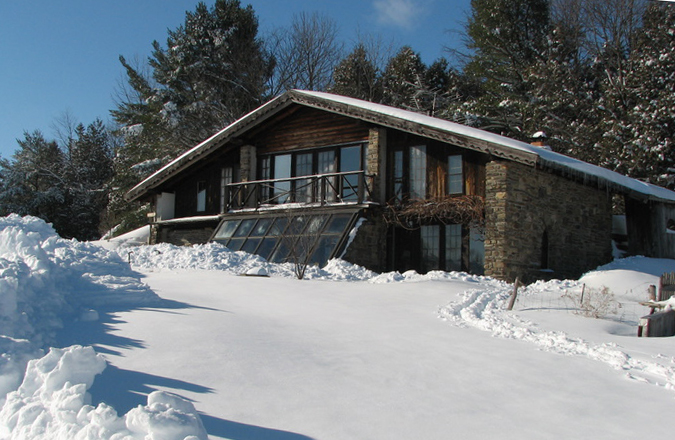
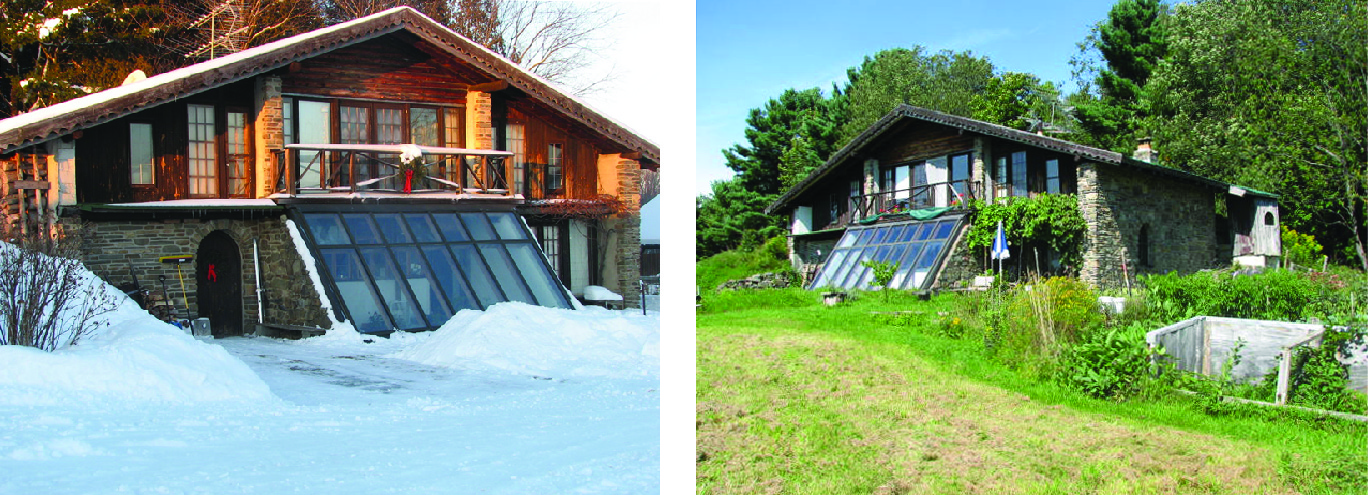
<blockquote><i>Figure 6. The farmhouse in Freetown
Corners</i></blockquote>

<p>In 1980 we moved from apprenticeship with low-input farming and
building in France to commercial farming in the US. Purchase of empty,
long-abandoned farmland gave us a clean slate with which to design and
build. We were accustomed to the fairy-tale quality of old European
villages and farms that nestled naturally into the countryside, a
consequence of a long process of adaptation whereby human habitat finds
its best &ldquo;fit&rdquo; both to the lay of the land and to the
aesthetic needs of the inhabitants. The planner of a small farm has an
opportunity that is unusual in our industrial age to design both an
enterprise and a habitat that is satisfyingly human in scale. A
farmhouse, barns, and farm-stead layout built to complement and
celebrate the natural beauty of the spot rather than conquer it are a
joy to live and work in, and this was our plan. We had enough capital
from the sale of the house in France to cover construction of a
farmhouse because we furnished most of the labor, contracted to thin
state forest plantings for low-cost saw logs, collected local stone from
old walls, and bought used windows, doors, and other fixtures at salvage
prices.</p>

<p><b>The Landscape.</b> The colder, almost continental climate of
Central New York required the fullest implementation of passive solar
design principles. A first energy efficiency design problem on our
windswept hilltop land was to locate the farmhouse and buildings in a
place sheltered from the prevailing winds. This we accomplished with
some effort by building in the lee of a small evergreen woods a quarter
of a mile back from the road and by planting a shelter belt of spruce
and pine saplings in the adjoining hedgerow. Putting the center of
operations out of the winter wind chill was well worth building the
extra lane, for it made the house easier to heat and our winter farm
work enjoyable.</p>

<p><b>Thermal Mass.</b> Our intent was to build a mostly masonry
residence, for its thermal mass and for the other qualities we had
discovered in European architecture. We also incorporated the dug-in
feature of the Canaveilles house, which in this site meant partially
covering the back and one side wall with earth berms.</p>

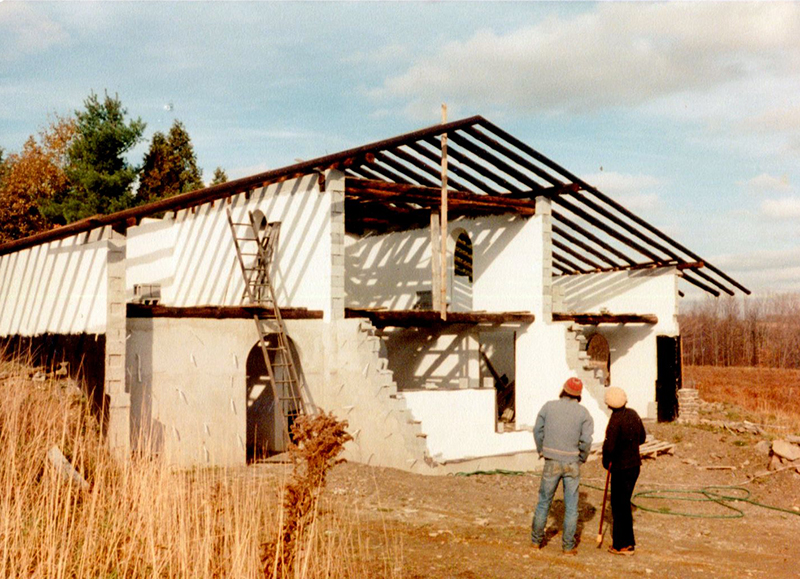
<p>The masonry consists of an insulated stone floor on the ground level
and a shell of concrete block on three sides, insulated heavily on the
outside and covered with a second wall of stone where walls were not
earth-sheltered. We left rafters and beams as whole logs for strength
and to save sawmill costs.  Another staple of European architecture that
we managed to incorporate was arched openings. We built them the
traditional way in the laid stone walls, and in the block walls we
poured concrete into forms, using a piece of sheet metal in the bottom
of the form, curved in the shape of an arch. At this point people said
that the structure looked like a large bird spreading its wings either
for take-off or to defend a brood.</p>

<a href="/images/bigpics/threehouses-fig07-drylaid.jpg">
<img src="/images/threehouses-fig07-drylaidA.jpg" width="640px"/></a>
<blockquote><i>Figure 7. Dry-laid block and bonding cement make strong
walls fast</i></blockquote>

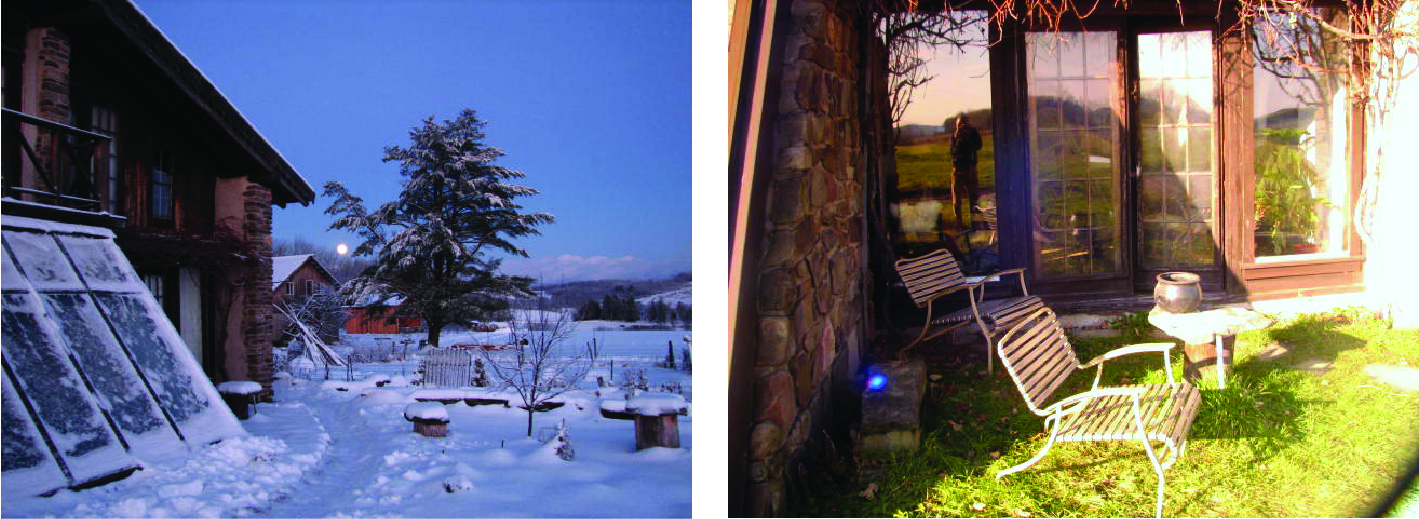
<p><b>Solar Glazing.</b> An attached <a href="#Solargreenhouse">solar
greenhouse</a> was a major addition to our solar building experience. It
merits careful treatment here because such a structure poses unique
design challenges. Our passive solar plan was to cover most of the
front, south-facing wall with glass. We are convinced that an attached
greenhouse is an essential of passive solar design because of its
multiple functions. Built to the same design standard for insulation and
double glazing, a greenhouse can capture as much heat as other south
windows, without overheating the main living space. Designed with
slanted glass, it provides even more heat to the interior than vertical
glass because for most of the year the sun hits it more directly. The
extra sunlight from slanted glass is often too much in the living space
of a house, but it improves three potential functions of a greenhouse
&mdash; to indirectly heat the house, to grow food and flowers, and to
provide solar heated water. Finally, provision for many plants in a
house freshens inside air: plants and animals have a symbiotic
respirational relationship; the stale exhale of each is the fresh air to
inhale of the other.</p>

<p>We sank our greenhouse four feet below grade to serve several
purposes. It creates a shaded space along the front for plants that
require more indirect light. It allows taller plants and a stepped set
of growing benches that makes better use of the space and light. And,
like the earth berms on other house walls, it adds the insulation value
of the ambient earth temperature and reduces insulation costs for the
underground parts of the walls.</p>

<a href="/images/bigpics/threehouses-fig08-professionally.jpg">
<img src="/images/threehouses-fig08-professionallyA.jpg" width="640px"/></a>
<blockquote><i>Figure 8. The professionally reglazed New York
greenhouse</i></blockquote>

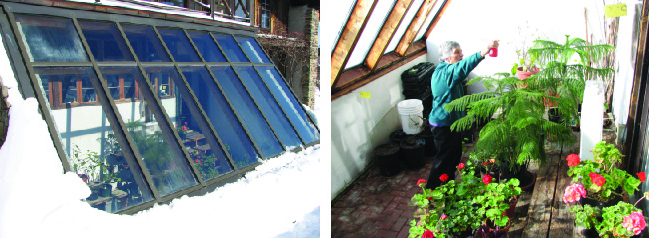
<p>Although slanted glass lets in more heat than vertical glass, it has
drawbacks that are an important design consideration. More exposed to
the weather than vertical glass, it takes more construction skill and
expense to make it weather tight. Our original construction of salvage
glass on an entirely wood frame served the purpose well for 15
years. But leaks and rot in the frame took their toll, and when we could
afford it, we replaced the front frame, roof, and glass with a
professional job. It has lasted many years with virtually no
deterioration but was much more expensive. The present version shown in
the photos consists of:</p>

<ul>

<li><p>High quality, relatively rot proof framing wood.</p></li>

<li><p>Thermopane double glazing.</p></li>

<li><p>Special hardware for the glass to ride on as it expands and
contracts at a different rate from the frame in the typically wild
swings of greenhouse temperatures.</p></li>

<li><p>A sheet metal external skin for further weather
protection.</p></li>

</ul>

<p>Movable insulation is also more of a challenge with slanted
glass. Placed inside, it is harder to move and in many cases subject to
soaking with window condensation. Placed outside, it needs to be weather
proof and easily movable and cleanable of snow and ice. We chose not to
insulate, but without it the greenhouse temperature drops to 40 &deg;F at
night and takes longer to reheat and to begin heating the house on sunny
winter days. This makes the greenhouse less of a source of heat for the
house than it would be with movable insulation. As nearly half the
south-facing glass is in the greenhouse, we now see this as a major
design flaw. There are of course technological solutions to these
problems (motorized operation, specialized insulation materials and
hardware), but not ones we could afford at the time.</p>

<a href="/images/bigpics/threehouses-fig09-slopedglass.jpg">
<img src="/images/threehouses-fig09-slopedglassA.jpg" width="640px"/></a>
<blockquote><i>Figure 9. Sloped glass gathers snow (left); grapevine
    shades let light through in winter (right)</i></blockquote>

<p>To alleviate the problem, we designed the common wall between the
greenhouse and the main house to include openable windows to light the
kitchen and to control transfer of heat between the two spaces. Like
movable insulation, these openings must be managed almost daily but work
well. Sloped glass collects snow but is easily swept with a long-handled
push broom. It also needs a shade cloth cover against the summer
heat.</p>

<p>Our building plan for the farmhouse called for 400 ft<sup>2</sup> of
glass, mostly placed on the south side. To stay within budget, we
acquired used glass: standard 3&rsquo;x6&rsquo; thermopanes whose seals
had broken and let in dirt over years of use and several sets of used
French doors obtained through a want ad. We separated the thermopanes
into single panes to clean them and to have enough to single-glaze all
fixed window space. To achieve the double glazing standard of passive
solar design, we installed plastic sheeting on wood frames in all these
windows. When later we were able to replace these windows with new
thermopane, we were gratified to discover that our makeshift originals
had kept heat in the house as well as the new ones.</p>

<p>The French doors were a different story. Although performing
perfectly their romantic function, they were not built for exterior use,
were single-paned, and could not seal well enough to meet the high
standard of air-tightness required in energy-efficient design. Our
solution to this problem was to close them permanently for the winter,
apply weather stripping, and attach a permanent second pane of
plexiglass on the exterior.</p>

<p>The house was still not designed to be sufficiently airtight, partly
because we had been able to ignore the problem in the relatively mild
French climate and did not take it seriously enough in cold New
York. The main leaks were around the home-built main external door and
in the all-important roof. Here again, there were easy solutions, but at
the time they cost more than we thought we could afford. In retrospect I
think building an airtight house is important enough to have warranted
the extra expense.</p>

<p><b>Passive Hot Water.</b> Next to heating the house, hot water
production is often the largest residential energy consumer. A house
designed to be heated by the sun supplemented by firewood can easily
incorporate use of the same sources to heat water, so we designed the
New York house to take full advantage of these on-site energy
sources. The most effective source of winter hot water, common in many
houses before the advent of cheap fossil energy, is a wood-fired kitchen
range that also heats the house and cooks the food. The best of these
are constructed of cast iron to retain heat and incorporate a water
jacket in the firebox through which water is piped to heat it. The water
jacket is connected by a
<a href="#Convectionloop">convection loop</a> to a tank placed above the
stove. The fact that water rises when heated causes constant circulation
of water in the loop and hot water accumulation in the tank, without an
extra pump. As in conventional hot water systems, the tank delivers hot
water to sinks and shower because it is part of the pressurized water
system of the house.</p>

<a href="/images/bigpics/threehouses-fig10-hotwater.jpg">
<img src="/images/threehouses-fig10-hotwaterA.jpg" width="640px"/></a>
<blockquote><i>Figure 10. Winter and summer hot water
systems (New York house)</i></blockquote>

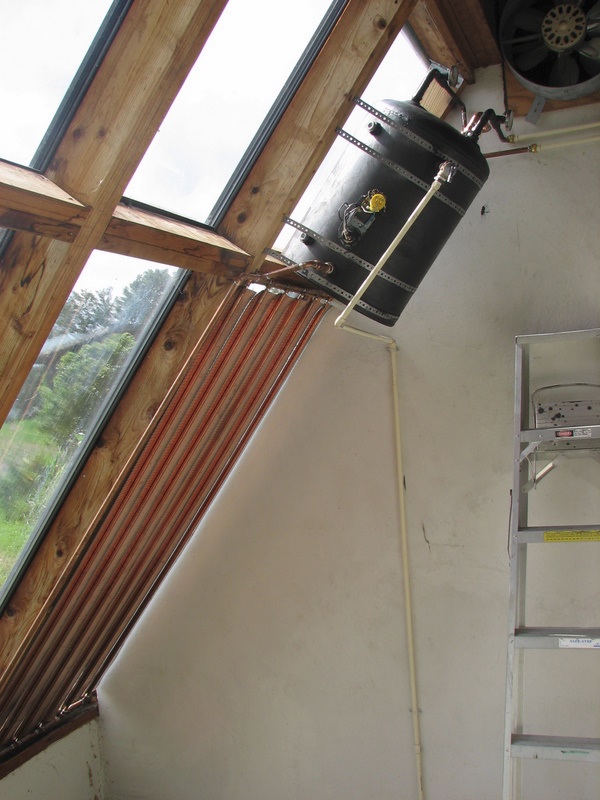
<p>The summer hot water system makes use of the slanted glass in this
greenhouse and a location protected from heat loss (inside the
greenhouse in this case), both of which are necessary to extract enough
solar energy to sufficiently heat the water. A flat plate collector,
which is an arrangement of pipes with fins to aid solar absorption,
connects to a tank above it, and it uses the same convection loop
principle as in the winter system to accumulate hot water in the
tank. Like the winter system, it is part of the pressurized water system
of the house. Most solar hot water collectors must be located outside
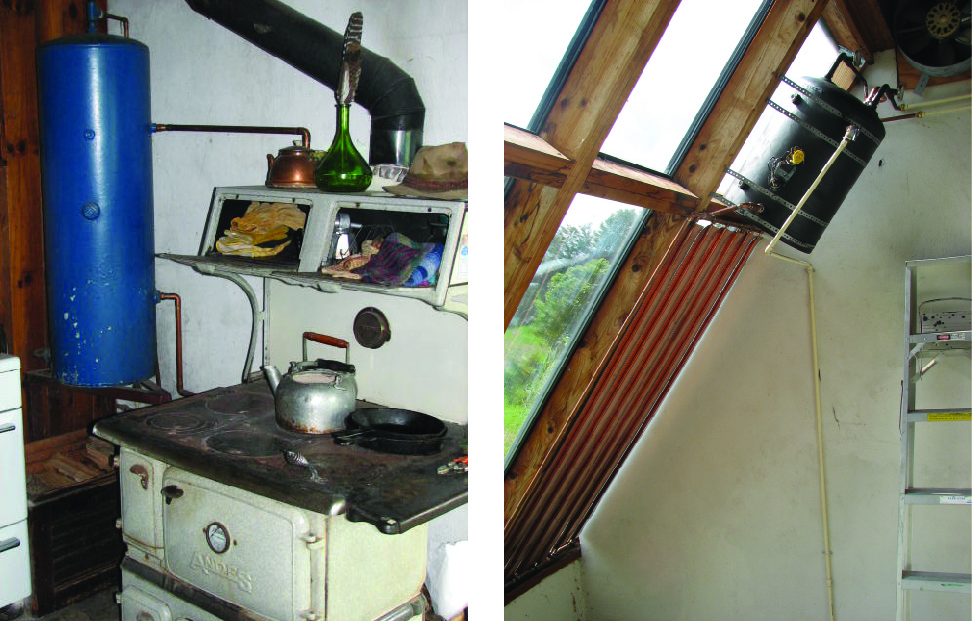
the house to obtain the proper angle to the sun and need an insulated
enclosure and special designs to prevent freezing. This system avoids
those costly complications.</p>

<p><b>Supplemental Heat.</b> Our wood-fired kitchen range built entirely
of cast iron (see photo) is second only to
a <a href="#Masonryheaters">masonry heater</a> in efficiency because of
its long smoke path, which allows the cast iron to absorb heat and keep
it in the house, then radiate it gradually. Sustainability is high
because the stove doubles as a cooking fire for half the year in this
climate.</p>

<p><b>Overhangs.</b> In houses that contain so much sun-trapping glass,
overhangs are essential to keep the house from overheating in the
summer. The overhangs must extend far enough to shade the glass from the
high summer sun, but not so much as to block the lower winter sun.</p>

<p>The size of the overhang depends in part on the latitude of the house
location, which determines the angle of incidence of the sun. Tables of
the angles of incidence at the summer and winter solstices at different
latitudes should be basis for designing the amount of overhang.  The
other design factor is the distance of the overhang above the window,
because a higher overhang will shade less. In fact, because the distance
of our chalet roof above the second floor center windows varies, it
failed to protect them despite a full 4 foot roof overhang, as one can
see in the summer photo of the house.</p>

<p>Since an overhang is impractical on slanted glass, we dropped a shade
cloth on the greenhouse in the summer. Above the other first floor
windows, rather than a roof we built a frame and trained grape vine to
cover it with leaves. The winter photo (Figure 9) shows the leafless
vine letting in the sun.</p>

<p><b>Air Control and Heat Distribution.</b> Management of air flow is
important in passive solar design, both air entry into the house and its
distribution throughout the rooms and through the thermal mass to store
heat effectively. Two techniques that we tried did not work well for
various reasons, although they are proven concepts. I will describe them
briefly because they will play an important role in the third house in
this saga.</p>

<p>Our first idea was to provide air to the house through 100 ft of
underground 4 inch pipe to locations near the kitchen range and a
<a href="#Rumfordfireplace">Rumford fireplace</a>. The long underground
passage warms the air to the earth temperature of 45 °F instead of
direct entry at much colder average winter air temperatures. Chimney
draft from the wood fires draws in the air, helped with a fan as
necessary. In a more airtight house, this technique would have worked
better. In this house, the fires could more easily draw in air from
poorly sealed doors instead.</p>

<p>The other idea was to counteract the heat stratification that can
occur in buildings of more than one story, so that upper floors tend to
get more heat. This is a typical design problem of passive solar
construction, where open floor plans allow warm air to move around the
house from its sources, the south windows and wood stoves. Using small
fans in two locations, we used the hollow block walls of the New York
house as channels to bring the warm air that collected at the top of the
house down through the walls and under the stone floor, storing some of
it in the masonry on the way. This would have worked better if the air
had not lost much of its heat to the walls before it reached the bottom
of the house. Two alternative solutions, a building design that
controlled air movement between floors, or placement of the heated
living space on a higher floor as we did in France, were not possible in
New York due to site constraints.</p>

<a href="/images/bigpics/threehouses-fig11-distribution.jpg">
<img src="/images/threehouses-fig11-distributionA.jpg" width="640px"/></a>
<blockquote><i>Figure 11. Heat distribution openings between greenhouse
and kitchen (New York house)</i></blockquote>

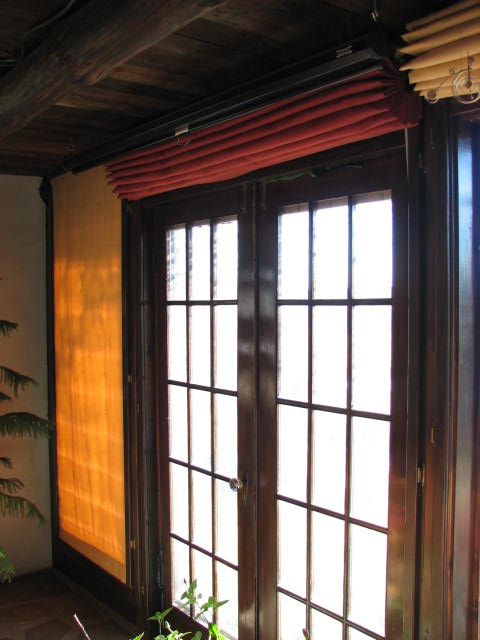
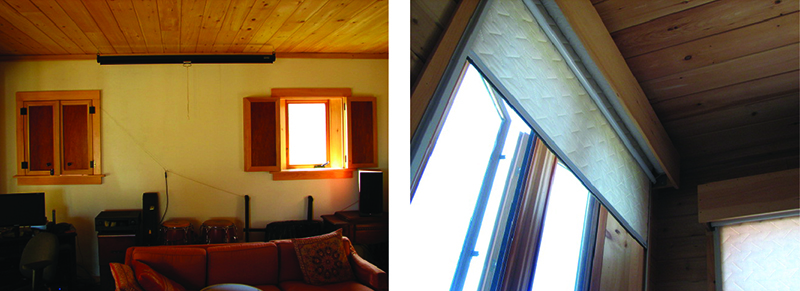
<p><b>Movable Insulation.</b> Initially we built light wood frames
filled with bubble pack and covered with colored cloth, which fit
tightly into the vertical windows. These worked well for
years. Eventually they wore out from constant moving, and a specialist
in the trade made us insulating quilts that could be let down like
Venetian Blinds and clamped on all sides. Because of the irregularities
of our rustic construction techniques, none of these solutions were as
airtight as we would like, but then the windows themselves were not
completely airtight either.</p>

<a href="/images/bigpics/threehouses-fig12-movable.jpg">
<img src="/images/threehouses-fig12-movableA.jpg"/></a>
<blockquote><i>Figure 12. Movable insulation (New York
house)</i></blockquote>

<table border="1">
<tr>
<td>Heated floor area</td>
<td>1000 ft<sup>2</sup></td>
</tr>
<tr>
<td>Wall, foundation and underfloor insulation</td>
<td>R = 28 </td>
</tr>
<tr>
<td>Roof insulation</td>
<td>R = 35</td>
</tr>
<tr>
<td>Thermal mass</td>
<td>Stone floor and 2500 concrete blocks in walls</td>
</tr>
<tr>
<td>South facing glass</td>
<td>400 ft<sup>2</sup></td>
</tr>
<tr>
<td>Other glass (East window)</td>
<td>10 ft<sup>2</sup></td>
</tr>
</table>
<p><i>Table 1. Specifics (New York House)</i></p>

<p>Despite its limitations, the house performed well enough to completely
solar heat itself on sunny, frigid winter days, and used no more than
two full cords of supplementary wood heat per year, mostly burned in a
vintage, high quality cast iron kitchen range. We paid more attention to
dimensions and proportions that are critical to passive solar design
than we did in the Mediterranean climate. The table lists these for
comparison with the third house that I will describe and with other
designs in the literature.</p>

<a href="/images/bigpics/threehouses-fig13-seasonalviews.jpg">
<img src="/images/threehouses-fig13-seasonalviewsA.jpg" width="640px"/></a>
<blockquote><i>Figure 13. Seasonal views of the New York
farmhouse</i></blockquote>

<p>Most of the limitations of our passive solar plan for the New York
farmhouse were deliberate choices to limit costs. In that regard, we
succeeded in our goal to build without debt. The cash outlay to build
the house, mostly for materials and a small amount of machine labor, was
an affordable $15,000 in 1980 dollars. Today the concrete block alone
would cost that much.</p>

<h2>Project 3. A  Professionally Built House in Far Downeast Maine</h2>

<p>In 2011 we designed a house for a farmstead two miles from the sea
and the Canadian border, and we acted as general contractor to oversee
its construction. Although the location is farther north than the New
York house, the moderating effect of the many surrounding bays and lakes
makes for a similar climate. Like the New York house, its hilltop
location is partly sheltered by forest from the prevailing winds.</p>

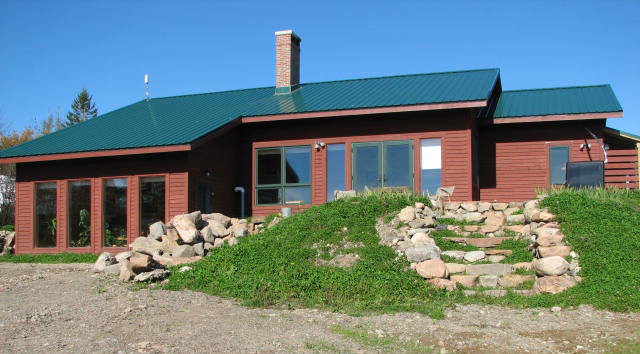
<a href="/images/bigpics/threehouses-fig14-southface.jpg">
<img src="/images/threehouses-fig14-southfaceA.jpg" width="640px"/></a>
<blockquote><i>Figure 14. South face of the Maine farmhouse in
mid-October</i></blockquote>

<p>The design gains from all our previous experience and from
improvements in passive solar design ideas, standards, and materials
since we built in 1980. We were also able to invest in better quality
and in passive solar elements of higher energy efficiency than we could
in the previous houses. In particular, this farmhouse gains from the
adoption of a unique way of integrating thermal mass devised by an
engineer/builder, James Kachadorian. He successfully tested the design
in a number of houses that he built in New England and wrote a book on
the subject, which we used as a guide.[2]</p>

<p>The cost of this house, however, was far greater than the others in
this study, because we had to pay professional builders and abide by
building codes and professional standards of finished carpentry, which
previously we had been able to avoid by doing our own work, using free
and salvage materials and building to more rustic standards. So I do not
pretend this house to be a model of inexpensive passive solar
construction. Although new to passive solar design, the builders carried
out our plans successfully so that the house performs as expected. I
think the fact that this design uses mostly conventional materials and
construction practices was critical to their success.</p>

<p>This house is a one-story stud frame building set on a concrete
foundation. A thermal mass consisting of a concrete slab floor and
subfloor concrete block area is insulated from the foundation. The frame
is covered with a raised truss roof. All of these elements involve
standard construction techniques but required some alterations to fit
our design.</p>

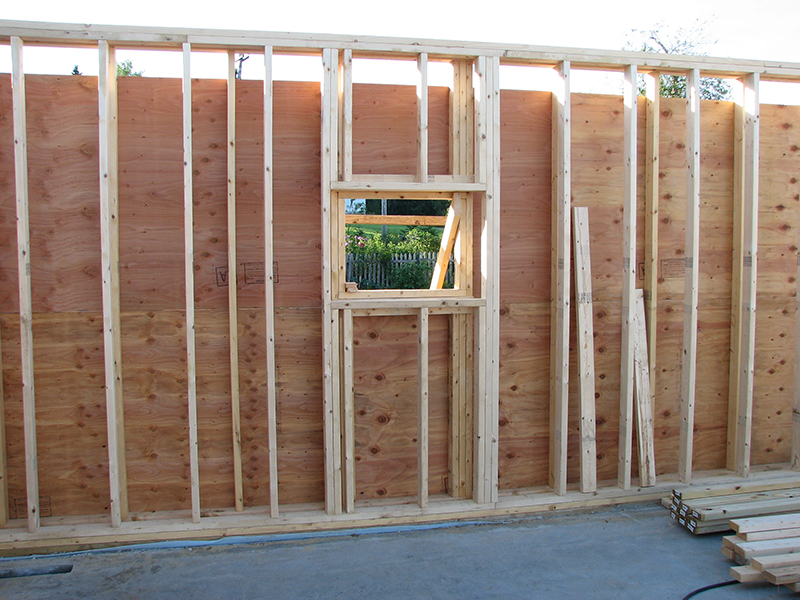
<a href="/images/bigpics/threehouses-fig15-doublewalled.jpg">
<img src="/images/threehouses-fig15-doublewalledA.jpg" width="640px"/></a>
<blockquote><i>Figure 15. Double-walled frame (Maine
house)</i></blockquote>

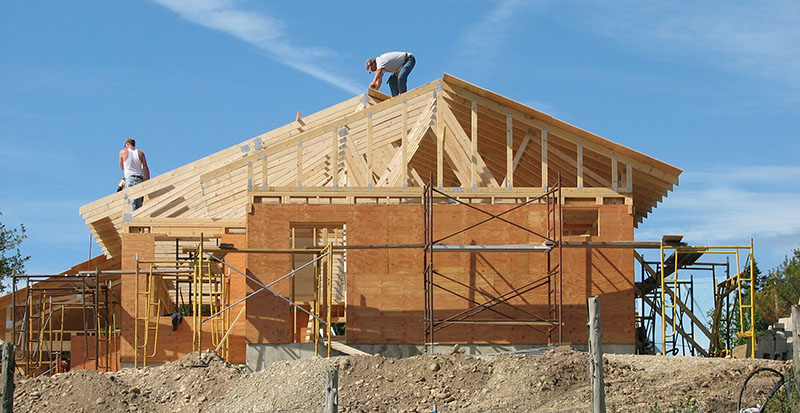
<a href="/images/bigpics/threehouses-fig16-raisedtruss.jpg">
<img src="/images/threehouses-fig16-raisedtrussA.jpg" width="640px"/></a>
<blockquote><i>Figure 16. Raised truss design (Maine
house)</i></blockquote>

<p><b>Insulation.</b> Current standards for energy efficient housing
call for super-insulation. Wall insulation of R=40 and insulation of
ceilings to R=80 are said to be worth the cost in energy savings. To
come close to these levels with our choice of blown-in cellulose
insulation, we had to build a double-walled frame 10 inches thick. The
two wall frames are tied together with wide sills and top plates. We
used different stud spacing for the inner and outer walls (see photo) to
offset them and reduce heat loss through the studs. To provide enough
space for insulation above the ceiling, we used a raised truss design
that allowed for 20 inches of cellulose, especially in the critical area
where the truss space narrows at the bottom of the roof where it meets
the top of the wall. Dense-packed in with a blower, the cellulose flows
around framing and fills all spaces.  Although cellulose insulation is
recycled paper goods and therefore promoted as &ldquo;green,&rdquo; it
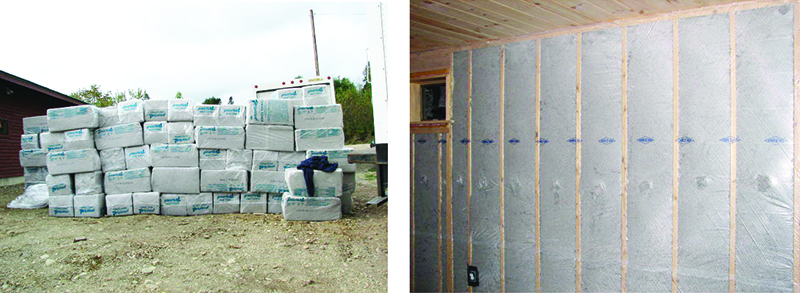
was not particularly cheap. As the photo shows, large quantities are
needed to achieve the desired standard. However, an owner-builder could
achieve a similar result by stuffing wall spaces with bags of dry
leaves, quantities of which are available in town neighborhoods at no
cost.</p>

<a href="/images/bigpics/threehouses-fig17-cellulose.jpg">
<img src="/images/threehouses-fig17-celluloseA.jpg" width="640px"/></a>
<blockquote><i>Figure 17. Cellulose insulation, as delivered (left) and
packed in a wall behind a vapor barrier (right)</i></blockquote>

<p><b>Thermal Mass and Heat Distribution.</b> In its original concept,
the Kachadorian design uses the convection loop created by air heated by
sun coming through the bank of south windows. The heated air rises,
pulling air through concrete blocks laid in channels under a poured
concrete floor and storing heat from the room air in this mass of
masonry.  Registers along the north and south edges of the house floor
allow air to enter the thermal mass at the north edge and exit below the
south windows. Because air in convection loops follows the path of least
resistance, we suspected that in the Kachadorian design most of the air
would flow across the top of the floor to replace the rising air,
following the normal path of least resistance of the convection loop in
a house and rendering the block channel storage mass ineffective.</p>

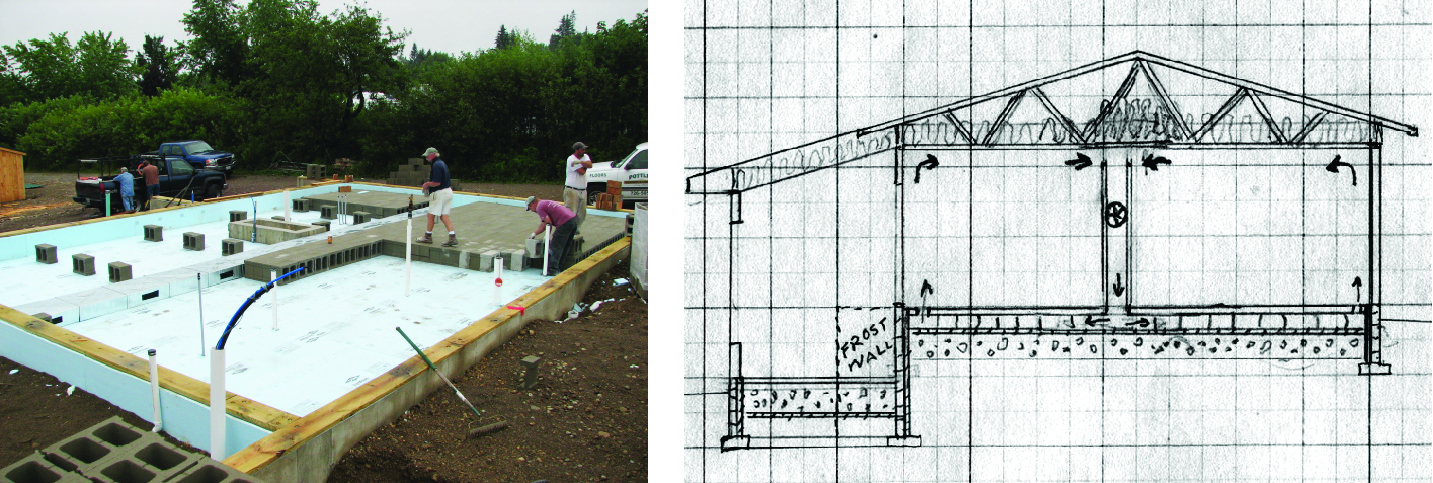
<p>To make sure that air flows through the block channels, we altered
the design as shown in the sketch. We placed a plenum across the middle
of the subfloor system from east to west. This is a central duct (metal
in the photo) that feeds the channels in the block. In the center of the
house we built a vertical duct containing a quiet, variable speed fan
that takes the warm air from the ceiling and pushes it down through the
plenum, through the block, and out the registers at the edges of the
floor. This design performs the double function of moving the warmest
air into the thermal mass and allowing us to close registers in
different rooms of the house to distribute stored heat differently to
the floor in each room.</p>

<p>As shown in Figure 18, rigid foam completely insulates the block and
poured floor from the foundation and the earth, which allows the masonry
to retain heat that is absorbed from the airflow and also from the sun
directly hitting the concrete floor. The floor is permanently stained a
dark color to maximize absorption of the sun&rsquo;s radiant heat. Over
time, the transfer of heat by these two routes brings the thermal mass
up to room temperature and stabilizes the house temperature by releasing
heat and keeping the temperature from dropping far when there is no sun
or artificial heat.</p>

<a href="/images/bigpics/threehouses-fig18-thermalmass.jpg">
<img src="/images/threehouses-fig18-thermalmassA.jpg" width="640px"/></a>
<blockquote><i>Figure 18. Thermal mass in the Maine house: laying the
block (left), cross-sectional sketch (right)</i></blockquote>

<p>The Kachadorian design calls for calculating the slab floor thickness
so that the heat storage capacity of the floor and block mass matches
the solar heat production capacity of the south window glass. The intent
is to avoid excessive solar heating. This is an example of the
calculation overkill that we think is common in the passive solar
literature. We built almost the maximum glass area possible into the
south wall and poured a standard four inch thick concrete floor. We see
excess solar heat in the winter as a minor problem that can be solved by
cracking open a window. In the summer, the roof overhangs and the
movable insulation keep out direct sun. The night air flow from open
windows cools the thermal mass, which holds down the temperature inside
during the day.</p>

<p><b>Movable Insulation.</b> Available capital and the predictable
geometry of frame construction allowed us to use a combination of
commercial and custom built solutions that insulated windows and doors
to the high energy efficiency standard of the other passive solar
elements in the design. Wherever there was sufficient wall space, the
carpenters built hinged shutters that seal tightly when closed and open
back against the wall. The wood frames and faces of the shutters enclose
rigid foam insulation board an inch thick. On the larger windows on the
south side there was no wall space for shutters, so we used commercially
available movable insulation in the form of quilts that are stored on
rollers above the windows and slide down on tracks that provide a tight
closure.</p>

<a href="/images/bigpics/threehouses-fig19-movable.jpg">
<img src="/images/threehouses-fig19-movableA.jpg" width="640px"/></a>
<blockquote><i>Figure 19. Movable insulation in the Maine house:
shutters and quilts on rollers</i></blockquote>

<p><b>Air Control.</b> Because we were able to afford windows and doors
that seal well, it was worth making the rest of the house airtight as
well. In addition to the plastic sheeting on the inside surface of walls
and ceiling that also served as the all-important vapor barrier, we
caulked and taped liberally in critical places like joints between walls
and ceiling and floor and around window and door frames. We used special
electrical boxes made to be airtight and allow taping to seal them to
the vapor barrier.</p>

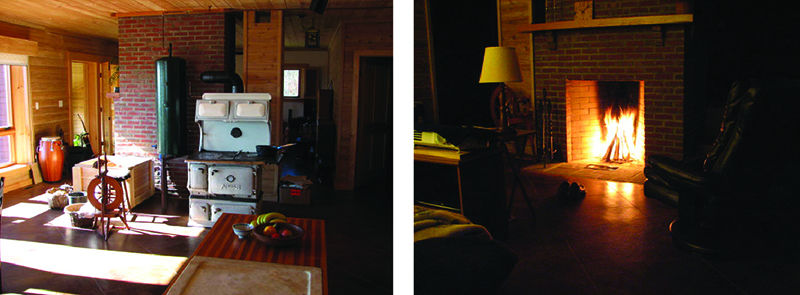
<p>A house built this tightly often needs an air intake in the
design. The wood fires that furnish supplemental heat and the breathing
inhabitants both need fresh air. As in the New York house, outside air
passes through an underground pipe that moderates its temperature and
enters close to a centrally located chimney that serves a fireplace on
one side and a wood-fired kitchen range on the other. This way the air
that feeds the fires travels a short distance and creates little
draft. The central chimney breaks the living space into two rooms while
keeping the open plan that helps distribute heat around the house. This
chimney location also adds to the thermal mass and keeps more of the
heat from the chimney inside the house than a chimney on an outside
wall. This chimney arrangement brings our cast iron, wood-fired kitchen
range closer to the high energy efficiency of a masonry stove at a
fraction of the price.</p>

<a href="/images/bigpics/threehouses-fig20-chimney.jpg">
<img src="/images/threehouses-fig20-chimneyA.jpg" width="640px"/></a>
<blockquote><i>Figure 20. A central chimney partitions the open floor
plan and services the kitchen range and fireplace, which provide all the
wood heat in the Maine house</i></blockquote>

<p><b> Overhangs.</b> On the principle that overhanging roofs on all
sides are good weather protection for the walls, windows, and doors of a
house and sometimes for things stored outdoors, our policy has always
been to design for them wherever possible. Because the raised truss in
this house adds height to the roof at the eaves, we made the roof
overhang nearly 3 feet in the attempt to shade the southern windows from
the summer sun. The photo of the whole house that begins this section,
taken in October, shows that despite the long overhang it permits the
cold season sun to shine on the whole south window area. Some summer sun
does penetrate the interior despite the overhang, but it can be stopped
by lowering the insulated window covers.</p>

<h3>Performance Comparisons</h3>

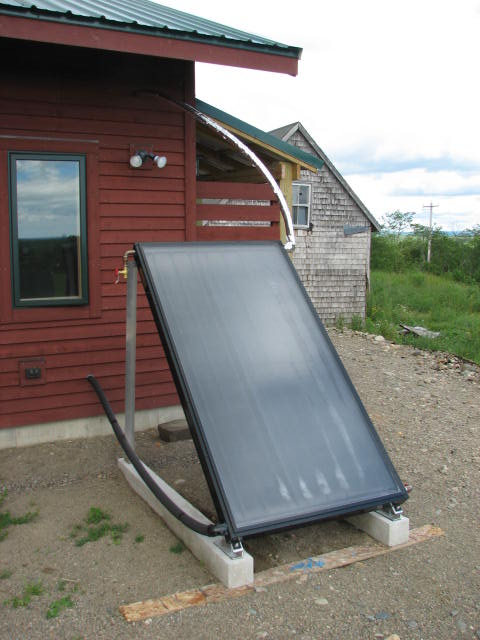
<p><b>Hot water.</b> The summer and winter hot water systems operate on the
same principles as in the New York house, and the winter system uses the
same stove and tank, brought from New York. Because we chose vertical
glazing for the greenhouse (these are the windows on the left in the
photo of the house in Figure 14), a solar collector for the summer
system was placed outdoors where it can be angled properly.  We located
a standard insulated electric hot water tank (not electrified) inside
the house, as close as possible to the solar collector to keep the
convection loop short and maximize hot water accumulation.  Because of
the insulation and a larger tank, the Maine system stores more hot water
longer than the bare tank in New York, enough for two days use after a
half day of sunlight.</p>

<a href="/images/bigpics/threehouses-fig21-flatplate.jpg">
<img src="/images/threehouses-fig21-flatplateA.jpg" width="320px"/></a>
<blockquote><i>Figure 21. The flat plate collector for summer hot water
at the Maine house is drained in winter</i></blockquote>

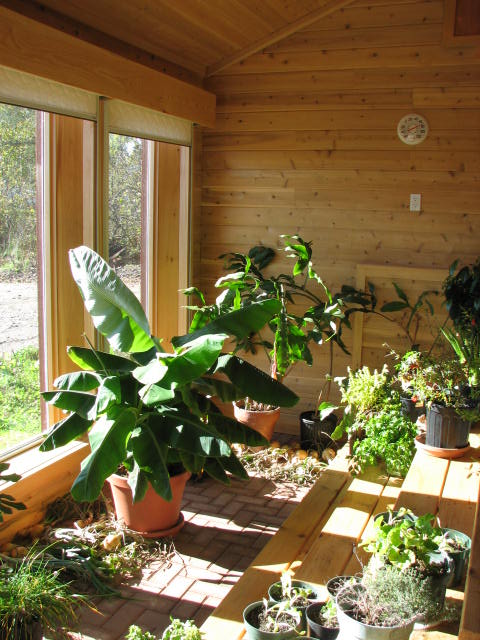
<p><b>Attached greenhouse.</b> We improved the solar functions of this
greenhouse over the one in the New York house. We chose vertical glazing
to permit the use of easily installed, commercially available movable
insulation. Hence the large area of glass in this greenhouse can
maximize the retention of the solar heat that it captures. Wide French
doors between the greenhouse and the house living space allow us to
better regulate airflow and create a temperature difference between them
if so desired. The outside door that we put in this greenhouse greatly
improves plant growing and summer ventilation. To provide easy external
access, we put the greenhouse floor at ground level and also built the
room partly into the hillside to preserve most of
the <a href="#Earthsheltered">earth-sheltered</a> design of the
greenhouse in New York, which has a sunken floor.</p>

<a href="/images/bigpics/threehouses-fig22-greenhouse.jpg">
<img src="/images/threehouses-fig22-greenhouseA.jpg"/></a>
<blockquote><i>Figure 22. The Maine greenhouse in late
fall</i></blockquote>

<p><b>Critical components.</b> Although the New York house has
considerably more thermal mass and south glass, the Maine house
outperforms it for several reasons. In a passive solar design, all the
elements must work together; weak links in any system limit the
performance of the whole. In the Maine house, all the elements are of
sufficient quality to perform their functions equally well. It is better
insulated and much more airtight. The thermal mass stores heat more
effectively because the fan continually moves air through it. There is
virtually no heat stratification: it is a one storey house, and stored
heat radiates up from the floor while the fan moves rising warm air down
from the ceiling through the thermal mass, which tends to equalize
temperature everywhere. The movable insulation is designed to close more
tightly as well. Finally, it has an improved attached greenhouse as
described above. However, all these improvements are working against the
colder winter (10 &deg;F colder) and shorter winter days of the higher
latitude in Maine (45&deg; N).</p>

<table border="1">
<tr>
<td>Heated floor area</td>
<td>1250 ft<sup>2</sup></td>
</tr>
<tr>
<td>Wall insulation</td>
<td>R = 40 </td>
</tr>
<tr>
<td>Roof insulation</td>
<td>R = 60</td>
</tr>
<tr>
<td>Foundation insulation</td>
<td>R = 20</td>
</tr>
<tr>
<td>Thermal mass</td>
<td>1300 12 inch concrete blocks under floor and 4 inch poured concrete floor</td>
</tr>
<tr>
<td>South-facing glass</td>
<td>162 ft<sup>2</sup></td>
</tr>
<tr>
<td>Other glass </td>
<td>78 ft<sup>2</sup></td>
</tr>
</table>
<p><i>Table 2. Specifics (Maine House)</i></p>

<table border="1">
<tr>
<td>Extra Insulation and Wall Thickness</td>
<td>$10,000</td>
</tr>
<tr>
<td>Window quality (thermopane and airtight)</td>
<td>$5,000</td>
</tr>
<tr>
<td>Thermal Mass</td>
<td>$4,000</td>
</tr>
<tr>
<td>Movable Insulation</td>
<td>$6,000</td>
</tr>
<tr>
<td>Total</td>
<td>$25,000</td>
</tr>
<tr>
<td>Percent of Total Construction Cost</td>
<td>15%</td>
</tr>
</table>
<p><i>Table 3. Extra Construction Costs for Passive Solar (Maine
House)</i></p>

<p>One test of a passive solar design is how well it holds heat
overnight on cold winter nights without any supplemental heat (our
practice in all the houses was to let the wood fires go out by 8
p.m.). By morning, the temperature in the NY house was dropping from 72
&deg;F to as low as 55 &deg;F as the winter wore on. By contrast, the
Maine house stayed close to room temperature overnight until a December
week of outside temperatures in the single digits. By the end of that
week, the overnight drop was to 65 &deg;F. As outside temperatures
returned to normal in January, the overnight drop inside the house
decreased, and the inside temperature on waking was around 69
&deg;F.</p>

<p>How much more does passive solar design cost? That can vary with the
way the design principles are applied and the materials a specific
design requires. The extra costs in the Maine house reflect the expense
of new materials and professional labor throughout the house, but the
solar fraction of the total construction cost was still a low 15%.</p>

<h2>Conclusion</h2>

<p>The goal of this account was to demonstrate a number of ways that
the same passive solar design principles can be applied to maximize
residential energy savings with the least cost and technical
difficulty. How will these ideas play in Tompkins County? Two Ithaca
architects who reviewed my design for the Maine house said that apart
from a small network of owner-builders that is applying a low-technology
approach, there is not yet much passive solar construction or renovation
in the county despite its overpopulation of intellectual heavyweights
and its reputation for progressive politics. Current interest in
&ldquo;green design&rdquo; tends to run to solar and wind electric
technologies that replicate the push-button convenience that our society
is used to but are very inefficient ways to heat a building. While this
approach bestows a certain social status, it is so expensive that it is
not a model likely to gain widespread adoption in an industrial economy
now headed into long-term decline. Area developers sometimes promote
&ldquo;green materials&rdquo; that may also confer status but rarely save as
much of the planet as simple construction designs that dramatically
reduce residential energy use.</p>

<p>Hence readers whom this saga encourages to &ldquo;walk the talk&rdquo; of
sharply reduced residential energy use may be viewed as oddballs until
resource depletion forces the rest of the community to see them more as
heroic pioneers. Because their houses achieve so much with so little in
the way of complicated equipment, a common reaction may be disbelief,
and the community may not take seriously their overly &ldquo;magical&rdquo;
accomplishment. Community interest in the houses described here, built
over a forty-year period, has been low.</p>

<p>However, the tide may be turning. Our head carpenter on the Maine
house monitored the condition of the unheated, unmanaged residence
during the winter before we moved in. When he found that its temperature
never dropped below 45 &deg;F, he was so amazed that he reported his
discovery widely. As the news percolates throughout this rural Maine
community, habituated to burning through mountains of firewood or fossil
fuel to get through New England winters, how will they see us, as
tricksters or alchemists, or as models for the future? Meanwhile our
carpenter, who knows, as builder of the house, that there is no magic
involved, proudly announced that he has installed movable insulation on
the windows of his own home.</p>

<h2>Glossary</h2>

<dl>

<dt><b><a id="Biomassburning">Biomass burning</a></b></dt>

<dd><p>The most efficient use of <a href="#Biomassenergy">biomass
energy</a>, as in heating directly by burning wood. Conversion of
biomass to other forms like liquid fuels or electric or steam power
involves a great waste of the energy in the biomass.</p></dd>

<dt><b><a id="Biomassenergy">Biomass energy</a></b></dt>

<dd><p>Energy from biological sources. Historically, wood has been the
main source. This energy is renewable if harvested sustainably because
it originates in the sun.</p></dd>

<dt><b><a id="Convectionloop">Convection loop</a></b></dt>

<dd><p>The circuit that fluids like air or water make that transfers
heat. When heated lower in the loop, the fluid becomes lighter and
rises, moving the rest of the fluid around the loop. In the hot water
systems described here, placement of a tank near the top of the loop
allows continual accumulation of heated water in the tank by convection
without an external source of energy to move the water.</p></dd>

<dt><b><a id="Earthsheltered">Earth-sheltered house, earth berm</a></b></dt>

<dd><p>An earth-sheltered house is a house partially surrounded by earth,
either because it is built partly underground (e.g., into the side of a
hill) or because one or more of its walls are backed by an earth berm,
earth pushed up against a wall. In either case the earth adds insulation
value, partly because the temperature underground is much higher than
average winter air temperatures in the Northeast, typically 40-50 &deg;F
in a completely sunken basement</p></dd>

<dt><b><a id="Fossilfuels">Fossil fuels</a></b></dt>

<dd><p>Oil, gas, and coal, which are the fast-depleting nonrenewable
energy sources on which industrial society is heavily
dependent.</p></dd>

<dt><b><a id="Insulatingglass">Insulating glass, thermopane</a></b></dt>

<dd><p>Glazing with two or more layers of glass sealed together so that
air or other gas held between the layers acts as insulation.</p></dd>

<dt><b><a id="Masonryheaters">Masonry heaters</a></b></dt>

<dd><p>The most efficient woodstoves because they allow hot,
efficient burns and they retain most of the heat in the masonry, heat
that is lost up the chimney in other woodstoves.</p></dd>

<dt><b><a id="Movableinsulation">Movable insulation</a></b></dt>

<dd><p>Designed to easily cover windows on the south side to prevent
heat from escaping when the sun is not shining in, insulating covers
also function to block excess sun in summer and to insulate windows on
other sides of the house when daylight is not needed. Inside and outside
cover designs are both used, but mine have all been inside. Unlike
curtains, these essential components of passive solar design must seal
to the window frame on all sides when closed to function properly as
insulation.</p></dd>

<dt><b><a id="Passivesolar">Passive solar</a></b></dt>

<dd><p>Building design that uses the sun to provide space and water
heating with little or no external energy inputs or technologically
expensive materials. For example, electrical components like converters,
batteries, pumps, and fans are mostly unnecessary.</p></dd>

<dt><b><a id="Solargreenhouse">Solar greenhouse</a></b></dt>

<dd><p>A greenhouse that incorporates as many of the elements of passive
solar design as possible.</p></dd>

<dt><b><a id="Rumfordfireplace">Rumford fireplace</a></b></dt>

<dd><p>An energy-efficient design used in colonial times for cooking and
heating.</p></dd>

<dt><b><a id="Rvalues">R values (e.g., R=28)</a></b></dt>

<dd><p>A universal measurement of insulation value of materials. For
example, rigid urethane has a relatively high R value of R=8 per inch of
thickness. I insulated the New York house entirely with rigid urethane,
most of it discarded by a company that cuts up large buns of the stuff
to order for clients. I got the discards for free.</p></dd>

<dt><b><a id="Thermalmass">Thermal mass</a></b></dt>

<dd><p>A heat storage material that is an essential component of passive
solar design. Water and metal store a lot of heat but stone, brick, or
other masonry are the most common because they can function as
structural elements of buildings and still store more heat than most
building materials.</p></dd>

</dl>

<h2>Notes</h2>

<p>[1] Following the historical pattern of human exploitation of all
finite resources, fossil energy extraction started with the sources
easiest to tap and has progressed toward sources that are the most
expensive, because they are lowest in quality and hardest to extract
from the earth. Hydraulic fracturing is an example of an expensive
extraction methodology that guarantees a higher cost of production over
the long run. This increasing cost will make fossil fuel prohibitively
expensive for more and more uses, eventually including residential
heating.</p>
 
<p>[2] Kachadorian, James. <i>The Passive Solar House: Using Solar
Design to Heat and Cool Your Home.</i> Chelsea Green, 1997.</p>
]]>
        
    </content>
</entry>

<entry>
    <title>Cities and Suburbs in the Energy Descent: Thinking in Scenarios</title>
    <link rel="alternate" type="text/html" href="http://tclocal.org/2012/10/cities_and_suburbs_descent.html" />
    <id>tag:tclocal.org,2012://16.6173</id>

    <published>2012-10-05T04:32:43Z</published>
    <updated>2012-10-05T04:41:11Z</updated>

    <summary>By Karl North The vulnerability of cities and suburbs in the post-petroleum era has been the object of much debate because their present organization makes their operation so energy-intensive. The debate heretofore has tended to swing between two extremes. One...</summary>
    <author>
        <name>Simon St.Laurent</name>
        <uri>http://simonstl.com/</uri>
    </author>
    
        <category term="agriculture" scheme="http://www.sixapart.com/ns/types#category" />
    
        <category term="development patterns" scheme="http://www.sixapart.com/ns/types#category" />
    
        <category term="food" scheme="http://www.sixapart.com/ns/types#category" />
    
        <category term="urban" scheme="http://www.sixapart.com/ns/types#category" />
    
    
    <content type="html" xml:lang="en" xml:base="http://tclocal.org/">
        <![CDATA[<p>By Karl North</p>

<p>The vulnerability of cities and suburbs in the post-petroleum era has
been the object of much debate because their present organization makes
their operation so energy-intensive. The debate heretofore has tended to
swing between two extremes. One claims that these forms of social
organization on the land are so unsustainable that their populations
will be forced to abandon them gradually as the energy descent
progresses.[1]</p>

<a href="/images/CSfig1.jpg">
<img src="/images/CSfig1.jpg" width="320px"/></a>
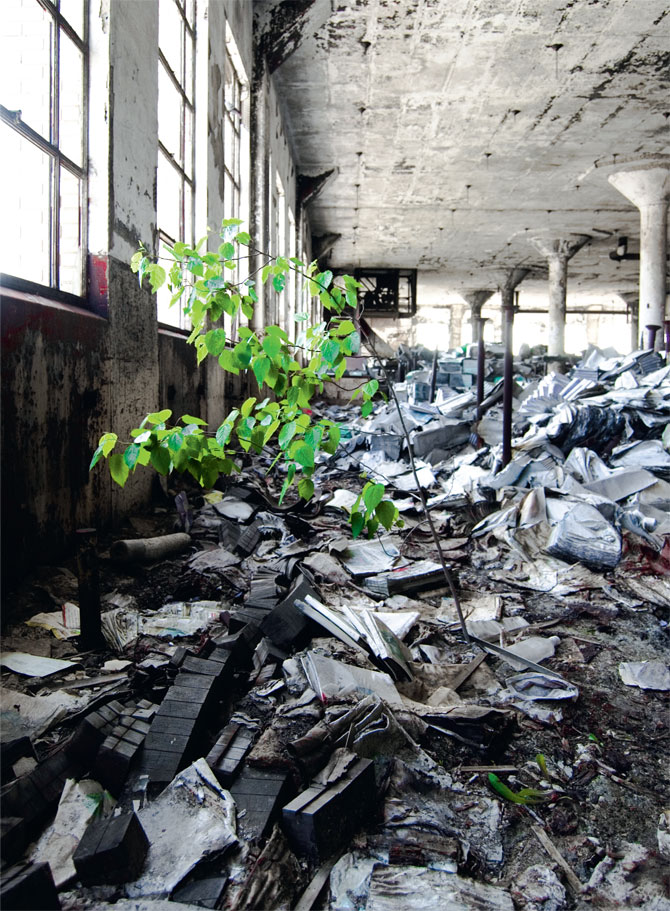
<blockquote><i>Figure 1. A tree grows in Detroit<br>(photo by James
    Griffioen, </i>vice.com<i>)</i></blockquote>

<p>James Kunstler, a well-known critic of the kind of cities and suburbs
that have emerged in recent decades, puts it bluntly:</p>

<blockquote>The whole suburban project I think can be summarized pretty
succinctly as the greatest misallocation of resources in the history of
the world. America took all of its post-war wealth and invested it in a
living arrangement that has no future.[2]</blockquote>

<p>The other extreme entertains dreams of massive programs of public
transportation to save suburbia. It also relies heavily on technologies
like high-rise agriculture and on the efficiencies of population density
to save cities. This is the vision of the eco-cities movement.</p>

<a href="/images/CSfig2.jpg">
<img src="/images/CSfig2.jpg" width="320px"/></a>
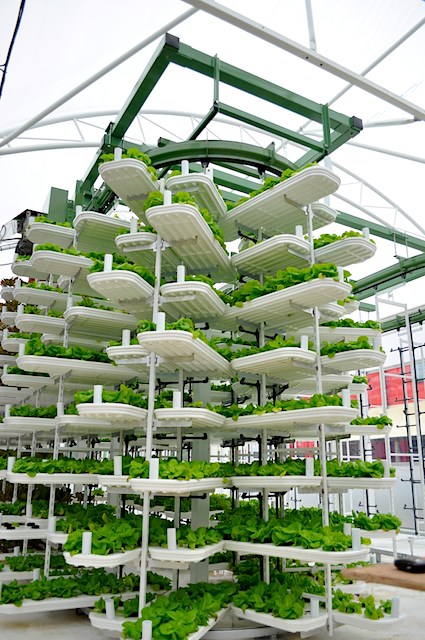
<blockquote><i>Figure 2. Techno-fantasy unchained<br>(</i>Time<i> magazine
    via </i>City Farmer News<i>)</i></blockquote>

<p>Neither of these scenarios makes much sense. The abandonment thesis
ignores the immense accumulated wealth of the built environment in
metropolitan areas, which is not likely to be left to fall apart, but
will more likely support a certain level of human population if salvaged
for other uses than it was originally designed for.[3] It is conceivable
that modern society will be reduced to energy inputs available in 1800,
before much use of fossil fuels. But that would not mean a simple return
to what life was like in those times, due in part to the bonanza of
accessible raw materials that the present built environment represents
(a good thing), and in part to two hundred years of accumulated damage
to the planetary resource base (not so good) that was unimaginable in
1800.</p>

<p>On the other hand, the claim that technological improvement can keep
cities and suburbs functioning in the current ways at current population
levels fails for many reasons. First, it perpetuates the above-mentioned
accumulation of damage to necessary ecosystemic functions, damage that
is intrinsic to &ldquo;technological improvements,&rdquo; damage that is
already causing exponential growth in the operating costs of
metropoles. Then there are the two reasons that the technological savior
argument always has failed: there is a limit to the efficiencies that
can be delivered by technology, and every technological advance requires
an increase in complexity in the socio-economic system, with a resulting
increase in consumption of energy and other raw materials in an era of
increasing resource scarcity.[4]</p>

<p>Moreover, as genres of social organization and human landscapes,
modern cities and suburbs are among the most energy consumptive
imaginable because their continued existence relies on a broader
agro-industrial base. Most calculations of the energy budgets of
metropolitan areas far underestimate because they fail to account for
the energy embodied in their construction and maintenance, which
includes the vast and often distant agricultural and industrial plant,
transport, and communication systems necessary to keep them
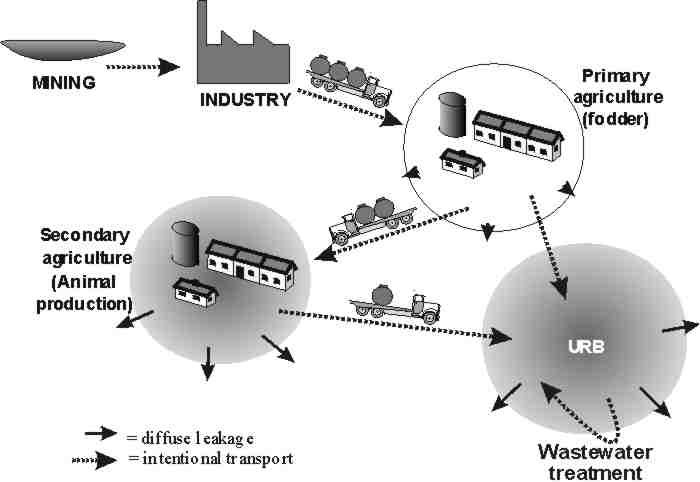
running. This diagram suggests the scope of the support system required
just to keep a metropolitan population in food.</p>

<a href="/images/CSfig3.jpg">
<img src="/images/CSfig3.jpg" width="640px"/></a>
<blockquote><i>Figure 3. &ldquo;The linear flow of minerals from mines
to farms and then dense human settlements leads to depletion at one end
and the concentration of wastes or dispersion into water at the
other.&rdquo; &mdash; Jason Bradford
(<a href="http://www.theoildrum.com/node/5773">http://www.theoildrum.com/node/5773</a>),
graphic by Folke G&uuml;nther
</i></blockquote>

<p>Of course, cities have existed ever since the advent of agricultural
systems capable of providing the surplus necessary for their growth. But
after a period of expansion, often spanning centuries, they have usually
destroyed enough of their resource base to cause them to decline. In the
last two centuries, cities have grown markedly in size and consumption
of resources. But this unprecedented level of urban expansion is
entirely reliant on access to fossil energy and other nonrenewable
resources that are now becoming permanently more scarce.</p>

<p>The main weakness of the eco-cities movement is its failure to
squarely face the increasing scarcity in energy and other resources and
seriously consider its implications in the energy descent. Green or new
urbanists claim that cities like New York are sustainable because their
population density allows a smaller per capita ecological footprint than
suburbs.[5] The clustering of populations that the ecocities movement
advocates <i>does</i> conserve energy in key areas like building heating
and human transport.  This clustering will be essential in the energy
descent at every scale of human community if we hope to avoid not only
the energy costs of most present building configurations and their
reliance on a distance economy, but also their misuse of agriculturally
valuable land.</p>

<p>But heating and human transport are only one part of the energy cost
of operating cities. The green urbanist scenario that compares present
cities favorably to present suburbs fails to consider the more
comprehensive assessment of many energy descent analysts that <i>no
dominant configuration of land use and built environment in the US
today, urban, suburban, or rural, is sustainable without fossil
fuels.</i> The embodied energy in cities in particular involves upstream
energy and material flows along many long production chains, and it
requires constant renewal due to entropy (depreciation). Hence embodied
energy in cities is commonly three times as high as operational energies
like heating and daily human transport.[6]</p>

<p>As a result, the eco-cities movement&rsquo;s current urban redesigns are
characteristically overly complex and overly expensive, and are
therefore aimed, like much organically grown food and most present
ecovillages, at a gentrified market that will not survive the energy
descent. This is not meant to criticize these efforts, but simply to
point out that they reflect the economic and cultural choices of a
society that has enjoyed cheap energy.</p>

<p>In addition to narrow thinking about the massive inflows of energy
and other natural resources that today sustain metropolitan areas, the
ecocities movement rarely considers more fundamental questions about
urban populations posed by energy descent. In a world where the energy
from oil has permitted a tripling of the population and, in rich
countries, an average per capita ecological footprint (a measure of
resource consumption) so large that it could support 30 African
peasants, what is the true carrying capacity? How is the disparity in
footprint justified when it reduces the supportable global population?
And what is the largest sustainable city when urban population densities
are on the order of 67,000 people per square mile[7], and the
transportation cost of provisioning such densities from
ever-more-distant locations increases with city size beyond the
declining energy capacity of the planet?</p>

<h2>A More Likely Scenario</h2>

<p>A third scenario that I will explore here as more likely than the two
considered above envisions a major transformation of both urban and
suburban land and resource use to make cities and suburbs habitable in
the coming low energy era, although necessarily supporting a much lower
population level than they do today. As in all ecosystems, the carrying
capacity of these areas will contract to fit the available energy, which
sooner or later will be mostly solar.</p>

<p>Carrying capacity (CC) is an essential concept for thinking in
scenarios about a future in which access to key resources is
declining. Carrying capacity is not just a population level. It is first
the level of sustainable resource consumption (SRC) that a particular
landscape or resource base can support, which in turn determines the mix
of population level and per capita resource consumption or material
standard of living. Thus the equation for sustainable resource consumption is

<blockquote>SRC = population &#x00D7; resource consumption per
capita</blockquote>

which makes clear that sustainable carrying capacity in terms of the
actual number of people it will support depends on the level of
individual consumption:

<blockquote>CC (sustainable population) = SRC &#x00F7; resource
consumption per capita</blockquote>

<p>This understanding of carrying capacity raises a concern about
present resource consumption. The modern industrial society that urban
areas epitomize now relies 80-90% on nonrenewable resources. A society
that must return to a resource use rate that rarely uses nonrenewables
except as recycled salvage will need to rely mainly on low-input
agriculture, aquaculture, and forestry for food and fiber, and similar
low-input technologies using renewable and salvageable materials in
other areas of production. Hence the inevitability of a return to a
relatively low-technology solar energy economy is likely to reduce
populations in large metropolitan areas to 10-20% of their current
levels.[8] Dispersal from city centers to hinterlands will account for
much of the decline. In the end this will be a salutary outcome because
it will contribute manpower to the increasingly labor-intensive farming
systems that will replace industrial agriculture.</p>

<a href="/images/CSfig4.jpg">
<img src="/images/CSfig4.jpg" width="480px"/></a>
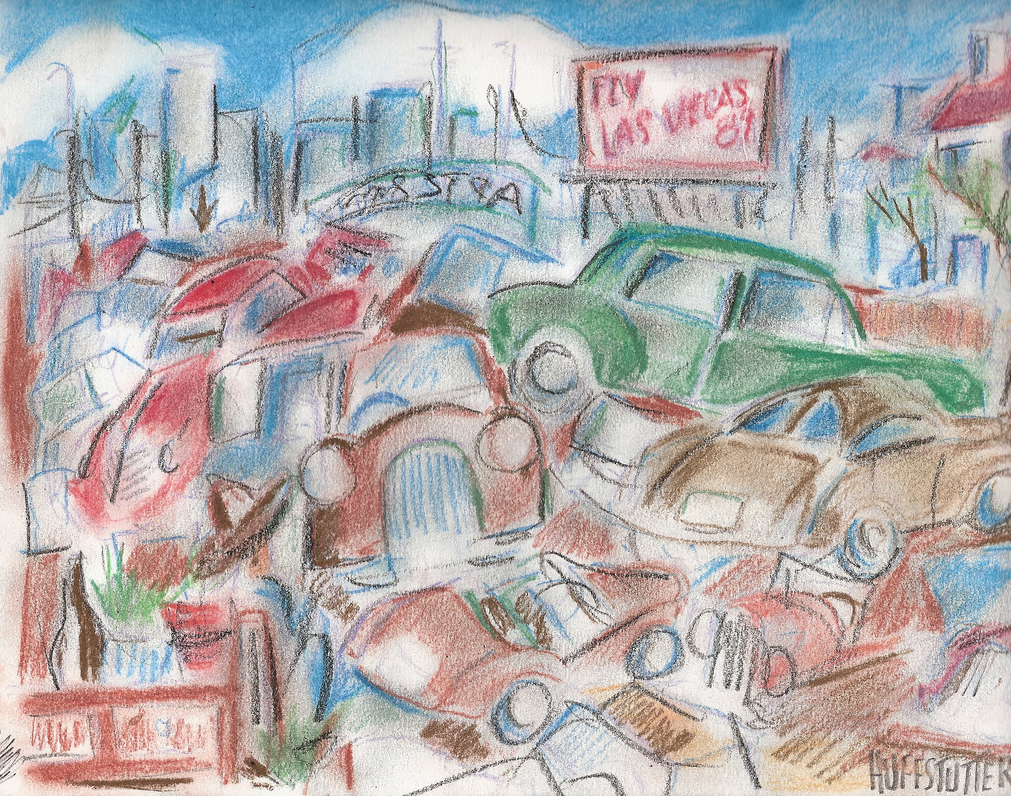
<blockquote><i>Figure 4. (Pastel by Robert
Huffstutter)</i></blockquote>

<p>How will employment and therefore population shrink in metropolitan
areas? The relative concentration of wealth in metropolitan areas has
spawned an urban economy that depends heavily on discretionary spending
beyond essentials. This part of the economy will tend to shrink first as
the energy to support the modern economy becomes scarce.</p>

<p>Also, many people who live in cities and their suburban bedroom
communities work in an economy that is parasitic: instead of creating
value it simply transfers wealth from one group to another. Much
employment in the so-called FIRE sector (finance, insurance, real
estate) falls into this category, which also includes much government,
advertising, litigation, and lobbying activity &mdash; economic sectors
that have arisen to exploit our society&rsquo;s failure to find better
ways to perform essential functions. Jobs in this parasitic economy can
be expected to disappear early in the energy descent. Many urban clerks
in cubicles, data gathering to feed the wealth transfer game, will need
to convert to skills that provide life&rsquo;s basic necessities &mdash;
food, shelter, basic tools, and services &mdash; and for many that will
mean leaving the city for farms.</p>

<p>In reality, much of the present urban population will be needed on
farms. According to energy descent scientist Richard Heinberg, the
de-industrialized agriculture that replaces the current energy-intensive
form of food production in the US will require fifty million farmers
instead of the present two million.[9] Indeed, there is a growing new
farmer movement across the US, served by organizations like Groundswell
here in Tompkins County.</p>

<p>The challenge of envisioning a plausible conversion of metropolitan
corridors like Bos-Wash to landscapes that are livable sans fossil fuel
is to think beyond current models of development or even redevelopment
schemes requiring levels of capital investment that a post-petroleum
economy cannot afford. The expensive visions of both the green urbanist
movement and the nodal cluster suburbanists run aground on this
obstacle. Awareness comes slowly because thinking about the upkeep of
these structures in the energy descent is often counterintuitive:</p>

<blockquote>Cities overburdened with skyscrapers will soon discover that
these structures are liabilities, not assets. The skyscrapers deemed
most &ldquo;innovative&rdquo; by today&rsquo;s standards &mdash; the
ones most dependent on high-tech materials and complex internal systems
&mdash; will be the greatest failures. This includes many of the new
&ldquo;green buildings.&rdquo;[10]</blockquote>

<p>An additional hurdle is the current resistance of the denizens of
these landscapes to using them differently, but eventually that
resistance will melt away as necessity becomes the mother of
adaptation.</p>

<p>Throughout their history, metropolitan areas have been centers that
have concentrated wealth and power drawn from exploited
peripheries. Early in the energy descent they can be expected to use
this accumulated advantage to allocate resources disproportionately to
themselves and thereby prolong consumption levels and material living
standards even as they decline in society as a whole. The maintenance of
centralized control that this requires may hinge on something as simple
as the ability of security forces, police and military, to fuel their
operations on renewables like biodiesel.</p>

<p>Later in the energy descent, however, much of the fuel-intensive
economic activity and centralized, hierarchical organization that is the
<i>raison d&rsquo;&#x00EA;tre</i> of cities and their umbilically
connected suburbs will become unaffordable, and the related employment
and population will evaporate. The long term budgetary agony of central
governing administrations, now well under way, is an early indicator of
economic contraction to come. Then human activity will return to a focus
on the basic necessities of food and shelter, and economies in these
places as elsewhere will self-reorganize around the provision of
farming, food systems, and housing that work with minimal fossil
fuel. My aim here is to summarize how I think this is likely to
happen. The key element in my scenario is the liberation of the built
environment and its rearrangement for other uses, a change made possible
by the contracting economy and population of metropolitan areas that I
have described as inevitable over time in the energy descent. Finally, I
will suggest how this scenario might play out in Ithaca, New York and
its hinterland, and by extension, in other small cities and towns.</p>

<h2>The Post-Petroleum Metropole</h2>

<p>Cities located on waterways will remain centers of some distant trade
as they have for centuries. On the downside, rising water levels could
eventually reduce habitable areas in seaport cities.  But for a while as
cities and suburbs shrink and depopulate, urban activity will center on
salvage of the built environment. As many parts of the built environment
are abandoned, we can expect their materials and land to be reclaimed
for structures and spaces for growing food and for makeovers of housing
and other structures to the level of energy efficiency required by the
new economy. Because the return to a solar energy economy will support
only a limited population, most land and buildings will stand empty and
provide a broad inventory of materials or, once cleared, space for
gardens. It is hard to imagine conversion of places like the canyons of
south Manhattan to either appropriate housing or food production, so
some city zones may remain abandoned except for salvage activities. At
the end of Apartheid in South Africa, for example, white businesses left
the high-rise section of Johannesburg. The squatters who replaced them
could not afford the energy needed to maintain the buildings, and they
gradually fell apart.[11] As urban areas everywhere experience a similar
drop in energy use, urbanites will abandon energy-intensive
structures. Hence a degree of decentralization will occur as urban areas
devolve into compact, semi-self-sufficient neighborhood communities
separated by empty salvage-yard commons.</p>

<p>The same process will occur in the suburbs, where abandoned
residential and commercial structures will serve as stores of materials
for low-cost conversion of residential housing for the remaining
population. Land to farm will be plentiful, but a main problem will be
to end the inefficiencies of suburban sprawl and reconfigure this
landscape into the kind of demographically dense agrarian villages that
have proved sustainable for centuries. The affordable solution will be
to move salvaged building materials or whole abandoned structures into
clusters at these central locations. This will recreate <i>at low energy
cost</i> the nodal demographic topography that historically has been
chosen as the most efficient mode of spatial organization of rural
communities the world over.[12] Thus in the long reach of history the
extravagance we call suburbia will prove to be a temporary
phenomenon.</p>

<p>Once the suburban topography is reformed into economically efficient
agrarian communities, some of these villages have the potential to
create a thriving trade in surplus food production with the nearest city
nodes, which in turn have a surplus of salvage inventory for which they
can exchange materials, and products handcrafted from them, and exchange
seasonal labor as well. In other words, city and suburb will convert to
symbiotic economies that bear some similarity to what they were before
the oil age. In the New York metropolitan area, for example, New Jersey
(the Garden State!), Long Island, coastal Connecticut, and the Hudson
Valley &mdash; the city&rsquo;s former breadbaskets &mdash; will regain that
function. As the distance economy that cities once depended on becomes
too costly, the ability of the near suburbs to convert from bedroom
communities to beehives of food production may well determine the size
of the population that can remain in the city.</p>

<h2>Solarized Housing</h2>

<p>In cool climates like the Northeast US, people will be forced to
rebuild housing to maximize solar heat and minimize biomass burning, as
biomass will regain its traditional role as the key strategic resource
and will experience renewed demand for many uses. Here again the
expensive models of residential energy efficiency popular today in the
green building movement are impediments to visioning.  For most of the
population the only conversion option will be to use scavenged materials
and hand labor, both of which will be plentiful, and in fact all that is
necessary to build highly effective passive solar systems for heating
both living spaces and water.</p>

<a href="/images/CSfig5.jpg">
<img src="/images/CSfig5.jpg" width="400px"/></a>
<blockquote><i>Figure 5. Solar hot water in attached solar greenhouse
</i></blockquote>

<p>To solarize a residence or other building that needs to be heated for
all-season use, urbanites will raze city structures that block it from
full southern exposure and will use their insulation, glass, masonry,
and plumbing hardware to convert it to reliance mostly on the sun for
heat and hot water.  Widespread conversion will occur when the massive
city and suburban built environment inventory becomes available for
salvage, because this type of solarization requires no expensive
technology or skills beyond elementary carpentry and plumbing. Enough
business buildings to support the shrunken economy will be converted in
the same way. Gradually buildings made of wood, with their short
turnover time of a few decades, will give way to more durable masonry
salvaged from unusable structures. The masonry will perform the added
function of furnishing the thermal mass to store solar energy required
by passive solar heating systems.</p>

<h2>Food Production Systems</h2>

<p>Like most current alternative architectural models, most organic
agriculture grew in the age of cheap oil and takes for granted many of
its luxuries. Food production everywhere will eventually adapt much more
closely to farming in nature&rsquo;s image. Like natural ecosystems, farms
will have to be largely self-sufficient in inputs, including a lot of
human and animal labor and relatively simple machines and tools.</p>

<p>City food production will reach limits, making city populations
dependent on the development of farming in the hinterlands that had been
suburbs. Once most empty urban spaces are used for farming, space will
be a limiting factor on urban growing because demolition and removal of
buildings in the energy descent will be very labor intensive. Another
limiting factor will be lack of space to &ldquo;grow&rdquo; fertility either
as green manure or manure from pastured livestock. This need for
fertilizer could motivate a return to transport within the metropole
using animals fed from fields outside cities, animals like those whose
manure supported urban food production until well into the industrial
era. In many metropolitan locations, efficient steel-on-steel rail
transportation systems work as well with animal power as with energy
derived from fossil fuels, just as they did for decades before and after
the turn of the twentieth century. An effective policy would prioritize
remaining fossil energy for the reconstruction of the rails and the
rolling stock and run the latter on animal power.</p>

<p>A distinct advantage of farming in cities and suburbs will be the
many existing structures that can be converted to solar greenhouses to
furnish the heat to perform and enhance essential services in the new
food system: intensive all-season growing, vermicomposting, food
conservation by solar drying, and even solar cooking. Husbandry of small
livestock like poultry and rabbits also will benefit from solar
greenhousing. Like the solarized human housing described above, these
structures will be low-cost conversions that require little skill beyond
an understanding of passive solar concepts.</p>

<h2>Implications for Tompkins County</h2>

<p>Whatever its previous form of habitation and land use &mdash; city,
suburb or rural &mdash; the most effective form of reorganization of
communities everywhere will be small, dense, and mixed-use, to make the
most of the traditional advantages of a convergence of many hands with
diverse talents in a world made more by hand and constrained mostly to
local self-reliance.</p>

<p>However, the size of an urban agglomeration will affect how easily
the scenario that I have described will occur. Bamako, in 1962 a city of
100,000 in the heart of West Africa, seemed to manage well on relatively
little fossil energy, as most of its population still cast a small
carbon footprint. But Havana, with a population ten times that of
Bamako, was suffering visibly despite massive compensatory government
programs when I observed it during visits in the 1990s, six years into
its peak oil experience (Cuba endured an 80% decline in energy and
related inputs).</p>

<p>The larger the metropolitan area, the more population shrinkage it is
likely to experience, and the greater the tendency for the city proper,
like the suburbs, to break up and reorganize into compact, walkable,
semi-self-sufficient communities. Cities as small as Ithaca will undergo
much of the repurposing of land use and built environment described
above, but the changes will be less extreme. Most of the downtown area
is already walkable, and a low-input public transportation system is
conceivable that would link neighborhood clusters to each other and to a
rural periphery that is relatively nearby.</p>

<p>Like many cities on waterways, Ithaca will benefit from a potential
lakeside trading area that low-input water transportation offers. The
lake provides a link to a large swath of farmland that might support
more of the current urban and suburban population in Ithaca than in
landlocked cities. Hence waterfronts in the city and county will regain
importance as points of departure in a revived system of waterborne
commerce. In an era of scarce, depleted resources, this waterfront
renaissance will need to occur mostly with salvaged or renewable
materials.</p>

<a href="/images/CSfig6.jpg">
<img src="/images/CSfig6.jpg" width="640px"/></a>
<blockquote><i>Figure 6. An advertisement for the Cayuga Lake
Transportation Company, ca. 1892.  The steamer served the same
communities around Cayuga Lake that are served by state routes 34, 34B,
90, and 89 today.  A high-resolution version of this figure can be
downloaded from
<a href="http://freepages.genealogy.rootsweb.ancestry.com/~springport/pictures75/7548cleaned2sharp.jpg">http://freepages.genealogy.rootsweb.ancestry.com/~springport/pictures75/7548cleaned2sharp.jpg</a>
(use &ldquo;Save link as&rdquo; to download before attempting to
view)</i></blockquote>

<p>The emergence of dense agrarian feeder hamlets along transportation
lines mentioned in my <i>Visioning County Food Production</i> series[13]
is more likely to proceed as I have argued here, by salvage of the
existing built environment, than by expensive new development as in the
present ecovillage model. However, the reorganization of the Tompkins
County food production system, food economy, and resultant urban and
suburban land use that I explored in that series is more conceivable in
its urban and suburban population of 100,000 than in a larger
metropolitan area, again for reasons that I have discussed here.</p>

<h2>Conclusion</h2>

<p>There is a fourth scenario for the nation&rsquo;s metropoles that
temporarily could partially avert the one I have described as most
likely. Governments could proclaim a &ldquo;wartime economy&rdquo; and create
a program of economic policies that redirects remaining fossil fuels and
other nonrenewables to uses that adapt urban areas to a low energy
future. If governments were to make appropriate major changes in
economic priorities, for a while they could maintain urban populations
and support levels of urban activity and consumption that are higher
than what I have described. Perhaps Departments of Descent would emerge
and begin setting economic policy, at least locally.</p>

<p>This would amount to converting the &ldquo;free-market&rdquo; economy to a
mixed command economy, which while common in many countries, generations
here in the US have been taught to regard as evil. However, our
sophisticated &ldquo;public relations&rdquo; industry has surmounted greater
challenges in manipulating the collective consciousness, and may well
show itself equal to the task of achieving a flip-flop in public
thinking. Whatever the success of a period of legislated economic
planning, its main positive function would be to delay the inevitable
return to a solar energy economy long enough to help society prepare and
adapt.</p>

<p>The present degree of <i>external</i> private control of local
economies is backed by government policy at all levels and is a major
obstacle to adaptation to the needs of the energy descent. Therefore, an
even better scenario that goes beyond emergency economic planning at a
national level might be a national program to gradually devolve
centralized economic control over the production of necessities to local
communities, which would even give them the potential to experience
economic democracy if they are so inclined.</p>

<p>But these scenarios might be too much to expect from the vested
interests that control much of state and federal policy making. Hence my
thinking about scenarios here has taken the route of cautiousness; it
assumes that because the notion of public planning of economic resource
use in the public interest at any level of government has become alien
to US cultural values, it is more likely that cities and suburbs will be
left to self-reorganize more or less chaotically into forms that can
support some level of human habitation in the energy descent.</p>

<p>Because of all the contingencies to consider, I believe it impossible
to estimate with a useful degree of probability the pace at which the
scenario that I have described will come to pass. At present, for
example, debt at all levels of social organization is being used to put
off the inevitable, although it will only make a later transition more
difficult. However, the gradual failure of the energy-intensive
metropolitan way of life is already making itself felt in declining
living standards for the great majority who are caught up in
it. Insolvency is increasing in municipalities, forcing them to start
filing for bankruptcy. Sooner or later in coming years and decades, most
of us will be forced to organize our lives differently. This attempt to
picture the consequences of declining energy for urban and suburban
areas hopefully will facilitate that transition.</p>

<h2>Notes</h2>

<p>[1] Kunstler, James Howard. <i>The Geography of Nowhere: The Rise and
 Decline of America&rsquo;s Manmade Landscape.</i> Simon & Schuster,
 1994.</p>

<p>[2] Kunstler, James Howard in <i>The End of Suburbia</i>,
  2004. <a href="http://www.youtube.com/watch?v=Q3uvzcY2Xug">http://www.youtube.com/watch?v=Q3uvzcY2Xug</a></p>

<p>[3] Vail, Jeff. &ldquo;Resilient Suburbia,&rdquo;
2010. <a href="http://www.jeffvail.net/2010/01/resilient-suburbia-toc.html">http://www.jeffvail.net/2010/01/resilient-suburbia-toc.html</a></p>

<p>[4] Tainter, Joseph. <i>The Collapse of Complex Societies.</i>
 Cambridge University Press, 1988.</p>

<p>[5] Owen, David. <i>Green Metropolis: Why Living Smaller, Living
  Closer, and Driving Less Are the Keys to Sustainability.</i>
  Riverhead Books, 2009.</p>

<p>[6] Fridley, David. &ldquo;Embodied Energy: An Alternative Approach
  to Understanding Urban Energy Use.&rdquo; <i>The Oil Drum,</i> August
  12, 2010. <a href="http://www.theoildrum.com/node/6842"
  >http://www.theoildrum.com/node/6842</a></p>
	
<p>[7] Owen, David. <i>Op. cit.</i></p>

<p>[8] Odum, Howard T. and Elizabeth C. Odum. <i>A Prosperous Way Down:
  Principles and Policies</i> (University Press of Colorado, 2001),
  p. 174. Written by pioneers in the application of systems ecology and
  energetics to problems of society.</p>

<p>[9] Heinberg, Richard. &ldquo;Fifty Million Farmers.&rdquo;
  <i>Energy Bulletin,</i> November 17,
  2006. <a href="http://www.energybulletin.net/node/22584"
  >http://www.energybulletin.net/node/22584</a></p>

<p>[10] Kunstler, James Howard. &ldquo;Back to the Future: A roadmap for
  tomorrow&rsquo;s cities.&rdquo; <i>Orion</i>, July/August 2011. </p>

<p>[11] Kunstler, James Howard. <i>Too Much Magic: Wishful Thinking,
  Technology, and the Fate of the Nation.</i> Atlantic Monthly Press,
  2012.</p>

<p>[12] Vail, Jeff. &ldquo;Envisioning a Hamlet Economy: Topology of
  Sustainability and Fulfilled Ontogeny,&rdquo; 2009.
  <a href="http://www.jeffvail.net/2006/04/envisioning-hamlet-economy-topology-of.html"
  >http://www.jeffvail.net/2006/04/envisioning-hamlet-economy-topology-of.html</a></p>

<p>[13] The series was published here in six parts:<br>

  <a href="http://tclocal.org/2009/07/visioning_county_food_producti.html"
     >http://tclocal.org/2009/07/visioning_county_food_producti.html</a><br>
  <a href="http://tclocal.org/2009/09/visioning_county_food_2.html"
     >http://tclocal.org/2009/09/visioning_county_food_2.html</a><br>
  <a href="http://tclocal.org/2010/02/visioning_county_food_prod_3.html"
     >http://tclocal.org/2010/02/visioning_county_food_prod_3.html</a><br>
  <a href="http://tclocal.org/2010/05/visioning_county_food_prod_4.html"
     >http://tclocal.org/2010/05/visioning_county_food_prod_4.html</a><br>
  <a href="http://tclocal.org/2010/06/visioning-county-food-prod-5.html"
     >http://tclocal.org/2010/06/visioning-county-food-prod-5.html</a><br>
  <a href="http://tclocal.org/2010/07/visioning_county_food_prod_6.html"
     >http://tclocal.org/2010/07/visioning_county_food_prod_6.html</a><br>

</p>]]>
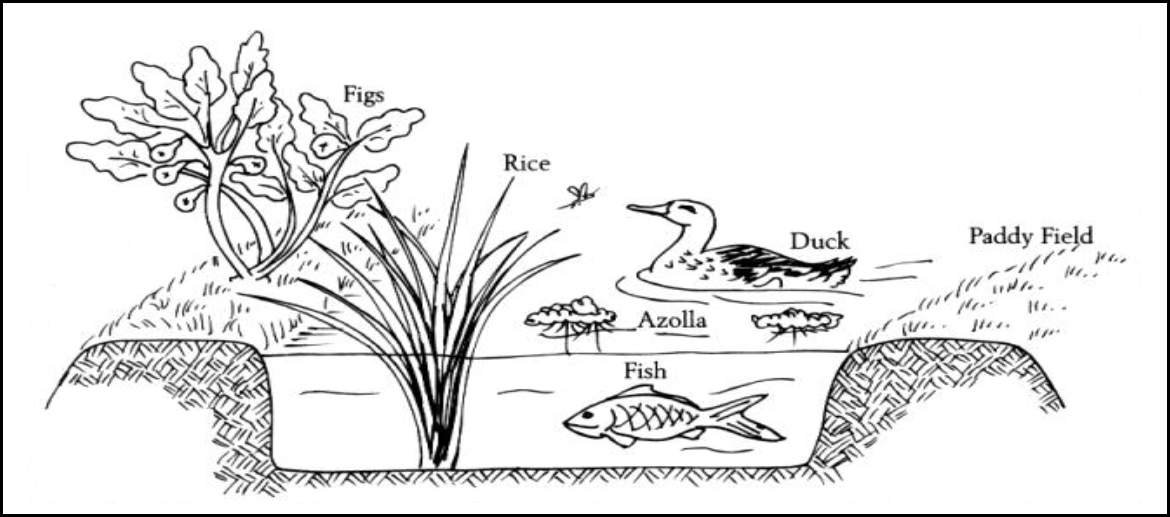
        
    </content>
</entry>

<entry>
    <title>Forecasting Weather Challenges</title>
    <link rel="alternate" type="text/html" href="http://tclocal.org/2012/06/forecasting_weather_challenges.html" />
    <id>tag:tclocal.org,2012://16.6089</id>

    <published>2012-06-11T20:19:37Z</published>
    <updated>2012-06-12T15:45:53Z</updated>

    <summary>Weather may seem like a local issue we can&apos;t control, but reality is more complicated than that. While we don&apos;t control the weather itself, we have drastically reduced its impact on us through forecasting and preparation. A Tompkins County resident...</summary>
    <author>
        <name>Simon St.Laurent</name>
        <uri>http://simonstl.com/</uri>
    </author>
    
        <category term="agriculture" scheme="http://www.sixapart.com/ns/types#category" />
    
        <category term="preparedness" scheme="http://www.sixapart.com/ns/types#category" />
    
        <category term="transportation" scheme="http://www.sixapart.com/ns/types#category" />
    
    
    <content type="html" xml:lang="en" xml:base="http://tclocal.org/">
        <![CDATA[<p>Weather may seem like a local issue we can't control, but reality is more complicated than that.  While we don't control the weather itself, we have drastically reduced its impact on us through forecasting and preparation.  A Tompkins County resident of the 1800s would marvel at the existence of a plausible five-day forecast, never mind radar images on a cell phone that can help indicate whether a thunderstorm will pelt one valley or the next.</p>

<p>Our weather forecasting infrastructure, however, is expensive and in many cases getting creaky.  It depends on technologies, notably aviation, rocketry, and helium balloons, that may face resource limits in the future, as well as a short-term set of challenges created by failed satellite launches and tighter budgets.</p>

<h2>Local Weather</h2>

<p>Tompkins County weather is rarely dull, with substantial variations in temperature and precipitation from week to week and year to year.  While Tompkins County is not regularly blasted by hurricanes or tornadoes, local weather is a complex set of intersections, dominated by continental weather coming from the west that mixes with arctic weather coming from the north and Atlantic weather coming from the south and sometimes east.</p>

<p>Although Ithaca has seen extreme temperatures of 103&deg;F (1936) and -35&deg;F (1934), most of the acute challenges in local weather come from precipitation.  Before the completion of the Flood Control Channel in Ithaca, the city faced regular floods, and even today it experiences occasional issues related to ice jams.  A 1935 flood caused problems across the county, even in Trumansburg <a href= "#weather1">[1]</a>, where debris blocked a bridge and created flooding in a place where it seemed impossible.  1972's floods accelerated the demise of local railroad infrastructure, while 1981 devastated the Village of Dryden. 2011 saw damage in Caroline, though Tompkins County dodged many worse issues to the east.</p>

<p>Although Tompkins County isn't in New York State's heaviest snow areas, blizzards have shut down the county every few decades, stranding residents and cutting off power.  Ice storms periodically disrupt transportation and electrical distribution, as well as damaging trees and buildings.</p>

<img src= "/images/snowAverages.gif" />
<p><cite>Average annual snowfall in inches, Upstate New York (from NOAA). Tompkins County is in the 60-80 inch band. <a href= "#weather2">[2]</a></cite></p>

<p>Tornadoes and windstorms do happen occasionally, with the Village of Dryden seeing tornadoes downtown in 1983 and 1996, and the Jersey Hill area having one last year.  While these have been relatively weak tornadoes, powerful tornadoes do occasionally occur in the northeast <a href= "#weather3">[3]</a>. </p>

<img src= "/images/2011tornadoesMap.png" width="600" />
<p><cite>US tornadoes, 2011 (from NOAA) <a href= "#weather4">[4]</a></cite></p>

<p>While the weather of spring 2012 may have seemed strange, odder and more damaging weather has happened in the past. May 23, 1925 saw 94 degrees in Buffalo, followed by ice and snow the next day, and harsh storms rolled across the northeast.  Perhaps most troubling, however, was 1816's "Year without a Summer" when the massive volcanic eruption of Indonesia's Mount Tambora shrouded the planet in haze, and frosts were common throughout the summer, devastating crops.</p>

<p>Less dramatic circumstances can still cause problems for farmers, who depend on the weather for their livelihood.  Crops need water, but too much water (or water at the wrong time) can create its own problems, both for plants and for the equipment used to manage them.  Hailstorms can demolish crops and equipment, while late frosts in spring or early frosts in fall can wreak havoc on harvests. </p>

<p>Even relatively minor-seeming weather - fog, light rain, or a little bit of snow or ice - can have a major impact on travel safety, especially on local hills.  Ithaca airport had to divert flights for a few weeks in March and April 2012 because a crystal needed for instrument navigation in cloudy or foggy weather was broken, but even simpler forms of transportation can become more complicated when weather is iffy.</p>

<p>The impact of climate change on day-to-day weather isn't clear yet, but added energy in the atmosphere can do more  than warm it.  More energy means more power for wind and storms, and it increases the possibility of events like that cold front of 1925.  In the long term, diversions or droughts that cause changes in the water volumes of the Great Lakes could also change weather patterns here.</p>


<h2>Forecasting: Collection, Communications, and Calculation</h2>

<p>While we haven't learned to actually manage the weather, we have spent the last two hundred years taming our temperate climates by getting better at knowing what weather is coming when, preferably far enough in advance to take precautions if necessary.  While it remains fairly difficult to precisely forecast how much precipitation will land where, or where in a possible storm tornadoes will form, meteorologists and their powerful tools have delivered better and better results over the last century or so.</p>

<p>Data collection is the first key to forecasting.  The earliest "weather maps" were built using old observations, but the spread of reliable instruments and telegraph lines made daily station data collection possible by the time of the Civil War.  Weather station reports today range from official Automated Surface Observing System (ASOS) installations, often at airports and National Weather Service (NWS) offices, to home stations that transmit their findings over the Internet. </p>

<p>Monitoring precipitation is important, but monitoring the impact of that precipitation on streams and rivers is also important for predicting flooding.  In Tompkins County, the US Geological Survey maintains recording gauges on Six Mile Creek at Brooktondale and Bethel Grove, on Fall Creek in Forest Home, and on Cayuga Inlet at the lake.</p>

<p>Weather balloons add critical upper air observations. They are typically released twice a day from 900 stations around the world.  Radiosondes <a href= "#weather5">[5]</a> transmit data on pressure, temperature, and humidity for up to a few hours, and the path of the balloon indicates wind speed and direction. The balloons themselves are single use, rising until they pop.  While about 20 percent of radiosondes are found and recovered, most disappear after a single use.  At $100 for each radiosonde plus approximately $20 for the balloon and perhaps another $20 to fill it, individual balloons may seem relatively cheap, but they become expensive over time.  Occasionally, as when Hurricane Irene was coming up the East Coast in 2011, the weather service uses them more than twice a day, but this is rare.</p>

<p>Weather satellites give meteorologists key overhead views of storms and normal weather.  Typically satellites collect visual and infrared data, monitoring temperatures and water vapor.  Satellites have made it possible to track hurricanes while they are still forming at sea, allowing for adequate warning.  They also monitor solar weather, tracking changes in solar radiation and their impacts on earth's electromagnetic fields.  For the United States, the key satellites are the geostationary GOES satellites.  There are four functioning satellites in orbit at present, including one spare.</p>

<p>Airplanes both need weather information and generate weather information.  While pilot reports have been important to forecasting since the early days of aviation, they were sporadic.  The Aircraft Communications Addressing and Reporting System (ACARS) and temperature and wind sensosrs on planes send about 35,000 weather report messages per day in the United States, and about 130,000 per day world wide.  These observations make a substantial difference in the quality of forecasting:</p>

<blockquote><p>From September 11 to September 13 [2001], the FAA grounded aircraft across the United States.  Without the benefit of the hourly aircraft observations, the 3-hour forecasts produced by NWS models became only as accurate as 12-hour forecasts normally are. <a href= "#weather6">[6]</a></p></blockquote>

<p>A newer system, TAMDAR, pushes airplane-based automatic reporting systems further, with 425 aircraft providing approximately 5000 daily reports on temperature, pressure, winds, humidity, icing, and turbulence.</p>


<p>Ground-based radar serves a different purpose, tracking local storms in motion and providing detailed information on where they're going and the dangers they may pose.  NEXRAD, the currently widespread weather radar, is deployed at National Weather Service sites around the US.  In New York State, NEXRAD is deployed at Buffalo, Binghamton, Albany, and Montague.  The NWS makes radar data available on the web and directly to private companies, which often assemble it into smooth maps that hide how it is built from multiple radar sources.  NEXRAD has been especially critical in the Great Plains for tornado warnings, but it is also useful for monitoring all kinds of thunderstorm, snow, and wind events.</p>

<p>A wide variety of communications networks link these systems, including government networks as well as private and public commercial networks.  Raw weather data from the government is freely available on the Internet, as is more-processed commercial data from vendors, often supported by advertising.  A dedicated network of weather radio stations run by the National Oceanic and Atmospheric Administration (NOAA) makes reports and warnings available across the country, including in Ithaca, where station WXN59 broadcasts continuously.</p>

<p>Global data is also critical.  Most nations share weather data freely, making it possible to build models of global weather that offer much greater long-term accuracy than models with sharp boundaries.  While weather doesn't simply cross the Pacific from Siberia or China, weather data from those places can still enhance forecasting for the United States.</p>

<p>Processing this flood of data requires massive computing power, though perhaps compared with climate simulations or nuclear weapons simulations it isn't so massive.  The National Weather Service maintains its own central models and distributes them to local offices, which issue their predictions (and warnings) based on the model and their understanding of local conditions.  (The Binghamton NWS handles forecasting for Tompkins County.)</p>


<h2>Fading Forecasting</h2>

<p>The intricate networks of complex tools required for today's level of forecasting accuracy are difficult to maintain.  Satellite launches and operations can cost millions of dollars and yet result in failure, and even the smaller components have their own difficulties.  Some warnings today may point to further challenges to come in a more resource-constrained world.

<h3>Current Challenges</h3>

<p>After decades of continuous weather forecasting improvements, American weather forecasting faces some difficult challenges today, even before considering issues of energy descent.  These are often phrased competitively - "U.S. numerical weather prediction (NWP), and particularly our global prediction skill, lags between major international centers". <a href= "#weather7">[7]</a> To some degree this is a question of priorities.  As the article asks:</p>

<blockquote><p>We spend this much money on a single jet fighter, but we can't invest this amount to greatly improve forecasts and public safety in the U.S.? </p></blockquote>

<p>Weather forecasting in all of its growing complexity does not, however, seem to be an especially popular investment.  Every decade or so reports emerge of resource shortages, cost overruns, and other complications.  <cite>Weather Forecasting: Cost Growth and Delays in Billion-Dollar Weather Service</cite> is a typical example from 1991.  Despite its more moderate-sounding title, the current <cite>Earth Science and Applications from Space: A Midterm Assessment of NASA's Implementation of the Decadal Survey</cite> <a href= "#weather8">[8]</a> reports that:</p>

<blockquote><p>the nation's Earth observing capability from space is beginning to wane as older missions fail and
are not replaced with sufficient cadence to prevent an overall net decline. The committee found that the
number of NASA and NOAA Earth observing instruments in space is likely to decline to as little as 25
percent of the current number by 2020...</p<
><p>as longrunning
missions end and key new missions are delayed, lost, or canceled.</p>
<p>The projected loss of observing capability could have significant adverse consequences for
science and society. The loss of observations of key Earth system components and processes will weaken
the ability to understand and forecast changes arising from interactions and feedbacks within the Earth
system and limit the data and information available to users and decision makers. Consequences are likely
to include slowing or even reversal of the steady gains in weather forecast accuracy over many years and
degradation of the ability to assess and respond to natural hazards and to measure and understand changes
in Earth's climate and life support systems. The decrease in capability by 2020 will also have far-reaching
consequences for the vigor and breadth of the nation's space-observing industrial and academic base...  (page 2)</p></blockquote>

<p>The challenges are basic, though the details are complicated:</p>

<blockquote><p>a budget profile that is not sufficient to execute the decadal
survey's recommended program. In addition, some of the survey-recommended missions have proved
more challenging than anticipated, and others envisioned synergies that are not readily achieved via the
suggested implementation. The ESD budget has been further strained as a result of mandates from
Congress (e.g., the addition of the approximately $150 million TIRS [Thermal Infrared Sensor] to the
Landsat Data Continuity Mission) and the interjection of administration priorities (e.g., the Climate
Continuity missions) without the commensurate required funding. (page 4)</p></blockquote>

<p>In particular:</p>

<blockquote><p>Lack of reliable, affordable, and predictable access to space has become a key
impediment to implementing NASA's Earth science program. Furthermore, the lack of a
medium-class launch vehicle threatens programmatic robustness. (page 5)</p></blockquote>

<p>Even on the ground, improving weather forecasting is no longer a strictly federal project.  In Texas, better weather forecasting comes with a hefty local commitment <a href= "#weather9">[9]</a>:</p>
	
<blockquote><p>The near-ground radar system, which will supplement the current NEXRAD Doppler radar network, will provide faster scans, higher-resolution images and multiple overlapping views of storm cells, said Bill Bunting, chief meteorologist for the National Weather Service in Fort Worth....</p>
	
<p>CASA is footing the approximate $4 million cost of the initial eight radar systems.</p>

<p>Local entities are responsible for the first year's operating cost, $500,000; the cost is expected to decline in the second year.</p></blockquote>

<p>$500,000 is still a small piece of a $40 million system, but localizing the cost of these services seems likely in an era where federal expenses of any kind are increasingly questioned.</p>

<h3>Possible Future Challenges</h3>

<p>Satellites are risky business under the best of circumstances, but resource constraints can wear on nearly every part of the weather forecasting system.  Satellites themselves are an extremely visible component of our weather tracking systems, and their information may also have military value, so it is possible that those could continue while other pieces of the system break down.</p>

<p>Components of the technical network that produces today's weather forecasts face four major challenges:</p>
<blockquote>
<dl>
<dt><p><strong>Physical wear</strong></p></dt>
<dd><p>Physical wear is a serious long-term challenge for weather station components but especially for things like stream gauges.  Wear may not show itself as failure, but through diminished accuracy, requiring regular calibration.</p></dd>
<dt><p><strong>Complex maintenance</strong></p></dt>
<dd><p>Radar and communications systems are complex to build, but even when they're operational they need regular upkeep.  In the case of satellites, "maintenance" often means "replacement".</p></dd>
<dt><p><strong>Questions of distribution (and cost distribution)</strong></p></dt>
<dd><p>The National Weather Service provides information to the public for free, but also provides data feeds to the many commercial weather providers. It's a complex and ever-changing relationship in which the NWS provides foundation information but "specialized services" are handled by industry.  Current expectations of things like free radar maps that have been combined and reprocessed depend on the health of a variety of commercial models.</p></dd>
<dt><p><strong>Changes in aviation</strong></p></dt>
<dd><p>As airlines streamline operations, consolidating flights to reduce the number of empty seats and cutting service to airports that don't meet their profitability expectations, fewer flights will yield less weather data from fewer locations.</p></dd>
</dl>
</blockquote>
<p>It is, of course, possible that Americans will demand better weather information and the federal government will make it a higher priority even if energy costs climb, but it is hard to forecast that.  There are scenarios - More satellites!  Bigger computers!  More ground stations! - in which weather forecasting quality could improve, but given the kinds of constraints TCLocal tries to prepare for, this is unlikely.</p>
	
<p>Weather forecasts probably won't go away, of course.  If parts of the system fade, the quality of the forecasts will decline, especially longer-term forecasts.  Rough seasonal forecasts based on ocean currents (El Ni&ntilde;o and similar) may continue to be useful, however, so long as the data continues to be collected.  Some pieces are more at risk than others - for example, Doppler radar is constantly a matter of life and death on the Great Plains, where tornadoes are common, so it's not hard to imagine a resource-constrained NWS moving key resources where they're most needed.  For radar, that isn't here.</p>

<h2>Impacts and Alternatives</h2>

<p>If weather forecast quality declines, the simplest general approach will be to prepare for more weather danger than may come to pass.  Forecasts have in many ways tamed a climate that already can lurch from blazing hot to freezing cold by letting us figure out what's going to happen before it gets here.  If that luxury becomes less reliable, residents will have to sacrifice efficient use of time and resources to avoid catastrophes.</p>

<p>Many of the changes suggested here also apply if climate change should produce weather more extreme and changeable than we already have.  Weather forecasting is largely a tool we use to moderate the effects of weather, so declining weather forecast quality is in some ways produces impacts equivalent to increasing extremes in actual weather.  Great weather forecasting can ease the impact of many aspects of extreme weather, while poor weather forecasting makes it harder to avoid even the impact of our usual weather.

<h3>Traveling on the Weather's Schedule</h3>

<p>On January 24, 1945, schoolbuses left Dryden Central School early to try to get students home in the face of a blizzard.  All but one couldn't get through, however, and 61 students returned to the school for three days.  When they finally went home, it was in open horse-drawn sleighs, not the buses or even the plows that couldn't get through the snow.</p>

<p>Today, that experience is hard to imagine. A school superintendent who knew snow was coming but hoped to avoid an extra snow day could easily have changed plans earlier in the day.  Although radar isn't great for identifying the rate at which snow falls, it certainly makes clear if a storm is moving more quickly than planned, and provides some extra margin to get students home.  We can plan our activities around weather forecasts, and change them in real time based on constantly updating data.</p>

<p>Without that data, however, working or traveling outside is more complicated.  Cars and trucks with wheels perform much better on smooth dry asphalt, especially on the hills of Tompkins County.  People in charge of wheeled transportation - a highway superintendent trying to keep roads open, a superintendent of schools commanding a fleet of buses, or a trucking company carrying gravel - will have harder times developing plans of action.  The odds of a mistake climb dramatically and caution becomes more prudent.</p>

<p>Similarly, people can choose to travel less.  That could increase the value of local shops, which could be more convenient than a drive to a bigger, farther location when snow seems possible.  Those who have the power to choose transportation network designs - school districts in particular, but also municipalities and some kinds of businesses - might opt for less centralization and shorter trips.  By increasing the overall cost of travel, weather uncertainty reduces the advantages of centralization.</p>

<p>Another option, of course, is to choose modes of transport that are less risky.  Pedestrians don't always enjoy ice and snow (or even rain), and shouldn't wander the countryside in a blizzard or throw aside their canes to dance on the icy sidewalk, but they have more options.  Snowshoes, skis, and traction devices for shoes are all easier to apply and remove than chains on vehicle tires.  Sleighs and snowmobiles provide another option, though not necessarily an option that works at large scale.</p>

<h3>Concentrating and Protecting Fragility</h3>

<p>While large-scale blizzards create problems across large areas, weather forecasting helps minimize the impact of many smaller problems.  Hail and frost warnings may only affect a small area or a small set of projects, but defending against either is difficult on a large scale.  A hail warning might, for example, tell individuals to park vehicles inside or protect key outdoor objects, while a frost warning might be a sign to protect seedlings or fruits with a cloche or similar wrap.  Without those warnings, people will have to guess what might be coming based on a broader picture of the weather.</p>

<p>Instead of cursing warnings that weren't issued, a simpler approach concentrates fragile items and protects them.  For vehicles, this is the classic garage or carport.  For plants, it could be a greenhouse, but it could also be a much lighter high tunnel that can cover large areas at low cost.  On a smaller scale, it could even be a row cover that protects smaller plants with metal frames and translucent covers.  None of these are cheap, but all of them bring other advantages.</p>

<p>In some cases, changing the style of agriculture or gardening may also be appropriate.  While most crops are grown in open fields to maximum sun exposure, some crops, notably currants and gooseberries, can thrive in light forests.  Food forests and silvipasture approaches may be more resilient against unexpected or more severe weather than traditional approaches.</p>

<p>Concentrating tasks that need attention and connecting them to people who can help is another option.  Medieval buildings that combined barn, stable and house for shared convenience (and warmth) might seem extreme, but such an arrangement can be practical.  A simpler approach is placing housing near buildings, notably barns, that need regular human visitors.  In many northern areas the connections between buildings are roofed or even turned into hallways, protected from the risks of wind, rain, and snowdrifts.</p>

<h3>Large-scale Protection</h3>

<p>Past flooding drove the construction of two major public works meant to reduce the dangers inherent in Tompkins County's system of streams.  The Flood Control Channel in Ithaca was built to reduce the impact of regular flooding in downtown Ithaca, and the Crispell Dam on Virgil Creek in southeast Dryden does the same for the Villages of Dryden and Freeville and for Fall Creek generally.  Around the county, many stream stabilization projects direct water away from places it would cause trouble.</p>

<p>These massive projects have had substantial effects.  The Crispell Dam slowed the rate of flow in Fall Creek at a critical moment in September 2011, and the Flood Control Channel has, with some minor exceptions, kept dry even areas that used to regularly flood.  The Flood Control Channel has even made development in formerly wet areas like Southwest Park and the current Ithaca High School seem more plausible.</p>

<p>While these public works can substantially reduce the uncertainty created by declining forecasts or more severe weather, they also cost a lot to build and maintain.  The Flood Control Channel in particular just received $13 million for dredging, a project that is already far behind an ideal schedule.  The dam and stream projects also require regular maintenance as well, though the work is smaller and less specialized.</p>

<p>Other kinds of public works can also make a substantial difference.  The floods in Trumansburg in 1935 and Dryden in 1981 shared a common culprit: bridges that filled with debris.  While larger bridges with designs that are harder to plug are more expensive, they may be an ever more necessary part of shared infrastructure.  (They also wash out less frequently.)</p>

	
<h3>Applying Microclimates</h3>

<p>Because of Tompkins County's varied terrain and water features, weather conditions can vary drastically over the course of a mile or even a few hundred feet.  Some of those microclimates have much calmer weather than the rest of the county, but may not be especially useful because they're in the bottoms of mostly shady gorges.  Elevation, exposure, and orientation all create different situations that produce significantly different weather.</p>

<p>Closer study of different areas could yield a map of places that are more and less prone to frost damage on cold nights, likely to receive more or less precipitation (and especially runoff), and which get more or less wind.  On a broad scale, the 2011 version of the US Department of Agriculture's climate zone map shows areas along the lake and at the lake's elevation as Zone 6a, with a minimum winter temperature of -10&deg;F, while the rest of the county is at Zone 5b, minimum winter temperature of -15&deg;F.</p>

<p>Identifying different microclimates is sometimes possible through simple observation over time.  People definitely talk about colder valleys and places where it's harder to grow fruit trees.  More detailed mapping, however, might be a good project to start while the full set of weather tools is still available.  Once identified, that knowledge would be a good complement to things like the Soil Type Maps when farmers need to decide what kinds of crops to plant where.</p>


<h3>Local Data, Local Warnings</h3>

<p>Today, weather warnings are issued by regional NWS offices.  While those warnings can be extremely useful, they come with natural limits because of the limited information about extremely local conditions.  Stream gauges, for example, are largely downstream of places where flooding might occur.</p>

<p>Local watches could become a regular part of government again.  During the 1935 flooding, a local watch on the Dryden Lake dam reported concerns about a break.  None occurred, and some people were unhappy about the false alarm, but that's information that the weather service can't really provide.  Certain key points with aging infrastructure or a dangerous history may be especially worth watching and monitoring.</p>

<h2>Recommended Reading</h2>

<p><cite>The Ultimate Guide to American Weather</cite>, by Jack Williams (2009), for an overview of current forecasting. </p>
<p><cite>Warnings</cite>, by Mike Smith (2010) on how warnings and related technology evolved.</p>
<p><cite>Air Apparent</cite>, by Mark Monmonier (1999), on how weather forecasting came to be.</p>
<p><cite>Eric Sloane's Weather Almanac</cite> (reprint, 2005) for a look back at weather lore by a noted antiquarian who also happened to be a Navy meteorologist.</p>
<p><cite>The 2012 Ithaca Weather Calendar</cite>, for local data.  The 2013 version will likely include new records.</p>
<p><cite><a href= "http://www.nws.noaa.gov/om/brochures/basicspot.pdf">Basic Spotters' Field Guide</a></cite>, the National Weather Service introductory guide for local weather spotters.</p>


<h2>Notes</h2>
<p><a id= "weather1"></a>[1] - "Home Movie of Trumansburg New York Flooding 1935." <a href= "http://www.youtube.com/watch?v=Dt7mNDxj_5o" >http://www.youtube.com/watch?v=Dt7mNDxj_5o</a></p>
<p><a id= "weather2"></a>[2] - "Average Seasonal Snowfall Over the Eastern Great Lakes Region." <a href= "http://www.erh.noaa.gov/er/buf/lakeffect/snowseason.html" >http://www.erh.noaa.gov/er/buf/lakeffect/snowseason.html</a></p>
<p><a id= "weather3"></a>[3] - "Tornado crosses NYS Thruway." <a href= "http://www.youtube.com/watch?v=8pWkmTVbqcA" >http://www.youtube.com/watch?v=8pWkmTVbqcA</a></p>
<p><a id= "weather4"></a>[4] - <a href= "http://www.spc.noaa.gov/wcm/annualtornadomaps/" >http://www.spc.noaa.gov/wcm/annualtornadomaps/</a>.</p>
<p><a id= "weather5"></a>[5] - "NWS Radiosonde Observations - Factsheet."<a href= "http://www.erh.noaa.gov/gyx/weather_balloons.htm" >http://www.erh.noaa.gov/gyx/weather_balloons.htm</a></p>
<p><a id= "weather6"></a>[6] - Williams, Jack. <cite>The Ultimate Guide to America's Weather</cite>, 138.</p>
<p><a id= "weather7"></a>[7] - Mass, Cliff. "Lack of Computer Power Undermines U.S. Numerical Weather Prediction (Revised)." <a href= "http://cliffmass.blogspot.com/2012/04/us-has-fallen-behind-in-numerical.html" >http://cliffmass.blogspot.com/2012/04/us-has-fallen-behind-in-numerical.html</a></p>
<p><a id= "weather8"></a>[8] - <cite>Earth Science and Applications from Space: A Midterm Assessment of NASA's Implementation of the Decadal Survey</cite>. <a href= "https://download.nap.edu/catalog.php?record_id=13405" >https://download.nap.edu/catalog.php?record_id=13405</a></p>
<p><a id= "weather9"></a>[9] - Campbell, Steve. "New weather radar better tracks violent storms." <a href= "http://www.standard.net/stories/2012/03/19/new-weather-radar-better-tracks-violent-storms">http://www.standard.net/stories/2012/03/19/new-weather-radar-better-tracks-violent-storms</a></p>
]]>
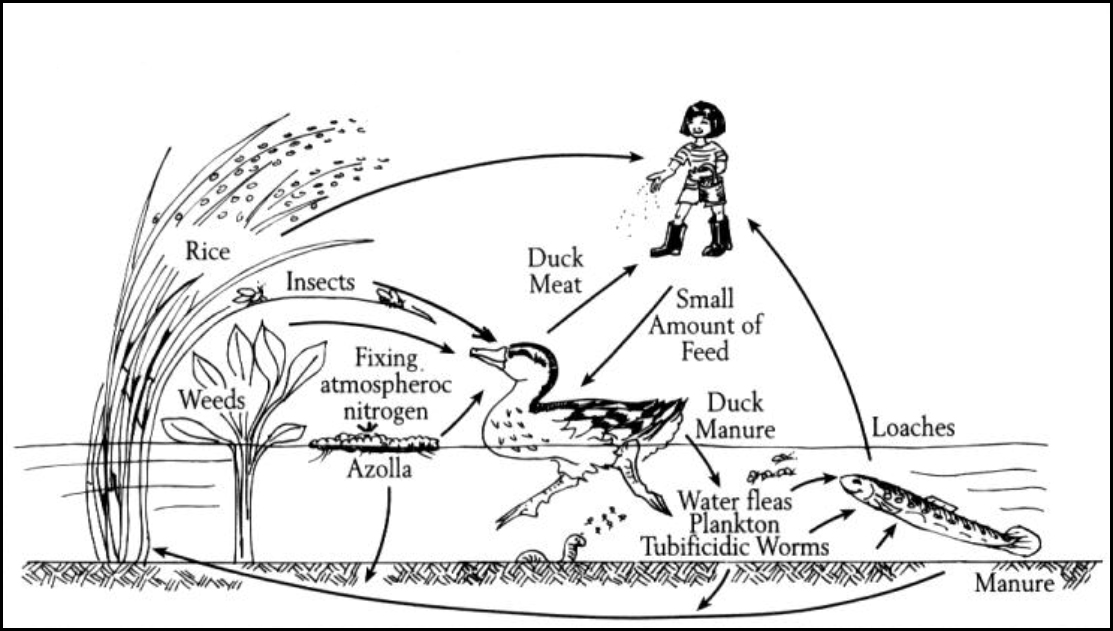
        
    </content>
</entry>

<entry>
    <title>A Consideration of the Benefits of a Lower Energy Civilization</title>
    <link rel="alternate" type="text/html" href="http://tclocal.org/2012/04/benefits_lower_energy_civ.html" />
    <id>tag:tclocal.org,2012://16.6024</id>

    <published>2012-04-02T11:51:23Z</published>
    <updated>2012-04-02T11:53:46Z</updated>

    <summary> By Karl North and Bethany Schroeder The seventies counterculture generation embraced voluntary simplicity and its low levels of resource use because it enabled not only a lighter ecological footprint but also the chance to escape the stifling straitjacket of...</summary>
    <author>
        <name>Simon St.Laurent</name>
        <uri>http://simonstl.com/</uri>
    </author>
    
        <category term="overview" scheme="http://www.sixapart.com/ns/types#category" />
    
    
    <content type="html" xml:lang="en" xml:base="http://tclocal.org/">
        <![CDATA[   <p>By Karl North and Bethany Schroeder</p>

   <p>The seventies counterculture generation embraced voluntary
   simplicity and its low levels of resource use because it enabled not
   only a lighter ecological footprint but also the chance to escape the
   stifling straitjacket of bourgeois institutions. Decades later the
   whole world faces a future of involuntary simplicity,
   or <i>d&eacute;croissance</i> (degrowth), as its advocates call it in
   Europe. Invevitable degrowth?  Really? How did that happen?</p>

   <h2>Introduction: Premises</h2>

   <p>Markets are the outward manifestation of the energy that
   motivates them. Especially during the past two centuries, the quest
   for greater and greater amounts of energy has driven the development
   of populations and their economies all over the world. Three
   important effects of this dynamic include environments degraded in an
   effort to access cheaply and quickly the sources of energy; the
   growth of populations out of proportion to the land&rsquo;s ability to
   sustain them; and a focus on increased profits, regardless of the
   associated environmental, social, and spiritual costs.</p>

   <p>An accounting of progress reveals that the effort to increase
   material wealth necessitates concomitant technologies of increasing
   complexity. In general, the more complex the solutions, the more
   energy they consume. Our global economy is one example of a complex
   solution. In an effort to keep up with the desire to realize
   increased material wealth from products, we have created complicated
   supply chains that span the globe; complicated enterprises to provide
   access to raw materials and the methods of transportation needed to
   support the supply chains; and many complicated interdependencies
   among people, information, and supplies to achieve the goals. The
   infrastructure required to ensure systems of production, whether
   manufacturing, agriculture, transportation, education&mdash;you name
   it&mdash;have become sufficiently complex as to defy easy review. The
   manufacture of products requiring more energy to build also creates
   more waste and pollution, both of which require resources, and
   therefore more energy, to ameliorate.[1]</p>

   <p>History tells us that societies have generally moved toward
   increasing levels of complexity, doing so at their peril. In the
   past, the emphasis on material progress has collided with limits on
   raw materials, resulting in social instability and even societal
   collapse. Complicated, expensive, and wasteful as material production
   has become, many of us wonder whether our only choice is to continue
   in this direction until we can go no further.[2]</p>

   <img src="/images/tainter.gif"/>

   <p>As Joseph Tainter has explained, building more complexity with
   more technology and energy yields diminishing returns to point C2,
   beyond which it starts destroying quality of life.[3]</p>

   <p>Most readers can imagine the 1800s, prior to the pervasive use
   of fossil fuels. If we were to assess the availability of energy from
   the vantage point of the Western world in the 1880s, what would we
   find? Could we re-organize our social frame of reference in ways to
   improve our chances of living within the limits of our natural
   resources? How much of the knowledge acquired since the 1800s would
   help to improve quality of life over what we were able to achieve
   prior to the beginning of that period? </p>

   <p>In recognizing that access to knowledge may not mean, at the
   same time, access to today&rsquo;s technologies developed from that
   knowledge, we can begin to come to terms with the energy costs of
   every technology, every act of production. We can ask ourselves
   whether the exertion is worth the price, and we can make this
   assessment from informed and sensitive perspectives. Worth noting is
   that like energy itself, every technology has life-cycle energy
   costs. When we evaluate the energy required to create a product, also
   known as a product&rsquo;s embedded energy, we make better decisions about
   whether we can afford the product in question. </p>

   <p>One of the benefits of assessing the potential for future
   energy consumption today is that we are able to use the tools
   presently available to us. Such tools include the internet and
   associated information technologies; products that capture energy,
   such as wind and solar technologies; and technologies related to
   advances in medicine, the production and distribution of food, and
   the use of materials ranging from metals to silken mesh, just to name
   a few. In these and other similar examples, our use of relevant
   technologies has capitalized on fossil fuels. We can use the
   investment in knowledge as we learn to live with less
   energy. According to environmental scholars Odum and Odum,
   &ldquo;Precedents from ecological systems suggest that the global society
   can turn down and descend prosperously, reducing assets, population,
   and unessential baggage while staying in balance with its
   environmental life support system. By retaining the information that
   is most important, a leaner society can reorganize itself and
   continue making progress.&rdquo;[4]</p>

   <h2>Material Benefits of Energy Descent</h2>

   <p>Before the broad availability of fossil fuels, the ecological
   burden that human populations imposed on the environment, as measured
   in depletion of raw materials and rates of damage to ecosystems, was
   much lower than it is today. Although the environmental movement has
   tried to influence the use and protection of resources, diminishing
   access to cheap energy will offer solutions to many problems that we
   experience today, including overshoot, or over-population, and
   breaches of carrying capacity, otherwise defined as the inability of
   resources to sustain populations without degrading the
   environment. Simply by shrinking the industrial economy, which slows
   the rate of damage, we can expect the following effects on some main
   problem areas:</p>

   <ol>
      <li>
         <p>Slower depletion of non-renewable resources and slower
         depletion of things that are either slowly renewable or
         renewable at a high cost. Recycling will become a necessity, a
         &ldquo;growth industry.&rdquo;</p>

      </li>

      <li>
         <p>Less chemical pollution of soil, air, and water,
         including greenhouse gas production.</p>

      </li>

      <li>
         <p>Serious reductions in the human invasion of the
         ecological niches of other species, as well as reductions in
         the resulting mass extinction of species. When we cease to use
         resources at the increasingly higher levels of the last 200
         years, and the earth returns to a carrying capacity that
         ecosystems had developed in the preceding millions of years of
         natural history, we can expect greater environmental and
         ecological balance.</p>

      </li>

      <li>
         <p>Diminishing capacity for modern warfare, with its
         impersonal, long-distance carnage,[5] and diminishing capacity
         for the long-distance institutional violence of modern economic
         empires. For example, many have argued that the wars in
         Afghanistan and Iraq have been resource wars, undertaken in
         response to U.S. concerns about dwindling access to liquid
         fuels. Whatever the cause, the results have been devastating
         for all social groups involved, in part because of the
         high-tech capabilities on every side of the
         disagreement.</p>

      </li>
   </ol>

   <h2>Social Benefits of Energy Descent</h2>

   <p>Arguably the most important benefits of lower energy use (which
   means functioning at a lower level of complexity) are its social
   implications for increased security, better social relations,
   economic restructuring, political decentralization, and healthier
   lifestyles.</p>

   <h3>Security</h3>

   <p>For most of us, the wealth and income that we achieve in our
   present economy offer little real security, because receiving them
   fails to confer direct power over them or their sources. As the
   dominant organization of economic life becomes more brittle and
   unreliable, its ability to provide economic security will decline,
   and a subsistence perspective will become more attractive to
   individuals and communities, because it will offer economic security
   through more resilient structures. Rather than a return to a
   particular historic model of a subsistence economy, a subsistence
   perspective may in fact offer something deeper: a view that seeks to
   regain the economic security and other benefits&mdash;mutualism,
   reciprocity, and production for use-value rather than market
   value&mdash;that characterized historic subsistence economies.[6]</p>

   <p>Besides offering economic security, a subsistence perspective
   is a view of empowerment that gives priority to the ability to
   produce or obtain the necessities of life through control over the
   necessary resource base (land, plant, and animal seed stock and their
   genetic heritage, income from household work, etc.).[7] Hence, a
   subsistence perspective has the potential to empower people who can
   see, hold, and refer to the means of their production. For example,
   economic relocalization can increase economic security by achieving
   food sovereignty. On the other hand, in the present global economy,
   growing mangoes empowers few in Nicaragua if the control over the
   mango plantations and markets lies in the hands of transnational
   corporations in New York. In fact, Nicaragua suffers distinct
   disadvantages: the industrial agricultural practices of
   Transnational Corporations, also referred to as TNCs, destroy soil
   fertility and pollute the environment, the mangoes do not enter the
   local food economy because they bring a better price in New York, and
   the mango plantations displace local food production, weakening food
   security for Nicaraguans. This example describes a global pattern in
   the present system. Similarly, the advantage to local communities of
   producing milk in the favorable conditions of New York State&rsquo;s dairy
   country is largely lost because corporate monopolies control milk
   markets, and much of the milk is shipped elsewhere.</p>

   <p>When it becomes clear that long-term inflation or its
   equivalent has been baked into the U.S. financial cake, and that time
   spent making money that only shrinks in value is a veritable
   treadmill experience, people will discover the relative advantages of
   time spent producing the essentially inflation-free goods of
   subsistence, goods such as food, shelter, and clothing. Such items
   must be produced and maintained, but they have a salutary affect on
   one&rsquo;s well-being and sense of achievement.</p>

   <h3>Social Relations</h3>

   <p>Societies will need to replace technological solutions with
   ones based more on human relations, which will in turn stimulate the
   rebuilding of the local community, including the revival of the
   collectively managed commons.[8] We can see an example of the good
   that accrues with this approach in the social and commercial
   successes of the Ithaca Farmers&rsquo; Market, as well as in similar
   enterprises in villages across Tompkins County. </p>

   <p>As economies return to more local production, gender relations
   may improve. Compared to modern society, peasant societies
   demonstrate more balanced gender relations, since women are often in
   control of markets despite distinct gender roles in the division of
   labor.[9]</p>

   <p>In human-scale economies, communities are more aware that
   economic health increases with equality and its broadened purchasing
   power. In some peasant communities, merchants vary prices according
   to a buyer&rsquo;s ability to pay. For example, even in Bavarian villages
   of several decades ago, villagers could recall a time when general
   stores practiced a sliding price scale as well as indefinite credit
   accounts that acted as a kind of debt jubilee. These customs have
   been contrasted with the practice of maximizing profits, a practice
   that has come to dominate modern capitalist economies.[10]</p>

   <p>The increasing strength of the informal economy at a human
   scale, including to some degree the gift economy,[11] carries its
   own potential benefits to the social health of the community. An
   example of the potential, at least, of the latter, might be time
   banking, which has been under consideration at intervals in Tompkins
   County. Time banking is just one way to jump-start a gift economy,
   and it has the advantage of avoiding a currency, along with the
   capacity to advance interest-free credit. </p>

   <h3>Economy</h3>

   <p>Much that is harmful in the present economy will become too
   costly to prolong, at least at present levels&mdash;the constant
   advertizing blitzkrieg; the &ldquo;happy motoring&rdquo; transportation economy
   with its traffic, road rage, commuting, and massive inefficiencies;
   the long-distance, &ldquo;colonial&rdquo; economy that enables centers of wealth
   and power based on exploitation of hinterlands.[12] In the U.S., we
   have cannibalized much of our environment, and we have now
   experienced more than half a century of developing strong interests
   in the lands of others. As the past ten years have demonstrated, the
   colonialization of distant places creates many problems, no matter
   the benefits. Simply put, the enterprise is costly.</p>

   <p>As happened in the collapse of the Soviet system,[13] an informal
   food economy (theoretically illegal in the former USSR) can put a
   floor under economic collapse. In much of the world it already does;
   three quarters of the world&rsquo;s economic activity operates as an
   informal labor economy.[14] The informal economy expanded rapidly in
   the U.S. during the Great Depression,[15] as was the case when
   farmers worked on others&rsquo; farms, in exchange for similar labor
   on their own farms.</p>

   <h3>Polity</h3>

   <p>As the cost of governing at state and national levels becomes
   unaffordable, the capacity for social control at those levels may
   weaken, creating a power vacuum and opening political space for more
   decentralized power structures, which in turn may allow people more
   participation in the decisions that affect their lives. In Tompkins
   County, our local system of government is such that residents
   frequently have the opportunity to participate on committees and
   boards during short- or long-term proceedings. The local approach to
   the recent development of Agricultural Plans in several Tompkins
   County towns is one such example.[16]

   <p>As in all periods of instability, the coming one presents an
   opportunity to break with a long historical period characterized by
   hierarchical structures of dominance and experiment with more
   horizontal structures of decision making.[17] European colonization
   of the New World offered such a break, occasioning much social
   experimentation. </p>

   <h3>Culture and Lifestyles</h3>

   <p>The more labor-intensive form of agriculture that industrial
   societies will be forced to adopt as available energy declines will
   put people into a healthier relation to the rest of nature, giving
   them a physically and mentally healthier lifestyle, geared to natural
   rhythms rather than the hyperactive patterns typical of urban
   life. We can also expect that increased exercise associated with less
   reliance on present modes of mechanical transportation and the
   ubiquitous use of labor- and energy-saving devices ranging from snow
   blowers to elevators will lead to improved health outcomes.</p>

   <p>The increasing costs of discretionary consumption may force
   society toward more satisfying behaviors. Cross-cultural studies
   provide evidence of an inverse relationship between happiness and
   material prosperity.[18] As the market price of frenzied consumerism
   rises, so that the manufacture of desire via ads that pander to
   commercial wants is no longer enough to maintain the addiction, other
   values will have a chance to surface and eventually prevail. When the
   energy available can no longer support today&rsquo;s commercialized
   spectator culture, people will return to more satisfying, participant
   forms of cultural activity. We can imagine relational activities, in
   which people share work and meals and stories in a community of
   effort toward shared goals. </p>

   <p>Local diversity of all sorts&mdash;physical, biological, economic,
   cultural, etc.&mdash;will return to replace the uniformity imposed by
   global capitalism once localities again become free to display their
   distinctive characteristics. Such diversity represents the natural
   adaptations to local physical realities and is healthier than the
   tendency of the current system to fit everything on the planet into
   the same marketable industrial mold. </p>

   <h2>In Summary: Localization and Salvage</h2>

   <p>Benefits of the energy descent are not instantaneous; they
   appear gradually as we learn to use the opportunities of
   localization. A view from the Transition Movement may be apt:</p>

   <blockquote>
   <p>All the research I&rsquo;ve seen, all the thinking I&rsquo;ve
   done, and all the people I&rsquo;ve talked to suggests to me that
   localisation will do a better job of meeting people&rsquo;s
   needs&mdash;people will be happier and will live in a more socially
   cohesive way and more sustainably.&hellip; They&rsquo;ll find that
   their community is providing them with more opportunities to enact
   those needs and those intrinsic values. They&rsquo;ll find that
   they&rsquo;re experiencing fewer barriers to enacting the intrinsic
   values and satisfying their needs.[19]</p>
   </blockquote>

   <p>If John Michael Greer, long-time energy observer and commentator,
   is right about his eco-successional theory of collapse,[20] breathing
   room will be available during the transition. As he sees it, in a
   first era of &ldquo;scarcity industrialism,&rdquo; as the limits to
   growth kick in, the industrial system will work, but less and less
   reliably, and will provide both time and incentives to evolve
   adaptive habits and structures of cooperation, localization,
   self-reliance, and voluntary simplicity. Greer argues that the
   accumulated wealth and power of a century of superpower status will
   give the U.S. adequate clout to provide temporary fixes while things
   fall apart. Even in the subsequent age Greer envisions of
   &ldquo;salvage societies,&rdquo; the immense accumulated built
   environment of the age of abundance in which the heavily
   industrialized nations have been living will serve as a store of
   useful raw materials, a bonanza unknown to earlier low-energy
   civilizations.</p>

   <h2>Notes</h2>

   <p>[1] Bardi, Ugo. &ldquo;Peak Civilization: The Fall of the Roman
   Empire.&rdquo; <a href="http://europe.theoildrum.com/node/5528"
   >http://europe.theoildrum.com/node/5528</a></p>
   
   <p>[2] Bardi, <i>op. cit.</i></p>
   
   <p>[3] Tainter, Joseph. 1996. &ldquo;Complexity, Problem Solving and
   Sustainable Societies.&rdquo; <a href="http://dieoff.org/page134.htm"
   >http://dieoff.org/page134.htm</a></p>
   
   <p>[4] Odum, Howard T., and Odum, Elisabeth C. <i>A Prosperous Way
   Down: Principles and Policies.</i> University of Colorado Press,
   2001.</p>
   
   <p>[5] Klare, Michael T. &ldquo;The Pentagon vs. Peak
   Oil.&rdquo; <a href="http://www.energybulletin.net/node/31067"
   >http://www.energybulletin.net/node/31067</a></p>
   
   <p>[6] Mies, Maria, and Bennholdt-Thomsen, Veronika. The Subsistence
   Perspective: Beyond the Globalized Economy. New York: Zed Books,
   2000. Also a talk by
   Mies, <a href="http://republicart.net/disc/aeas/mies01_en.htm"
   >http://republicart.net/disc/aeas/mies01_en.htm</a>.</p>
   
   <p>[7] Mies and Bennholdt-Thomsen, <i>op. cit.</i> </p>

   <p>[8] Ostrom, ed. <i>Governing The Commons: The Evolution of
   Institutions for Collective Action.</i> Cambridge University Press,
   1990. <a href="http://www.cooperationcommons.com/node/361"
   >http://www.cooperationcommons.com/node/361</a></p>
   
   <p>[9] Mies and Bennholdt-Thomsen, <i>op. cit.</i> </p>

   
   <p>[10] Mies and Bennholdt-Thomsen, <i>op. cit.</i> </p>

   
   <p>[11] Graeber, David. <i>Toward an Anthropological Theory of Value:
   The False Coin of Our Dreams.</i> Palgrave Macmillan, 2001.</p>

   <p>[12] Berry, Wendell. <i>The Unsettling of America.</i> Sierra Club
   Books; Revised edition, 1996.</p>

   <p>[13] Orlov, Dmitry. <i>Reinventing Collapse: The Soviet Example and
   American Prospects.</i> New Society Publishers, 2008.</i> Also
   &ldquo;Closing the Collapse
   Gap.&rdquo; <a href="http://www.energybulletin.net/node/23259"
   >http://www.energybulletin.net/node/23259</a></p>
   
   <p>[14] Astyk, S. &ldquo;Elephants: Involuntary Simplicity.&rdquo;
   <a href="http://www.energybulletin.net/node/47405"
   >http://www.energybulletin.net/node/47405</a></p>
   
   <p>[15] Astyk, <i>op. cit.</i></p>

   <p>[16] See the TCLocal article &ldquo;As Local As It Gets: The Town
   of Ithaca Agricultural Protection Plan.&rdquo; 
   <a href="http://tclocal.org/2012/01/as_local_as_it_gets_ag_plan.html"
   >http://tclocal.org/2012/01/as_local_as_it_gets_ag_plan.html</a>

   <p>[17] Korten, David C. <i>The Great Turning: From Empire to Earth
   Community.</i> Kumarian Press, 2006. Also the interview &ldquo;A
   Defining Moment in
   History.&rdquo; <a href="http://www.youtube.com/watch?v=6n7prGOvyGU&amp;feature=related"
   >http://www.youtube.com/watch?v=6n7prGOvyGU&amp;feature=related</a></p>
   
   <p>[18] Goldberg, Carey. &ldquo;Materialism is bad for you, studies
   say.&rdquo; <a href="http://www.nytimes.com/2006/02/08/health/08iht-snmat.html"
   >www.nytimes.com/2006/02/08/health/08iht-snmat.html</a></p>
   
   <p>[19] Hopkins, Rob. &ldquo;Does Transition Build
   Happiness?&rdquo; <a href="http://transitionculture.org/2011/10/21/does-transition-build-happiness-an-article-from-the-latest-resurgence-magazine/"
   >http://transitionculture.org/2011/10/21/does-transition-build-happiness-an-article-from-the-latest-resurgence-magazine/</a></p>
   
   <p>[20] Greer, John Michael. <i>The Ecotechnic Future: Envisioning a
   Post-Peak World.</i>  New Society Publishers, 2009. See also
   Greer&rsquo;s blog entries &ldquo;The Age of Scarcity
   Industrialism&rdquo;
   (<a href="http://thearchdruidreport.blogspot.com/2007/10/age-of-scarcity-industrialism.html"
   >http://thearchdruidreport.blogspot.com/2007/10/age-of-scarcity-industrialism.html</a>)
   and &ldquo;The Age of Salvage Societies&rdquo;
   (<a href="http://thearchdruidreport.blogspot.com/2007/10/age-of-salvage-societies.html"
   >http://thearchdruidreport.blogspot.com/2007/10/age-of-salvage-societies.html</a>).</p>
]]>
        
    </content>
</entry>

<entry>
    <title>As Local As It Gets: The Town of Ithaca Agricultural Protection Plan</title>
    <link rel="alternate" type="text/html" href="http://tclocal.org/2012/01/as_local_as_it_gets_ag_plan.html" />
    <id>tag:tclocal.org,2012://16.5943</id>

    <published>2012-01-16T15:09:46Z</published>
    <updated>2012-01-16T15:33:53Z</updated>

    <summary> By Jon Bosak As regular TCLocal readers know, we are deeply concerned about our local ability to feed ourselves, and we have published a number of articles on the need to preserve local agricultural production. There was some good...</summary>
    <author>
        <name>Simon St.Laurent</name>
        <uri>http://simonstl.com/</uri>
    </author>
    
    
    <content type="html" xml:lang="en" xml:base="http://tclocal.org/">
        <![CDATA[
<p>By Jon Bosak</p>

<p>As regular TCLocal readers know, we are deeply concerned about our
local ability to feed ourselves, and we have published a number of
articles on the need to preserve local agricultural production.</p>

<p>There was some good news on the local food security front this fall.
One recent critical success was the election of antifracking candidates
in several Tompkins County towns, which for the moment at least has
challenged the claimed right of area landowners to extract short-term
profits at the expense of the long-term health and agricultural
productivity of local farmland.  The other development was the November
2011 approval of the Town of Ithaca Agricultural and Farmland Protection
Plan (AFPP) by the Ithaca Town Board and the preparation of similar
plans for the Towns of Lansing and Ulysses.</p>

<p>A copy of the Town of Ithaca AFPP can be found here:</p>

<p><a href="http://www.town.ithaca.ny.us/draft-agricultural-and-farmland-protection-plan"
>http://www.town.ithaca.ny.us/draft-agricultural-and-farmland-protection-plan</a></p>

<p>Adoption of the AFPP is important not just to the twenty thousand
residents of the Town of Ithaca but also to the thirty thousand
residents of the City of Ithaca, because it puts the Town firmly on
record in support of preserving the remaining agricultural land in
Tompkins County situated closest to City residents; food produced in the
Town is as local as it gets in Ithaca.</p>

<p>Even more importantly, the Town of Ithaca AFPP provides a preview of
the plans currently in preparation in Ulysses and Lansing, which are
aimed at preserving their much larger agricultural acreage and are being
prepared by the same team of experts (Monika Roth and Debbie Teeter of
Cornell Cooperative Extension with the assistance in each Town of
municipal staff and volunteer ad-hoc committee members).  These other
AFPPs, funded like Ithaca&rsquo;s by grants from NYS Agriculture and Markets,
can be expected to share many of the same qualities that make the Ithaca
plan such an important contribution to our local food movement, but on a
larger scale.</p>

<p>The formal purpose of the AFPP is to identify precisely the
agricultural lands in the Town most deserving of protection in order to
lay the groundwork for future requests for funding, in particular
funding for the purchase of development rights (PDR) to compensate
landowners in return for an agreement to keep the land in production and
out of development.  Along the way, however, it also makes important
contributions to agricultural policy and to our access to knowledge
about the Town&rsquo;s agricultural resources while laying the
groundwork for improved relations with the Town&rsquo;s farmers.</p>

<p>First and foremost, the Ithaca AFPP clearly enunciates a Town policy
supportive of agriculture and the preservation of existing farmland:</p>

<blockquote>
<p>The Town of Ithaca recognizes that agriculture is an integral part of
the Town&rsquo;s economy and environment, provides locally grown food
and other agricultural products, and enhances the quality of life for
Town residents.  The Town proactively promotes a diversity of farm
types, seeks the long-term preservation of the Town&rsquo;s
agricultural-land resources, supports the economic viability of the
farming community and the profitability of each farm, values the local
public agricultural research and educational resources, and encourages
the general public to understand and support local agriculture.</p>
</blockquote>

<p>This strong commitment to the preservation of agricultural land in
the Town comes at a critical time in the process of preparing the
long-awaited update to the Town of Ithaca&rsquo;s Comprehensive Plan,
the current version of which dates from 1993.  As noted in the AFPP,</p>

<blockquote>
<p>It is anticipated that the recommendations from this AFPP will be
incorporated into the updated Comprehensive Plan and that the entire
AFPP will be included as an appendix to the Comprehensive Plan.</p>
</blockquote>

<p>Inclusion of the AFPP recommendations in the revised Comprehensive
Plan should result in the assignment of higher priority to the
preservation of active and potential farmland in the Town and less to
residential development that would take land in the Town out of
production.  This is good news for everyone concerned with the distance
food has to travel to come to consumers in the City of Ithaca, which for
many reasons is already a more logical place to develop additional
housing.</p>

<p>Beyond setting a general policy of protecting farmland in the Town,
however, the Ithaca AFPP also puts the Town on record as adopting
several specific goals of the Plan:</p>

<ol>

<li><p>Promote the availability of locally grown foods and other
agricultural products for all residents, including limited income
families</p></li>

<li><p>Retain and encourage a diversity of economically viable farm
types</p></li>

<li><p>Ensure long-term protection of agricultural-land resources for
agriculture, open space, and scenic resources</p></li>

<li><p>Encourage public understanding and involvement</p></li>

<li><p>Promote wise land use and waste management on agricultural
land</p></li>

</ol>

<p>To accomplish these goals, the AFPP sets forth a number of concrete
objectives, the job of implementing which will now fall to the Town
Board and Town Planning Department. </p>

<p>Some key objectives are:</p>

<ul>

<li><p>To revitalize the Town Agricultural Committee (the AFPP includes
the draft of a new Ag Committee structure designed to help local farmers
fit meetings into their schedules)</p></li>

<li><p>To designate a member of the Town staff as the &ldquo;go-to&rdquo; person for
farmer interaction with the Town</p></li>

<li><p>To revise local zoning, building, and signage laws to decrease
development pressure, reduce conflict between farms and non-farming
neighbors, ease restrictions on farm construction projects, and promote
income through farm stands on local roads</p></li>

</ul>

<p>Specifically, the AFPP sets forth the following plan for
implementation:</p>

<ol>

<li><p>Strengthen the relationship between Town farmers and Town
staff</p>

<ul>

<li><p>Encourage farmer representation on the Town Board, Planning
Board, Zoning Board of Appeals, and Conservation Board</p></li>

<li><p>Designate a Town staff person to be a farmer contact</p></li>

<li><p>Educate Town of Ithaca staff and decision makers regarding the
needs, benefits, and operational aspects of agriculture and how these
are affected by the Town&rsquo;s permitting processes</p></li>

<li><p>Ensure that Town staff is respectful and courteous in dealing with
the agricultural community</p></li>

</ul>
</li>

<li><p>Support the implementation of the Town of Ithaca Agricultural and
Farmland Protection Plan</p>

<ul>

<li><p>Adopt the Town of Ithaca AFPP as part of the Town of Ithaca&rsquo;s
current Comprehensive Plan update</p></li>

<li><p>Encourage the Town&rsquo;s Agricultural Committee to take an active
role in the implementation of the AFPP</p></li>

<li><p>Actively seek State, Federal, private, or other sources of funding
to assist in implementing the recommendations in this AFPP</p></li>

<li><p>Use the Implementation Chart below as a list of implementation
activities and to establish time frames and expectations for
implementation</p></li>

</ul>
</li>
</ol>


<p>A copy of the Implementation Plan (including the Implementation Chart
referred to above, which assigns specific time horizons and responsible
organizations for each element of the Plan) is linked from here:</p>

<p><a href="http://ibiblio.org/tcrp/ag/TOI-AFPP-Implementation-Plan.pdf"
>http://ibiblio.org/tcrp/ag/TOI-AFPP-Implementation-Plan.pdf</a></p>

<p>The Plan includes some 50 recommended actions to be carried out by
partnerships of one kind or another between the Town of Ithaca, the Town
of Ithaca Agricultural Committee, Cornell Cooperative Extension of
Tompkins County, New York State, the New York State Department of
Conservation, the Soil and Water Conservation District, the Tompkins
County Farmland Protection Board, and the Tompkins County Council of
Governments, and it specifically identifies which of these players will
need to be involved in implementing each recommendation.  Among the
steps to be taken are actions intended to moderate traffic around farms,
encourage new smaller-scale farming, promote agritourism, improve retail
sales (including sales from roadside stands), provide listings of land
for lease, encourage shared infrastructure development, and make the
Town government more farmer-friendly.  There are also steps to encourage
community gardening and educate the public regarding the rights of farmers.</p>

<p>The following actions are identified in the Plan as both &ldquo;especially
critical to supporting agriculture in the Town&rdquo; and capable of being
carried out by the Town acting alone, without depending on other
organizations:</p>

<ul>

<li><p>Revise Zoning and other Town Ordinances (e.g., Sign Law) to
accommodate farm stands, year-round farm markets, greenhouses,
value-added product operations, home food production, U-picks, Community
Supported Agriculture (CSA), and agritourism sites</p></li>

<li><p>Review and revise regulations pertaining to structures to
accommodate farm operations (e.g. Sprinkler Law, use of rough-cut
timber, property-maintenance law)</p></li>

<li><p>Reactivate and support the Town of Ithaca&rsquo;s Agricultural
Committee</p></li>

<li><p>Enhance zoning as a tool to control non-agricultural development
on or adjacent to agricultural land</p></li>

<li><p>Continue implementation of the Town&rsquo;s current agricultural
conservation easement acquisition (PDR) program for appropriate
agricultural parcels that have been targeted in the Policies and
Procedures Manual for the Agricultural Land Preservation
Program</p></li>

</ul>

<p>These steps are not only completely under the Town&rsquo;s control;
they are (with the exception of the PDR program) without significant
financial impact, and given their importance, we can hope that the Town
will soon begin work on them.  But there are a number of other
recommendations in the Plan that can also be carried out simply by
changing existing Town regulations or by adopting certain policies (for
example, changing the signage laws to allow better advertising of farms,
or limiting extension of municipal sewer and water in agricultural areas
to discourage residential development). Such reforms will have little or
no budgetary effect, and there should therefore be no impediment to
their implementation by the Town now that the AFPP has been adopted.</p>

<p>Beyond setting important new policy directions, the AFPP also
provides a wealth of critical information about the Town&rsquo;s
agricultural resources that would otherwise be difficult to assemble.
In addition to a historical and statistical overview of farming in the
Town, the AFPP also includes a collection of maps showing the
Town&rsquo;s agricultural resources at a level of detail ordinarily
available only to Town and County planning staffs. The maps of Zoning,
Agricultural Soils, and Existing Land Use / Land Cover are particularly
interesting.  For convenience, we&rsquo;ve packaged the AFPP maps into a
single PDF file that can be downloaded from here:</p>

<p><a href="http://ibiblio.org/tcrp/ag/TOI-AFPP-Maps.pdf"
>http://ibiblio.org/tcrp/ag/TOI-AFPP-Maps.pdf</a></p>

<p>While our concern in TCLocal is with local food production, it should
be noted that much of the public interest in preserving farmland in this
area is based on quality-of-life considerations.  In a survey of Town
residents conducted in 2009 and included in the AFPP, 70 percent of the
respondents rated the existence of farmland as &ldquo;Important&rdquo;
or &ldquo;Very Important&rdquo; to their quality of life, with a similar
combined rating (72 percent) for &ldquo;Ability to buy locally produced
farm products.&rdquo; An even higher proportion (91 percent) gave this
combined rating to &ldquo;Scenic views,&rdquo; which is relevant because
farmland is essential to the existence of a number of the Town&rsquo;s
best views as identified in its scenic views inventory.  In another part
of the survey, 82 percent of Town residents said that they
&ldquo;Support&rdquo; or &ldquo;Strongly Support&rdquo; spending Town
money on &ldquo;Protecting farmland from development.&rdquo; Thus the
preservation of farmland for relocalized food production in our region
is building upon a general recognition of farming as an important
component of the local character.</p>

<p>Whatever the current motivation, it is encouraging to see the
adoption of land use policies that will help promote local food
production. Everyone concerned with sustainability in Tompkins County
should applaud the already adopted Town of Ithaca AFPP and the Lansing
and Ulysses plans currently nearing completion.</p>
]]>
        
    </content>
</entry>

<entry>
    <title>Producing sweeteners locally</title>
    <link rel="alternate" type="text/html" href="http://tclocal.org/2011/09/producing_sweeteners_locally.html" />
    <id>tag:tclocal.org,2011://16.5782</id>

    <published>2011-09-12T12:38:39Z</published>
    <updated>2011-11-28T15:47:25Z</updated>

    <summary>By Simon St.Laurent One of the most common complaints about the industrial age is its constant and seemingly ever-growing use of sweeteners. Whether it was cheap sugar (and rum) in the early 1800s, saccharin in the early 1900s, or high-fructose...</summary>
    <author>
        <name>Simon St.Laurent</name>
        <uri>http://simonstl.com/</uri>
    </author>
    
        <category term="agriculture" scheme="http://www.sixapart.com/ns/types#category" />
    
        <category term="food" scheme="http://www.sixapart.com/ns/types#category" />
    
    
    <content type="html" xml:lang="en" xml:base="http://tclocal.org/">
        <![CDATA[<p>By Simon St.Laurent</p>

<p>One of the most common complaints about the industrial age is its constant and seemingly ever-growing use of sweeteners.  Whether it was cheap sugar (and rum) in the early 1800s, saccharin in the early 1900s, or high-fructose corn syrup in the late 20th century, sweeteners have had a bad&mdash;but tasty&mdash;reputation.</p>

<p>In a local context, however, sweeteners are extremely important.  Many of the local fruits that contain Vitamin C, for instance, are difficult eating unless sweetened.  <i>Aronia Melanocarpa</i> is called "chokeberry" for a reason.  Black currants are difficult eating off the bush.  The more familiar perennial rhubarb also becomes far more enjoyable with sweetening.  Even in less extreme cases, sweeteners can certainly add enjoyment to foods otherwise too bitter or too bland to be attractive.  Sugar is also very important in preserving food, where it creates a hostile environment for bacteria as well as a delicious treat.</p>

<p>Many different sweeteners are available today, though they may become more or less important in localization or energy descent situations. Some require industrial facilities and major energy inputs, and a few are dangerous, but many familiar sweeteners will likely remain available into even an uncertain future.</p>

<h2>Sugar and Molasses</h2>

<p>Sugar cane, a tropical plant, doesn't grow in Central New York. United States sugar producers are in Louisiana and Florida, though sugar refineries have been prominent features of port cities along the coasts.  Modern sugar production relies on energy-intensive industrial processing and distribution. Cane sugar's long history, however, suggests that it and its by-product molasses can still be valuable with reduced processing, as extracting sugar is relatively simple and can be fueled with the cane that created it[1].  Sugar distribution and storage are similarly simple, as it is easily packed for safe storage.</p>

<p>Sugar produced from beets has many of the same issues as cane sugar, but unlike sugar cane, sugar beets can be grown in New York State.  However, the quantity of sugar beets currently grown is small enough that the USDA National Agricultural Statistics Service[2] doesn't even offer sugar beets as a query option for New York.  Today, sugar beets receive more industrial processing than does sugar cane, despite containing 17% sugar while cane contains 10%.  Unlike cane, beets cannot easily be processed using their byproducts for fuel. (The byproducts are typically used as animal feed.)  Sugar beets are also typically used as a crop in rotation, so the yield per acre is substantially lower than that of cane.[3] Sugar beets can be processed at home on a small scale by chopping, boiling, and evaporating, however.[4]</p>


<img src="/images/sw-fig01.jpg" width="640px"/>
<blockquote><i>Figure 1. Sugar beet field, Sweden (<a href= "http://www.flickr.com/photos/dag_endresen/4189812241/" >original source</a>, used under Creative Commons license from Dag Endresen.)</i></blockquote>


<p>The primary questions about sugar in an energy descent situation revolve around price, distribution, and quality.</p>

<ul>
<li><p>Though sugar in the United States is expensive relative to sugar in the rest of the world (roughly double the Canadian price because of American import quotas[5]) it remains a remarkably cheap commodity by historical measures.  As the energy costs of sugar refining climb, those prices will likely climb.  Diversion of sugarcane to ethanol production may also shrink the available supply of sugar substantially, also increasing the price.</p></li>

<li><p>If energy costs climb, the cost of distributing sugar, especially cane sugar coming from a distance, will climb.  Sugar works well with slower and less energy-demanding forms of transport, but transitions to new distribution patterns may take time.  Disruptions may also be more difficult because of the longer supply chain of cane sugar.</p></li>

<li><p>While less-refined sugar has become a high-end product recently, most people still expect their sugar to be a pure white with a relatively neutral taste and predictable cooking behavior.  If the extra energy cost of refining to white sugar climbs, more people may need to get used to less-refined sugar.</p></li>
</ul>

<p>It may be possible to create a substantial sugar beet industry in New York State&mdash;or it may make sense to count on sugar's relatively easy tradability to keep it available.</p>


<h2>Corn sweeteners</h2>

<p>Corn-based sweeteners thrive today because of a combination of the import quotas noted above and subsidies for corn production.  Dent corn is converted into corn starch by a wet millling process and then treated with enzymes to produce corn (glucose) syrup.  High-Fructose Corn Syrup (HFCS) is made by an additional enzyme process to convert much of that glucose to fructose.[6]  This is a strictly industrial energy intensive  process:</p>

<blockquote><p>Corn wet milling is the most energy intensive industry within the food and kindred products group, using 15% of the energy in the entire food industry. After corn, energy is the second largest operating cost for corn wet millers in the United States. A typical corn wet milling plant in the United States spends approximately $20 to $30 million per year on energy.[7, page 3]</p></blockquote>

<img src="/images/sw-fig02.jpg" width="640px"/>
<blockquote><i>Figure 2. Wet corn mill (<a href= "http://www.flickr.com/photos/hammer51012/3044862727/" >original source</a>, used under Creative Commons license from Jim Hammer.)</i></blockquote>


<p>While dent corn can be grown locally, the industrial scale and energy requirements of wet corn milling seem to put local corn syrup out of reach.  There was a corn wet mill in Montezuma, New York, just up Cayuga Lake, but it closed in 1986.[7, page 73] Like sugar, corn syrup can be easily transported and stored.  </p>


<h2>Artificial sweeteners</h2>

<p>If you count the extremely toxic "Sugar of Lead" (lead acetate), artificial sweeteners have been around for thousands of years, though the modern history usually begins with saccharin in 1879.  While it is likely possible to create most of these sweeteners in the laboratory facilities available at Cornell, most of them are produced today in large volume at chemical plants.</p>

<p>As many artificial sweeteners (notably neotame, aspartame, saccharin, and sucralose) are sweeter by volume than sugar, and store reasonably well, they may be easier trade goods than sugar itself.  Xylitol, mannitol, and sorbitol, the sweet alcohols, are roughly as sweet as sugar and are useful both to sweeten food for diabetics and potentially as a tooth decay preventative.</p>

<p>Lead acetate deserves special attention as a danger, as it is not difficult to synthesize from lead and has commonly been used as an adulterant in foods and drinks.</p>

<h2>Honey</h2>

<p>Honey is a commonly available sweetener that can be produced in large quantities in the Finger Lakes region.  Beekeepers encourage hives to produce more honey than they need to survive the winter, then take the extra honey for human consumption.</p>

<p>Beekeeping is a complex art, though it scales down to the household level more easily than the production of many other sweeteners.  Keeping hives alive has become more difficult in recent years with the spread of pests, notably varroa mites, but the infrastructure and learning investments required to become a successful beekeeper are still fairly small.</p>

<p>Until the mid-19th century, beekeepers used hollow logs or straw houses, called skeps, for their bees.  While these worked, they didn't allow beekeepers to inspect the hive for disease, and the hive usually had to be destroyed to retrieve the honey.  Because of disease issues, skeps are illegal in the US.</p>

<p>Most beekeepers use Langstroth hives, rectangular boxes filled with frames in which the bees make their home.  So long as beekeepers maintain precise distances between equipment inside of the hive, the bees will avoid gluing everything together.  This flexibility makes it simpler for beekeepers to inspect the hive, as well as to add and remove equipment to gather honey.  Langstroth equipment does require a fairly substantial investment, and most beekeepers buy sturdy frames filled with wax or plastic foundation printed in a hex pattern.  This gives bees a bit of a head start, and reinforcements in that foundation make it much easier to extract honey by spinning the frames mechanically.</p>

<img src="/images/sw-fig03.jpg" width="640px"/>
<blockquote><i>Figure 3. Bees on framed comb, honey top right, brood lower left. (Photo Simon St.Laurent.)</i></blockquote>


<p>It is possible, though slow, to replace frames with bars with a simpler strip of wax on the bottom and have the bees build their comb on that, but the frames will be less regular and more difficult to use with an extractor.  Taking that idea further, some beekeepers are using top bar hives.  These hives fit into a single box organized horizontally rather than stacked vertically.  The bees build their own comb, and beekeepers who want to collect the honey press or cut the comb instead of spinning it.  This destroys the comb, requiring the bees to work harder to make new honey, but requires less dedicated equipment.</p>

<p>While much beekeeping equipment can be built from readily available wood and metal, two pieces of the beekeeping system are more difficult.  The foundation is generally manufactured, though it can be created on a smaller scale using old equipment like some of that on display in the <a href= "http://www.masterbeekeeper.org/dyce.htm" >Dyce Lab</a> at Cornell.  The harder challenge is the supply of bees and queens.  New bees and queens can be raised in the north, but at present most nurseries for bees are considerably farther south and rely on express delivery services.  Local breeding has become more popular as a way to improve bees, so this may not remain an issue for very long.</p>

<p>Beekeepers are facing an ever-wider variety of diseases and parasites. While Colony Collapse Disorder (CCD) made headlines, most beekeepers are battling a variety of problems, most notably varroa mites.  Chemical solutions can keep mites at bay, but mites seem likely to be a permanent feature of beekeeping at this point.  Integrated Pest Management (IPM) mixes chemical and other approaches, focusing on keeping hives going.  Inspection, now an optional event in New York State, may become especially important again if beekeepers have to rely on their own production of bees rather than importing new ones from the south.</p>

<p>While some beekeepers might find warmer weather convenient, changing weather patterns, especially if extreme weather becomes more common, could create difficulties.  Rain and snow can keep bees in their hives and prevent their collecting food, while drought can delay or hinder plants from flowering.  Bees also fly much less when temperatures are 90&deg; F or higher, staying home to cool the hive.  Bears moving north present another challenge.</p>


<h2>Maple Syrup and Maple Sugar</h2>

<p>Upstate New York has been producing maple syrup and maple sugar for centuries.  Native Americans taught European settlers about collecting and concentrating sap, and Europeans gradually technologized and standardized the process.  It was a key part of the development plan for early Cooperstown, though visions of maple fortunes faded quickly[8], and the energy and infrastructure challenges of making maple syrup have kept it from competing with cane or beet sugar. (Beet syrup starts at a concentration of 6 parts water to 1 part sugar, cane syrup starts at 10:1, and maple sap is at 40:1.)</p>

<p>While many modern maple syrup producers use plastic tubing to collect the sap, simple metal taps and buckets can provide a sustainable (if labor-intensive) collection system.  Even a simple pot can work for boiling down sap, though large flat pans and especially more complex flue pans make it much easier to evaporate sap down to syrup.  An indoor wood stove already used for heat can boil syrup at the household level, while a sugarhouse with vents is likely a better idea for a larger pan.  A sugarhouse will need a dedicated supply of wood (or other fuel), but that is frequently available in the same areas as maple stands.[9]</p>

<p>While sugar maples (Acer saccharum) are the traditional tree for maple syrup production, red, black, and some silver maples can also be tapped, as can box elders and birches.</p>

<p>At any scale, however, maple faces some challenges.  The flow of sap depends on the weather, particularly on the contrast between daytime and night time temperatures.  Sap flows during the day, carrying sugar from the roots.  A  winter that turns too suddenly into spring can disrupt maple production, as can seasonal storms that make it difficult to collect and evaporate syrup.  The short season and its unreliability make maple syrup a risky product.  While it is not difficult to preserve maple syrup, its greater water content makes it more likely to spoil than honey or sugar.  (Maple syrup can be made into maple sugar, at a large energy cost in additional refining.)</p>

<img src="/images/sw-fig04.jpg" width="640px"/>
<blockquote><i>Figure 4. Evaporating syrup in Marathon, NY (photo Simon St.Laurent)</i></blockquote>


<p>Maples also face environmental challenges.  Climate change may shift the range northward, giving hickories and oaks an advantage while limiting maples.  Long-term changes in spring weather patterns could also complicate or reduce the maple season further. The Asian Long-Horned Beetle, already present in New York City, attacks and weakens maple trees and a variety of other species. Larvae tunnel through the wood, weakening the tree.[10]  These beetles may reduce the number of healthy maples and make it more difficult for new maples to survive.</p>

<h2>Sorghum</h2>

<p>Sweet sorghum, though traditionally grown further south, can produce a syrup similar to molasses, as well as silage or forage for animals.  Some farmers are experimenting with it in Tompkins County as a cover crop and animal feed today, and it may be an appealing option if climate change extends the growing season.</p>
	
<p>Processing sorghum for syrup requires stripping the leaves and seed head off the cane, then squeezing the juice out of it and evaporating and skimming that juice.  Crushing the cane is generally done with a simple mill, and the resulting juice yields about a gallon of syrup from ten gallons of juice.[11]</p>

<img src="/images/sw-fig05.jpg" width="640px"/>
<blockquote><i>Figure 5. Sorghum mill (<a href= "http://www.flickr.com/photos/g2223060/2213853113/" >original source</a>, used under Creative Commons license from g-s-h.)</i></blockquote>


<h2>Fruit Juices</h2>

<p>Fruit juices and concentrates, and even applesauce, are classic sweeteners.  While whole fruits are, of course, a delicious way to enjoy fruits, juicing and similar processes make it much easier for people to consume fruits that are bruised, damaged, or simply useful as a background sweetener rather than as the primary flavor.  Commonly available apple and grape juices, both products of Upstate New York, are regularly used to provide bulk and sweetness to more expensive juices like cranberries, blackberries, blueberries, or (more recently) pomegranate.</p>

<p>Like fruits, fruit juices can be canned or frozen.  They require more energy input to preserve than do sugar or honey, but are easier to create with ordinary pots or pans or with simple tools like steam juicers.  They scale up to greater volumes easily as well.</p>

<h2>Malt</h2>

<p>Grains are another common source of sweetness.  Malting grain is a fairly complex process involving drying, storing, adding water, partially germinating, and then processing and often mashing.  Today most malting relies on industrial equipment and purpose-built malting floors, but the basic steps can be done with simple equipment on a wide variety of scales.</p>

<img src="/images/sw-fig06.jpg" width="640px"/>
<blockquote><i>Figure 6. Malting floor (<a href= "http://www.flickr.com/photos/sharpsharp/2596691659/" >original source</a>, used under Creative Commons license from Chris Sharp)</i></blockquote>

<p>Malt is most commonly used as a fermentation base for beer and whiskey, but it is also a key component in malted milks, malt vinegar, and malt candies.  Barley is the most common grain used for malting.  Many grains are bred specifically to provide the enzymes needed for the malting process.</p>

<h2>Stevia</h2>

<p>Stevia is a relative newcomer, at least in the United States.  The plant <i>Stevia rebaudiana</i>, originally from South America, has leaves that are approximately 30 times sweeter than sugar, and its core sweetening compounds are approximately 250 times sweeter.  The Food and Drug Adminstration has allowed the sale of stevia as a food supplement but not as an ingredient, though stevia-derived sweeteners are now legal for use.</p>

<img src="/images/sw-fig07.jpg" width="640px"/>
<blockquote><i>Figure 7. Stevia plant. (<a href= "http://www.flickr.com/photos/hardworkinghippy/3844517407/">original source</a>, used under Creative Commons license from Irene Kightley)</i></blockquote>


<p>Stevia's climate expectations limit its use for large-scale plantings in Tompkins County.  However, it may prove useful as a household-scale sweetener, especially for people who have difficulties with other sweeteners.  It can grow as a window plant, getting the sun that it needs while avoiding the cold.  Stevia leaves can be used directly as a sweetener without further processing.</p>

<h2>Alcohol</h2>

<p>All of the natural sweeteners except stevia can be converted into alcohol through fermentation, possibly followed by more energy-intensive distillation.  Malt is traditionally used for beer; fruit juices for wine; hard cider, and brandies, honey for mead; and sugar and molasses for rum. In addition to its intoxicating qualities, alcohol can be used as a preservative and to sterilize medical equipment and wounds.</p>

<p>In an energy descent situation, however, sugars are perhaps dangerously attractive as an easy source of alcohol for fuel.  Competition between food and energy uses of sugar will likely increase demand (and prices) for sweeteners.</p>

<h2>Policy Suggestions</h2>

<p>Some projects supporting local sweetener production already exist.  Cornell's Master Beekeeper program and its work with maple products in the Arnot Teaching and Research Forest focus on honey and maple syrup.  Cornell Cooperative Education offers sessions on fruit juices and preserving.</p>

<p>Some sweeteners, notably cane sugar and corn syrup, are unlikely ever to become local products, and most of the artificial sweeteners are unlikely to become economical local products.</p>

<p>Sorghum and stevia originated in far warmer climates than Tompkins County has to offer, but both are worth exploring in different contexts.  For now, sorghum seems useful primarily as a cover crop, with some potential for use as a sweetener.  Stevia is more promising because of its ability to grow as a houseplant, and could be an excellent target for Cooperative Extension projects and local nursery development.</p>

<p>There is one great danger here, something that local public health officials should watch for: the possible return of lead acetate.  At present, this threat is discussed mostly in the context of imported food, but it could just as easily surface in local food.  Watching for symptoms and developing testing protocols could become much more important if the price of sweeteners climbs.</p>


<p>[1] <a href= "http://www.sucrose.com/lcane.html" >http://www.sucrose.com/lcane.html</a>

</p><p>[2] <a href= "http://www.nass.usda.gov/QuickStats/Create_Federal_All.jsp" >http://www.nass.usda.gov/QuickStats/Create_Federal_All.jsp</a>

</p><p>[3] <a href= "http://www.sucrose.com/lbeet.html" >http://www.sucrose.com/lbeet.html</a>
	
</p><p>[4] <a href= "http://www.grandpappy.info/rsugar.htm" >http://www.grandpappy.info/rsugar.htm</a> and <a href= "http://www.ehow.com/how_2177131_sugar-beets.html" >http://www.ehow.com/how_2177131_sugar-beets.html</a>

</p><p>[5] <a href= "http://edis.ifas.ufl.edu/sc032" >http://edis.ifas.ufl.edu/sc032</a>

</p><p>[6] <a href= "http://www.madehow.com/Volume-4/Corn-Syrup.html" >http://www.madehow.com/Volume-4/Corn-Syrup.html</a>

</p><p>[7] <a href= "http://www.energystar.gov/ia/business/industry/LBNL-52307.pdf" >http://www.energystar.gov/ia/business/industry/LBNL-52307.pdf</a> , page 3 and 73

</p><p>[8] Taylor, Alan. <cite>William Cooper's Town: Power and Persuasion on the Frontier of the Early American Republic</cite> (Vintage, 1996), 130-4

</p><p>[9] Perrin, Noel. <cite>Making Maple Syrup</cite> (Storey, 1983)

</p><p>[10] <a href= "http://www.dec.ny.gov/docs/lands_forests_pdf/alb.pdf" >http://www.dec.ny.gov/docs/lands_forests_pdf/alb.pdf</a>
	
</p><p>[11] <a href= "http://www.herculesengines.com/sorghum/default.html" >http://www.herculesengines.com/sorghum/default.html</a> and <a href= "http://www.motherearthnews.com/relish/making-sorghum-zb0z11zalt.aspx" >http://www.motherearthnews.com/relish/making-sorghum-zb0z11zalt.aspx</a>

</p>]]>
        
    </content>
</entry>

<entry>
    <title>Relocalizing Investment in Our Local Food System</title>
    <link rel="alternate" type="text/html" href="http://tclocal.org/2011/06/relocalizing_investment_food.html" />
    <id>tag:tclocal.org,2011://16.5672</id>

    <published>2011-06-06T17:18:46Z</published>
    <updated>2011-11-28T15:50:55Z</updated>

    <summary><![CDATA[By Krys Cail Over the past decade or so, social trends have emerged that promote local economic exchange around a regional or local food system. The rise in popularity of farmers&rsquo; markets is shown by the 16 percent increase in...]]></summary>
    <author>
        <name>Simon St.Laurent</name>
        <uri>http://simonstl.com/</uri>
    </author>
    
        <category term="agriculture" scheme="http://www.sixapart.com/ns/types#category" />
    
        <category term="food" scheme="http://www.sixapart.com/ns/types#category" />
    
        <category term="investment" scheme="http://www.sixapart.com/ns/types#category" />
    
    
    <content type="html" xml:lang="en" xml:base="http://tclocal.org/">
        <![CDATA[<p>By Krys Cail</p>

<p>Over the past decade or so, social trends have emerged that promote
local economic exchange around a regional or local food system. The rise
in popularity of farmers&rsquo; markets is shown by the 16 percent
increase in number of markets between 2009 and 2010.[1] Grocery stores,
college cafeterias, and now even Walmart stores are trying to source
more fruits and vegetables from local growers.</p>

<p>Slow Food is an international NGO that began in Italy but is now
world-wide in scope. It celebrates the local and regional culture of the
table while encouraging taking the time to enjoy basic social
activities, like sharing food. Indirectly, the Slow Food movement also
encourages local culinary, agricultural, and wine tourism industries. In
the Tompkins County area, we have made significant progress in the
development of local and regional food systems, often in collaboration
with the region&rsquo;s grape growers and wine makers. Local food is a
current focus of local interest that we would be well served to further
develop in view of energy decline and the need to shorten food supply
chains.</p>

<p>The Slow Food Movement was among the inspirations for the work of
Woody Tasch, a socially responsible investing leader and author. He
coined the term &ldquo;Slow Money&rdquo; to describe investing in the
local foodshed with a portion of one&rsquo;s portfolio&mdash;with an
understanding that this investment might pay off better in social and
environmental benefits while generating a somewhat lower financial
return. His book, <a
href="http://www.slowmoney.org/book.html"><i>Inquiries into Slow Money:
Investing As If Food, Farms and Fertility Mattered</i></a>[2], inspired
others, and a number of like-minded individuals launched an effort aimed
at starting a <a href="http://www.slowmoney.org/">Slow Money
Movement</a>[3]. They adopted a goal&mdash;one million people investing
one percent of their assets in local food systems within ten years. They
also adopted <a
href="http://www.slowmoney.org/uploads/1/3/6/7/1367341/principles.pdf"
>principles</a>[4] and began working with local and regional Slow Money
organizations to establish investment programs.

Slow Money has gained some national recognition over the past couple of
years, with articles appearing in <a
href="http://www.businessweek.com/smallbiz/running_small_business/archives/2009/12/big_ideas_for_2.html"
>Business Week</a>[5] (one of their &ldquo;big ideas for 2010&rdquo;),
<a href="http://www.entrepreneur.com/article/217795">Entrepreneur.com
</a>[6] (one of &ldquo;five financing trends for 2011&rdquo;), <a
href="http://www.utne.com/Politics/Utne-Reader-Visionaries-Woody-Tasch-Slow-Money-Alliance.aspx"
>Utne Reader</a>[7], <a
href="http://www.time.com/time/business/article/0,8599,1921889,00.html"
>Time</a>[8], <a
href="http://online.wsj.com/article/SB125305092106313571.html" >The Wall
St. Journal</a>[9], and <a
href="http://articles.latimes.com/2009/sep/22/business/fi-smallbiz22"
>The Los Angeles Times</a>[10].</p>

<p>A local group, loosely affiliated with the national movement, has
begun planning activities here in Tompkins County. This Slow Money
Central New York group can be contacted through the <a
href="http://www.alternatives.org/cents.html">Alternatives Business
CENTS program</a>[11] or <a href="http://localfirstithaca.org/">Local
First Ithaca</a>[12].</p>

<p>Envisioning a new investment paradigm is difficult theoretical work,
but actually implementing a system that directs flows of investment cash
into local food systems is even more difficult. As a nascent movement,
Slow Money has moved methodically to build a robust infrastructure for
implementation. A growing national network of interested people have
been considering how local groups or &ldquo;Slow Money Alliances&rdquo;
would be structured in order to accomplish the work of bringing more
investment into local food systems. The national Slow Money Alliance
uses a number of other national organizations as models, including Slow
Food, BALLE (Business Alliance for Local Living Economies), Social
Ventures Partners, and Transition US. There is a focus on preparing for
energy descent through relocalization by investing in local food
systems.</p>

<p>Investors may have a simple need&mdash;to keep at least a portion of
their portfolio invested in the local foodshed. Food buyers, both in the
urban areas in the region and in the Tompkins County area, also want to
buy food from nearby. This gets complicated very quickly, however, by
rural/urban interdependence. Cities, and especially huge port cities
like NYC, relocalize by becoming more dependent on a regional, not
local, foodshed. Rural areas in the region may be dependent on
investment from the urban areas. Tompkins County may or may not be in a
position in the future to source investment capital from local investors
alone; rural areas may find that they continue to have
some dependence on larger regional centers of finance. Many Tompkins
County farm and food businesses currently sell a portion of their
produce to local markets, and also ship a portion to regional urban
population centers, most typically NYC. Tompkins County is within the
NYC Greenmarkets catchment area, and currently, many local food
producers make the trip to sell in those lucrative markets. While that
pattern may change some as the price of truck transportation increases
markedly, it may not: sourcing fresh foods from even farther away may
cost yet more, making the relative cost of Tompkins County grown food in
NYC still attractive.</p>

<p>Additionally, wholesale foodstuff supply chains move food from local
farms and food processors into urban markets. Locally-owned shipping
companies, such as <A HREF="http://www.regionalaccess.net/Home.html"
>Regional Access</A>[13], may adapt to new transportation approaches as
fossil fuels increase in price.  For example, multi-modal shipping via
train and/or barge would allow shelf-stable or cooled produce to travel
more economically. One gallon of fuel will take a ton of freight about
155 miles by truck, 413 miles by train, and 576 miles by barge.[14] In
particular, crops such as grains, beans, seeds, oils, and meats that
require a large land base for their production are likely to continue to
be imported into large cities from their peripheral rural areas. In many
cases, it&rsquo;s more cost-effective to manufacture minimally processed
foods, such as canned or dried fruits and vegetables, closer to where
they are grown, and then ship them via lower-energy transport, such as
barges or trains. Tompkins County is exceptionally well placed to ship
local goods by water; it is possible to send goods by boat from Ithaca
to anywhere on the Great Lakes, the Mississippi, or the East Coast.</p>

<p>The Central NY Slow Money Group has been meeting at the <A
HREF="http://alternatives.org/">Alternatives Federal Credit
Union</A>[15]. The group has established a cooperative, interdependent
relationship with Slow Money NYC. Central NY generally, and Tompkins
County in particular, has many farm and food enterprises, but relatively
fewer eager high-net-worth investors. For NYC, that situation is
reversed. Some collaboration can be of value, allowing people who eat
Tompkins County food to invest in Tompkins County food growers and
processors, whether they live very near the farm or in the nearest
megalopolis.</p>

<p>Access to capital can be gained by a business through an equity deal
(selling portions or shares of business ownership) or through debt
instruments (loans requiring a stipulated repayment schedule, but
conferring no ownership rights). There are also hybrid arrangements,
such as debt instruments that convert to equity shares if not repaid
over a certain period. Under the current regulatory framework, it is
difficult&mdash;not impossible, just difficult&mdash;to raise private
equity funds for a business venture from a large number of investors of
limited means. Typically, &ldquo;qualified investors&rdquo; (those with
more than one million dollars in net worth) are able to play by somewhat
different rules than the rest of us, as the regulators consider them to
be savvy enough to fend for themselves in the investment world. To make
an offering to a group of people who are not all &ldquo;qualified
investors&rdquo; (for instance, the membership of Greenstar Cooperative
Market), some form of an intermediary fund is probably most
practical.</p>

<p>Cooperative membership/ownership organizations are but one model that
allows for a large group of investors to provide capital and share risk.
The CSA (Community Supported Agriculture) model is another approach.
Slow Money groups at the national, local, and NYC levels are all
exploring the best ways to facilitate these kinds of transactions,
meeting the needs of businesses while mitigating exposure to risk for
investors and also keeping some liquidity for investors.</p>

<p>Slow Money group members seek to meet two very different kinds of
needs with one suite of mechanisms.</p>

<p>First, investors want to move beyond socially-responsible investment
opportunities and now want to invest their money in businesses that have
a triple-bottom-line benefit: businesses that are socially responsible
and environmentally appropriate while also making some profit. People
who understand the inevitability of energy decline may well want their
money invested in shortening the supply chains for essentials like
foodstuffs.</p>

<p>Second, small farm and food businesses need access to capital to grow
and process the foodstuff supplies that we need in a more localized or
regionalized food system. Traditional financing, still stuck in a global
market worldview, is often disinclined to channel investment into the
type of enterprise that could help smooth the adjustment to a world with
a lot less oil.</p>

<h2>Three opportunities for investment in Tompkins County food
systems</h2>

<p>Several local initiatives offer both Tompkins County residents and
city dwellers the opportunity to invest &ldquo;slow money&rdquo;
here. In the following, I&rsquo;ll briefly describe three of them.</p>

<h3>Local opportunity number 1: Facilitating land acquisition by
prospective farmers trained at Groundswell</h3>

<p><a href="http://www.groundswellcenter.org/">Groundswell</a>[16] is a
program that uses both classroom teaching and on-farm training to teach
students to farm. If there is one practical suggestion for an easier
transition in the face of energy decline, it is that more people need to
learn to be able to grow food. In a globalized market for energy,
food-growing resources have been diverted to the production of fuels
such as ethanol, which, in combination with increases in costs of
petrochemical inputs into industrial farming, has caused food
commodities to experience great price volatility. In the near term, we
are likely to see spot price run-ups and shortages, while in the long
run, food grown closer to home and with more animal-power, human
attention and labor, and organic inputs will be more
sustainable. Groundswell&rsquo;s programs are tailored to producing more
farmers through a classroom-based curriculum of instruction delivered at
EcoVillage at Ithaca, dovetailed with hands-on farming apprenticeship in
a structured program that exposes students to many local farms. The
emphasis on sustainable and organic methods prepares new farmers to farm
with less reliance on fossil fuels. When newly-trained would-be farmers
emerge from this training, however, they require land to farm.</p>

<p>Some communities, such as Burlington, Vermont, have established
agricultural land specifically set aside for use by beginning
farmers. The Intervale in Burlington is an area that includes community
gardens as well as small acreages for use by tenant farmers who are just
starting out in vegetable farming. The land has excellent soil and is
close to housing in the city. The location is ideally suited for this
purpose, and the property has been protected from development by the
generous action of a philanthropist. Tompkins County currently lacks
such tenant-farming options, but Groundswell is attempting to develop
similar options locally.</p>

<p>Joanna Greene, Executive Director of Groundswell, has worked with
local farmers and EcoVillage to establish a farm incubator program in
Tompkins County. If an intermediary financial capital stream were
available, the graduates of such programs would be ideally suited to
match with a group of local investors. Alternatively, CSA models or
direct equity investment on the part of larger, qualified investors, or
debt-to-equity financing, may be more appropriate financing approaches.
A &ldquo;Slow Money&rdquo; program could take a number of forms. Joanna
has been participating in Slow Money planning talks, representing the
needs of beginning farmers.
</p>

<h3>Local opportunity number 2: Facilitating grain processing for local
grain farmers through Farmer Ground Flour</h3>

<p>Grain farmers Erick Smith and Thor Oeschner joined forces with Greg
Mol about a year ago to begin a grain-milling operation in Trumansburg,
<a href="http://farmergroundflour.squarespace.com/">Farmer Ground
Flour</a>[17]. They use a modern mill that can make up to 15,000 pounds
of flour a month. They began by grinding the wheat, spelt, corn, rye,
and other grains they grew. At first, they had to take the grain to Penn
Yan to dehusk it, but now that operation is handled at one of the farms.</p>

<p>They clearly hit an area of the food system ready for development. By
January 2011 they were in the <i>New York Times</i> in an article titled
<a
href="http://www.nytimes.com/2010/01/06/dining/06flour.html?_r=1">&ldquo;Reviving
New York State&rsquo;s Grain Belt&rdquo;</a>[18]. To quote from the
article:</p>

<blockquote>
<p>It is a cooperative effort among several farms growing organic corn,
spelt and wheat, often heirloom varieties&hellip;. Packaged under the
Farmer Ground Flour label, the flours are sold in paper sacks in
Greenmarkets by Cayuga Pure Organics, a participant in the
cooperative. The flours are fresh, and have not sat for months in
warehouses.</p>
</blockquote>

<img src="http://tclocal.org/images/sm-fig01.jpg" width="640px"/>
<blockquote><i>Greg Mol bags rye flour at Farmer Ground Flour</i></blockquote>

<p>Located at the old Agway building in Trumansburg, the mill occupies a
site where animal feed was milled in the past. In many ways, it is an
ideal site for an enterprise that includes a lot of unloading grain from
trucks and a lot of loading flour and other milled products back onto
them.</p>

<p>Farmer Ground Flour has been very successful in meeting an emerging
need for artisan-milled flours and meals in NYC. That is not, however,
their only emphasis.  They also sell flour and other milled products to
the local market, through Regional Access, Greenstar Coop Natural Foods
Market, and Garden Gate home delivery service. A recent edition of <a
href="http://www.greenstar.coop/index.php?option=com_content&amp;task=view&amp;id=565&amp;Itemid=219"
>GreenLeaf</a>[19], the newsletter of Greenstar Coop Natural Foods
Market, showed the big-picture development of Farmer Ground Flour in
historical perspective:</p>

<blockquote>
   <p>Farmer Ground&rsquo;s success is part of a larger effort to restore
   grain growing to New York state. While now thought of as dairy country,
   upstate New York once grew so much grain that Rochester topped the
   nation&rsquo;s flour production in the mid 1830s, giving it the nickname
   &ldquo;Flour City.&rdquo; (A later rise of nursery businesses changed
   that moniker to &ldquo;Flower City.&rdquo;) That flour was shipped to
   New York City and beyond via the Erie Canal.</p>

   <p>Oechsner and Smith have both worked closely with Elizabeth Dyck, of
   the Organic Research and Information Sharing Network, which seeks to
   reintroduce wheat growing to New York state&hellip; [She] is working
   with farmers like Oechsner to identify those [varieties] that grow well
   in New York&rsquo;s challenging climate, and, just as importantly, also
   taste great and bake well.</p>

   <p>&hellip;Like other foods, &ldquo;the flavor has been bred out of
   wheat,&rdquo; [Oeschner] explained, in favor of yield and
   uniformity. &ldquo;Growing the old wheat varieties is like growing an
   heirloom tomato.&rdquo;</p>

   <p>&ldquo;Farmer Ground Flour is really making a difference for other
   farmers,&rdquo; said Dyck. &ldquo;They&rsquo;re a great example of
   farmers banding together to put needed infrastructure into place, in
   this case a milling facility. They deserve enormous amounts of
   respect.&rdquo;</p>
</blockquote>

<p>No question, there is market interest, both regionally and locally,
in the product of a local grain mill. But how does a small,
&ldquo;farmer-owned, grown, and ground&rdquo; operation finance the
necessary equipment purchases to keep up with the demand? Greg Mol,
Erick Smith, and Thor Oeschner approached banks to seek financing for
their equipment needs, but the amount of money that they sought to
borrow was too small to fit the lending programs available. They have
pursued working with individuals in the community to finance their
equipment needs, but there is no organized program for doing so. The
need for relatively small infusions of capital hampers their ability to
expand and improve Farmer Ground Flour.</p>

<p>Will grain farming for human food expand in New York State only as
quickly as the processing capacity is able to expand? Slow Money could
be a means by which those interested in the re-development of grain
farming in New York State could participate in the effort to develop the
needed processing capacity. Greg, Erick, and Thor have already made
connections with a few local investors to gain some access to expansion
capital, and hope to do more of this in future. And the availability of
their product has already spurred other business start-ups and more
local investment opportunities. For instance, <a
href="http://www.wideawakebakery.com/">Wide Awake Bakery</a>[20]
operates a bread CSA using Farmer Ground Flour as an input.</p>

<h3>Local opportunity number 3: Expanding 
Cayuga Pure Organics into rolled grains</h3>

<p>Erick Smith is not only a partner in Farmer Ground Flour, he is also
a principal of <a href="http://www.cporganics.com/live/">Cayuga Pure
Organics</a>[21]. Cayuga Pure Organics is the source of much of the
&ldquo;locally grown&rdquo; beans and grains offered for sale in the
Greenmarkets, co-ops, and restaurants of NYC. They also supply our local
Tompkins County region with these products. Cayuga Pure Organics was
also featured in a <i>New York Times</i> article this year, in the
Magazine under <a
href="http://www.nytimes.com/2010/10/17/magazine/17food-t-000.html">&ldquo;Field
Report - Market Watch&rdquo;</a>[22]. This excerpt shows how Cayuga Pure
Organics evolved to serve the niche market it now depends on, growing
grains and beans for human consumption, to be sold in Tompkins County
and NYC:</p>

<blockquote>
<p>
In 2003, Erick Smith and Dan Lathwell &mdash; men nearing 60 who&rsquo;d
farmed intermittently when not working at Cornell or teaching elsewhere
&mdash; thought they&rsquo;d hit upon a smart niche when they created
Cayuga Pure Organics to grow pesticide-free feed for the region&rsquo;s
newly organic dairy farms. Two years later, the Ithaca food co-op and a
natural-food distributor asked if they&rsquo;d grow organic beans on
their land in the town of Caroline. They were also connected with a
local taqueria, and soon the two were struggling to keep up with the
restaurant&rsquo;s weekly order for 500 pounds of black and pinto
beans. Then, in the fall of 2008, the farm inspector for New
York&rsquo;s Greenmarket tracked them down in her quest to find a grower
to satisfy the demand for local beans and grains.
</p>

<p>
&ldquo;We hemmed and hawed, thinking that going to New York City is a
whole step up in the organizational process,&rdquo; said Smith, an
articulate man for whom overalls and a graying beard are a natural fit
after years of teaching math education. It also required getting up to
speed in marketing, which for farmers means both self-promotion and
literally selling at markets.
</p>
</blockquote>
<img src="http://tclocal.org/images/sm-fig02.jpg" width="640px"/>
<blockquote><i>Owner Erick Smith with wheat cleaning equipment at Cayuga Pure
   Organics </i></blockquote>
<p>Many of the processes for harvesting, shelling, and cleaning the
beans and grains can be handled directly on-farm. Over time, Cayuga Pure
Organics has become less dependent on other farmers for the use of
processing equipment, streamlining the efficiency of the operation.
However, specialized equipment for such tasks can be expensive, and it
can be difficult to raise the capital needed to purchase it, house it,
and integrate it into the operation. For some time, Cayuga Pure Organics
has had plans to purchase equipment to be able to roll oats.  Oats are a
crop well-suited to our climate in Tompkins County, but they are almost
always consumed by humans in the form of rolled oats, also known as
oatmeal. Cayuga Pure Organics applied to the NYC Slow Money
Group&rsquo;s first Entrepreneurs Showcase to pitch the idea of
investing in this business expansion. They were one of only ten
businesses that will be featured in the first Showcase, giving them the
opportunity to gain Slow Money investment for this business
expansion.</p>

<h2>Conclusion</h2>

<p>The area between the growing consciousness on the part of consumers
that they want to support a more localized food chain on the one hand
and farmers who want to grow and provide local foods on the other is
ripe with possibility to re-invent investment. While the shape of this
emerging movement is not yet clear, the motivations of farmers, food
processors, short-haul food transporters, and restaurant chefs are
clearly aligned with those of investors with an interest in facilitating
a more localized farm and food sector. The roles of regional investors,
and the roles of local investors, will be established in part based on
who steps forward to help shape the food web through investment and
marketing. Perhaps, depending on developments, the Ithaca Hours local
currency revival will also play a role. Establishing a farm and food
sector in Tompkins County that is able to provide grains, beans, oils,
meats, and dairy products to the metropolitan areas of the region as
well as the local market seems a relocalizing strategy worthy of
the investment of both thought and money.</p>

<h2>Postscript from the Farmer: Erick Smith notes some additional
benefits and hurdles</h2>

<p><i>Erick Smith of Farmer Ground Flour and Cayuga Pure Organics read an early draft of this
article and responded with the following note, which he has kindly given
us permission to include here.</i></p>

<p>The basic products we produce are helping support others in the
community. &nbsp;Farmer Ground Flour is one such startup. &nbsp;Another
is Wide Awake Bakery in Mecklenburg&hellip; Ron Springer in Van Etten is
using our grains to produce sprouted products including sprouted gain
crackers, sprouted rolled grains, and sprouted breads. &nbsp;Also, Hans
Butler, an Ithaca-based chef, is actively developing products from our
beans and grains under the name: Cayuga Pure Organics, Chef Hans. He is
currently producing the bean dips that are available at Greenstar and is
in the process of developing other products. This year we are also
growing mustard seed for Mary Graham, a local mustard producer. The
point is that Cayuga Pure Organics and Oeschner Farms, as producers of
basic organic commodities, provide the basis for other small-scale food
processors to create their own products based on our locally-grown
commodities.</p>

<p>A major struggle that both CPO and Farmer Ground Flour face is the
lack of infrastructure to support what we are trying to do. 100
years ago, operations like ours were scattered across NY State and there
was appropriate equipment, repair parts, local expertise, and market
structures in place to support these operations. One of our
technical and financial challenges is recreating this infrastructure in
a modern world where few models are available.</p>

<p>Another major issue we both face is that, compared to conventional
farms and conventional flour mills, we are very, very small-scale, yet
from the perspective of many of the producers of local produce, we seem
large. A major reason is that growing grains and beans and milling
flour require a certain level of mechanization that forces certain
economies of scale. So the tractors we use are small compared to
what would be found on typical crop farms and the 40-year old combines
we use for harvest are so small that the size machine we use is no
longer even available new. To operate on a smaller scale would
make our products prohibitively expensive. Yet, because we are so
mechanized, we are very dependent on fossil fuel energy. Farmer
Ground depends on electricity and the farms depend on diesel
fuel. We know that this has to change and that we face a major
challenge in creating that change. Greg is currently actively looking
into the prospect of using water power to produce the electricity to run
the mill. We currently are using about 10% bio-diesel and would
like to use more, but the older diesel engines in our equipment can have
problems with higher levels of bio-diesel. So, we know change is coming
and may very well, at some point, be looking for ways for the community
to support our efforts, both technically and financially. If the
Slow-Food and Slow-Money communities are serious about supporting the
needed changes for a local-foods economy, these are issues that we all
need to be looking at together.</p>

<h2>Further reading</h2>

<p>Previous TCLocal articles on local aspects of agriculture, food
systems, solid fuel (biomass) agriculture, and food processing have
included the following:</p>


<p style="margin-left:5em;text-indent:-5em">2008.01.27: Fruits in a
Post-Peak Tompkins County [<a
href="http://tclocal.org/2008/01/fruits_in_a_postpeak_tompkins_1.html">http://tclocal.org/2008/01/fruits_in_a_postpeak_tompkins_1.html</a>]</p>

<p style="margin-left:5em;text-indent:-5em">2008.12.09: Local and Urban
Small Livestock and Poultry [<a
href="http://tclocal.org/2008/12/local_and_urban_small_livestoc.html">http://tclocal.org/2008/12/local_and_urban_small_livestoc.html</a>]</p>

<p style="margin-left:5em;text-indent:-5em">2009.02.25: Food Processing
in Tompkins County [<a
href="http://tclocal.org/2009/02/food_processing_in_tompkins_co.html">http://tclocal.org/2009/02/food_processing_in_tompkins_co.html</a>]</p>

<p style="margin-left:5em;text-indent:-5em">2009.03.28: Examining the
potential local foodshed of Tompkins County [<a
href="http://tclocal.org/2009/03/examining_the_potential_local.html">http://tclocal.org/2009/03/examining_the_potential_local.html</a>]</p>

<p style="margin-left:5em;text-indent:-5em">2009.06.16: Can New York
State Feed Itself? [<a
href="http://tclocal.org/2009/06/can_new_york_state_feed_itself.html">http://tclocal.org/2009/06/can_new_york_state_feed_itself.html</a>]</p>

<p style="margin-left:5em;text-indent:-5em">2009.07.25: Visioning County
Food Production, Part One: Introduction [<a
href="http://tclocal.org/2009/07/visioning_county_food_producti.html">http://tclocal.org/2009/07/visioning_county_food_producti.html</a>]</p>

<p style="margin-left:5em;text-indent:-5em">2009.09.02: Visioning County
Food Production, Part Two: General Problem Areas in Sustainable
Agricultural Design [<a
href="http://tclocal.org/2009/09/visioning_county_food_2.html">http://tclocal.org/2009/09/visioning_county_food_2.html</a>]</p>

<p style="margin-left:5em;text-indent:-5em">2009.10.15: Burning
Transitions [<a
href="http://tclocal.org/2009/10/burning_transitions.html">http://tclocal.org/2009/10/burning_transitions.html</a>]</p>

<p style="margin-left:5em;text-indent:-5em">2010.01.20: Heating with
Biomass in Tompkins County [<a
href="http://tclocal.org/2010/01/heating_with_biomass_in_tompki.html">http://tclocal.org/2010/01/heating_with_biomass_in_tompki.html</a>]</p>

<p style="margin-left:5em;text-indent:-5em">2010.02.13: Visioning County
Food Production, Part Three: Seeing County Food Production as an
Integrated Whole [<a
href="http://tclocal.org/2010/02/visioning_county_food_prod_3.html">http://tclocal.org/2010/02/visioning_county_food_prod_3.html</a>]</p>

<p style="margin-left:5em;text-indent:-5em">2010.04.26: Funding and
Finagling the Transition to Biomass Heat and Power [<a
href="http://tclocal.org/2010/04/funding_and_finagling_the_tran.html">http://tclocal.org/2010/04/funding_and_finagling_the_tran.html</a>]</p>

<p style="margin-left:5em;text-indent:-5em">2010.05.31: Visioning County
Food Production, Part Four: Urban Agriculture [<a
href="http://tclocal.org/2010/05/visioning_county_food_prod_4.html">http://tclocal.org/2010/05/visioning_county_food_prod_4.html</a>]</p>

<p style="margin-left:5em;text-indent:-5em">2010.06.20: Visioning County
Food Production, Part Five: Peri-urban Agriculture [<a
href="http://tclocal.org/2010/06/visioning-county-food-prod-5.html">http://tclocal.org/2010/06/visioning-county-food-prod-5.html</a>]</p>

<p style="margin-left:5em;text-indent:-5em">2010.07.31: Visioning County
Food Production, Part Six: Rural Agriculture [<a
href="http://tclocal.org/2010/07/visioning_county_food_prod_6.html">http://tclocal.org/2010/07/visioning_county_food_prod_6.htm</a>]</p>

<p style="margin-left:5em;text-indent:-5em">2011.01.18: Health and Food
Security [<a
href="http://tclocal.org/2011/01/health_and_food_security.html">http://tclocal.org/2011/01/health_and_food_security.html</a>]</p>

<p style="margin-left:5em;text-indent:-5em">2011.04.15: Chickens in the Energy Descent [<a
href="http://tclocal.org/2011/04/chickens_in_the_energy_descent.html">http://tclocal.org/2011/04/chickens_in_the_energy_descent.html</a>]</p>


<h2>Notes</h2>

<p style="margin-left:1.5em;text-indent:-1.5em">[1] <a
href="http://www.ams.usda.gov/AMSv1.0/ams.fetchTemplateData.do?template=TemplateS&amp;leftNav=WholesaleandFarmersMarkets&amp;page=WFMFarmersMarketGrowth&amp;description=Farmers%20Market%20Growth&amp;acct=frmrdirmkt"
>http://www.ams.usda.gov/AMSv1.0/ams.fetchTemplateData.do?template=TemplateS&amp;leftNav=WholesaleandFarmersMarkets&amp;page=WFMFarmersMarketGrowth&amp;description=Farmers%20Market%20Growth&amp;acct=frmrdirmkt</a>
</p>

<p style="margin-left:1.5em;text-indent:-1.5em">[2] <a
href="http://www.slowmoney.org/book.html"
>http://www.slowmoney.org/book.html</a></p>

<p style="margin-left:1.5em;text-indent:-1.5em">[3] <a
href="http://www.slowmoney.org/" >http://www.slowmoney.org/</a></p>

<p style="margin-left:1.5em;text-indent:-1.5em">[4] <a
href="http://www.slowmoney.org/uploads/1/3/6/7/1367341/principles.pdf"
>http://www.slowmoney.org/uploads/1/3/6/7/1367341/principles.pdf</a></p>

<p style="margin-left:1.5em;text-indent:-1.5em">[5] <a
href="http://www.businessweek.com/smallbiz/running_small_business/archives/2009/12/big_ideas_for_2.html"
>http://www.businessweek.com/smallbiz/running_small_business/archives/2009/12/big_ideas_for_2.html</a></p>

<p style="margin-left:1.5em;text-indent:-1.5em">[6] <a
href="http://www.entrepreneur.com/article/217795"
>http://www.entrepreneur.com/article/217795</a></p>

<p style="margin-left:1.5em;text-indent:-1.5em">[7] <a
href="http://www.utne.com/Politics/Utne-Reader-Visionaries-Woody-Tasch-Slow-Money-Alliance.aspx"
>http://www.utne.com/Politics/Utne-Reader-Visionaries-Woody-Tasch-Slow-Money-Alliance.aspx</a></p>

<p style="margin-left:1.5em;text-indent:-1.5em">[8] <a
href="http://www.time.com/time/business/article/0,8599,1921889,00.html"
>http://www.time.com/time/business/article/0,8599,1921889,00.html</a></p>

<p style="margin-left:1.5em;text-indent:-1.5em">[9] <a
href="http://online.wsj.com/article/SB125305092106313571.html"
>http://online.wsj.com/article/SB125305092106313571.html</a></p>

<p style="margin-left:1.5em;text-indent:-1.5em">[10] <a
href="http://articles.latimes.com/2009/sep/22/business/fi-smallbiz22"
>http://articles.latimes.com/2009/sep/22/business/fi-smallbiz22</a></p>

<p style="margin-left:1.5em;text-indent:-1.5em">[11] <a
href="http://www.alternatives.org/cents.html"
>http://www.alternatives.org/cents.html</a></p>

<p style="margin-left:1.5em;text-indent:-1.5em">[12] <a
href="http://localfirstithaca.org/"
>http://localfirstithaca.org/</a></p>

<p style="margin-left:1.5em;text-indent:-1.5em">[13] <a
href="http://www.regionalaccess.net/Home.html"
>http://www.regionalaccess.net/Home.html</a></p>

<p style="margin-left:1.5em;text-indent:-1.5em">[14] <a
href="http://www.waterwayscouncil.org/study/public%20study.pdf"
>http://www.waterwayscouncil.org/study/public%20study.pdf</a></p>

<p style="margin-left:1.5em;text-indent:-1.5em">[15] <a
href="http://alternatives.org/" >http://alternatives.org/</a></p>

<p style="margin-left:1.5em;text-indent:-1.5em">[16] <a
href="http://www.groundswellcenter.org/"
>http://www.groundswellcenter.org/</a></p>

<p style="margin-left:1.5em;text-indent:-1.5em">[17] <a
href="http://farmergroundflour.squarespace.com/"
>http://farmergroundflour.squarespace.com/</a></p>

<p style="margin-left:1.5em;text-indent:-1.5em">[18] <a
href="http://www.nytimes.com/2010/01/06/dining/06flour.html"
>http://www.nytimes.com/2010/01/06/dining/06flour.html</a></p>

<p style="margin-left:1.5em;text-indent:-1.5em">[19] <a
href="http://www.greenstar.coop/index.php?option=com_content&amp;task=view&amp;id=565&amp;Itemid=219"
>http://www.greenstar.coop/index.php?option=com_content&amp;task=view&amp;id=565&amp;Itemid=219</a></p>

<p style="margin-left:1.5em;text-indent:-1.5em">[20] <a
href="http://www.wideawakebakery.com/"
>http://www.wideawakebakery.com/</a></p>

<p style="margin-left:1.5em;text-indent:-1.5em">[21] <a
href="http://www.cporganics.com/live/"
>http://www.cporganics.com/live/</a></p>

<p style="margin-left:1.5em;text-indent:-1.5em">[22] <a
href="http://www.nytimes.com/2010/10/17/magazine/17food-t-000.html"
>http://www.nytimes.com/2010/10/17/magazine/17food-t-000.html</a></p>]]>
        
    </content>
</entry>

<entry>
    <title>Chickens in the Energy Descent</title>
    <link rel="alternate" type="text/html" href="http://tclocal.org/2011/04/chickens_in_the_energy_descent.html" />
    <id>tag:tclocal.org,2011://16.5614</id>

    <published>2011-04-15T12:11:22Z</published>
    <updated>2011-11-28T15:50:18Z</updated>

    <summary>By Tom Shelley Introduction Birds and their eggs have been part of our food chain for tens of thousands of years. In hard times, birds and their eggs were survival foods. In the not too distant future, chickens will be...</summary>
    <author>
        <name>Simon St.Laurent</name>
        <uri>http://simonstl.com/</uri>
    </author>
    
        <category term="agriculture" scheme="http://www.sixapart.com/ns/types#category" />
    
        <category term="food" scheme="http://www.sixapart.com/ns/types#category" />
    
    
    <content type="html" xml:lang="en" xml:base="http://tclocal.org/">
        <![CDATA[<p>By Tom Shelley</p>

<h2>Introduction</h2>

<p>Birds and their eggs have been part of our food chain for tens of
thousands of years. In hard times, birds and their eggs were survival
foods. In the not too distant future, chickens will be a pillar of
survival and resiliency as we proceed into what we believe to be a
looming energy descent. Chickens are comparatively easy to raise and
provide high quality meat and eggs all year round. Some writers prefer
ducks,[1] and ducks are an important contributor to the small farm
environment, but well-managed chickens are a better fit as an integrated
component of a sustainable farming system.[2]</p>

<p>Raising chickens for eggs provides a highly versatile source of
protein. Eggs can be stored for a reasonable period of time with
relatively little energy input. They may be sold or traded for other
goods. In her new book, <i>The Resilient Gardener,</i> Carol Deppe
defines five crops you need to &ldquo;survive and thrive&mdash;potatoes,
corn, beans, squash and eggs.&rdquo; This article will consider some of
the parameters for raising chickens, explain how these parameters will
be affected by the energy descent, explore some alternatives for current
practices, and offer many questions still to be answered.</p>

<h2>Which came first, the chicken or the egg?</h2>

<p>In the energy descent, raising chickens first for eggs and
secondarily for meat will be a preferred strategy, for three
reasons. First, the nutrients in eggs are denser and more complete than
the bird&rsquo;s meat itself; second, eggs can be stored or preserved fairly
easily for future use; and third, eggs have more versatility for food
preparation than just the chicken meat itself. Mayonnaise, custards,
etc., depend upon the chemistry of the egg to make a unique food
product. Roosters, roughly fifty percent of hatchlings, are generally
reserved for meat birds, as are hens that are no longer productive.</p>

<p>There are currently 113 breeds of chickens recognized by the American
Poultry Association.[3] Many more varieties and strains of chickens are
available, and the selection of the appropriate chickens can be a
daunting task. Laying hens are selected for their egglaying
productivity, length of their productive years, heartiness, body size,
egg color, temperament, and other factors. I am familiar with Black
Australorps, but Plymouth Rocks, Orpingtons, Rhode Island Reds and a
number of other breeds are reliable egg producers. Some aids are
available for novice chicken owners to help with breed selection.[4]</p>

<img src="/images/ch-fig01.jpg" width="640px"/>
<blockquote><i>Figure 1. Black Australorps feeding</i></blockquote>

<p>One distinct advantage of chickens (and many other fowls) is their
ability to easily breed and brood eggs to make more laying hens. There
are many devices that have been invented to incubate eggs to produce
chicks. In the energy descent, especially during times of crisis, it may
not be possible to incubate eggs with electrically powered
equipment. Since it is fairly easy for chickens to produce and raise
their own young, it is strongly advised that all small scale chicken
raisers lean how to breed and brood their own chicks to ensure a
sustainable supply of laying hens. Several good references for raising
chickens from eggs have been published. One highly recommended book is
Gail Damerow&rsquo;s <i>Storey&rsquo;s Guide to Raising Chickens.</i>[5]</p>

<img src="/images/ch-fig02.png" width="640px"/>
<blockquote><i>Figure 2. Selecting a breed (from [15])</i></blockquote>

<p>Day-old chicks are widely available from many sources, local,
regional, and national. They are going to be increasingly expensive in
the future due to rising transportation costs and newer food security
regulations. In a steep energy decline, the traditional regional and
national sources may no longer be affordable or even available at all.
We will need to depend upon home-brooding or smaller scale, local
commercial brooding/incubation of chicks.</p>

<h2>Housing options</h2>

<p>Many beginning chicken owners have romantic notions of
&ldquo;free-range&rdquo; chickens. Free-range chickens usually have at
least a 50 percent loss rate due to predators. Also, the eggs of
free-range chickens can be difficult to gather because they are often
laid in hidden, inaccessible places, greatly reducing the useful yield
of the flock. If you are dependent upon chickens and their eggs for a
subsistence food base, &ldquo;free-range&rdquo; is not a good idea.</p>

<p>To maintain high levels of productivity and prevent predation,
chickens must be watched over and, at a minimum, contained within a
secure fence high enough to keep the chickens in the pen. An electrified
fence powered by a small solar panel will prevent almost all
small-animal predation. For an example of this type of fencing see [6].
These portable fencing systems, while not inexpensive, allow for
frequent relocation of the fence to enable appropriate management of the
areas being pastured. Netting the penned-in area may be needed to
prevent predation from hawks. Chickens kept in fenced-in enclosures are
said to be pasturing or &ldquo;free-roaming,&rdquo; but they are not
free-ranging.</p>

<img src="/images/ch-fig03.jpg" width="640px"/>
<blockquote><i>Figure 3. Chickens behind electro-net fencing</i></blockquote>

<p>The construction and use of a secure chicken coop that is
small-mammal proof is strongly recommended. Our chickens roost in their
coop and are tightly closed in at night to prevent loss from predation
and to provide shelter during bad weather, especially over the
winter. Chicken coops can be made from a wide variety of materials, from
hundreds of available designs. For examples, see [7].</p>

<img src="/images/ch-fig04.jpg" width="640px"/>
<blockquote><i>Figure 4. Chicken coop on skids</i></blockquote>

<p>The use of chicken tractors is also very popular and greatly extends
the functionality of having chickens while providing additional
protection and security. A chicken tractor is a lightweight, moveable
coop. Many designs are available, depending upon your use of the tractor
and the number of chickens involved. <i>Chicken Tractor,</i> by Andy Lee
and Pat Foreman,[8] gives extensive information on the construction and
use of chicken tractors. Chicken tractors can be used to pasture
chickens, with the tractor being moved to fresh grass as needed. If
tightly constructed and installed, a chicken tractor will provide
reasonable security against attacks by small predators. Our chicken
tractors are a wood frame covered with chicken wire with a hinged piece
of plastic sheet roofing material for a lid. The lid is normally hooked
shut when the tractor is in use. Some people use small hoop houses for
chicken tractors. You will see a wide variety of chicken tractors at
[9].</p>

<p>The best use of the chicken tractor is to prepare an existing garden
for planting. Six to ten chickens in one of our chicken tractors will
eat everything organic down to the ground over a 4 x 8 foot area in 10
to 14 days, including all sorts of difficult-to-eradicate weeds and
grasses. We then loosen up the area with a fork to remove the big roots
of last years&rsquo; crops and weeds while mixing in the chicken manure and
some additional compost. Other techniques are possible, such as working
up a new garden plot or feeding specific home-grown crops to
chickens.</p>

<img src="/images/ch-fig05.jpg" width="640px"/>

<blockquote>
<i>Figure 5. Chicken tractors in the garden</i> </blockquote>

<h2>Food and Water</h2>

<p>For many small-flock chicken owners, the cost of traditional grain-
and soy-based feeds is 70 percent of the cost of the maintenance of
their flock.[10] Commercial grain products used in chicken feeds consume
vast amounts of fossil fuels in their production, processing, and
distribution. Overall, agriculture contributes eight percent of the
anthropogenic component of global warming gases. Even a modest rate of
energy decline will have disproportional impacts on the cost of laying
mash, pushing the price of chicken feed out of the range of feasibility
for many small flock owners. This is already happening. A steep rate of
decline would mean that nicely milled and amended layer mash in 40-pound
bags may no longer be available at all.</p>

<p>Fortunately, for those who can develop a flexible and resilient
approach to feeding chickens, many options to currently available
commercial chicken feed are available. Chickens will eat almost
anything, with some major exceptions (alliums and citrus in
particular). If chickens are free-roaming and pastured and given a
variety of supplementary foods, they will eat those foods that provide
adequate nutrition. Many small flock owners feed mostly kitchen food
scraps and some scratch feed (cracked corn or corn/wheat mix) and have
healthy chickens and lots of great eggs. Owners of larger flocks cannot
supply enough scraps to provide adequate nutrition, so they
traditionally resort to commercially available feed mixes.</p>

<p>As the energy decline progresses, access to commercially available
layer mash will be increasingly limited for the the small flock owner
due to increased costs, limited access to some ingredients commonly used
in commercial feed mixes, and other factors (the difficulty
manufacturers may have in repairing or replacing equipment, for
example). If land is available, many crops can be grown for chicken feed
with low technology and few investments. Since chickens will eat
everything from amaranth to zucchini,[11] there are many options,
depending on the type of soil and the availability of water and
nutrients (compost), seeds, labor inputs, etc. Carefully selected crops,
most of which are human food crops as well, will allow for adequate
nutrition for a flock of chickens over the seasons. Larger flocks are
going to require large plots of land, with more grains and seeds to be
grown and saved for the winter.[12]</p>

<p>Other local grain and feed options are readily available. For
example, I have been purchasing &ldquo;waste&rdquo; grain products from
Farmer Ground Flour in Trumansburg, New York. I mix supplements with the
waste grain products and make a high-grade, organic layer mash. The
carbon footprint of my homemade layer mash is significantly less than
feed from other regional or national outlets. Other nearby grain mills
have sold &ldquo;seconds&rdquo; or waste products to local farmers over
the years for chickens and other farm animals. I anticipate that feed
co-ops will develop to split up the rising costs of the components of
feeds. Fish and crab meal, for example, are commonly used feed
amendments. Being in the interior of the country, traditional sources of
fish meal would be either very expensive or non-existent, depending upon
the slope of the energy decline curve. Perhaps a local source of farmed
fish for fish meal could be developed?</p>

<img src="/images/ch-fig06.jpg" width="640px"/>
<blockquote><i>Figure 6. Locally made layer mash</i></blockquote>

<p>Cooperative efforts to share resources for chicken feed would be very
useful. Sharing bigger farming equipment, sharing saved seeds, and
trading chicks to maintain diversity are examples. Chickens love milk,
yogurt, and other dairy products. Apples, pumpkins, squash, and other
fall veggies that store fairly well can be fed over the winter,
providing diversity when pasture isn&rsquo;t available. Waste vegetables
from nearby farm stands can often be gleaned in the summer and fall, and
they add value to the nutrient intake of your flock. Chickens love hay
in the winter, and we have very local sources of organic alfalfa hay.
Duckweed, which commonly grows on local ponds, is a highly nutritious
chicken food (see the TCLocal article <a
href="http://tclocal.org/2010/07/visioning_county_food_prod_6.html"
>&ldquo;Visioning County Food Production, Part 6&rdquo;</a> for more
about duckweed in sustainable food production). Sprouted grains provide
grass in the winter; I use oat grass, because oats are very inexpensive
and germinate readily.</p>

<img src="/images/ch-fig07.jpg" width="640px"/>
<blockquote><i>Figure 7. Chickens eating oat grass</i></blockquote>

<p>Other options include feeding chickens active compost or certain
insect larvae. Active compost has a high percentage of insects and other
high-protein sources perfect for chickens. Some chicken farmers raise
meal worms or black soldier fly larvae as chicken feed.[13] These
techniques can significantly reduce the consumption and dependence upon
grain-based feeds and their high fossil fuel inputs and large carbon
footprint.</p>

<p>Chickens need a lot of water. Laying hens use up to two cups of water
per day and even more in hot weather.[14] Water requirements are often
higher in winter, when humidity is low and feeds and grasses are dry
(hay, alfalfa cubes). The chickens&rsquo; water needs to be clean, potable
water from a reliable source. Springs, wells, and urban water sources
are all commonly used. In the early stages of energy decline, most of
these sources will remain stable, although spare parts for pumps and
wells may be hard to obtain at times. In a steep energy decline, energy
sources and systems (delivery of public water supplies) will be
disrupted or non-existent, parts will be impossible to obtain, and only
secure natural sources (uncontaminated springs or wells) will allow for
good quality water. Alternatives need to be developed. Clean rainwater
catchment on a scale to water a modest flock is possible for most
chicken owners.[15] The catchment and storage systems would need to be
in place and functional when needed. Chickens can also drink from a
clean stream or pond if one is available. Contamination from
agricultural runoff, especially if you are raising organic chickens, and
from animal wastes is of serious concern when using a stream or pond as
a water source.</p>

<p>Other requirements for chickens are oyster shell and grit. Layer hens
have a high calcium uptake, and the general recommendation, based on
information from Lakeview Organic Grain, is 127 pounds of crushed oyster
shell per ton of feed. The grit, needed to grind food internally, is
most frequently sold as ground granite. Grit is free-fed; in a
free-range or free-roaming situation most chickens will find all of the
grit they need outside. Grit is most often fed in winter, when snow
cover and frozen ground prevent normal foraging. Oyster shell will be
more problematic, especially in a steep energy decline, and alternative
materials and sources need to be found. Ground up egg shells provide one
option, but this is a limited source.</p>

<h2>Flock management</h2>

<p>Many management issues will be affected by energy descent. Moving a
coop from pasture to pasture is easy if you have an appropriately sized
tractor and the fuel to run the tractor. If not, do you have a neighbor
who owns a horse who will help you every two weeks or so? Some may elect
to have their own horse; perhaps several nearby farms could share a
horse and the expense of maintaining the horse. Building a coop with
wheels would facilitate movement, perhaps only requiring a few strong
people.</p>

<img src="/images/ch-fig08.png" width="640px"/>
<blockquote><i>Figure 8. Coop on wheels</i></blockquote>

<p>As the energy descent progresses and liquid fuels become more
expensive, different business models will quickly evolve. We now deliver
most of our eggs to our CSA customers. Perhaps there could be a central
pickup point arranged for several customers in one area so as to save on
fuel costs. Feed co-ops will develop to split up the rising costs of the
components of feeds. Joint ownership of expensive equipment will enable
a number of farms to thrive.</p>

<p>As eggs become an increasingly valuable component of our diets, food
security issues become more important. There are well-established
protocols for the handing of birds and eggs that reduce the possibility
of contamination and disease transmission.[16] This is an area that is
often poorly understood by small-flock owners.</p>

<p>Keeping chickens cool in summer and warm in winter is important. The
use of solar heating and solar PV for other equipment will become
increasingly important. If global warming increases at the rates
projected, it may be necessary to change the breeds or varieties of
chickens and other fowl to those that tolerate heat better than
traditional breeds.</p>

<p>Attention to manure management will be especially important. Chicken
manure is very rich in nitrogen and other nutrients. It may be composted
or mixed directly into the soil. The appropriate rotation of fertilized
pastured areas, gardens, and grain plots can maximize the inputs of
chickens to the nutrient cycle. In a steep energy descent, most or all
of our resources will come from the farm itself.</p>

<p>The management of breeding stock, the culling of poor producers, and
other hands-on management issues will need to be addressed to maximize
the long-term success of the flock. Health issues will may be more of an
issue, especially in a steep energy descent. Our chicks come from
Missouri, arriving with vaccinations for several diseases. Where would
these vaccinations come from in the future? Very few vets know about
chickens. Last year New York State defunded the state veterinarian
position that has served the poultry industry in New York for several
decades, so there is only thin support of flock health available going
into the near future. How are we going to learn to be our own vets as
far as our flock health is concerned? There are many challenges
ahead.</p>

<h2>Conclusion</h2>

<p>Readers of this article may not live to see the hard times ahead, but
their grandchildren certainly will. Chickens and other fowl will be an
integral component of a resilient community as we enter an uncertain
future.</p>

<h2>References</h2>

<p>[1] Deppe, Carol. <i>The Resilient Gardener.</i> Chelsea Green
Publishing, 2010, p. 178.</p>

<p>[2] See the TCLocal series of articles on local food production by
Karl North, beginning with &ldquo;Visioning County Food
Production&mdash;Part One: Introduction&rdquo; (<a
href="http://tclocal.org/2009/07/visioning_county_food_producti.html"
>http://tclocal.org/2009/07/visioning_county_food_producti.html</a>).
</p>

<p>[3] See, for example, <a href="http://139.78.104.1/breeds/poultry/"
>http://139.78.104.1/breeds/poultry/</a>, from Oklahoma State
University.</p>

<p>[4] See, for example, <a
href="http://www.mypetchicken.com/chicken-breeds/which-breed-is-right-for-me.aspx"
>http://www.mypetchicken.com/chicken-breeds/which-breed-is-right-for-me.aspx</a>.</p>

<p>[5] Damerow, Gail. <i>Storey&rsquo;s Guide to Raising Chickens.</i> Storey
Publishing, 1995. For additional general information see 
<a href="http://www.backyardchickens.com/lcenter.html"
>http://www.backyardchickens.com/lcenter.html</a> and
<a href="http://www.lionsgrip.com/pastured.html"
>http://www.lionsgrip.com/pastured.html</a>;
<i>Small-scale Poultry Keeping</i> by Ray Feltwell (Faber and Faber,
1992); and the periodical
<i>Backyard Poultry</i> (<a href="http://www.backyardpoultrymag.com"
>http://www.backyardpoultrymag.com</a>).</p>

<p>[6] <a
href="http://www.premier1supplies.com/c/poultry_supplies/electric_netting/"
>http://www.premier1supplies.com/c/poultry_supplies/electric_netting/</a></p>

<p>[7] <a href="http://www.freewoodworkingplan.com/index.php?cat=212"
>http://www.freewoodworkingplan.com/index.php?cat=212</a>. Sometimes the
home page works better: <a href="http://freewoodworkingplan.com/"
>http://freewoodworkingplan.com/</a>.</p>

<p>[8] Good Earth Publications, 2006.</p>

<p>[9] <a
href="http://home.centurytel.net/thecitychicken/tractors.html"
>http://home.centurytel.net/thecitychicken/tractors.html</a></p>

<p>[10] <i>Storey&rsquo;s Guide to Raising Chickens,</i> p. 53.</p>

<p>[11] For example, <a
href="http://steephollowfarm.wordpress.com/2009/06/18/chickens-like-a-lot-of-things/"
>http://steephollowfarm.wordpress.com/2009/06/18/chickens-like-a-lot-of-things/</a>.
See &ldquo;Local Notes on Chicken Feed&rdquo; (<a
href="http://tclocal.org/docs/chicken-feed.pdf"
>http://tclocal.org/docs/chicken-feed.pdf</a>) for some ideas about
local possibilities.</p>

<p>[12] See Logsdon, Gene, <i>Small-Scale Grain Raising</i> (Chelsea
Green Publishing, 2009).</p>

<p>[13] See <a
href="http://www.sialis.org/raisingmealworms.htm#timetable"
>http://www.sialis.org/raisingmealworms.htm#timetable</a> and <a
href="http://blacksoldierflyblog.com/"
>http://blacksoldierflyblog.com/</a>.</p>

<p>[14] <i>Storey&rsquo;s Guide to Raising Chickens,</i> p. 60.</p>

<p>[15] See, for example, Mollison, Bill, <i>Permaculture&mdash;A
Designers&rsquo; Manual,</i> 2nd ed. (Tagari Publications, 2004),
pp. 165-170. A detailed overview of rainwater catchment techniques
developed in third-world countries can be found in Gould, John and Erik
Nissen-Petersen, <i>Rainwater Catchment Systems for Domestic Supply</i>
(ITDG Publishing, 1999).</p>


<p>[16] <a
href="http://www.eggsafety.org/producers/food-safety-regulations"
>http://www.eggsafety.org/producers/food-safety-regulations</a></p>]]>
        
    </content>
</entry>

<entry>
    <title>Health and Food Security</title>
    <link rel="alternate" type="text/html" href="http://tclocal.org/2011/01/health_and_food_security.html" />
    <id>tag:tclocal.org,2011://16.5529</id>

    <published>2011-01-18T15:40:10Z</published>
    <updated>2011-11-28T15:51:54Z</updated>

    <summary>By Bethany Schroeder Introduction To many people, health is largely a matter of perspective. In the main, we subscribe to a working definition that includes feeling physically good; able to act and react according to some semblance of a reasonable...</summary>
    <author>
        <name>Simon St.Laurent</name>
        <uri>http://simonstl.com/</uri>
    </author>
    
        <category term="food" scheme="http://www.sixapart.com/ns/types#category" />
    
        <category term="health" scheme="http://www.sixapart.com/ns/types#category" />
    
    
    <content type="html" xml:lang="en" xml:base="http://tclocal.org/">
        <![CDATA[<p>By Bethany Schroeder</p>

<h2>Introduction</h2>

<p>To many people, health is largely a matter of perspective. In
the main, we subscribe to a working definition that includes
feeling physically good; able to act and react according to some
semblance of a reasonable self image; remaining fit in a passable
manner; and weighing in at something near the insurance
industry&rsquo;s norms.</p>

<p>Food security is another matter: some people describe food
security as little more than being assured of the next meal,
whereas others are unsatisfied with anything less than pantries
full of canned and dried goods and well-stocked freezers. Members
of disciplines as disparate as nutrition, planning and
development, medicine, social justice law, and the armed services
have considered the meaning and uses of the term with a view to
overcoming the implied warning in its terminology.</p>

<p>Both health and food security are fraught with expectations at
social, academic, and governmental/regulatory levels. Both are
states of mind as well as physical conditions. Absent either, the
human organism eventually dies. In short, health and food security
are necessary to life&mdash;all life, and in the case of the
present examination of the terms, most pointedly to human
life. Health and food security are worth consideration because
they are basic to life and because they have at all times in
specific contexts existed in some imbalance. In general, when it
comes to health and food security we expect much and plan all too
little.</p>

<p><a href= "/images/gardenB.jpg" ><img src="/images/gardenA.jpg" title="click to enlarge"></a><p align="left"><i>The author, in search of food security</i></p></p>


<h2>Food security versus food insecurity</h2>

<p>Depending on the audience, experts have defined food security
in formal and informal ways. In 1996, participants at the World
Food Summit identified the presence of food security as in effect
&ldquo;when all people at all times have access to sufficient,
safe, nutritious food to maintain a healthy and active
life.&rdquo;[1] Participants also emphasized the combined
requirements of being able to find and afford both nutritious food
and food that meets an individual&rsquo;s preferences.[2]
According to the Bureau of Public Affairs, it is thought across
the globe that, quite simply, people are food secure when they can
find and pay for food. Under this rubric, families are food secure
when the members neither experience hunger nor fear starvation.[3]
Furthermore, people with ethnic traditions and socio-religious
mandates require that food be culturally appropriate. Many will
refuse foods&mdash;even when hungry, even when in the midst of a
food shortage&mdash;that fail to meet their expectations.[1] At
least one local source, the Community Food Security Coalition,
maintains that &ldquo;community food security is a condition in
which all community residents obtain a safe, culturally
acceptable, nutritionally adequate diet through a sustainable food
system that maximizes community self-reliance and social
justice.&rdquo;[4]</p>

<p>Regarding the relationship between health status and food
security, it may be sufficient to define good health as the
ability to withstand the effects of exposure to illness and
injury. The connection between nutritious food and health status
is, from this perspective, fundamental, whether or not
innate. Leaving aside the question of how to educate people to
make healthy and nutritious choices, assuring access and
affordability becomes a matter of public policy and the generous
application of social support.</p>

<p>Also worth noting is the counter-intuitive notion of
wide-spread hunger and food insecurity in the presence of
abundance.[5] Inequalities in distribution combined with general
and pervasive poverty and a lack of knowledge about food
preferences and prohibitions can result in food insecurity so
endemic that neither individuals nor communities can overcome
barriers to supply and access adequate to mitigate the
problem.</p>

<p>In the past couple of decades, the terms and circumstances of
food insecurity have been the subjects of increasing
scrutiny. Citing 1990 research findings, the USDA describes food
insecurity as &ldquo;. . . limited or uncertain availability of
nutritionally adequate and safe foods or limited or uncertain
ability to acquire acceptable foods in socially acceptable
ways.&rdquo;[5] What is more, the conditions associated with food
insecurity are just those that we expect will result from declines
in the availability of energy and the subsequent threats to the
status of human health.</p>

<h2>Hunger, food insecurity, and the effects on health</h2>

<p>Until recently, the absence or presence of hunger was the
primary measurement by which many experts assessed food security
as it applies to an individual&rsquo;s well-being. Without
minimizing the significance of hunger, researchers recognized that
hunger in a household might be an inconsistent problem and might
apply primarily to one or more persons without being true of the
entire household. Wanting to understand the role of hunger as it
relates to food insecurity, researchers and policy makers began to
think about food security or insecurity in the larger context of
the community and the availability of food in general. Questions
that routinely arose included the following:</p>

<ul>

<li>What are the circumstances of hunger in a household?</li>

<li>Who, in a household, experiences hunger, and why?</li>

<li>What are the effects of hunger in a household?</li>

<li>What is required to relieve hunger, both temporarily and
permanently?</li>

</ul>

<p>Such inquiries found that hunger is typically the result of
inadequate resources to obtain food but can exist when food
choices are limited, too. Hunger often affects select adults who
may ration food for more vulnerable members of the household. In
the presence of food insecurity, hunger can affect everyone,
especially the very young and the very old. Effects can include
periodic hunger and the potential to develop food insecurity, if a
lack of resources to acquire food or the unavailability of food is
the cause of hunger. To achieve short- and long-term improvements
in relieving routine or chronic hunger accompanied by food
insecurity requires that planners, leaders, farmers and other food
producers, just to name a few invested parties, develop a systemic
understanding of the problem.</p>

<p>As a result of this and associated research, the USDA in
particular altered its use of terms related to hunger and food
insecurity, and has continued to look for refinements in ways of
categorizing and addressing both phenomena. Germaine to this
TCLocal article is the realization by USDA and others that the
understanding of hunger deriving from food insecurity
&ldquo;. . . results in discomfort, illness, weakness, or pain
that goes beyond the usual uneasy sensation [of hunger].&rdquo;[5]
Especially during the past two decades of discussion and
investigation, policy makers and those responsible for conducting
research and the instruction of the next generation of field and
university researchers and educators have come to appreciate the
connection between food insecurity and the conditions,
manifestations, and ramifications of ill health. Among other
things, the implication is that hunger, in addition to being a
symptom of food insecurity, is also a part of the panoply of
conditions that signal compromised health status.</p>

<p>Undernourishment and malnutrition are two conditions widely
agreed to be the results of hunger and food insecurity. Among
children, conditions that can coincide with the latter include
weight loss, fatigue, stunting of growth, and frequent
colds. Studies have shown that undernourished pregnant women are
more likely to bear babies with low birth weight, and the babies
are then more likely to experience developmental delays that can
lead to learning problems.[6]</p>

<p>Iron deficiency anemia is also common among hungry and food
insecure children on one end of the spectrum and older adults on
the other. In children, the condition can cause delays in
development and learning. Children with iron deficiency anemia are
also more susceptible to the effects of lead poisoning. In people
of every age group, iron deficiency anemia can cause fatigue,
weakness, shortness of breath, and irregular heart rhythms, among
other symptoms.[6]</p>

<p>Moreover, hunger and food insecurity worsen the effects of all
diseases and can accelerate degenerative conditions, especially
among the elderly. Hunger and food insecurity create psychological
responses such as anxiety, hostility, and negative perceptions of
self-worth.[6] In an energy- and resource-constrained world,
diseases like malaria, HIV/AIDS, dengue fever, and other
infectious conditions from distant places, which experts
anticipate will migrate in reaction to changes in weather
patterns, can be expected to become more prevalent. More frequent
incidents of these and other opportunistic diseases are likely to
be reported, resulting in the potential to overburden the ability
of any medical or public health system that tries to address the
problem(s).[7]</p>

<h2>Local considerations in combating hunger and food insecurity</h2>

<p>In an energy-constrained future, such as TCLocal envisions in
the next 10 to 20 years[8], food insecurity and its consequences
are expected to be increasingly common. The combined pressures of
a larger population, climate change, reduction in the adjuvant
energy required to grow food as well as the increased cost of such
energy, and the potential for reduced or altered water resources
could all create the environmental circumstances that lead to food
insecurity. In fact, simply based on a growing population with the
means to purchase choice foods, the demand for food could increase
by as much as 50 percent by 2030. On the other hand, researchers
speculate that increased demand and falling productivity could
create widespread hunger and food insecurity, especially in the
poorest communities of the world. All over the world, taking a
preventive approach to food insecurity will require that we
improve agricultural productivity and make access to markets
easier.[9]</p>

<p>The outlook for our region is likely to be similar to that of
the rest of the Northern Hemisphere, if not the world. The good
news is that many of the residents of Tompkins County have
developed an appreciation for the need to husband resources, as
well as some of the skills to be effective at the
practice. Locally, educators in well-established and informal
venues alike have focused on the connection between promoting food
security in combination with supporting good health, underscoring
that each facilitates the other.</p>

<p>Assessing food security on a local level at this juncture with
a view to predicting the potential for future changes will allow
for planning and intervention. For example, according to 2009
statistics regarding the perception of hunger in Tompkins County,
people across all income levels reported that the problem was
widely evident. Twenty-three percent of respondents in the
county&rsquo;s COMPASS survey said that having enough money to buy
food was a problem in their own households. The use of local food
pantries increased 30 percent between 2003 and 2008. Food stamp
use also increased during the same period, with 4,223 households
reporting participation in this subsidized food program in 2008
versus 2,288 households participating in 2003. Between 2001 and
2007, increases in reduced-fee or free lunches were noted among
school children, with a quarter or more of all students in Groton,
Dryden, Ithaca, and Newfield receiving support in the purchase of
their meals.[10] Thus even in Tompkins County, where the standard
of living is widely thought to be above average, a notable number
of households experience hunger and food insecurity.</p>

<p>Though more can be accomplished, much is being done to address
the problems associated with declines in health and food security.
The services of agencies like the Department of Social Services,
Catholic Charities, TC Action, the Red Cross, FoodNet, and others
directly address local problems and enjoy an overall reputation
for effectiveness. At the same time, the notable array of local
Community Supported Agriculture seasonal options, the variety of
U-pick and share farms in our area, the small and large market
gardens, and the many agencies and local programs that educate
people about how to use and preserve food have increased the
general awareness of the need to address food security in Tompkins
County.</p>

<p>A short list of local access-oriented programs includes
emergency food services through Loaves & Fishes and the Salvation
Army; the United Way&rsquo;s Food Pantry Garden in Brooktondale;
the school district&rsquo;s Fresh Food and Vegetable program,
which serves elementary age children; and assistance to childcare
providers, parents, and pregnant teens through the Child
Development Council, just to name a few. The Human Services
Coalition&rsquo;s Information and Referral program and 2-1-1
Connect have also been helpful in directing people to much needed
resources, including food resources.[10] Web-based support is
available through the Community Cooperative Extension and the
locally developed websites of Prepared Tompkins, IthaCan, and
Harvestation. As is true in many communities across the U.S., in
Tompkins County the internet has the capacity to connect people
with resources by way of specific mail lists that promote local
activities and community solutions to many problems, including
hunger, food insecurity, and the consequences for health.</p>

<p>Increasing awareness of the existence of or potential for
hunger among our neighbors and friends has spurred local efforts
to find immediate relief. Although considered an unsanctioned
method of food collection in some parts of the Western world,
gleaning is not uncommon in communities across the U.S. In this
region, grassroots efforts to serve and protect the poor among us
have been responsible for large local gleaning projects,
frequently announced on the mailing lists of Sustainable Tompkins
and the Finger Lakes Permaculture Institute, among others.</p>

<p>Local food security is also promoted by community gardens,
where area residents not only grow food for their tables but
practice prevention and health promotion in the act of working
outside. Many local groups, including TCLocal, the Level Green
Institute, and Sustainable Tompkins, have called for the
development of this readily available solution to the problem.</p>

<h2>Local options for enhancing health and food security</h2>

<p>At an evening meeting of farmers and others interested in
issues related to local food production, one of the farmers
responded to the question, &ldquo;Can the farmers in Tompkins
County feed the population here?&rdquo; with, &ldquo;No. We can
probably provide just 20 percent of the needs of the local
community.&rdquo; Important in this anecdote is 1) the
farmer&rsquo;s frank assessment and 2) that the question arose
just four years ago.</p>

<p>Others have asked whether New York State can feed itself[11].
Indeed, in a time of energy descent, when fewer resources are
available to grow and transport food, the potential for growing
food closer to home, as well as recruiting and supporting local
growers, may be among the most important questions to ask. In
addition to assessing how much food production is possible
locally, planners, growers, and area residents should consider the
ways in which each might contribute to the solution rather than
merely being part of the problem.</p>

<p>For starters, every yard and container has the capacity to be a
food garden of one kind or another. Today the activity might
primarily focus on cultivating the skills to grow food, whereas
future circumstances may require skills honed to fill the table
and the larder. Spending time outside in the garden encourages
bone density through the absorption of vitamins. It also helps to
build muscles and to keep the body fit and healthy. While not
everyone likes to work in the garden, most of us like to
eat. Learning to think about food production as a civic
responsibility has historical contexts all over the world, as much
in Tompkins County as anywhere else.</p>

<p>Legislators at all levels of government could help more of us
to be producers rather than only consumers of food. Suspending or
discontinuing ordinances that restrict farming, gardening, and
tree-crop production could encourage more participation in the
food economy, most likely at the informal level. Whether
considering food for sale, barter, or personal consumption,
reducing the unnecessary barriers to food production that inhibit
growers is the first step in ensuring that everyone has enough to
eat. Rethinking area ordinances about the management of food and
food systems will be necessary to enhancing health and food
security in an energy-constrained world. Considerations of what
constitutes agricultural land, who can hold it, and how it&rsquo;s
taxed should be topics of discussion at county, town, and city
levels of local government.</p>

<p>In general, Tompkins County has an abundance of fertile,
versatile land and adequate water supplies to promote the growth
of every manner of food that can be produced in this
climate. Increasingly significant in the study of agricultural
techniques are nutritional outcomes, depending on the quality of
soil and its augmentation. Despite many studies and much debate,
the jury remains undecided about the relative value of organic
versus conventional methods of soil management for the sake of
healthy nutritional impacts.[12] Nonetheless, researchers do agree
that organic methods produce less environmental stress. At the
very least, the absence of additives, typically derived from
natural gas, commends organic techniques to the small farmer or
gardener in circumstances of energy descent. No matter which
methods we use to grow food, we must thoughtfully manage the
short- and long-term integrity of the soil if we want to help
retain its best characteristics year after year.</p>

<p>So too must we be careful stewards of the region&rsquo;s ponds,
creeks, and lakes. At the local level, the protection of all water
resources is a matter directly related to health and food
security. The public health department oversees the potability of
water, relying on standards set at state and federal
levels. Common sense and a basic understanding of
interdependencies are enough to show that poor management of our
water will affect whether we can grow adequate food, not to
mention whether water supplies are safe for our consumption and
for consumption by livestock.</p>

<p>Animal husbandry includes the allocation of important food
resources, but the practice is presently defined and permitted
according to economic standards that we, under circumstances of
reduced access to energy, cannot hope to sustain. Owning a cow or
a flock of chickens, for example, may not be necessary to every
family, yet the availability of milk and eggs locally sold (or
shared) and produced might well come to be viewed as a necessary
feature of community life.</p>

<p>At the same time, assuring that those who work to grow food,
whether formally or informally, have access to hygienic resources
makes good sense from the perspectives of safeguarding the talent
and skill necessary to effective farming and gardening and to the
quality of our food at its source. People need bathrooms and sinks
or other hand washing options, especially options that don&rsquo;t
contribute more trash to already overburdened landfills or the use
of supplies made from oil or natural gas. We could make facilities
more widely available near gardens and farms, and we could manage
them locally.</p>

<p>Discussions at NOFA conferences and other similar meetings are
reportedly well attended, exhibiting the kind of regional
knowledge and sensitivity to local issues that supports asking
important questions about food issues and promotes success in
approaches to planning that address those issues. In particular,
food policy councils, frequently made up of interested
professionals, community members, farmers, vendors, and
legislators, have proven to be useful in some communities in
helping to organize the selection, production, and distribution of
food.[12] As noted earlier in this article, a loose coalition of
food experts and community organizers in Tompkins County has
lately convened to discuss the possibility of an area food
council. Among others, issues explored included, first, the
activities helpful to improving the local food system via a food
policy council, and second, the necessary resources and commitment
needed for success.</p>

<p>In this article, I have described just a few considerations
related to health and food security. I hope that others will
follow up my work with a deeper and more expert examination of the
issues. In addition to adhering to the principles that guide
TCLocal in its goal of understanding how residents might operate
with fewer resources and more sustainable approaches to
development, I recommend that we examine first principles of fair
access, fair use, and fair expectations regarding health and food
security. A healthy, integrated, and self-aware community must
learn how to share resources, recognizing that the whole is only
as strong as its weakest part.</p>

<h2>References</h2>

<p>[1] <a href="http://www.who.int/trade/glossary/story028/en/"
>http://www.who.int/trade/glossary/story028/en/</a>.</p>

<p>[2] Nutritional research has shown that social, religious, and
personal food preferences play a significant role in maintaining
appetite, ultimately influencing the quality of an
individual&rsquo;s diet.</p>

<p>[3] <a
href="http://www.state.gov/s/globalfoodsecurity/129952.htm#"
>http://www.state.gov/s/globalfoodsecurity/129952.htm#</a>.</p>

<p>[4] <a
href="http://groundswell-ithaca.blogspot.com/2010/12/working-toward-food-security-in-ithaca.html"
>http://groundswell-ithaca.blogspot.com/2010/12/working-toward-food-security-in-ithaca.html</a>.</p>

<p>[5] <a href="http://www.ers.usda.gov/Briefing/Food
Security/measurement.htm">http://www.ers.usda.gov/Briefing/Food
Security/measurement.htm</a>.</p>

<p>[6] <a
href="http://www.frac.org/html/hunger_in_the_us/health.html"
>http://www.frac.org/html/hunger_in_the_us/health.html</a>.</p>

<p>[7] Bissell, R., Bumbak, A., Levy, M., & Echebi,
P. (2009). Long-term global threat assessment: challenging new
roles for emergency managers. Journal of Emergency Management, Vol
7, No. 1, pp. 19-37.</p>

<p>[8] <a
href="http://tclocal.org/2010/10/outlook_for_liquid_fuels.html"
>http://tclocal.org/2010/10/outlook_for_liquid_fuels.html</a>.</p>

<p>[9] <a
href="http://www.usda.gov/wps/portal/usda/!ut/p/c4/04_SB8K8xLLM9MSSzPy8xBz9CP0os_gAC9-wMJ8QY0MDpxBDA09nXw9DFxcXQ-cAA_2CbEdFAEUOjoE!/?navid=FOOD_SECURITY&parentnav=FOOD_NUTRITION&navtype=RT"
>http://www.usda.gov/wps/portal/usda/!ut/p/c4/04_SB8K8xLLM9MSSzPy8xBz9CP0os_gAC9-wMJ8QY0MDpxBDA09nXw9DFxcXQ-cAA_2CbEdFAEUOjoE!/?navid=FOOD_SECURITY&parentnav=FOOD_NUTRITION&navtype=RT</a>.</p>

<p>[10] <a
href="http://uwtc.org/compass-ii-20-social-issues-key-findings"
>http://uwtc.org/compass-ii-20-social-issues-key-findings</a>.</p>

<p>[11] <a
href="http://tclocal.org/2009/06/can_new_york_state_feed_itself.html"
>http://tclocal.org/2009/06/can_new_york_state_feed_itself.html</a>.</p>

<p>[12] <a href="http://www.foodsecurity.org/FPC/council.html"
>http://www.foodsecurity.org/FPC/council.html</a>.  One of the
best Websites I found while completing the background reading for
this article, the site is rich in subjects that range from
agronomy to wildcrafting, from vitamin deficiencies to nutritional
variances among indigenous peoples.</p>]]>
        
    </content>
</entry>

<entry>
    <title>Outlook for Liquid Fuels, 2010-2020</title>
    <link rel="alternate" type="text/html" href="http://tclocal.org/2010/10/outlook_for_liquid_fuels.html" />
    <id>tag:tclocal.org,2010://16.5454</id>

    <published>2010-10-19T18:29:56Z</published>
    <updated>2011-11-28T15:52:27Z</updated>

    <summary><![CDATA[by Jon Bosak As our regular readers know, we here at TCLocal are engaged in a long-term effort to help develop local responses to energy descent&mdash;the condition of decreasingly available energy. The near-term manifestation of energy descent is high liquid...]]></summary>
    <author>
        <name>Simon St.Laurent</name>
        <uri>http://simonstl.com/</uri>
    </author>
    
        <category term="energy production" scheme="http://www.sixapart.com/ns/types#category" />
    
    
    <content type="html" xml:lang="en" xml:base="http://tclocal.org/">
        <![CDATA[<p>by Jon Bosak</p>

<p><i>As our regular readers know, we here at TCLocal are engaged
in a long-term effort to help develop local responses to energy
descent&mdash;the condition of decreasingly available energy.  The
near-term manifestation of energy descent is high liquid fuel
prices caused by a leveling and decline in global oil production,
and it has been part of our job over the five years since we
started TCLocal to keep an eye on the liquid fuel outlook and
periodically advise the residents of Tompkins County (in
particular, local policy makers) on what we&rsquo;re finding.</p>

<p>In September, five of us TCLocal contributors had the honor of
presenting a panel discussion on &ldquo;Local Responses to Energy
Descent&rdquo; at the monthly meeting of Back to Democracy in
Trumansburg.  The audience heard from Katie Quinn-Jacobs on
Preparedness; Karl North on Food Production; Bethany Schroeder on
Health Care; and Tom Shelley on Energy.  Articles by all of these
authors can be found elsewhere on the TCLocal.org web site (see
the list at the end of this article).  It was my job to introduce
these responses to energy descent with a quick summary of the
outlook for liquid fuels.  A version of that introductory
presentation serves as our TCLocal article for the months of
September and October.</p>

<p>The overview that follows was based on a fresh analysis of the
current situation conducted over the summer by a team consisting
of myself, Bethany Schroeder, Karl North, and Tom Shelley.  Not
every detail will be agreed upon by every TCLocal contributor or
even by every member of the research team, but it does represent
in a general way a shared view of the outlook for liquid fuels
over the next decade. Illustrations drawn from the Web
are credited where the source is known and are reproduced here
under the Fair Use provisions of copyright law.</i></p>

<h2>The Lesson of Deepwater Horizon</h2>

<p>Predicting the price of oil is an extraordinarily difficult
task even for petroleum experts, which we are not, and the effect
of the economic downturn on the oil business has made reliable
forecasting almost impossible for the last couple of years.  But
this summer, one thing, at least, became very clear: the easy oil
is gone.  That&rsquo;s not a future development; it&rsquo;s already here.</p>

<p><a href= "/images/fire.jpg" ><img src="/images/fireA.jpg" title="click to enlarge"></a><p align="right"><i>U.S. Coast Guard</i></p></p>


<p>No one pursues a course as risky, dangerous, and expensive as
drilling four miles down into the Gulf of Mexico unless all the
easier stuff is no longer available.  It doesn&rsquo;t take a degree in
petroleum engineering to see this.</p>

<p><a name="EXTRACTION-REF"></a><i>It is enlightening to
understand some basic facts about oil extraction, though, so if
you&rsquo;d like to know more about that, <a
href="http://ibiblio.org/tcrp/sidebars/extraction.html">
click here.</a> You&rsquo;ll be returned back to
this place when you&rsquo;re done.</i></p>

<p>Here&rsquo;s a recently published official view of the future from
the U.S. Department of Energy&rsquo;s Energy Information Agency
(EIA).</p>

<p><a href= "/images/eia-liquidfuels.jpg" ><img src="/images/eia-liquidfuelsA.jpg" title="click to enlarge"></a></p>


<p>The top line in this remarkable graph is world demand for
liquid fuels.  Over the long term it <i>always</i> increases
steadily due to population growth, if nothing else.</p>

<p>The colored areas show the global sources of liquid fuels,
taking into account all currently known projects.  As the graph
makes clear, existing sources of conventional oil are already in
steep decline, and unconventional sources can&rsquo;t keep up with
that decline.  The result is a growing gap between supply and
demand beginning not long after 2012.</p>

<p>In the petroleum world, this has never happened before.  Up
until now, there has always been enough liquid fuel to meet
demand, because it could be pumped out as fast as people had a use
for it.  A widening gap between supply and demand will eventually
have an upward effect on prices beyond anything seen so far.</p>

<p>The label &ldquo;Unidentified Projects&rdquo; in the
illustration acknowledges that no one really knows what sources
can fill this widening gap between supply and demand.  It is
certain that no combination of currently foreseeable efforts can
make up for the rate of decline in conventional oil production,
and any new projects are certain to be much more expensive than
those of the past.</p>

<h2>Red Herrings and Dead Ends</h2>

<p>At this point, most readers will be thinking of their favorite
solution to the energy problem.  But within the ten-year period
that we&rsquo;re discussing here, <i>there is no solution.</i> No
current proposal will avert a near-term future of decreasingly
less available liquid fuel.</p>

<p>This conclusion may come as a shock to anyone who&rsquo;s put
their faith in technological fixes.  We seem to have so many
promising solutions to choose from; you&rsquo;d think the problem
was just getting them implemented.  There certainly is a lot we
could be doing that we aren&rsquo;t, but on examination it turns
out that the proposed technological solutions to the coming oil
crunch are at best wishful thinking and at worst border on the
fraudulent.</p>

<p>A prime example of this latter category is the idea that we
will replace current vehicles with ones fueled by hydrogen.  The
fact is that hydrogen is not a source of energy, it&rsquo;s just a
way of storing energy, like batteries.  And if we had the extra
energy to store, we could distribute it much more easily by
building out the existing electric grid&mdash;and much more
efficiently, too.  As shown here, the pure electric approach
delivers three times the power to the road from a given input of
electricity than the hydrogen-based approach.</p>

<p><a href= "/images/hydrogen.jpg" ><img src="/images/hydrogenA.jpg" title="click to enlarge"></a></p>
<p align="right"><i>Bossel, Proceedings of the IEEE</i></p>

<p>Remember GM&rsquo;s relentless promotion of hydrogen cars? The
last serious publicity the company put into this was in 2006.
It&rsquo;s now obvious that this was all just a PR campaign
designed to reassure consumers that GM was working toward a
transition away from fossil fuels.  That role is now being played
by electric cars.  This is an improvement, but unfortunately not a
solution.</p>

<p>The proposal to solve the liquid fuels problem by transitioning
to electricity is one of a large class of putative solutions that
make some technical sense but just don&rsquo;t comprehend the
scale of the problem.  It&rsquo;s clear that widespread conversion
to electric vehicles will require some kind of addition to our
generating capacity, but few people appreciate the size of the
change.  The fact is that most people have no idea how much energy
we&rsquo;re consuming to move as many vehicles around as we
do.</p>

<p>Let&rsquo;s do a little back-of-the-envelope calculation here.
According to the EIA, total U.S. petroleum consumption in 2007 was
20,680,000 barrels per day, and 70 percent of it went to
transportation.  A barrel of oil represents 1700 kWh of energy.
Do the arithmetic and you&rsquo;ll find that transportation in the
U.S. uses about 9.0 billion MWh/year of energy from petroleum.  By
comparison, according to the EIA, total U.S. electrical output in
2007 was about 4.2 billion MWh.  In other words, the amount of
energy represented by the fuel we&rsquo;re using in vehicles is
more than twice as much as the total amount of energy represented
by the electricity we&rsquo;re producing each year.  Speaking very
roughly, therefore, a proposal to replace half of our vehicle
fleet with electric versions amounts to a proposal to double the
size of our entire electric generating and distribution system,
which includes doubling the amount of fuel consumed (chiefly
coal).  It is safe to assume that we will not see this happening
in the next ten years, if ever.</p>

<p>Proposals that rely on solar, wind, or nuclear to provide the
missing electricity demonstrate a similar failure to understand
the scale of the problem.  The following diagram illustrates this
point.</p>

<img src="/images/US-electric-generation-by-source.png"  width="640px"/>


<p>Count off the sources by working up from the bottom of the
graph and you&rsquo;ll begin to understand what a tiny proportion
of our electrical generating capacity is due to wind, solar, and
biomass; their contribution is barely visible.  Electricity from
nuclear is much greater, of course, but the cost and planning
horizon of nuclear projects means that any sizable expansion of
nuclear capacity would lie many years in the future.  Aside from
the inability of these sources provide liquid fuel, no believable
expansion scenario envisions any combination of them being able to
fill more than a fraction of the energy gap that&rsquo;s opening
up due to the decline of conventional oil.</p>

<p>A third class of solutions <i>would</i> actually solve the liquid
fuel problem, but only for a little while, and at an enormous cost
in other resources.  Hydrofracking for natural gas in our local
Marcellus shale is an example of this category of solutions: we
get a temporary shot of fossil fuel at the cost of our farms and
our drinking water, and at the end of the process we're left back
where we started but with permanent damage to our environment.</p>

<p>Another technology in this category is oil from &ldquo;tar
sands&rdquo; and &ldquo;oil shales,&rdquo; production of which uses
phenomenally large amounts of water and is even more destructive
to the environment than hydrofracking.</p>

<img src="/images/dilbert2008029341502.gif" />

<p>Tar sands are also representative of a class of good-looking
production technologies that don&rsquo;t yield significantly more
energy than they use but simply substitute one source of energy
for another, in this case, massive amounts of natural gas to heat
the &ldquo;tar&rdquo; (bitumen).  Another example of an energy
&ldquo;source&rdquo; that doesn&rsquo;t actually deliver
significantly more energy than it consumes is liquid fuel from
biomass, such as ethanol from corn.</p>

<p>To sum up, then: some of these alternatives&mdash;in
particular, the development of solar and wind power&mdash;really
are worth pursuing, but none of the current proposals can change
the history of the next decade or so, either because they are not
solutions at all or because it is physically impossible to
increase production from alternative sources quickly enough to
have a meaningful impact in that period of time.  The only thing
that could change the basic reality would be a massive, all-out
effort to replace liquid fuels with substitutes from coal or
natural gas.</p>

<p>Large-scale production of liquid fuels from coal has only been
accomplished twice in history, once by the Nazi government in
Germany and once by the apartheid regime in South Africa; the
synthetic fuel is of excellent quality, but the technology is
brutally expensive and therefore instituted only as a last resort.
And of course large-scale coal-to-liquids would just delay the
inflection point without really changing anything, because coal
and natural gas are themselves finite resources that are closer to
their own peaks than most people realize.</p>

<p>Coal-to-liquids shares one more flaw with most of the other
proposed solutions: we&rsquo;re out of time.  A 2005 study
commissioned by the U.S. Department of Energy concluded that
widespread disruption to our economic system from peak oil could
be averted by nothing less than a WW2-level national mobilization
effort to implement coal-to-liquids starting <i>at least</i> a
decade ahead of the peak&mdash;and we don&rsquo;t have that kind
of time left.</p>

<h2>Timing the Gap</h2>

<p>The inevitability of a coming liquid fuel price crisis caused
by failure of oil production to meet increasing demand is much
easier to establish than the precise timing of that crisis.  But
this year several independent studies have arrived from different
directions at approximately the same conclusion.</p>

<p>In &ldquo;The Status of Conventional World Oil Reserves,&rdquo;
published recently in the journal <i>Energy Policy,</i>
researchers Owen, Interwildi, and King conducted an in-depth
survey of all currently available information regarding oil
production and petroleum reserves, with special attention to the
reliability of reporting in the OPEC countries.  Their
conclusion:</p>

<blockquote>Supply and demand is likely to diverge <b>between
2010 and 2015,</b> unless demand falls in parallel with supply
constrained induced recession.</blockquote>

<p>Note the &ldquo;unless&rdquo;; we&rsquo;ll return to that
shortly.</p>

<p>In the article &ldquo;Forecasting World Crude Oil Production
Using Multicyclic Hubbert Model,&rdquo; published last April in
<i>Energy & Fuels 2010,</i> a team from Kuwait University
(Nashawi, Malallah, and Al-Bisharah) performed an in-depth
mathematical analysis of the 47 leading oil-producing countries.
While based on a methodology completely different from that used
by Interwildi <i>et al.,</i> their findings are strikingly
similar:</p>

<blockquote>World oil reserves are being depleted at an annual
rate of 2.1%.... World production is <b>estimated to peak in
2014</b>....</blockquote>

<p>A third independent study is notable for its source: the United
States Joint Command (that is, the U.S. military establishment).
Their official public assessment of the current situation,
published last February in <i>Joint Operating Environment
2010</i>, is short on detail but very clear:</p>

<blockquote><b>By 2012,</b> surplus oil production capacity could
entirely disappear, and <b>as early as 2015,</b> the shortfall in
output could reach nearly 10 MBD.</blockquote>

<p>Ten million barrels per day (MBD) is about 12 percent of
current global oil production.  A shortfall of that magnitude
would have an effect on fuel prices that&rsquo;s difficult to
fully imagine.</p>

<p>The mainstream business press has until recently been notably
dismissive of such estimates, regardless of the credibility of
their sources (how can you dismiss the entire U.S. military?).
But in September, <i>Forbes,</i> which bills itself as the
&ldquo;capitalist tool,&rdquo; broke the wall of denial in an
interview with respected oil analyst and oil industry veteran
Charles Maxwell (nicknamed &ldquo;the Dean of Oil
Analysts&rdquo;).  Maxwell said:</p>

<blockquote>A bind is clearly coming. We think that the peak in
production will actually occur in the period 2015 to 2020. And if
I had to pick a particular year, I might use 2017 or 2018. That
would suggest that <b>around 2015, we will hit a near-plateau of
production around the world,</b> and we will hold it for maybe
four or five years. On the other side of that plateau, production
will begin slowly moving down. <b>By 2020, we should be headed in
a downward direction</b> for oil output in the world each year
instead of an upward direction, as we are today.</blockquote>

<p>As might be expected, the estimate in <i>Forbes</i> is the most
conservative of the forecasts quoted here, but even it clearly
sees a fundamental change in the liquid fuels supply before the
end of the decade.</p>

<a name="OLDQUOTES"></a>
<p><i>These are just the most recent in a series of warnings by
eminently credible sources dating back to 2004.  For some earlier
quotes, <a
href="http://ibiblio.org/tcrp/sidebars/olderquotes.html">click
here</a>.</i></p>

<p>Now let&rsquo;s take another look at that first study.  It says that
supply and demand are likely to diverge between 2010 and 2015,
<i>unless demand falls in parallel with supply constrained induced
recession.</i> In other words, this forecast, like the rest, is
based on the assumption <i>that the economy stays healthy,</i>
because (as just happened) an economic downturn reduces the demand
for liquid fuels.  So we can sum up all four of these recent
analyses in one conclusion:</p>

<blockquote><i>IF</i> the economy stays healthy, <i>THEN</i>
supply shortages or very high prices will begin to develop before
the end of this decade, probably some time between 2012 and
2015.</blockquote>

<p>In forecasting the timing, therefore, the operative question
is, <i>How likely is it that the economy will stay healthy?</i>
And the answer is, <i>Not very.</i> This is because fuel prices
and the economy have become deeply interdependent.  Just as a bad
economy causes fuel prices to fall (as we saw in 2008), so high
fuel prices cause the economy to fall.  An often cited threshold
is $85 per barrel, above which the price of fuel has a damaging
effect on the economy.  Our current economic downturn was about
bad credit and a real estate bubble, but some analysts suspect
that the first card to be pulled out of the house of cards was the
spike in oil prices that briefly drove crude to $145 a barrel.</p>

<img src="/images/hit-by-bus.gif" width="640px"/>

<p>Instead of the steady decline shown in the EIA graph, we
may see a period of boom-and-bust cycles where a rising economy
causes a rise in fuel prices followed by an economic downturn and
falling fuel prices.  If this happens, the point at which global
demand permanently exceeds global supply may, contrary to all the
estimates quoted above, be pushed clear into the next decade.
<i>But this does not affect the basic finding that, as a society,
we will soon use much less liquid fuel,</i> for several
reasons.</p>

<p>First, from here on out, both sides of the boom-and-bust cycle
limit the amount of fuel we will be consuming on average.  Either
we will be employed but unable to afford the high fuel prices
associated with a good economy, or we will have lower fuel prices
in an economic downturn but be unable to buy any because we&rsquo;re
unemployed.</p>

<p>Second is the fact that the U.S. imports most of its oil.  So
for us, the question is not how much oil is being produced
globally, but how much of it is available for import.  And from
this viewpoint, the picture looks very dark indeed.  All the big
oil exporting countries have internal development needs to meet at
the same time that almost all of them are producing less oil every
year.  The combination of increasing internal consumption and
decreasing oil production can very quickly send exports from a
given country to zero.</p>

<p>A third factor that guarantees less fuel available to us in the
future is China&rsquo;s quiet acquisition of long-term contracts
with major oil producers, which will take a lot of oil out of the
open market we&rsquo;ve been depending on to supply our needs.</p>

<p>Finally, the notion that the global economic cycle will be
driven by our national vicissitudes is based on the assumption
that the world economy depends on the U.S. economy.  That&rsquo;s
been true till now, but the moment the Chinese realize that
instead of lending us money to buy their products, they can lend
themselves the money to buy their products, we fall out of the
picture, and at that point we may well find ourselves with a
decreasing ability to pay for fuel that is becoming increasingly
expensive, with prices driven upward by an Asian economic
expansion that has decided to go on without us.</p>

<h2>A Dangerous Situation</h2>

<p>The more we consider the dependence of our economy on cheap
fuel, the more fragile it appears.  Everything about the American
economy is based on the assumption that growth is inevitable;
indeed, compound interest itself&mdash;the bedrock of our
financial system&mdash;is based on this concept insofar as it
represents actual growth and not just inflation.  Take that growth
away, and the whole thing collapses, as we saw when real estate
prices stopped increasing.</p>

<p>The unprecedented disappearance of spare liquid fuel production
capacity makes the system highly vulnerable to interruptions in
supply, as diagrammed here by TCLocal contributor Karl North; a
problem with oil production (far left) can set in motion a set of
feedback loops that brings down the entire economic system.  From
this perspective, our current situation is actually rather
precarious.</p>

<p><a href= "/images/failure-feedback.jpg" ><img src="/images/failure-feedbackA.jpg" title="click to enlarge"></a></p>

<p>While it&rsquo;s devoutly to be hoped that we can get past the
inflection point of oil production with our society more or less
intact, no one should underestimate the downside potential of this
development.  Another recent objective analysis, this one carried
out by the German Army (the Bundeswehr), summed up the consequences
of declining oil production for their country this way:</p>

<blockquote>Investment will decline and debt service will be
challenged, leading to a crash in financial markets, accompanied
by a loss of trust in currencies and a break-up of value and
supply chains&mdash;because trade is no longer possible. This would in
turn lead to the collapse of economies, mass unemployment,
government defaults and infrastructure breakdowns, ultimately
followed by famines and total system collapse.</blockquote>

<p>There is no reason to believe that the potential damage we
could be facing here in the U.S. would be any less than in
Germany, which is one of the richest and most advanced countries
in the world and one that has put far more effort into
transitioning to alternative energy than we have.</p>

<h2>The Outlook for This Decade</h2>

<p>These considerations lead to the conclusion that the watchword
for the coming decade is <i>instability.</i> We will probably
cycle between economic hardship and high fuel prices for a while,
and this cycle will militate against constructive responses.  When
the economy is bad, we won&rsquo;t have the money to spend on
sensible measures like alternative energy and mass transit, and
when it starts to recover, we&rsquo;ll tell ourselves that the
problem was temporary and that we&rsquo;ll soon be back to
business as usual.  It&rsquo;s an old story: when the roof leaks,
it&rsquo;s raining too hard to fix it, and when it stops raining,
a fix isn&rsquo;t needed&hellip;until the whole thing comes down on
our heads.</p>

<p>As murky as the future appears, however, some things are fairly
easy to predict.  Here is a list of things that will probably have
occurred, or at least be starting to occur, by the end of this
decade.</p>

<ul>

<li>
<p><i>Liquid fuels and energy in general will be more
expensive.</i> This one&rsquo;s easy.  Even if we could keep expanding
oil production (which no one who has looked into it believes),
that oil will become increasingly more expensive to extract as we
are forced to look farther out into the ocean for it.</p>
</li>

<li>
<p><i>Less fuel will be available to use.</i> This is another easy
call; either fuel will be too expensive, or we won&rsquo;t be in a
position to buy as much as we used to.</p> </li>

<li>
<p><i>We will have begun to stay closer to home.</i> This is
already happening.  Another way to put it is that life will become
more local.</p>
</li>

<li>
<p><i>Supply chains will have begun to contract.</i> This is another
direct consequence of rising fuel prices.  The distance that goods
travel to market became noticeably shorter in just the few months
during which we experienced the last price spike.  Consequences
include a shift back to more local production.</p>
</li>

<li>
<p><i>Food (as a percentage of income) will be increasingly
expensive.</i> Yet another direct consequence of the increasing
price of fuel, which is used in enormous quantities both to
produce food and to transport it over long distances.  Farm land
will increase in value, and farm employment will rise as manual
labor begins to replace energy provided by liquid fuels.</p>
</li>

<li>
<p><i>We may begin to see occasional interruptions in some
services (electricity, water, sewer, internet, etc.).</i> This one
is not as obvious as the preceding, as none of these services are
directly impacted by the price of liquid fuels; but huge
quantities of liquid fuel are consumed in <i>maintaining</i> all
of these service infrastructures, and rising fuel prices will
probably result in deferred maintenance and a possible consequent
lack of reliability.  I don&rsquo;t think this is likely before the end
of the decade, but it&rsquo;s certainly a possibility, and one that
should be planned for.</p>
</li>

<li>
<p><i>Rationing of fuel and perhaps even food is possible by the
end of the decade.</i> Rationing would demonstrate real
sensitivity for the social justice aspects of the situation, so I
don&rsquo;t expect to see it happening any time soon, but it&rsquo;s a
possibility.</p>
</li>

</ul>

<p>Some broader developments are simply continuations of current
trends that will be accelerated by high fuel prices and their
effect on the overall economy.</p>

<ul>

<li>
<p><i>Our standard of living will continue to fall.</i>
U.S. household income in real dollars peaked in 1998-1999 and has
been declining ever since.  There&rsquo;s no reason to believe that this
trend will be reversed.</p>
</li>

<li>
<p><i>Fewer financial resources will be available to
government.</i> This is another development that&rsquo;s already
underway, and it means that most meaningful responses will have to
come from individual efforts or self-organized community action.</p>
</li>

<li>
<p><i>Providing health care for all will be increasingly
difficult.</i>  Responses include better health education, free
clinics, citizen involvement in county public health advisory
boards, and the assumption of greater responsibility for
maintaining our own health.</p> </li>

<li>
<p><i>Military conflict over resources will become increasingly
likely.</i> Which is, of course, why the U.S. Joint Command is so
interested in our energy outlook!</p>
</li>

</ul>

<h2>Final Thoughts</h2>

<p>Three observations come out of all this.</p>

<p><i>The first half of the decade (2010-2015) looks better
than the second half (2016-2020).</i> If you have any major
projects in mind, this might be a good time to get going.  In
particular, this would be a good time to make infrastructure
improvements, establish a garden, and move closer to work (or
arrange to work closer to home).</p>

<p><i>The developments listed above as possible by 2020 are
virtually certain by 2030.</i> The descent doesn&rsquo;t stop until
we&rsquo;ve achieved a state of equilibrium with a much lower
level of resource exploitation.  That transition can be easier or
harder depending on how we approach it.</p>

<p><i>A lot of these developments can be prepared for.</i> And
that is the purpose of TCLocal: to begin to plan for the future
looming on the near horizon.  We hope that the foregoing gives the
context for our effort and that the articles we&rsquo;ve published
here are helping us begin to confront and plan for the challenges
facing us over the coming decade.  The following list provides
links to all the articles we&rsquo;ve published so far.</p>

<p><a
href="http://tclocal.org/2008/01/fruits_in_a_postpeak_tompkins_1.html"
>Fruits in a Post-Peak Tompkins County</a><br />
by Angelika St. Laurent (January 2008)
</p>

<p><a
href="http://tclocal.org/2008/03/roads_and_bridges_in_a_postpea.html"
>Roads and Bridges in a Post-peak Tompkins County</a><br />
by Simon St. Laurent (March 2008)
</p>

<p><a
href="http://tclocal.org/2008/05/water_treatment_water_power.html"
>Water Treatment, Water Power</a><br />
by Jon Bosak (May 2008)
</p>

<p><a
href="http://tclocal.org/2008/07/postpeak_land_use_part_1_ecoci.html"
>Post-Peak Land Use Part 1: Ecocities</a><br />
by Josh Dolan (July 2008)
</p>

<p><a
href="http://tclocal.org/2008/07/postpeak_land_use_part_2_the_c.html"
>Post-Peak Land Use Part 2: The Country</a><br />
by Josh Dolan (July 2008)
</p>

<p><a href="http://tclocal.org/2008/09/preparedness_basics.html"
>Preparedness Basics</a><br />
by Katie Quinn-Jacobs (September 2008)
</p>

<p><a
href="http://tclocal.org/2008/10/health_care_in_an_energyconstr.html"
>Health Care in an Energy-Constrained Environment, Part 1</a><br />
by Bethany Schroeder (October 2008)
</p>

<p><a
href="http://tclocal.org/2008/12/local_and_urban_small_livestoc.html"
>Local and Urban Small Livestock and Poultry</a><br />
by Angelika St. Laurent (December 2008)
</p>

<p><a
href="http://tclocal.org/2009/01/wasting_in_the_energy_descent.html"
>Wasting in the Energy Descent: An Outline for the Future</a><br />
by Tom Shelley (January 2009)
</p>

<p><a
href="http://tclocal.org/2009/02/food_processing_in_tompkins_co.html"
>Food Processing in Tompkins County</a><br />
by Persephone Doliner (February 2009)
</p>

<p><a
href="http://tclocal.org/2009/03/examining_the_potential_local.html"
>Examining the Potential Local Foodshed of Tompkins County</a><br />
by Christian Peters (March 2009)
</p>

<p><a
href="http://tclocal.org/2009/06/can_new_york_state_feed_itself.html"
>Can New York State Feed Itself?</a><br />
by Jon Bosak (June 2009)
</p>

<p><a
href="http://tclocal.org/2009/07/visioning_county_food_producti.html"
>Visioning County Food Production, Part 1</a><br />
by Karl North (July 2009)
</p>

<p><a href="http://tclocal.org/2009/09/visioning_county_food_2.html"
>Visioning County Food Production, Part 2</a><br />
by Karl North (September 2009)
</p>

<p><a href="http://tclocal.org/2009/10/burning_transitions.html"
>Burning Transitions: How Planned, Localized, Sustainable Non-food
Biomass Utilization Can Help Ease Energy Descent and Mitigate
Global Climate Change</a><br /> by Krys Cail (October 2009)
</p>

<p><a
href="http://tclocal.org/2009/11/health_care_in_an_energyconstr_2.html"
>Health Care in an Energy-Constrained Environment, Part 2: Options
for Re-evaluating Care Resources</a><br />
by Bethany Schroeder (November 2009)
</p>

<p><a
href="http://tclocal.org/2010/01/heating_with_biomass_in_tompki.html"
>Heating with Biomass in Tompkins County</a><br />
by Krys Cail and Tony Nekut (January 2010)
</p>

<p><a
href="http://tclocal.org/2010/02/visioning_county_food_prod_3.html"
>Visioning County Food Production, Part 3: Seeing County Food
Production as an Integrated Whole</a><br /> by Karl North
(February 2010)
</p>

<p><a
href="http://tclocal.org/2010/04/funding_and_finagling_the_tran.html"
>Funding and Finagling the Transition to Biomass Heat and
Power</a><br />
by Krys Cail (April 2010)
</p>

<p><a
href="http://tclocal.org/2010/05/visioning_county_food_prod_4.html"
>Visioning County Food Production, Part 4: Urban
Agriculture</a><br />
by Karl North (May 2010)
</p>

<p><a
href="http://tclocal.org/2010/06/visioning-county-food-prod-5.html"
>Visioning County Food Production, Part 5: Peri-urban
Agriculture</a><br />
by Karl North (June 2010)
</p>

<p><a
href="http://tclocal.org/2010/07/visioning_county_food_prod_6.html"
>Visioning County Food Production, Part 6: Rural
Agriculture</a><br />
by Karl North (July 2010)
</p>
]]>
        
    </content>
</entry>

<entry>
    <title>Visioning County Food Production Part Six: Rural Agriculture</title>
    <link rel="alternate" type="text/html" href="http://tclocal.org/2010/07/visioning_county_food_prod_6.html" />
    <id>tag:tclocal.org,2010://16.5376</id>

    <published>2010-07-31T18:00:06Z</published>
    <updated>2011-11-28T15:53:22Z</updated>

    <summary>by Karl North This series of articles is an exploration of designs for agriculture in Tompkins County to approach sustainability in a future of declining access to the cheap energy and other inputs on which our industrialized food system relies....</summary>
    <author>
        <name>Simon St.Laurent</name>
        <uri>http://simonstl.com/</uri>
    </author>
    
        <category term="agriculture" scheme="http://www.sixapart.com/ns/types#category" />
    
        <category term="development patterns" scheme="http://www.sixapart.com/ns/types#category" />
    
    
    <content type="html" xml:lang="en" xml:base="http://tclocal.org/">
        <![CDATA[<p>by Karl North</p>

<p>This series of articles is an exploration of designs for
agriculture in Tompkins County to approach sustainability in a
future of declining access to the cheap energy and other inputs on
which our industrialized food system relies. In earlier parts of
this series, I proposed principles of agroecosystem design;
addressed the key issues of fertility, energy, water, and pest
control; and pictured the future county food system as a whole,
including its historical context, implications, and the
interdependencies among the parts that will make them most
effective as an integrated system. I said that providing for the
local food needs of urban populations requires a design that
integrates three overlapping categories of production systems:
<i>urban agriculture systems</i> (many small islands of gardening
in the city center), <i>peri-urban agriculture</i> (larger
production areas on the immediate periphery), and <i>rural
agriculture</i> (feeder farms associated with village-size
population clusters in the hinterland of the city but close enough
to be satellite hamlets).</p>

<p>In this month&rsquo;s article I will consider the needs and
resources that will shape the design of future agrarian
communities sharing a symbiotic relationship with the city of
Ithaca and will offer a case study as a design example.</p>

<h2>A general agricultural model</h2>

<p>In rural parts of the county, space and other resources provide
the opportunity to redesign agriculture most fully according to
the general integrated system model described in <a
href="http://tclocal.org/2009/09/visioning_county_food_2.html">Part
Two</a> of this series. Moreover, the many existing or reclaimable
wetlands in the county offer the prospect of sustainable systems
on the model exemplified in Part Two by the colonial farming
system of Concord, Massachusetts. In colonial times, many agrarian
communities in the Northeast made this grassland form of
chinampa-style agriculture (<a
href="http://tclocal.org/2010/06/visioning-county-food-prod-5.html"
>Part Five</a>) the core of their farming system. Communally
managed wetlands were central because they <i>sustainably</i>
produced the fertility that drove the system, indirectly via hay
and thence manure, and directly from muck dredged from the
canals:</p>

<blockquote>

<p>These wetlands required considerable hydrological manipulation
to make them productive, and they were transformed to a carefully
managed resource in many towns. Extensive systems of drainage
ditches, sometimes connecting for miles, rendered the meadows firm
and accessible for teams during the mowing season, whereas dams,
dikes, and road causeways provided hydrological control and
augmented fertilization from natural flooding. Mowing, burning,
and grazing, in combination with manipulation of the water table,
shifted the composition of many wetlands from tree and shrub
dominated to a cover of desirable grasses and sedges. The meadows
returned a reliable yield of rather coarse hay, along with a rich
muck that was cleaned from the ditches in the fall, dried, and
carted to the barnyard or plow land.[1]</p>

</blockquote>

<p>In land systems both wet and dry, grazing species such as the
multi-functional cow formed the core of agriculture in colonial
New England and sustainable agroecosystems in Cuba and
elsewhere. They will likely be central to rural farming systems
designed to survive the petroleum era.</p>

<h2>A reconfigured social topography</h2>

<p>Changes in rural land use, while not directly the subject of
this essay, should be considered when envisioning a new plan for
agriculture. If, like earlier societies that lacked fossil fuels,
our society must use less energy to feed more people, it will
require smaller, denser population centers with residences close
to places of work. This constraint applies not only to cities such
as Ithaca, but also to peripheral feeder towns and to the social
topography of rural agriculture. In the US, cheap energy, cheap
land, and the individualist ethic of &ldquo;every man his
castle&rdquo; modeled on the European ideal of a landed
aristocracy spawned a pattern of suburban sprawl on one hand and
isolated farms on the other. In recent decades, the farms had to
grow larger and even more isolated to survive in an agricultural
economy where agribusiness multinationals exert monopoly
control.</p>

<p>The traditional pattern in Europe is markedly different: apart
from estates left over from feudalism, rural populations in Europe
are even now clustered in agricultural towns and villages that
include the farm residences and barns of many of the farmers who
go out to work the surrounding land.</p>

<p>Energy descent planners in the US, including ecovillage
advocates like Ithacan Robert Morache,[2] have made a strong case
for converting to the European model of rural population centers,
because, unlike suburban sprawl, this model clusters both farm and
non-farm rural populations to make efficient use of energy, land,
and transportation resources that link to nearby urban centers.
Ideally, these farming villages, circled by their farmlands, will
replace present configurations of land use, in particular suburbia
and many of the remote farms operated on the industrial model,
both of which are unlikely to survive the end of the oil
era. Whether our society will have the material resources or the
political will to make such a complete conversion is an open
question at this point.  See the TCLocal article <a
href="http://tclocal.org/2008/07/postpeak_land_use_part_2_the_c.html">
<i>Post-Peak Land Use Part 2: The Country</i></a> for more detail
on the farming village model.</p>

<h2>Visioning a satellite farming village case: Lansing Landing</h2>

<p>Imagine a once-thriving farming village connected to the county
seat by good water, rail, and road transport routes that had in
later times become a bedroom community. Now revived as a satellite
ecovillage, buildings that serve a variety of agricultural,
residential, and service functions are densely clustered in a hub
surrounded by land devoted to diverse but related farming
enterprises. Individual families and private cooperatives manage
the enterprises within the general goals and guidelines set by the
community and the county. Along with the community&rsquo;s
commercial agricultural output, many households are engaged in
homesteading production from kitchen gardens and small-scale
animal husbandry. The village is planned with a systems design,
well illustrated in the permaculture movement, which uses both
food and nonfood species for the greater health of the farming
community and its ecosystem: it organizes them functionally,
spatially, and temporally in a calendar with a decades-long time
horizon to serve this goal.</p>

<p>Today&rsquo;s ecovillages have made a start on the
agro-integrated design that will be required here in the
future. Figure 1, based on a study of the Ithaca Ecovillage,
demonstrates some of the flows, interdependencies, and synergies
that can be captured in a farming ecovillage designed as an
integrated system.[3]</p>

<p><img src="/images/vis/fig01.jpg" ></p>

<blockquote>
<i>Figure 1. Ecovillage interdependencies (drawing courtesy of
Jason Fleischer)</i>
</blockquote>

<p>Lansing Landing builds on the example of many ecovillages
today, but aims for a higher standard of sustainability, including
the need for greater heat and energy self-sufficiency;
affordability (many ecovillage dwellings are too expensive for the
average person); diversity of functions, including farming as the
core function; and more complete recycling (how many ecovillages
collect and process night soil?). Some of the components and
functions present in the community envisioned here attain the high
level of integration planned for an agricultural community in the
United Kingdom by the Institute for Science in Society, as
illustrated in Figure 2.[4]</p>


<p><a href= "/images/vis/fig02.jpg" ><img src="/images/vis/fig02A.jpg" width="600px" title="click to enlarge"></a></p>

<blockquote>
<i>Figure 2. Functional integration in a planned agricultural
community</i>
</blockquote>

<p><b>Fertility.</b> Open, sloping land plays an important role in
the village agroecosystem. As described in Part Two, animals graze
a hillside system[5] of perennial forages dotted with
food-producing trees. Hedgerows crisscross this landscape,
surrounding fields and carving them into enclosures of appropriate
size.  Hedgerows serve many functions: shelterbelts, perennial
food species, and fences. They stop erosion, and by so doing even
begin the process of reshaping hillsides into arable
terraces. Figure 3 is an example of terrace formation from
Cuba.</p>

<p><a href= "/images/vis/fig03.jpg" ><img src="/images/vis/fig03A.jpg" width="600px" title="click to enlarge"></a></p>

<blockquote>
<i>Figure 3. A hedgerow in Cuba stopping soil movement on a
slope</i>
</blockquote>

<p>The grazing animals participate in a fertility scheme where a
surplus of manure is built up as bedding packs in barns where
stock is overwintered, then processed in the main village
vermicomposting center. This fertility scheme is the foundation of
village wealth production, and so ultimately determines its
quality of life. Farmers also use the grazing animals to optimize
biomass production in row crop acreage whenever the acreage is in
a grass rotation.</p>

<p>Along with biodigested humanure from the village and the city
of Ithaca, applications of compost made from winter livestock
manure and bedding create the tight nutrient cycling that builds
and sustains the fertility of the land. Manure and village sewage
that is more conveniently handled as liquid is fed through a
fuel-producing biodigester, then solids separators followed by
cleansing ponds that grow duckweed for high protein animal feed,
and finally back to fields as in Figure 2. Village farmers use a
sophisticated scheme of fallows, rotations, and winter- and
roller-killed cover crops to further control fertility and weeds
with minimal tillage.[6]</p>

<p><b>Water and wood.</b> In Lansing Landing, ponds have been
placed high on the hillsides to capture spring water and runoff
for many uses: village and livestock supply, water power, and
irrigation, to name a few. Lower ponds recapture water for
additional uses: recreation, fire protection, and a village
reserve. They function as part of a water management array of
berms or swales, like the keyline plan described in Part Two, that
keep water working within the watershed as long as possible.</p>

<p>Drawdown of forest resources to the point of crisis occurred
repeatedly in European and U.S. history before the oil age, when
biomass was the main source of energy. Forest cover in Tompkins
County dropped from almost 100% in 1790 to 19% by 1900, then
increased to 28% by 1938 and to over 50% in 1980.[7] Most of the
loss of forest cover can be attributed to a combination of logging
for firewood and timber and clearing for livestock production and
other agriculture. The much bigger present county population will
make far greater demands on forest resources.  It would be
mistaken, therefore, to assume on the basis of current forest
cover that the county can rely on wood for its future energy
needs.</p>

<p>The village actively manages enough forestland to do its part
in providing county forest product needs, among which firewood for
heat and timber for shelter are paramount. By replacing the
extremes of no management and monoculture that were luxuries
typical of an earlier era, active management stimulates both
biodiversity and production in a balance to achieve a wide range
of agroforestry goals. Many forests are maintained on ridge tops
and uplands for the health of the watershed. Groves near the
village center create useful microclimates, temper prevailing
winds, and provide for recreation.</p>

<p><b>Food and Fiber.</b> The imperative of energy efficiency has
gradually reconfigured land use in this village to cluster the
more intensive agricultural activities in the flat, most fertile
land ringing the village center. This circle contains the rotating
fields of starch staples, vegetable polycultures, meadows for the
most intensive animal husbandry, and fibers like hemp and
flax. Its output of foods and fibers that traditionally grow well
in the region help ensure the food security of the county.</p>

<p>Crops like flax and hemp, which produce fiber, oil, and other
ingredients of manufactured products such as paper, clothing,
paints, and preservatives have reappeared as competing petroleum
products have disappeared and competition for forest products has
increased. Different parts of the hemp plant produce flour and oil
for food, paper, and composites, including boards that reduce
logging pressure on forests, rope and cloth, lubricants and other
petrochemical substitutes, and important nontoxic medicines. Hemp
productivity per acre is four times that of sustainably harvested
wood, and twice that of cotton-without cotton&rsquo;s need for
pesticides.[8]</p>

<p>Not far from the village is a wetland modified with canals and
ponds to grow aquaculture crops. Because of the constant source of
crop water, the wetland system is an anchor that guarantees a
reliable source of forage and bedding for livestock both in the
village and in the peri-urban animal enterprises.</p>

<p>Part of the wetland has been developed into a true
chinampa-style production system. As described in Part Two of this
series, the chinampa configuration of aquaculture in canals
surrounding raised fields is integrated in a way that ensures
higher productivity over dry-land agriculture. While most examples
of this system come from Central America and Southeast Asia, the
system has also succeeded in northern Japan in a water-moderated
climate similar to ours in Lansing Landing. Figures 4 and 5 from
Japan demonstrate some of the possibilities.[9]</p>
<p><a href= "/images/vis/fig04.jpg" ><img src="/images/vis/fig04A.jpg" width="600px" title="click to enlarge"></a></p>

<blockquote>
<i>Figure 4. A rice-fish-duck-azolla system. Azolla (duckweed) 
is a floating fern that fixes nitrogen and produces protein</i>
</blockquote>

<p><a href= "/images/vis/fig05.jpg" ><img src="/images/vis/fig05A.jpg" width="600px" title="click to enlarge"></a></p>

<blockquote>
<i>Figure 5. Material cycles of azolla + loaches + ducks +
rice. The system produces rice, duck meat, duck eggs, and fish for
a small input of feed
</i>
</blockquote>

<p>The core of village livestock husbandry is the dairy
enterprise, much of which has returned to the energy-efficient
model of seasonal, grass-fed milk production from the hillside
pastures and hay fields. Breeds chosen to fit the system are
hardy, dual-purpose, and smaller than the energy-intensive breeds
of the industrial agriculture era that were designed to maximize
production at any cost. Cows, sheep, and goats are pastured along
with work mules and horses in a multi-species grazing system that
benefits from the complementary grazing functions of the different
species. Dairy and crop byproducts sustain some pig and chicken
production. The level of animal production is determined by the
role of animals in supplying ecological services to the
community&rsquo;s agriculture, not by county demand for animal
food products, which is currently excessive and unhealthy. At
Lansing Landing, the level of production of animal foods is closer
to what is needed for a healthy human diet.</p>

<p>Like animal genetics, the genetics of the crops grown by the
village have changed to reflect the exigencies of the
post-petroleum era. Instead of hybrids that sacrifice local seed
control and the resilience that a large gene pool provides,
village farmers, employing traditional selection methods, have
developed open-pollinated seeds that they can save and
share. While yields from savable seeds can rival the productivity
of hybrids[10], village farmers have selected for both plant and
animal types that balance productivity with traits like hardiness
and other low-maintenance characteristics.</p>

<p><b>Village Enterprises.</b> Even closer to the center, to be
within walking distance of their workers, are animal and crop
barns, village-scale composting and biogas digester sites, tool
manufacture and repair shops, and other agricultural support
facilities. One example is a piggery used to turn compost. Fed
largely from dairy byproducts and kitchen garbage, its manure in
turn feeds a small biogas generator like the one in Figure 6.</p>

<p><a href= "/images/vis/fig026.jpg" ><img src="/images/vis/fig06A.jpg" width="600px" title="click to enlarge"></a></p>

<p><blockquote> <i>Figure 6. Biodigester made with one layer of
plastic tubing 1.2 m in diameter and 6 m long, connected to a pig
pen with 20 animals and fenced with Mulberry tree. Finca Ecológica
Tosoly, UTA Foundation, Guapotá, Santander, Colombia.  Photo:
Lylian Rodriguez</i> </blockquote></p>

<p>Processing plants that preserve raw farm products while
reducing water content to make them more transportable are village
enterprises that serve an important function in the county food
system. Examples include the conversion of milk and fruit to aged
cheese and preserves and the lumber-drying sheds at sawmills. Near
the center of town is the village recreational fish and skating
pond, one of the ways a stream running through the valley has been
harnessed.</p>

<p>One of the important functions of the village is to recruit and
train new farmers from the urban population to run the more
labor-intensive agriculture of the new era. An educational complex
serves as a public school for the village, an agricultural
research and farmer training center, a farm camp for urban youth,
and an adult farm camp for harvest volunteers and vacationers from
Ithaca. In turn, the village draws on urban populations for short
pulses in labor needs, like haying and other harvest activities
that must be accomplished in a brief window of opportunity.</p>

<h2>Rural agriculture and the county food supply</h2>

<p>This series has described three types of area agriculture
needed to sustain a county population of 100,000: urban,
peri-urban, and rural.  Of these, rural agricultural systems will
be of primary importance. Urban and peri-urban gardens can provide
quantities of fresh vegetables and fruits, but only rural farms
have the space to grow enough of the starchy staples like
potatoes, grains, beans, and rice that have historically supported
urban population densities.  Moreover, only rural farms can supply
enough of the materials like oils, fibers, and wood that are basic
necessities in our cold climate. Agrarian villages, not the urban
center, will again become the heart of a relocalized county food
system in the coming years.</p>

<h2>Notes</h2>

<p>[1] Redman, Charles L. and David R. Foster. <i>Agrarian
Landscapes in Transition: Comparison of Long-Term Ecological and
Cultural Change.</i> Oxford: Oxford University Press, 2008.</p>

<p>[2] Morache&rsquo;s plan of village clusters in the urban
hinterland includes farms, residences for urban workers, and
enough commerce to support a population of 450
households. www.chrysalisconcordium.org</p>

<p>[3] A contribution from of one of my students, Jason Fleischer,
in a college course on ecological agriculture.</p>

<p>[4] http://www.i-sis.org.uk/DreamFarm2.php</p>

<p>[5] North, Karl. &ldquo;Optimizing nutrient cycles with trees
in pasture fields.&rdquo; Leisa Magazine, 24/2, June
2008. http://www.leisa.info/index.php?url=getblob.php&o_id=209102&a_id=211&a_seq=0</p>

<p>[6] Pioneered by Pennsylvania vegetable farmers Anne and Eric
Nordell and archived in their ongoing column, &ldquo;Cultivating
Questions,&rdquo; that dates from the 1990s in <i>The Small
Farmers Journal</i>, Sisters, Oregon.</p>

<p>[7] Bryce E. Smith, P. L. Marks, and Sana
Gardescu. 1993. &ldquo;Two Hundred Years of Forest Cover Changes
in Tompkins County, New York.&rdquo; <i>Bulletin of the Torrey
Botanical Club,</i> Vol. 120, No. 3 (Jul. - Sep., 1993),
pp. 229-247.</p>

<p>[8] The 1995 documentary film <i>Hemp Revolution.</i> Anthony
Clarke, director.</p>

<p>[9] Furuno, Takao. <i>The Power of Duck.</i> Tasmania: Takari
Publications, 2001.</p>

<p>[10] Berlan, Jean-Pierre and R.C. Lewontin, &ldquo;The
Political Economy of Hybrid Corn.&rdquo; <i>Monthly Review,</i>
July-August 1986.</p>]]>
        
    </content>
</entry>

<entry>
    <title>Visioning County Food Production, Part Five: Peri-urban Agriculture</title>
    <link rel="alternate" type="text/html" href="http://tclocal.org/2010/06/visioning-county-food-prod-5.html" />
    <id>tag:tclocal.org,2010://16.5321</id>

    <published>2010-06-20T16:12:40Z</published>
    <updated>2011-11-28T15:54:45Z</updated>

    <summary>by Karl North This series of articles is an exploration of designs for agriculture in Tompkins County to approach sustainability in a future of declining access to the cheap energy and other inputs on which our industrialized food system relies....</summary>
    <author>
        <name>Simon St.Laurent</name>
        <uri>http://simonstl.com/</uri>
    </author>
    
        <category term="agriculture" scheme="http://www.sixapart.com/ns/types#category" />
    
        <category term="development patterns" scheme="http://www.sixapart.com/ns/types#category" />
    
        <category term="urban" scheme="http://www.sixapart.com/ns/types#category" />
    
    
    <content type="html" xml:lang="en" xml:base="http://tclocal.org/">
        <![CDATA[<p>by Karl North</p>

<p>This series of articles is an exploration of designs for
agriculture in Tompkins County to approach sustainability in a
future of declining access to the cheap energy and other inputs on
which our industrialized food system relies. In earlier parts of
this series, I proposed principles of agroecosystem design;
addressed the key issues of fertility, energy, water, and pest
control; and pictured the future county food system as a whole,
including its historical context, implications, and the
interdependencies among the parts that will make them most
effective as an integrated system. I said that providing for the
local food needs of urban populations requires a design that
integrates three overlapping categories of production systems:
<i>urban agriculture systems</i> (many small islands of gardening
in the city center), <i>peri-urban agriculture</i> (larger
production areas on the immediate periphery), and <i>rural
agriculture</i> (feeder farms associated with village-size
population clusters in the hinterland of the city but close enough
to be satellite hamlets).</p>

<p>In this month's article I will consider the needs and resources
that will shape the design of peri-urban agriculture systems
around the city of Ithaca, and offer a case study as a design
example.</p>

<p><a href= "/images/cubaB.png" ><img src="/images/cubaA.png" width="600px" title="click to enlarge"></a></p>

<blockquote>
<i>Figure 1. Cooperative farms on the edge of Havana, Cuba</i>
</blockquote>

<p>Cities are often ringed with suburbs, parks, and industrial and
commercial zones that can be converted to larger, more integrated
agricultural systems than densely populated urban neighborhoods
(Figure 1). Deer and rodents have proliferated in the
urban-suburban boundaries that are excellent edge habitats for
these species. Agriculture in these areas will need to achieve
deer and rodent control by fencing that is effective against
jumping and burrowing and by regulated trapping for meat and hides
to eventually reduce populations.</p>

<p>The best candidates for conversion to farming are sites that
have good soil and water resources yet are close enough for easy
access by urban consumers and potential farm labor. Two such areas
on the periphery of Ithaca are the flood plain beside the lake and
inlet and the nearest locations on the main existing transport
routes, particularly those with existing rail lines, north up the
east edge of the lake and south along route 13.</p>

<h2>The flood plain</h2>

<p>One-sixth of 19th-century Paris was devoted to intensive urban
gardens, prominently in the Marais (wetland) on the right bank of
the Seine River. Fueled by manure from the city's thousands of
working horses, peri-urban gardens fed Parisians with greens,
vegetables, and fruits the year around. The history of a similar
district on the edge of climatically similar Ithaca indicates its
food production potential. This neighborhood was once home to a
distinctive waterside community of fisher-farmers who, despite
their lower socio-economic status compared to some Ithacans, were
able to achieve relative self-sufficiency on the rich alluvial
soils and aquatic resources of their neighborhood.</p>

<p>Ithaca has a unique resource in these lakeside and inlet
soils. They are potentially the most productive agricultural land
in the county when converted to the chinampa-style systems
described in Part Two (Figure 2).</p>

<p><a href= "/images/chinampasB.png" ><img src="/images/chinampasA.png" width="600px" title="click to enlarge"></a></p>

<blockquote>
<i>Figure 2. Mexico City chinampas</i>
</blockquote>

<p>Some of this land may now be &ldquo;brown fields&rdquo; of
soils that are polluted from years of commercial and industrial
use but can be reclaimed biologically. Bioremediation can take
various forms. Several years of intensive grazing and repeated
trash plowing and replanting of grass cover not only builds soil
organic matter rapidly but cleanses it as well by bacterial action
as the soils become more biologically active. Instead of normal
plowing that buries sod, trash plowing upends it for fast aerobic
decomposition.  If this is insufficient, raised beds with imported
soil are a solution that has worked in many urban locations.</p>

<p>Land use policy for the district would have to change to
reflect the food production priorities of the energy descent. Some
lands now dedicated to industry, the commercial strip of big box
stores, and parts of parks and the golf course will be
acknowledged as prime farmland. Figure 3 illustrates examples of
potential waterside farm sites.</p>

<p><a href= "/images/farmsitesB.png" ><img src="/images/farmsitesA.png" width="600px" title="click to enlarge"></a></p>

<blockquote>
<i>Figure 3. Examples of potential waterside farm sites on the edge of Ithaca</i>
</blockquote>

<p>The politics of conversion of water-side lands to prime food
production sites will require a new mindset. Agriculture may be
the best use of some of the land now devoted to recreational
activities like sailing, picnicking, and golf. Consumers
accustomed to shopping in national chain stores will need to learn
that they represent what Wendell Berry in The <i>Unsettling of
America</i> called an extractive, colonial economy. This economy
transfers wealth to metropolitan centers of power from rural
peripheries and operates at many scales, from impoverished banana
republics like Nicaragua, to shrunken agricultural towns in
Nebraska, to the depressed areas of upstate New York. Thus the
national chain stores that ring the Ithaca periphery are economic
&ldquo;monocultures&rdquo; that strip economic wealth from the
county just as agricultural monocultures drain fertility from the
soil.</p>

<h2>Transport route locations</h2>

<p>Conversion to more sustainable food production requires more
people living closer to food production in order to provide labor
and to facilitate nutrient recycling. Energy descent writer
Richard Heinberg estimates the need for 50 million farmers in the
U.S., up from 2 million today.[1] In a similar assessment, Swedish
systems ecologist Folke Günther estimates that the rural farming
population needed to support an urban community should be 12 times
the urban population. The starting point in our case is a county
population of 100,000, of which 30,000 is urban. To achieve the
necessary balance, Günther suggests relocation of some urban and
close suburban populations to clustered housing in satellite
farming villages[2] as older urban housing is replaced by urban
gardens. The most economical location for some of these peripheral
ecovillages might be in the peri-urban agricultural district along
the main transport routes near the city.</p>

<p>Ideally this process would be part of a general physical
redesign of both the urban and hinterland communities according to
the model that emerged in Europe, where centuries of higher
population densities have dictated more careful land use
planning. Even today, European towns large and small are
characteristically dense clusters of buildings that end abruptly
in agrarian vistas.</p>

<h2>Visioning a peri-urban case: Waterside Gardens</h2>

<p>Commercial strips and malls that typify the urban edge, vacated
in the shrinking national economy, are prime candidates for a
public takeover that would convert their parking lots to
agriculture and the empty buildings to farming and related
community uses. To exemplify this conversion, we will envision a
farm operated as a commercial cooperative, using a future
abandoned Wegmans waterside parking lot and supermarket building
(one of the locations outlined in Figure 3). Let's call our
imaginary cooperative &ldquo;Waterside Gardens&rdquo; (Figure
4).</p>

<p><a href= "/images/watersideB.png" ><img src="/images/watersideA.png" width="600px" title="click to enlarge"></a></p>

<blockquote>
<i>Figure 4. Waterside Gardens (artist's conception by Jane North)</i>
</blockquote>

<p><b>A policy framework.</b> The dirty little secret of small
farms is that they don't make much of a profit in competition with
industrialized agriculture. A food policy framework guarantees the
economic viability of Waterside Gardens:</p>

<ul>

<li>As part of a county-wide green belt policy to stop and convert
urban sprawl, the city has remunicipalized most of the inlet area
from the lake front to Buttermilk Falls, providing a free lease to
co-ops like this one as long as they continue to build food
security and food sovereignty in the county.</li>

<li>In the wake of widespread demand for local food sovereignty,
the country has revised the Constitution. As part of a growing
reliance on local, county-wide economic policy making, a tariff is
now levied on food coming into the county based on food miles and
the ability of local agriculture to provide the product.</li>

<li>A trolley stop on the public light rail line serves the site
to bring agricultural inputs to the co-op and consumers to its
retail food market.</li>

</ul>

<p><b>Models of ecological health and productivity.</b> Waterside
Gardens incorporates two highly productive models of small-scale
agriculture that have proved themselves to be effective
historically in peri-urban agriculture: chinampa-style canal-side
gardens (Mexico city)[3] and the French intensive market garden
(Paris).[4]</p>

<p>In the gardens that use the inlet directly, hydrologically
controlled subcanals between garden beds divert water from the
adjacent inlet canal. These alternating strips of water and land
crops are managed to make the system highly productive in several
ways:</p>

<ul>

<li>Constant sub-irrigation of the growing beds;</li>

<li>Aquaculture production from a self-feeding, integrated system
of water plants and animals;</li>

<li>Surplus fertility from the aquatic system in the form of muck
dredged periodically from the canals for the adjacent bed
soils;</li>

<li>Temperature stabilization from the waterways that improves
daily crop growth and extends the growing season.</li>

</ul>

<p>Farther from the water lie the frame and cloche beds
characteristic of the French intensive method. Despite the
development of biomass-based plastics, competition from higher
priority biomass uses like food and heat has prompted a return to
the French tradition of glass for frame covers and the bell-shaped
cloches that create the microclimates to protect beds and
individual plants.</p>

<p>Windmills pump canal water into raised tanks to provide a
constant reserve of gravity-fed irrigation water. Adjacent ponds
capture and biocleanse storm water that runs off the city's hills,
constituting a water reserve that makes the system resilient to
drought.</p>

<p>Another input essential to the intensive method is a constant
and copious supply of fresh manure that is placed under and around
frames and cloches to maintain growing temperatures in these
all-season gardens. Initially the only manure source was the small
population of livestock that peri-urban production systems can
integrate. However, diminishing supplies of fossil fuel and
limited supplies of local fuels like biogas from municipal black
water processing have driven local transportation partially to
rely on animal power. A growing mule population now transports
people and produce around the county, much of it efficiently on
the rebuilt light rail network.  Like other peri-urban farms, this
one provides stables for some of the mule contingent in return for
the steady supply of hot manure. Their hay is transported by water
directly into docks at the garden site from farms around the
lake.</p>

<p>Wind protection is part of the intensive gardening system. The
old supermarket and the high hedges on the northeast and northwest
edges stop the coldest prevailing winds, and low walls throughout
the gardens reduce wind at plant level while letting in sun.</p>

<p>While much of the French system is possible in urban
agriculture, peri-urban spaces allow its full development as it
originally functioned on the outskirts of Paris. This is because
its year-round production requires quantities of hot manure as
well as the constant attention of full-time gardeners highly
skilled in the careful timing of watering, frame and cloche
ventilation, and protection of frames from sun and cold. This
garden recaptures the full knowledge- and management-intensive
qualities that made the Paris market garden system so
successful.</p>

<p><b>A more extensive system.</b> The co-op includes a third,
more extensive gardening system to grow crops like roots and
tubers that need more space and to integrate small animal
production. To fertilize this garden, the co-op manages a facility
in which pig turners enhance the vermicomposting of part of the
city's segregated organic waste stream.</p>

<p>Originally judged a brownfield, the soil of this part of the
market garden spent its first years of conversion to agricultural
quality under intensive grazing alternated with heavy applications
of compost seeded with fast growing forages in the cleansing
process described earlier. Now it consists of beds long enough to
be worked by some of the mules housed in the co-op and grassed
alleys wide enough to permit farm vehicles and grazing with
rabbits and poultry in movable pens, as illustrated in Figure
5. In season, the rabbits thrive on an all-grass diet, and feed
for the poultry is supplemented with part of the garbage and worms
from compost production. The alleys are lined with composting
sheds to which the poultry have access as their grazing pens are
moved along the alleys. In all seasons the pigs, poultry, and
rabbits consume the co-op's garden waste as one of their roles in
the system.</p>

<p><a href= "/images/rabbitsB.png" ><img src="/images/rabbitsA.png" width="600px" title="click to enlarge"></a></p>

<blockquote>
<i>Figure 5. Grass-fed rabbit production at Northland Sheep Dairy,
a farm near Tompkins County</i>
</blockquote>

<p>The old supermarket now serves many new functions. In addition
to the stables, it houses farm tools and machines and harvest and
feed storage areas.  It also includes community centers to market
products from adjacent community gardens, train new farmers, and
house full-time farm workers and food processing centers. The
south front is a passive solar greenhouse that heats the building
and grows vegetable and nursery transplants for the rest of the
farm.</p>

<p>Boundaries of the tripartite farm as well as individual beds
are specifically designed for multiple functions. They include
habitats that attract beneficials and trap pests before they reach
food plants; bird and bat houses; flowering plants to attract
pollinators; food bearing bushes, trees, and trellises that act as
shelter belts against wind and sun; and walkways and benches to
function as a parkland that brings urban residents into contact
with the gardens.</p>

<p>As with much of peri-urban agriculture, the size of this co-op
creates heavier seasonal labor needs than city gardens. With a
large city population close at hand, however, it manages to
attract enough seasonal workers by paying them with credits they
can use when they purchase the food products of the
enterprise.</p>

<h2>Notes</h2>

<p>[1] <a href="http://www.energybulletin.net/node/22584"
>http://www.energybulletin.net/node/22584</a></p>

<p>[2] <a
href="http://www.holon.se/folke/lectures/Ruralisation-filer/v3_document.htm"
>http://www.holon.se/folke/lectures/Ruralisation-filer/v3_document.htm</a></p>

<p>[3] <a href="http://en.wikipedia.org/wiki/Chinampa"
>http://en.wikipedia.org/wiki/Chinampa</a></p>

<p>[4] Weathers, John. 1909. <i>French Market Gardening.</i> <a
href="http://ia331426.us.archive.org/3/items/frenchmarketgard00weatrich/frenchmarketgard00weatrich.pdf"
>http://ia331426.us.archive.org/3/items/frenchmarketgard00weatrich/frenchmarketgard00weatrich.pdf</a></p>
]]>
        
    </content>
</entry>

<entry>
    <title>Visioning County Food Production Part Four: Urban Agriculture</title>
    <link rel="alternate" type="text/html" href="http://tclocal.org/2010/05/visioning_county_food_prod_4.html" />
    <id>tag:tclocal.org,2010://16.5301</id>

    <published>2010-06-01T00:25:45Z</published>
    <updated>2011-11-28T15:55:33Z</updated>

    <summary>by Karl North This series of articles is an exploration of designs for agriculture in Tompkins County to approach sustainability in a future of declining access to the cheap energy and other inputs on which our industrialized food system relies....</summary>
    <author>
        <name>Simon St.Laurent</name>
        <uri>http://simonstl.com/</uri>
    </author>
    
        <category term="agriculture" scheme="http://www.sixapart.com/ns/types#category" />
    
        <category term="development patterns" scheme="http://www.sixapart.com/ns/types#category" />
    
        <category term="urban" scheme="http://www.sixapart.com/ns/types#category" />
    
    
    <content type="html" xml:lang="en" xml:base="http://tclocal.org/">
        <![CDATA[<p>by Karl North</p>

<p>This series of articles is an exploration of designs for
agriculture in Tompkins County to approach sustainability in a
future of declining access to the cheap energy and other inputs on
which our industrialized food system relies. In earlier parts of
this series, I proposed principles of agroecosystem design,
addressed the key issues of fertility, energy, water, and pest
control, and pictured the future county food system as a whole,
including its historical context, its implications, and the
interdependencies among the parts that will make them most
effective as an integrated system. I said that providing for the
local food needs of urban populations requires a design that
integrates three overlapping categories of production systems:
<i>urban agriculture systems</i> (many small islands of gardening
in the city center), <i>peri-urban agriculture</i> (larger
production areas on the immediate periphery), and <i>rural
agriculture</i> (feeder farms associated with village-size
population clusters in the hinterland of the city but close enough
to be satellite hamlets).</p>

<p>In this month&rsquo;s article I will consider the needs and
resources that will shape the design of urban agriculture systems
in the city of Ithaca, and offer a case study as a design
example.</p>

<p>The high institutional and population density of urban areas
promotes labor-intensive production methods, community
regeneration through cooperative management, and transport
efficiency for agricultural inputs and products. The ability to
have more farmers per acre permits the kind of
management-intensive system that maximizes productivity through
close monitoring and good timing throughout the growing
season. Increased headcount allows a division of labor to manage
diversified production integrated into one system.  One neighbor
could grow rabbits (Figure 1) and provide manure and meat while
another grows vegetables and a third concentrates on fruits.</p>

<img src="/images/rabbits.png">

<blockquote>
<i>Figure 1. Urban rabbit hutches in Cuba</i>
</blockquote>

<p>The abundance of city institutions presents opportunities to
build gardening appendages on existing social structures organized
for other purposes. In the sudden energy shortage that transformed
Cuba&rsquo;s agriculture, schools, workplaces, and even
governmental institutions were quick to become partly
self-sufficient in food production. As awareness builds that
gardening is a form of physical education whose value increases
relative to, say, football, schools will see the need to devote
more playground space to school gardens.</p>

<h2>Intensive Design</h2>

<p>The high productivity of urban agriculture has proven itself in
many cities, notably in the severe food crisis that Cuban cities
experienced in the 1990s.[1] Productivity in urban agriculture
comes in great part from intensive design and management. The
greater labor required for intensive production is potentially
available in urban agriculture and can make it highly productive
in several ways. Space can be used more efficiently than in
extensive row cropping. Intensive growers can plant many
vegetables in permanent beds instead of rows, minimizing walk or
machine alleys between rows and concentrating soil building in the
beds rather than the whole field. Also, farmers can plant crops of
fast maturing foods, like salad or cooking greens, in spaces
between large, slower maturing ones like broccoli. This practice
of planting so-called catch crops makes more intensive use of
limited space during the growing season. Tiered design that uses
light efficiently is possible. Crops can be grown in companion
polycultures to trade ecological services; legumes like pole beans
fixing nitrogen for the corn that provides the pole, or a row of
peas climbing a wall while fertilizing a row of carrots. Maximum
use and close management of protective devices like frames and
cloches permit not only season extension but also more effective
temperature and moisture control of plant growth during the
regular season. Finally, the consumers of urban-grown food are
close enough to permit effective recycling of nutrients into the
garden soil via backyard compost piles and composting toilets,
partially or totally eliminating the need for space for compost
crops.</p>

<p>For these reasons, urban spaces can be nearly 15 times more
productive than rural farms.[2] In World War II, residential
&ldquo;Victory gardens&rdquo; in the US produced a quantity of
fresh vegetables equal to the total commercial output of these
foods.</p>

<h2>The Ithaca Urban Environment</h2>

<p>Ithaca&rsquo;s topography of central flatlands surrounded by
steep hills presents distinctive opportunities and constraints for
urban garden design in each area. Josh Dolan&rsquo;s map of
current and potential community and school garden sites in
Tompkins County illustrates some of the possibilities.[3]</p>

<a
href="http://maps.google.com/maps/ms?hl=en&ie=UTF8&msa=0&msid=112967405631074443966.00046b4b4eb5e29a3ab69&t=h&ll=42.435707,-76.459758&spn=0.014475,0.026994&z=15"><img src="/images/gardens.png"></a>

<blockquote>

<i>Figure 2. Community and School Gardens of Tompkins County. Blue
= community gardens; yellow = school and educational gardens;
green = farmers&rsquo; markets; light blue = sites that have
expressed an interest in gardens or have been identified as
potential sites for new community gardens. Click or see link in footnote
for more detail</i>

</blockquote>


<p>On the hillsides, some food production will require terracing,
but the many south and west facing retaining walls and house walls
in residential neighborhoods on Ithaca&rsquo;s steep hills provide
opportunities for vertical growing. This will maximize use of
space, which is important in urban gardens. Vine plants can
sometimes grow either from the top of the wall down or from the
bottom up. Twine or poles laid against the walls help plants like
tomatoes and beans get a grip going up, and planks or slates
shoved between wall stones support heavy fruits like melons or
squash as they grow bigger.</p>

<p>Projections of climate change for the Northeast include a 20 to
30 percent increase in winter precipitation over this century, but
hotter summers when water is needed for growing, suggesting a
greater need for seasonal water capture.[4]</p>

<p>The hills of Ithaca have great potential for gravity irrigation
if water is distributed downhill through many residential
gardens. Pools at each site can store water to provide gravity
irrigation to terraces via berms and swales. Institutional sites
might justify tapping this gravity flow to power small grain mills
or electric generators.</p>

<p>On the city&rsquo;s flatlands, current uses of many commercial
sites will become obsolete in the energy descent. Energy
inefficient businesses and parking lots will become prime sites
for takeover by guerilla gardeners, building pressure for
legalization. Water is relatively abundant in our environment, but
because of its importance for highly productive food growing,
water reserves collected from roof drains into garden-side
irrigation pools will be vital to build resilience into urban
production systems[5]. More resilience can be achieved by routing
roof water into attic or upper story tanks for household use and
then channeling the overflow into irrigation pools.</p>

<h2>Visioning an urban agriculture case</h2>

<p>A group of neighbors has decided to form a loose gardening
cooperative, because a pooled effort will solve the core
production problems of fertility, water, pest control, and energy
more efficiently than would completely individual projects as well
as promoting the sharing of equipment and pooling of knowledge. In
individual backyards they have been growing a few vegetables and
fruits, often in containers they can bring inside for extended
season growing[6]. Many neighbors have enough small stock such as
rabbits, chickens, and pigeons to process organic kitchen garbage;
however, their yards are mostly too small for the amount of food
they want to produce as a co-op.</p>

<p>The neighborhood group has agreed to devote most backyard space
to compost production and the collection of irrigation water for
the co-op. They have quietly attached composting toilets to their
houses and built filter/digesters for household greywater and
little ponds to store greywater and roof water, while currying
support for legalization when the time is politically
ripe. Eventually the city created property ownership and lease
contracts with management agreements that provide incentives for
ecological management, like composting of residential waste
streams and maintenance of food perennials on the property.</p>

<p>To make space for the main garden the neighborhood co-op razed
a building abandoned as too costly to renovate for energy
efficiency, and depaved an adjacent parking lot that became
obsolete when the city got serious about public
transportation. The land owners were happy to lend the properties
in long-term agreements because the city had created land tax
credits for land lent for urban agriculture.  As in the
urbanization of agriculture in Cuba (Figure 3), our neighborhood
co-op often left rubble in place and created raised beds over it
with soil imported from nearby rural farms and compost from
backyard and municipal production sites. This photo also
illustrates the use of a pest insect trap crop of corn planted at
the end of the raised beds containing other crops.</p>

<img src="/images/pinardelrio.png">

<blockquote>
<i>Figure 3. Urban coop garden, Pinar del Rio, Cuba</i>
</blockquote>

<p>The co-op employs a master gardener to design and manage the
garden to include the polycultures, rotations of crops among beds,
water, compost, and mulch acquisition and application that will
maximize the health of the system. Because it integrates a greater
diversity of crops and habitats, this system achieves a higher
level of sustainability than community gardening by individual
allotment. Each household is assigned responsibility for working a
section of the garden under the direction of the manager. As
different crops or polyculture combinations rotate through each
section, all neighbors gradually have become skilled at growing
all the foods that the co-op produces. The manager arranges for
extra labor when necessary, as in planting and harvesting, for
compost and water from backyard ponds, and for supplemental
compost from the city&rsquo;s public composting enterprise.</p>

<p>The project design includes a number of elements not yet found
in many urban gardens: hot and cold frames and nursery beds to
feed transplants into the garden; glass bed covers to provide
season extension; habitats for beneficials and other native
species; insectaries, bird houses and trap and repellent crops for
pest control; border hedges of nut and fruit bushes and trees and
other perennial crops; and artistic corners in which to rest and
enjoy the garden.</p>

<p>The neighborhood co-op provides regular shares of harvests to
its members, and sells surplus produce in a market stand on site
using the local county currency.  Some members operate small
processing enterprises to preserve co-op output for the
neighborhood.</p>

<p>This model of urban agriculture may work in a number of
locations, but many other models will be needed that are adapted
to conditions of specific sites or parts of the city.</p>

<p>[1] Murphy, Catherine. 1999.<i>Cultivating Havana: Urban
Agriculture and Food Security in the Years of Crisis.</i>
Development Report Number 12. Food First: Institute for Food and
Development Policy.<a
href="http://www.foodfirst.org/pubs/devreps/dr12.pdf">http://www.foodfirst.org/pubs/devreps/dr12.pdf</a></p>

<p>[2] Ableman, Michael. &ldquo;Agriculture&rsquo;s Next Frontier:
How Urban Farms Could Feed the World.&rdquo; Center for Urban
Agriculture at Fairview Gardens. 2007.<a
href="http://www.fairviewgardens.org/pub_next_frontier.html">http://www.fairviewgardens.org/pub_next_frontier.html</a></p>

<p>[3] <a
href="http://maps.google.com/maps/ms?hl=en&ie=UTF8&msa=0&msid=112967405631074443966.00046b4b4eb5e29a3ab69&t=h&ll=42.435707,-76.459758&spn=0.014475,0.026994&z=15">http://maps.google.com/maps/ms?hl=en&ie=UTF8&msa=0&msid=112967405631074443966.00046b4b4eb5e29a3ab69&t=h&ll=42.435707,-76.459758&spn=0.014475,0.026994&z=15</a></p>

<p>[4] <i>Confronting Climate Change in the Northeast.</i> Summary
of a 2007 study conducted in part by the Union of Concerned
Scientists.<a
href="http://www.climatechoices.org/assets/documents/climatechoices/new-york_necia.pdf">http://www.climatechoices.org/assets/documents/climatechoices/new-york_necia.pdf</a></p>

<p>[5] Two resources on water management for urban agricultural
use: <a
href="ftp://ftp.fao.org/docrep/FAO/011/ak003e/ak003e05.pdf">ftp://ftp.fao.org/docrep/FAO/011/ak003e/ak003e05.pdf</a>;
<a
href="http://www.ruaf.org/sites/default/files/Chapter%209.pdf">http://www.ruaf.org/sites/default/files/Chapter%209.pdf</a></p>

<p>[6] <a
href="http://www.gardeningknowhow.com/urban/designing-your-container-vegetable-garden.htm">http://www.gardeningknowhow.com/urban/designing-your-container-vegetable-garden.htm</a></p>
]]>
        
    </content>
</entry>

<entry>
    <title>Funding and Finagling the Transition to Biomass Heat and Power</title>
    <link rel="alternate" type="text/html" href="http://tclocal.org/2010/04/funding_and_finagling_the_tran.html" />
    <id>tag:tclocal.org,2010://16.5280</id>

    <published>2010-04-26T23:20:27Z</published>
    <updated>2011-11-28T15:59:35Z</updated>

    <summary>by Krys Cail This article follows up on two other recent articles about solid biomass fuel as a source of heat: (October 2009) Burning Transitions: How Planned, Localized, Sustainable Non-food Biomass Utilization Can Help Ease Energy Descent and Mitigate Global...</summary>
    <author>
        <name>Simon St.Laurent</name>
        <uri>http://simonstl.com/</uri>
    </author>
    
        <category term="energy production" scheme="http://www.sixapart.com/ns/types#category" />
    
        <category term="investment" scheme="http://www.sixapart.com/ns/types#category" />
    
    
    <content type="html" xml:lang="en" xml:base="http://tclocal.org/">
        <![CDATA[<p>by Krys Cail<p>

<p>This article follows up on two other recent articles about
solid biomass fuel as a source of heat:</p>

<blockquote>
 (October 2009) <i>Burning Transitions: How Planned, Localized,
 Sustainable Non-food Biomass Utilization Can Help Ease Energy
 Descent and Mitigate Global Climate Change</i> [1]
</blockquote>

<blockquote>
 (January 2010) <i>Heating with Biomass in Tompkins County</i> [2]
</blockquote>

<p>This installment adds discussion of combined heat and power
applications. While continuing to focus on local efforts and local
projects, the article also examines the role of local and
larger-scale governmental entities in supporting the development
of the biomass industry in Tompkins County and considers some
roles played by local businesses and nonprofits. Some local
demonstration projects that were briefly mentioned in the earlier
articles are more fully considered here.</p>

<h2>Abbott/Lund Hansen LLC</h2>

<p>The U.S., with relatively abundant biomass resources, is far
behind some other countries in the use of those resources for heat
and power production. This has the perverse effect of encouraging
the export of US biomass resources to European countries, where
both governments and businesses have embraced the development of
technology and infrastructure to accommodate the use of non-fossil
fuels for these purposes. Conversely, the technology needed to use
North American biomass resources has often had to be imported from
Europe.</p>

<p>In any comparison of biomass use across nations, Denmark stands
out for the success it has had in weaning itself from a
petroleum-dependent infrastructure. The initial motivation for
this development was not an abundance of available alternative
resources, but, rather, a serious brush with scarcity in the wake
of the first oil shock. However, at this point, the success that
Denmark has attained in maximizing efficiency in combined heat and
power generation is also making Danish technology attractive
elsewhere around the world. Recently, a local businessman and real
estate developer and a Danish engineer established a new company
aimed at emulating the Danish approach to combined heat and
power.</p>

<p>In 2010, the new company Abbott/Lund Hansen LLC was formed,
joining a Danish district heating specialist with a Tompkins
County developer. District heating, as a concept, is the idea of
heating a number of adjacent or nearby buildings with one central
heating plant. In Denmark, super-efficient heating plants may be
operated on biomass fuel (pellets or chips) or traditional fuels
like natural gas. Combined heat and power (CHP) is also common in
the Danish systems, with the heat that is generated in the course
of making electricity for a district captured and used in heating
the district. Below is a synopsis of Abbott/Lund Hansen
LLC&rsquo;s work, in the words of its founders.</p>

<blockquote>

<p>Bruce Abbott and Thomas Lund Hansen recently formed a marketing
and lobbying firm that is advocating for district energy in
Tompkins County. A local example of district energy is at Cornell
University. In 1888 Cornell built a coal fired steam heat only
system for its campus. This year that system has been converted to
a natural gas fired steam combined heat and power (CHP)
system. Cornell&rsquo;s CHP system will not only supply heat to
buildings on campus but it will supply 80% of Cornell&rsquo;s
electricity needs. The only difference between the Cornell system
and the systems that Abbott/Lund Hansen are advocating is that the
Cornell system relies on steam and the Abbott/Lund Hansen systems
relies on hot water. For the end user, hot water CHP systems are
safer, more reliable, and cost less then comparable steam
systems.</p>

<p>Combined Heat and Power systems, in general, increase energy
efficiency by 30% while decreasing energy cost by 15%. There are
other advantages for building CHP systems in Tompkins County. CHP
systems can drastically reduce greenhouse gas emissions because
they can burn a variety of fuels. For example, using biomass as
fuel would reduce [greenhouse gas emissions] to virtually zero for
the buildings that are connected to a biomass CHP system. Another
advantage CHP systems would have in Tompkins County is that there
would be numerous job opportunities building and operating these
systems&hellip;</p>

</blockquote>

<p>Bruce Abbott stresses that the jobs created by district
generation/CHP will remain in the local economy and can&rsquo;t be
transferred elsewhere, including the jobs harvesting and
manufacturing biomass fuel. The company envisions a number of
scenarios under which district generation/CHP could offer the
local economy job-creation and economic development
benefits. These major building projects require significant
capital investment to attain a scale that can realize the
efficiencies inherent in their design and reap the employment and
economic development benefits. One approach that Abbott has
advocated for Tompkins County is to have the AES Cayuga power
plant establish and operate these districts in areas where they
are practicable, such as the Downtown Ithaca Business District or
the South Hill Office Campus. The new company has also suggested
that Tompkins County (or the Town or City of Ithaca) might invest
in the development of heating districts. The new business,
Abbott/Lund Hansen, is also pursuing other opportunities to design
these combined heat and power generation districts in the region;
it has just signed a contract to do the preliminary design for a
biomass (wood-chip) CHP system that will supply the electricity,
heat, and air-conditioning for 700,000 square feet of mixed use
commercial and residential space in rural Pennsylvania.</p>

<p>It will be interesting to see what types of
entities&mdash;businesses/developments, educational institutions
and other nonprofits, or governmental bodies&mdash;will have the
vision, the capital and the sites to try this new approach to
providing heat and power. The adoption of these highly efficient
systems in the private sector can be advanced through governmental
incentives to adopt the technology, which is how the Danish system
came into being. What is needed is the will to transition, and a
plan for accomplishing the switch. Bruce Abbott puts it
succinctly:</p>

<p>In summary, moving toward a less costly, local, and reliable
energy solution that improves energy security and environmental
impact is possible today. What is required is a well-written plan
and the political will to put it into practice.</p>

<h2>Cayuga Nature Center&mdash;Heated by Biomass</h2>

<p>Some movement exists in New York State government to subsidize
the adoption of biomass heat. The New York State Energy Research
and Development Authority (NYSERDA) funded a demonstration project
to show how efficient and cost-effective biomass heat can be,
right here in Tompkins County at the Cayuga Nature Center. The
multi-fuel (woodchip or pellet) boiler used in this conversion to
biomass heat was the very first unit produced by a Schenectady
firm, ACT Bioenergy[3]. The firm has licensed European multi-fuel
boiler technology to produce these units in New York State from
all U.S.-made materials.</p>

<p>The 10,000 square foot Cayuga Nature Center lodge houses both
educational and administrative offices for the nonprofit
organization. Installation of the containerized boiler and
adjacent fuel storage areas did not require any construction work
or disruption of programs in the program and office
space. Existing hot-water radiators were used in the retrofit, and
all conversion work was kept in the basement area of the
building. The three existing propane boilers were kept in place to
act as an emergency back-up system. The fuel and the boiler
itself, in its containerized outdoor location, are an additional
educational display along a path that also includes other
educational exhibits and gorge overlooks used in Nature Center
programs.</p>

<img src="/images/cnc-propane.jpg">
<blockquote>
<i>Figure 1. The propane-fired system that formerly heated the
10,000 square foot Cayuga Nature Center.  The system is kept on
standby as a backup</i>
</blockquote>

<img src="/images/cnc-exterior.jpg">
<blockquote>
<i>Figure 2. Exterior of new woodchip fired boiler.  The wooden
feed bin on the right holds about a week's worth of fuel at
maximum boiler output.  An auger automatically conveys fuel from
the hopper to the boiler</i>
</blockquote>

<img src="/images/cnc-boiler.jpg">
<blockquote>
<i>Figure 3. The boiler can produce 400,000 BTU per hour from
wood chips</i>
</blockquote>

<img src="/images/cnc-sweeper.jpg">
<blockquote>
<i>Figure 4. Interior of feed bin (almost empty) showing the
sweeper that moves chips across the auger trough</i>
</blockquote>

<img src="/images/cnc-chamber.jpg">
<blockquote>
<i>Figure 5. Chips are fed from below to the center of a grate at
the bottom of the combustion chamber.  Optimal combustion is
achieved by controlling the air supplied through holes in the chip
bed and holes on the sides of the combustion chamber.  The ash
produced by this process is less than one percent of the fuel
burned</i>
</blockquote>

<img src="/images/cnc-shed.jpg">
<blockquote>
<i>Figure 6. A 12 x 40 foot shed (on the left) stores chips to
periodically replenish the feed bin (on the right). The shed was
constructed with volunteer help from Cornell Engineers for a
Sustainable World</i>
</blockquote>

<img src="/images/cnc-winter.jpg">
<blockquote>
<i>Figure 7. Left: The storage shed in winter and the front loader
used to transfer chips to the feed bin; Right: Receiving a 10 ton
(50 cubic yard) chip delivery from Mesa Reduction of Auburn,
NY. The chips are made from the waste streams of regional lumber
mills.  In the future, some fuel will come from CNC and other
nearby forests</i>
</blockquote>

<p>This project would not have been possible without the
determined and persistent effort of TC Local contributor and local
biomass proponent Tony Nekut. NYSERDA was eager to have a
demonstration project, and the Cayuga Nature Center was eager to
solve the problem of high propane heat bills, but it took a local
activist to bring the need and those with the funding together to
make it work. While fuel costs have not yet been tabulated for the
year, it is estimated that the new boiler will result in a 50 to
75 percent savings in fuel.</p>

<p>The CNC installation is part of a larger NYSERDA effort to
support the evaluation and improvement of biomass-fired heating
equipment. According to a recent press release,[4]</p>

<blockquote>

<p>The program will clear a path for New York-grown fuels, create
new manufacturing jobs, and improve environmental performance of
biomass technologies&hellip;.</p>

<p>ACT&rsquo;s project at the Cayuga Nature Center in Ithaca, NY,
will demonstrate a fully automated, 90 percent efficient
wood-gasification boiler technology that is proven in Europe and
adapted for the U.S. market. These systems have emissions that are
significantly better than conventional wood boilers and comparable
to typical oil or gas boilers. Mid-sized buildings
(10&ndash;100,000 sq.ft.) represent 90 percent of the boiler
market in the U.S., and are prime targets for these wood systems
which can achieve rapid paybacks when replacing fossil-fuel
boilers.</p>

</blockquote>

<p>More information on this project is available at <a
href="http://www.actbioenergy.com/brochure/Cayuga%20wood%20boiler%20photos.pdf"
>http://www.actbioenergy.com/brochure/Cayuga%20wood%20boiler%20photos.pdf</a>

<h2>Town of Danby Highway Barns&mdash;Project to Retrofit ACT
Bioenergy Boiler Using American Reinvestment and Recovery Act
(ARRA) Funds</h2>

<p>The Town of Danby has a high level of interest in biomass as a
heat and energy source. Not only are Town elected officials and
staff excited about the potential of making use of a local
resource in moving away from fossil fuels, the residents of the
Town are also very involved. Citizen involvement is primarily
through the Danby Land Bank Cooperative,[5] which &ldquo;provides
an organization and an infrastructure that allows rural property
owners to use their fields and forests for grass and wood pellet
production.&rdquo; In the neighboring township of Caroline, Cayuga
Biomass Energy, a small group of entrepreneurs that includes TC
Local contributor Tony Nekut, is attempting to start a biomass
pellet manufacturing plant.</p>

<p>The projected cost to convert the Town&rsquo;s 10,000 square
foot office and truck bay complex to wood chip heat is about
$267,000. While the projected fuel cost savings are estimated to
be 50 percent or greater, a capital improvement of that scale is
difficult for a small rural township to budget or buy bonds for;
usually, help from a higher level of government is needed for
improvements on this scale. In this case, the Town administration
decided to pursue funding under the American Reinvestment and
Recovery Act (ARRA)-the federal stimulus package. </p>

<p>As in the Cayuga Nature Center project, biomass proponents
helped to bring the need and the source of funds together&mdash;in
this case, Tony and I helped the Town of Danby make application
for these funds by coordinating grant-writing and project
specification tasks.[6] In March of 2010, NYSERDA awarded these
federal funds to Danby. For its part in the project, the Town will
contribute some highway worker hours to the excavation and
concrete work needed to construct a covered fuel storage area. The
boiler unit, which is almost identical to the one in use at Cayuga
Nature Center, will be installed by a regional heating contractor,
and the jobs producing biomass fuel will be
hyper-local&mdash;ideally, in Danby or adjoining Caroline. In
fact, the Town Highway crews plan to produce some of the wood chip
fuel themselves in the process of keeping the roadways clear. This
is a good use of a federal program aimed at maintaining and
creating jobs in economically distressed counties like
Tompkins.</p>

<h2>RPM Ecosystem&rsquo;s Combined Heat and Power Project/Biomass
Demo Plantations</h2>

<p>PJ Marshall, one of the principals of RPM Ecosystems[7], wanted
to provide the heat and power to operate the firm&rsquo;s Town of
Dryden greenhouses and company headquarters while remaining
carbon-neutral. And she wanted to do so using only the products
RPM grows&mdash;native hardwood trees. Additionally, she sought to
develop and demonstrate a biomass plantation system using native
hardwood trees planted specifically for a combination fuel/lumber
harvest, staged to produce first fuel wood and then lumber, over a
number of years, while maximizing forest canopy and carbon
sequestration throughout the process. RPM pursued this plan
through local Congressman Michael Arcuri, looking to secure a
federal appropriation to fund the project.</p>

<p>The company made good progress in developing the project and
getting the appropriation drafted last year (2009) but then
encountered difficulties when Congress passed a rule requiring
that no appropriations go directly to private companies. RPM
regrouped and engaged TCAD[8] as a fiscal sponsor for the
projects. Heather Filiberto, Director of Economic Development
Services at TCAD, describes the agency and its role in the project
this way:</p>

<blockquote>

<p>TCAD, the County&rsquo;s lead economic development agency, is a
non-profit organization whose mission is to build a thriving and
sustainable economy that improves the quality of life in Tompkins
County by fostering the growth of business and employment. In
situations in which governmental funding must be received by a
non-profit, TCAD has stepped in and sponsored applications on
behalf of local entrepreneurs in the past. TCAD has agreed to
sponsor this request for federal funding on behalf of RPM.</p>

</blockquote>

<p>In order to succeed in getting an appropriation in the federal
budget for a project, the applicants must obtain letters of
support from a wide variety of local officials. The typical
support letter is prepared by the applicant in overall substance,
then transferred to letterhead and signed by the various elected
officials with only slight modifications. The projects are briefly
described along with the expected benefit to the community. The
following excerpt, from Senator James Seward&rsquo;s letter,
demonstrates the approach.</p>

<blockquote>

<p>I am writing to express my strong support for Tompkins County
Area Development and RPM Ecosystems Ithaca LLC&rsquo;s, innovative
Dryden, New York, green building and renewable energy project
titled Distributive Biomass Combined Heat and Power for
CO2-Neutral Facility Operations&hellip;.</p>

<p>&hellip;this project helps install and commission a 200KWe
distributive biomass combined heat and power set for
sustainable/renewable electricity and thermal energy production in
support of RPM Ecosystems Ithaca LLC&rsquo;s operations.&hellip;</p>

</blockquote>

<p>TCAD, RPM Ecosystems, and Congressman Arcuri are all hopeful
that the funding for this project will be included in this
year&rsquo;s federal budget. Still, the project must wait to
commence until the political process runs its course. </p>

<h2>Individual Homeowners Can Access Governmental Biomass
Incentives</h2>

<p>Some government-assisted financing options exist for individual
homeowners interested in converting some or all of the heat or hot
water produced in their homes to biomass fuels. Anyone who is in a
position to benefit from a tax incentive can receive up to 30
percent of the cost of a pellet stove (not to exceed $1,500) in
tax savings. A website is available to help with determining
whether this program meets your needs,[9] or contact the Pellet
Fuels Institute.[10] Local pellet stove merchants can also assist
in understanding the program and which units
qualify. Unfortunately, stoves and furnaces that burn cordwood are
not eligible for these incentives.</p>

<p>NYSERDA also has some homeowner financing programs[11] for the
installation of a pellet stove and for the energy efficiency
retrofits that can be accomplished in conjunction with a
transition to a heat source based on certain kinds of renewable
fuel. In general, cordwood stoves and furnaces are ineligible for
these programs. For homeowners with low or moderate income,
low-interest financing programs, and even some grants, are
available through Ithaca Neighborhood Housing Services.[12]
Similar programs are available through Tompkins Community
Action,[13] and some similar services may be available through
Better Housing for Tompkins County[14] as a part of home
rehabilitation. All of these housing agencies should be contacted
to determine what programs might work best for your individual
needs. </p>

<p>Most programs will require that you obtain a professional
energy audit to determine which energy improvements may be most
cost-effective for you. Even if you don&rsquo;t use an incentive
program, an energy audit can help you to tackle energy investments
in the order that gives you the most benefit for the money
invested. Conservation measures and efficiency upgrades are often
more cost-effective than investing in a renewable fuel heat
source. The housing agencies linked above can provide referrals
for homeowners of all incomes to qualified energy audit providers
and Building Performance Institute (BPI) certified contractors. In
most cases, only BPI-certified contractors are eligible to perform
work that will qualify for incentives. These energy auditors and
BPI-certified contractors are also trained to make use of
up-to-date methods and products for saving energy and using
renewable fuels.</p>

<h2>Funding and Finagling: Negotiating the Political Process to
Transition to Biomass</h2>

<p>Local, state, and federal governments are involved in energy
policy and the implementation of energy projects in a number of
different and evolving ways. Even a very savvy and motivated
community such as Tompkins County may find it difficult to work
the system well enough to get sufficient funding and financing for
transitions to carbon-neutral and renewable fuel sources. Over
time, government-funded energy efforts at conservation, which
should always be the first step in a sustainable energy plan, have
become institutionalized in a way that makes them more accessible
to homeowners, businesses, and other community
institutions. However, renewable energy conversions remain new
enough that the path to government sponsorship is not always
clear-in both the sense of &ldquo;visible&rdquo; and &ldquo;free
of obstructions.&rdquo;</p>

<p>Some motivated activists claim that the slow grinding of the
gears in the public sector is not worth the patience to
accommodate. The fastest and best approach when projects are
low-tech and inexpensive may be a community barn-raising kind of
effort. However, commercial-scale projects in large buildings, or
the highly efficient district heat and power systems that group
many buildings in a densely developed area on one heating system,
can&rsquo;t easily be accomplished via small-scale community
efforts. Both funding and implementation will typically require
some level of governmental assist or substantial private
investment of capital.</p>

<p>How do thinkers, planners, and activists work most effectively
to bring about a transition away from fossil fuel dependence?
Understanding the ways that the layers of government divvy up
responsibility, and how they do and don&rsquo;t collaborate, is an
important place to start when developing a strategy.</p>

<p>Planning efforts go on at all levels of
government&mdash;federal, state, regional, county, and
municipal. Professional planners are often those who elected
officials turn to for information and explanation of policy
options, even though elected officials themselves enact policy. It
is productive to educate both planners and elected officials about
new policies on renewable energy enacted by other governments and
to call their attention to demonstrations of new technology. By
definition, planners are charged with taking the long view of our
situation, and may be the first to show interest in emerging
technology and trends. Eventually, however, elected officials must
choose to implement new projects.</p>

<p>Those of us, planners or otherwise, who take a long view of our
local adjustment to energy descent may consider funding for
transitions away from dependence on fossil fuel to be one of the
most vital things our governments can do to assure our future
security. Implementing that transition can be accomplished by
educating elected officials and the professional planners who
advise them, and also by applying for and using the funds (grants
and capital) and financing (low-interest loans and tax-exempt
bonds) for the purpose when such are available. The process is
likely to be difficult, even frustrating at times. To lead the way
to a renewable-fuels future, we should focus on creating the will,
knowledge, and capacity to make good use of every opportunity for
implementing projects. The more we show each other how to heat
with renewable fuels, the more examples of successful projects
will be available to help others understand the
benefits. Eventually, we will reach a tipping point at which the
logic of using sustainable, renewable sources for our heat and
power will make more sense than fighting one another for a
rapidly-diminishing stock of polluting fossil fuels.</p>

<h2>Notes</h2>

<p>[1] <a
href="http://tclocal.org/2009/10/burning_transitions.html"
>http://tclocal.org/2009/10/burning_transitions.html</a></p>

<p>[2] <a
href="http://tclocal.org/2010/01/heating_with_biomass_in_tompki.html"
>http://tclocal.org/2010/01/heating_with_biomass_in_tompki.html</a></p>

<p>[3] <a href="http://www.actbioenergy.com/"
>http://www.actbioenergy.com/</a></p>

<p>[4] <a href="http://www.actbioenergy.com/news.html#"
>http://www.actbioenergy.com/news.html#</a></p>

<p>[5] <a href="http://www.danbylandbank.com/site/home.html"
>http://www.danbylandbank.com/site/home.html</a></p>

<p>[6] Contact Tony Nekut or Krys Cail through the comments
section linked to this article if your Tompkins County
municipality or school district is interested in pursuing biomass
heat funding; we are interested in sharing information.</p>

<p>[7] <a href="http://www.rpmecosystems.com/"
>http://www.rpmecosystems.com/</a></p>

<p>[8] <a href="http://www.tcad.org/"
>http://www.tcad.org/</a></p>

<p>[9] <a
href="http://energytaxincentives.org/consumers/heating-cooling.php"
>http://energytaxincentives.org/consumers/heating-cooling.php</a></p>

<p>[10] <a
href="http://www.pelletheat.org/3/residential/taxCredit.html"
>http://www.pelletheat.org/3/residential/taxCredit.html</a></p>

<p>[11] <a
href="http://www.getenergysmart.org/SingleFamilyHomes/ExistingBuilding/HomeOwner/Financing.aspx"
>http://www.getenergysmart.org/SingleFamilyHomes/ExistingBuilding/HomeOwner/Financing.aspx</a></p>

<p>[12] <a
href="http://www.ithacanhs.org/pdf/LendingServicesWeb020210.pdf"
>http://www.ithacanhs.org/pdf/LendingServicesWeb020210.pdf</a></p>

<p>[13] <a href="http://www.tcaction.org/energy.htm"
>http://www.tcaction.org/energy.htm</a></p>

<p>[14] <a href="http://www.betterhousingtc.org/bet2_rehab.html"
>http://www.betterhousingtc.org/bet2_rehab.html</a></p>]]>
        
    </content>
</entry>

<entry>
    <title>Visioning County Food Production - Part Three: Seeing County Food Production as an Integrated Whole</title>
    <link rel="alternate" type="text/html" href="http://tclocal.org/2010/02/visioning_county_food_prod_3.html" />
    <id>tag:tclocal.org,2010://16.5243</id>

    <published>2010-02-13T15:34:09Z</published>
    <updated>2011-11-28T16:18:48Z</updated>

    <summary>by Karl North In Part One of this series, I proposed principles of agroecosystem design for growers to follow if agriculture is to approach sustainability in a future of declining access to the cheap energy and other inputs on which...</summary>
    <author>
        <name>Simon St.Laurent</name>
        <uri>http://simonstl.com/</uri>
    </author>
    
        <category term="agriculture" scheme="http://www.sixapart.com/ns/types#category" />
    
        <category term="food" scheme="http://www.sixapart.com/ns/types#category" />
    
    
    <content type="html" xml:lang="en" xml:base="http://tclocal.org/">
        <![CDATA[<p>by Karl North</p>

<p>In Part One of this series, I proposed principles of
agroecosystem design for growers to follow if agriculture is to
approach sustainability in a future of declining access to the
cheap energy and other inputs on which our industrialized food
system relies. I said that providing for the local food needs of
urban populations requires a design that integrates three
overlapping categories of production systems: <i>urban agriculture
systems</i> (many small islands of gardening in the city center),
<i>peri-urban agriculture</i> (larger production areas on the
immediate periphery), and <i>rural agriculture</i> (feeder farms
associated with village-size population clusters in the hinterland
of the city but close enough to be satellite hamlets).  In Part
Two I addressed four key issues &mdash; fertility, energy, water,
and pest control &mdash; and the kinds of agroecosystems that
might incorporate sustainable solutions.</p>

<p>In this month&rsquo;s article I will picture the future county
food system as a whole: its historical context and implications,
and interdependencies among the parts that will make them most
effective as an integrated system.</p>

<p>In future parts of this County Food Production series I will
offer visions of each type of production system that incorporate
as many of the sustainable design solutions from Part Two as seem
applicable to each environment. Finally, I will explore aspects of
policy and social organization that could facilitate the necessary
transformation to a relocalized food system.</p>

<p>As the most ambitious part of this visioning project, the
scenarios in this article and future ones carry the most risk of
vulnerability and even failure due to historical contingencies
that are impossible to predict and even hard to envisage at this
juncture.  Therefore, instead of a full-scale scenario for the
county that could be misinterpreted as a plan, I will describe
ideal types of urban, peri-urban, and rural systems to illustrate
what might be beneficial or even necessary to feed the population
of the county.</p>

<h2>Learning from history: pre-fossil fuel food miles</h2>

<p>How relocalized does a food economy need to be in the energy
descent era? Throughout history, food security everywhere has been
heavily dependent on a reliable supply of staple foods, especially
starch staples like root crops, pulses (beans, peas, etc.) and
grains. Our region once was self-sufficient in staples but
gradually imported most of them. To regain food security, we must
establish a measure of food sovereignty as local policy,
especially in staple foods.</p>

<p>A look at NYS history is a reminder that easily conserved and
transportable food commodities traveled far before the railroads
existed, and to a degree even before the canal system was
built.</p>

<p>Pre-canal overland commerce in high-value imports and
industrial goods, paid for in farm products, was common across New
York State. The account in Figure 1 shows the sorts of goods that
flowed in both directions.[1]</p>

<p><a href="/images/nysgoodsB.png"><img src= "/images/nysgoodsA.png" title="Click for larger version"  alt="commercial trade in 19th century rural New York" /></a><br /><em>Figure 1. Goods that historically made up the bulk of
commercial trade in 19th century rural New York</em></p>

<p>By 1830 the New York canal system linked most agricultural
depots of the state to waterways--the Great Lakes and lesser lakes
like Lake Champlain and the Finger Lakes to the main state
rivers--and thence to the population centers and to foreign
trade. Figure 2 is an account of the primary commodities in the
lake traffic through Buffalo in 1847 and provides a rough measure
of the tonnage and kinds of foods that moved long distances in
that era.[2]</p>

<p><a href="/images/traffic1847B.png"><img src= "/images/traffic1847A.png" title="Click for larger version"  alt="Great Lakes traffic arriving at Buffalo, 1847" /></a><br /><em>Figure 2. Great Lakes traffic arriving at Buffalo, 1847</em></p>

<p>In the late 19th century the railroads took over most transport
of farm products out of rural areas; even certain bulkier items
that travel well like potatoes, onions, cabbage, and livestock
were included in state-wide commerce and beyond.</p>

<p>Apart from food security, the stimulus to the local economy and
the provision of fresh, superior quality food are good reasons to
produce as much food locally as possible. But consideration of the
above historical perspective suggests that the question of <i>how
much we need to depend on locally produced food</i> turns on the
ability of the state to promote the revival of the railroads or,
failing that, at least the canal system. The existence of
long-distance trade before the era of <i>energy ascent</i> in
products like grain that travel well suggests that during
<i>energy descent</i> widespread trade in some agricultural
products will persist despite rising transport costs.</p>

<p>However, many energy descent analysts[3] believe that the US
economy has been so undermined by internal and external debt and
dependence on fossil fuels that state and federal institutions
will eventually be unable to maintain the present social order,
much less take on the reconstruction of pre-oil transportation
networks. This scenario suggests the need for a high level of
local food production. Analysis of probable futures at this
macro-level clearly suffers from the uncertainty surrounding so
many of the key variables. Perhaps the best insight one can draw
from the records of earlier food systems is a ranking of
agricultural products for localization, according to their
sensitivity to a shrunken distance economy.</p>

<p>Even assuming the construction or restoration of
energy-efficient transport networks, other concerns ultimately
will force increasing dependence on locally grown food. A
sustainable food system must recycle nutrients. The historical
expansion of US food miles relied first on the depletion of
fertile virgin soils, then on cheap fertilizer and other
manufactured inputs. Without the crutch of increasingly expensive
inputs, declining agricultural yields in farms distant from
consumers will force large foodsheds to shrink over time. Even
proposals for the reorganization of the national and global food
system into bioregional systems or foodsheds larger than counties
have ignored the nutrient cycling imperative, which becomes
increasingly difficult as food is grown farther from where it is
eaten. This raises the question of how to feed large cities in a
purported Northeast foodshed and still sustain the health of the
soil that grows the food.</p>

<p>As early as 1862, scientists were writing of a <i>metabolic
rift</i> that had developed between city and countryside.[4] The
rift was both biological and social; the nutrient cycle had broken
as the nutrients that fed urbanites no longer returned to the
rural lands where the food was grown, and urbanites had lost
appreciation of the fact that urban prosperity ultimately depends
on the health of the land and its natural systems.</p>

<p>The social/cultural rift may be the biggest obstacle to
change. The very existence of cities depends on the accumulation
of a surplus of wealth from agriculture and other raw material
extraction from the land. The temporary ability of humanity to
substitute fossil fuel dependent technologies for human labor and
the soil fertility and other services originally supplied by
natural systems created the illusion that human labor and
ecological services are of little importance in agriculture, and
therefore have little bearing on the question of the survival of
cities. Technology, apparently an urban product, became paramount
in the hierarchy of urban cultural values. In that hierarchy,
technology could even replace the social capital of healthy
families and communities that traditionally gave agrarian society
much of its strength and resilience.</p>

<p>The county needs to be ready for these challenges. The limiting
factor that inhibits food system change is not biophysical
knowledge of how to do it, but social knowledge of the power
structures that have closed down local food economies and
prevented their revival. Successful strategies for change can
emerge only from a deeper understanding of how things work in the
system of power relations, both in the county and beyond.</p>

<p>A county policy framework that effectively favors local
production and reverses the power shift in modern society toward
centers that today exploit peripheries will ultimately improve
local quality of life. In the early 19th century, before the rise
of competition from the Midwest, agrarian NY communities sold to
nearby cities and enjoyed a relative prosperity that reflects the
true dependence of urban affluence on the wealth of the
land. Recently it was estimated that in Maine, $10 a week spent on
locally produced food would put $104 million into the
state&rsquo;s economy.[5] This suggests that a public program to
relocalize the county food economy eventually could sell
politically as a core element in regenerating the local economy
overall.</p>

<h2>Interdependencies in the county food system</h2>

<p>The three types of county agriculture to be explored in this
series are best suited to different, complementary roles in county
food production. Taking its cue from the pattern in earlier times,
urban agriculture will give priority to production of vegetables
and fruits for fresh consumption that can be grown intensively, in
raised beds for example. Peri-urban agriculture will supplement
urban gardens with produce that requires more space, and will
support some livestock. Rural agriculture will be responsible for
most of the large animal production and large-scale field
cropping. A high priority of farming in satellite villages will be
to grow the bulk of the staples, like potatoes, oats, roots,
brassicas, legumes, squash, alliums, and apples, which have proven
to be dependable in cool, temperate climates. The county will need
to rely mainly on outlying farms for non-food essentials as well,
such as oilseeds, flax, hemp, wool, leather, and wood.</p>

<p>Because the agriculture of the future will need closed nutrient
cycles, fertility for all county food production cannot be
considered apart from county organic waste streams.[6] To maintain
fertility, organic waste must return in some form to food
production sites. As the dense urban population produces the bulk
of the waste, public institutions will need to take responsibility
for separate collection of the purely organic component of the
urban garbage and sewage waste streams, recycling part of it back
to rural farms.[7]</p>

<p>Fertility in urban and peripheral agricultural soils can be
sustained with compost from the city organic garbage stream
alone. A study of one urban community revealed that urban
agriculture alone could absorb 20% of the organic waste production
of the city.[8] This will require a municipal policy and program
of careful triage, collection, and composting at optimum C/N ratio
by mixing high-nitrogen food garbage with high-carbon sources like
leaves and shredded paper trash. The city could assign
responsibility to urban institutional sources, such as schools and
restaurants for moving their large organic waste streams to
composting facilities at specific peri-urban food production
sites. A map of existing Tompkins County composting sites
demonstrates the composting potential (Figure 3).[9]</p>

<p><a href="/images/compostmap2000-e.pdf"><img src= "/images/compostmapA.png" title="Click for PDF version"  alt="Composting sites in Tompkins County" /></a><br /><em>Figure 3.  Composting sites in Tompkins County (click image for PDF version)</em></p>

<p>As for sewage, eventually Ithaca will have to desewer,
converting to urban night soil collection, biogas extraction, and
the recycling of residual organic matter to county farms that will
be necessary to maintain the mineral content of rural agricultural
soils. In the short run, guerilla humanure composting from
backyard compost toilets can build toward full conversion (Figure
4). These household facilities are satisfactorily self-policed,
because the product will be used in closed-cycle residential food
production.</p>
<p><a href="/images/toiletB.png"><img src= "/images/toiletA.png" title="Click for larger version"  alt="functioning home-built composting toilet" /></a><br /><em>Figure 4. A functioning home-built composting toilet based on a
55 gallon drum that has been in operation in Cortland County since
1983. The drum is periodically rotated out through a composting
cycle</em></p>


<h2>Conclusion</h2>

<p>In this article, I have discussed the possibility that some of
the current massive importation of the county&rsquo;s food
consumption could go on for decades. I pointed out serious risks
to food security if this were allowed to continue, and argued that
the distance economy in food causes metabolic rifts that make it
ultimately unsustainable. I described in outline how a local food
production system could mend the biological rift. Detailed visions
of urban, peri-urban, and rural food production systems in the
next articles will explain design solutions to the basic problems
of fertility, energy, water supply, and pest control in specific
cases of each type of production. And the reorganization of county
agriculture itself will begin to address the most challenging
rift, the social and cultural rift between urban and rural
life.</p>

<h2>Notes</h2>

<p>[1] Hedrick, Ulysses Prentis. <i>A History of Agriculture in
the State of New York.</i> Albany: New York State Agricultural
Society, 1933.</p>

<p>[2] Ibid.</p>

<p>[3] Martenson, Chris. <a
href="http://www.chrismartenson.com/crashcourse"
>http://www.chrismartenson.com/crashcourse</a><br>

Heinberg, Richard. <i>Peak Everything: Waking Up to a Century
of Declines.</i> Gabriola, BC : New Society Publishers, 2007.<br>

Kunstler, James Howard. <i>The Long Emergency.</i> New York :
Atlantic Monthly Press, 2005.</p>

<p>[4] The earliest to apply the term <i>metabolic rift</i> to the
&ldquo;robbery&rdquo; of country soils through the exportation of
food to cities appears to have been the German chemist Justus von
Liebig in the introduction to the seventh edition of his
<i>Organic Chemistry in its Application to Agriculture and
Physiology.</i> The term was later used by Karl Marx and
others. See Foster, J.B., &ldquo;Marx&rsquo;s ecology in
historical perspective,&rdquo; <a
href="http://pubs.socialistreviewindex.org.uk/isj96/foster.htm"
>http://pubs.socialistreviewindex.org.uk/isj96/foster.htm</a> and
Clausen, Rebecca, &ldquo;Healing the Rift: Metabolic Restoration
in Cuban Agriculture,&rdquo; <i>Monthly Review,</i> May 2007.</p>

<p>[5] Community Food Security Coalition. &ldquo;Urban Agriculture
and Community Food Service in the United States: Farming from the
City Center to the Urban Fringe.&rdquo; FoodSecurity.org. October
2003. <a href="http://www.foodsecurity.org/PrimerCFSCUAC.pdf"
>http://www.foodsecurity.org/PrimerCFSCUAC.pdf</a></p>

<p>[6] For information about local waste processing facilities,
see the TCLocal article &ldquo;Wasting in the Energy Descent: An
Outline for the Future&rdquo; by Tom Shelley, <a
href="http://tclocal.org/2009/01/wasting_in_the_energy_descent.html"
>http://tclocal.org/2009/01/wasting_in_the_energy_descent.html</a></p>

<p>[7] Tom Shelley has recently begun to prototype this process
with &ldquo;The Sustainable Chicken Project,&rdquo; which returns
nutrients to the land by collecting kitchen scraps in the City of
Ithaca on a subscription basis and feeding them to chickens at
Steep Hollow Farm three miles outside the city in the Town of
Ithaca. See <a
href="http://www.sundancechannel.com/sunfiltered/2010/01/sustainable-chicken-project/"
>http://www.sundancechannel.com/sunfiltered/2010/01/sustainable-chicken-project/</a>
and the farm&rsquo;s blog at <a
href="http://steephollowfarm.wordpress.com/"
>http://steephollowfarm.wordpress.com/</a>
</p>

<p>[8]</a>Mougeot, Luc J.A. Growing Better Cities: Urban
Agriculture for Sustainable Development. Ottawa: International
Development Centre, 2006. <a
href="http://www.idrc.ca/openebooks/226-0/"
>http://www.idrc.ca/openebooks/226-0/</a>
</p>

<p>[9] <a
href="http://www.co.tompkins.ny.us/gis/maps/pdfs/CompostMap2000-E.pdf"
>http://www.co.tompkins.ny.us/gis/maps/pdfs/CompostMap2000-E.pdf</a></p>
]]>
        
    </content>
</entry>

</feed>