<?xml version="1.0" encoding="utf-8"?>
<feed xmlns="http://www.w3.org/2005/Atom">
    <title>TCLocal</title>
    <link rel="alternate" type="text/html" href="http://tclocal.org/" />
    <link rel="self" type="application/atom+xml" href="http://tclocal.org/atom.xml" />
    <id>tag:tclocal.org,2008-04-12://16</id>
    <updated>2010-01-21T04:19:49Z</updated>
    <subtitle>Planning for energy descent in Tompkins County</subtitle>
    <generator uri="http://www.sixapart.com/movabletype/">Movable Type 4.32-en</generator>

<entry>
    <title>Heating with Biomass in Tompkins County</title>
    <link rel="alternate" type="text/html" href="http://tclocal.org/2010/01/heating_with_biomass_in_tompki.html" />
    <id>tag:tclocal.org,2010://16.5235</id>

    <published>2010-01-21T04:04:00Z</published>
    <updated>2010-01-21T04:19:49Z</updated>

    <summary><![CDATA[by Krys Cail and Tony Nekut This article continues the discussion of heating with local biomass begun in our October feature, &ldquo;Burning Transitions&rdquo; (http://tclocal.org/2009/10/burning_transitions.html). There it was noted that the best application for local biomass energy is combustion for space...]]></summary>
    <author>
        <name>Simon St.Laurent</name>
        <uri>http://simonstl.com/</uri>
    </author>
    
    
    <content type="html" xml:lang="en" xml:base="http://tclocal.org/">
        <![CDATA[<p>by Krys Cail and Tony Nekut</p>

<p>This article continues the discussion of heating with local
biomass begun in our October feature, &ldquo;Burning
Transitions&rdquo; (<a
href="http://tclocal.org/2009/10/burning_transitions.html">http://tclocal.org/2009/10/burning_transitions.html</a>).
There it was noted that the best application for local biomass
energy is combustion for space heating, possibly coupled with
distributed CHP (combined heat and power) electricity generation,
and that these technologies are, for the most part, already
developed and available in the form of high-efficiency gasifying
boilers and pellet stoves.</p>

<p>Work is required along the entire supply chain (growing,
harvesting, processing, distribution, and utilization) if local
biomass energy is going play a significant role in Tompkins
County&rsquo;s energy future. The traditional economic
stakeholders are a diverse group of mutually dependent players
(landowners, loggers, foresters, farmers, manufacturers, fuel
retailers, and consumers), each requiring commitment from the
others to make the system work. Leadership and planning are
essential to moving beyond gridlock by demonstrating how, through
cooperation, everyone along the chain stands to
benefit. Fortunately, there are a variety of case histories and
other resources that have been developed in recent decades that
render this demonstration somewhat easier.</p>

<p>Barring unforeseen breakthroughs in energy technology, it seems
clear that this resource will indeed be developed. Local biomass
is already cost competitive with fossil fuels for space heating,
and its economic viability will only improve as fossil fuel prices
continue to rise. The time has therefore arrived to begin
development, because time will be required build the needed
infrastructure.</p>

<h2>The scale of the local biomass development challenge</h2>

<p>Every form of biomass yields about 16 million BTUs per dry ton
when burned. Sustainable annual biomass productivity ranges from
about 0.5 dry tons per acre for our local forests to 5 dry tons
per acre for some locally suited energy crops. These
productivities represent conversion efficiencies from solar
radiant energy to stored chemical energy of about 0.1 to 1
percent. If half of Tompkins County&rsquo;s 300,000 acre land area
were committed to growing biomass, the annual per capita energy
production would range from about 12 to 120 million BTUs. (See the
discussion of County land cover in the October <a
href="http://tclocal.org/2009/10/burning_transitions.html">&ldquo;Burning
Transitions&rdquo;</a> article.) By comparison, current (2007)
statewide annual per capita primary energy consumption is 219
million BTUs. In other words, the amount of biomass energy we
could get from our land even in relatively rural Tompkins County
would yield nowhere near our total energy needs.</p>

<p>Meeting our heating needs is another matter. Each household in
the County uses about 100 million BTUs annually for water and
space heating; this is about 43 million BTUs annually per capita
&mdash; approaching the range of sustainable large-scale local
production. Adding the wholesale implementation of residential
energy efficiency measures would bring total heating energy
self-sufficiency within reach. Ed Marx, Tompkins County
Commissioner of Planning and Public Works, has been quoted as
estimating that biomass could heat up to 40 percent of the homes
in the county, or even more if homes were super-insulated.</p>

<h2>The biomass heating gap</h2>

<p>Local biomass energy for heating has enormous potential
benefits. It creates jobs, keeps money local, provides energy
security, reduces CO<sub>2</sub> emissions (locally burned biomass
is virtually carbon-neutral), increases carbon sequestration,
slows fossil fuel depletion, improves forest and soil health,
maintains rural land values, reduces development pressures,
creates community ties, and raises community environmental
awareness. But fewer than 5 percent of County homes are listed in
census data as heated primarily with biomass (cordwood and
pellets). For 2008, the Census Bureau&rsquo;s American Community
Survey estimates the percentages shown in the following diagram
for heating the 37,749 occupied housing units of Tompkins
County.</p>

<img src="/images/heating-pie.jpg" alt="heating pie">

<p>The apparent lack of interest in heating with wood shown by the
4.5 percent figure is partly an artifact of the way the data is
gathered and partly due to active discouragement of wood heat by
mortgage lenders and insurance companies.</p>

<p>Wood heat appliances do not enjoy wide acceptance by those who
underwrite mortgages and insure homes. Due to the perceived risk
of fire, many underwriters of homeowners insurance will not insure
properties with wood stoves. (Pellet stoves, which are less likely
to cause chimney fires, are a bit more acceptable.) In particular,
homes that include rental units &mdash; even if the home is also
owner-occupied &mdash; are very difficult to insure if there is
wood-burning equipment in use for heating and the insurer is aware
of that fact.</p>

<p>Of course, homeowners insurance is a requirement for any house
that has a mortgage. But it is not just the reticence of
homeowners insurance underwriters to insure homes with woodstoves
that limits use of this technology; there is also a problem
associated with wood heat when the lender packages the mortgage
for resale on the secondary mortgage market. Despite the worldwide
use of this simple technology, burning wood to heat a dwelling is
perceived as too risky. Where woodstoves are a secondary, rather
than primary, source of heat, this is overlooked. But a home that
relies predominantly on wood for its heating source is a home
whose purchase will be difficult to finance.</p>

<h2>Gaining a more accurate estimate of local trends</h2>

<p>This situation &mdash; which makes it plausible to add wood
heat as a secondary heat source, but difficult to rely on it as a
primary heat source &mdash; helps explain why the census figures
for wood heat seem so low. This is a problem even in the decennial
direct counts.</p>

<p>The between-decades estimates suffer from an additional
problem: there&rsquo;s no mechanism for reporting a local
trend. Households demographically similar to the various household
types in Tompkins County are surveyed at various locations around
the country, and the composite picture of their changes is applied
to local households with similar characteristics. For instance, if
upper-income professional couples with two or fewer children in
the home were, for the most part, heating with natural gas across
the US, there would be no mechanism for the American Community
Survey to read a recent upswing in purchases of woodstoves and
pellet stoves among local college and university faculty.</p>

<p>To get a better idea of what&rsquo;s really happening locally,
we had to ask around. The results, while anecdotal, point to just
such a trend.</p>

<p>The sales managers of both local woodstove/pellet stove retail
outlets indicated that business has been steadily increasing
throughout the decade, with particularly noticeable upswings in
wood heat appliance purchases when other forms of fuel &mdash;
particularly fuel oil &mdash; experienced price run-ups or price
volatility. Both described their typical customers as college
professors or other professionals interested in saving money and
in helping to conserve non-renewable resources. While families
living in more rural and suburban locations were the norm for
local wood heat users at the beginning of the decade, the
increasing popularity of pellet stoves has resulted in more urban
families buying wood heating appliances.</p>

<p>A construction manager at Ithaca Neighborhood Housing Services,
which administers a group of NYSERDA programs aimed at green
energy for heating, concurred that more urban residents are
choosing pellet stoves, and that the help available from NYSERDA
resulted in more low- and moderate-income families being able to
access affordable financing to add wood heat to their homes.</p>

<p>Another indication of the rising local popularity of wood heat
of various sorts is the brisk business that fuel purveyors are
doing in cordwood and pellets. The owner-operator of Finger Lakes
Firewood, the largest local cordwood dealer, has purchased
additional automated equipment to better clean and move his
cordwood as his customer base has continued to expand. Ithaca
Agway has been using its display sign to advertise pellets, and
the Home Depot devoted as much space at the front door to
sale-price wood pellets as to the snow blowers.</p>

<h2>Industrial uses of wood heat</h2>

<p>Wood heat is beginning to appear in local industrial
operations, too. For example, US Salt in Watkins Glen is in the
process of converting the heating of its large facility on Seneca
Lake to biomass.</p>

<p>According to Len Boughton, an engineer with the firm who has
been responsible for overseeing the construction and retrofitting,
the system, after two years of work, is now in place and
operational, but the switch to wood-based fuel will wait till
March to allow troubleshooting during a season of less extreme
heating demand.</p>

<p>Plant Manager Frank Pastore said that US Salt has contracted
with TreeSource Solutions (<a
href="http://treesourcesolutions.com/">http://treesourcesolutions.com/</a>)
to avoid the management burden of dealing with multiple suppliers.
TreeSource is a wholly owned subsidiary of Catalyst Renewables (<a
href="http://www.catalystrc.com/">http://www.catalystrc.com/</a>).
Pastore said that he expected the bulk of the fuel to come from
local sources, through the Wood Yard that TreeSource has
established nearby in Burdett, but that he trusted the contractor
to source wood fuel as appropriate in order to maintain a stable
and affordable price.</p>

<h2>Buying and selling biomass in Burdett</h2>

<p>The Wood Yard at the old railroad depot in the Village of
Burdett was, in its last incarnation, a steel recycling facility,
and many of the buildings are simply being reused &ldquo;as
is&rdquo; the old depot itself is used as a scalehouse for
weighing trucks. The facility includes a large, rambling lot with
a gated entrance from State Route 79. The Yard was not officially
open the day of our visit, but it&rsquo;s clear that the facility
is used in a number of synergistic ways in addition to providing a
means to weigh and store wood intended for use as biomass
fuel.</p>

<p><a href="/images/burdett-signB.jpg"><img src= "/images/burdett-signA.jpg" title="Click for larger version"  alt="Entrance to the Burdett Wood Yard" /></a></p>


<p><i>Entrance to the Burdett Wood Yard</i></p>

<p>A recently constructed pole barn houses a portable bandsaw
mill, and some rough-milled lumber showed that the facility is in
active use. A large pile of logs awaiting conversion to woodchips
was evidence of the yard&rsquo;s role as a source of fuel, though
there was no tub grinder on site. A tub grinder, which can cost up
to a million dollars, is typically portable over the road system
and will presumably be brought onto the site to process the logs
as needed.</p>

<p><a href="/images/burdett-millB.jpg"><img src= "/images/burdett-millA.jpg" title="Click for larger version"  alt="Portable bandsaw mill at the Burdett Wood Yard" /></a></p>


<p><i>Portable bandsaw mill at the Burdett Wood Yard</i></p>

<p>Arrangements for dropping off wood and arranging payment are
made directly with TreeSource Solutions&rsquo;s buyer, Jack
Santamour, who spends most of his time at TreeSource&rsquo;s
facility in the Adirondacks and manages the Burdett yard via
telephone with the help of some local employees. TreeSource is
currently buying logs by the ton every Friday or by
appointment.</p>

<p><a href="/images/burdett-woodB.jpg"><img src= "/images/burdett-woodA.jpg" title="Click for larger version"  alt="Entrance to the Burdett Wood Yard" /></a></p>

<p><i>Wood awaiting processing by TreeSource Solutions</i></p>

<h2>A cooperative model of biomass production in Danby</h2>

<p>One key to sustainable local wood heat in Tompkins County is
the creation of a system whereby local landowners can convert
otherwise unused or underutilized farm or pasture land to biomass
production. The Danby Land Bank Cooperative (<a
href="http://www.danbylandbank.com/">http://www.danbylandbank.com/</a>)
provides an organization and infrastructure that allows owners of
10 or more acres in the Town of Danby to use their fields and
forests (much of it marginal for farming) for grass and wood
pellet production.</p>

<p>Built on a classic cooperative model, the goal of the Land Bank
is &ldquo;to unify fragmented and non-farming rural landowners to
form a large enough agricultural base to provide economies of
scale.&rdquo; Local members of the co-op lease their land to be
harvested of perennial grasses as feedstocks for grass pellets or
briquettes; the land is cleared for free, and the owners receive
tax credits and, eventually, a share of the profits.</p>

<p>In operation barely a year, the DLBC has already gained 20
owner-members with more than 350 acres devoted to the project.
Governance structures are in place, and plans are in the works to
incorporate as a legal cooperative. The project, aided by
consultation with the County Planning Department and close
cooperation with Cornell Cooperative Extension, received major
publicity in November with the appearance of a feature article in
<i>Rural Cooperatives,</i> a publication of the U.S. Department of
Agriculture (<a
href="http://www.rurdev.usda.gov/rd/pubs/RuralCoop_NovDec09_Final.pdf">www.rurdev.usda.gov/rd/pubs/RuralCoop_NovDec09_Final.pdf</a>).</p>

<p><a href="/images/cutting-hay_2009B.jpg"><img src= "/images/cutting-hay_2009A.jpg" title="Click for larger version"  alt="Entrance to the Burdett Wood Yard" /></a></p>

<p><i>First hay cutting of the Danby Land Bank Cooperative (photo
courtesy of DLBC)</i></p>

<p>Establishment of a local pelletizing plant has been identified
as a key to long-term sustainability and economic viability
through reduction of transportation costs. The pellets, which are
manufactured by grinding, drying, and extruding raw biomass into a
dense, free-flowing fuel of consistent quality that can be
efficiently used in inexpensive residential appliances, have a
retail market value per dry ton well over twice that of the raw
feedstocks. The value added more than covers manufacturing costs,
so pelleting can provide an economically viable link between local
biomass suppliers and the existing local pellet market.</p>

<p>The DBLC recently joined with Energy Independent Caroline to
sponsor Town Hall meetings in Danby and Caroline regarding a
company called Community Biomass Energy, which proposes to build a
local biomass pelletizing mill on Boiceville Road in Caroline just
south of State Route 79. (Disclosure: One of us (Nekut) is a
principal in this effort.)  See the DBLC&rsquo;s newsletter
(linked from <a href="http://www.danbylandbank.com/">their web
site</a>) for details and updates.  The December 2009 issue is at
<a
href="http://www.danbylandbank.com/site/resources_files/DLBC_Newsletter_Dec_2009.pdf">http://www.danbylandbank.com/site/resources_files/DLBC_Newsletter_Dec_2009.pdf</a>.</p>

<h2>Unresolved issues</h2>

<p>Local biomass harvesting and processing hold great promise for
reestablishing the county's ability to provide for its own heating
needs.  However, several issues remain unresolved.</p>

<ul>

<li><p>We need to relocalize food production, too.  While much of
the land in the county that could produce biomass for heating is
marginal for raising cultivated crops, a substantial percentage of
that land could alternatively serve for rotational grazing of
livestock, which is arguably a less-intensive, lower-input use of
the same acreage.  Thus the optimum allocation of land for biomass
production vs. land for grazing or the production of winter hay
remains an open question whose eventual resolution will depend on
a number of variables that are difficult to predict.</p></li>

<li><p>The increased use of biomass for heating will increase
economic incentives to harvest wood resources beyond a level
that's sustainable.  The large-scale reversion of former Central
New York farmland to successional forest over the last half
century makes it easy to forget how quickly the forest can be
cleared again.  The establishment of sustainable forest management
practices will be essential to the return of biomass heating as a
long-range relocalization strategy.</p></li>

<li><p>The rediscovery of biomass as a heat source has created a
market for American wood chips as far away as Europe.  Our
region's potential as a major biomass producer also makes it
susceptible to the kind of resource exploitation we associate with
third-world countries.  Heating our homes with local biomass won't
succeed if higher prices cause local biomass to be exported rather
than used locally.</p></li>

</ul>

<p>The need for greater local control over the allocation of our
local resources argues for the establishment of biomass harvesting
and processing facilities under local management and provides
further reason to hope for the success of initiatives such as the
Danby Land Bank Cooperative and the proposed Community Biomass
Energy facility in Caroline.</p>

<h2>Online wood heating resources</h2>

<p>Cornell Cooperative Extension has posted an excellent collection
of links to articles on firewood resources and heating with wood
on their statewide web site at</p>

<blockquote>
<a
href="http://cce.cornell.edu/Environment/Pages/HeatingwithWood.aspx"
>http://cce.cornell.edu/Environment/Pages/HeatingwithWood.aspx</a>
</blockquote>
]]>
        
    </content>
</entry>

<entry>
    <title>Health Care in an Energy-Constrained Environment (Part II)</title>
    <link rel="alternate" type="text/html" href="http://tclocal.org/2009/11/health_care_in_an_energyconstr_2.html" />
    <id>tag:tclocal.org,2009://16.5206</id>

    <published>2009-11-23T14:15:55Z</published>
    <updated>2009-11-23T20:26:21Z</updated>

    <summary>Options for Re-evaluating Care Resources By Bethany Schroeder In Part One of this two-part series on healthcare resources in Tompkins County, I pointed out that today we have a variety of options and a well-developed infrastructure to meet the health...</summary>
    <author>
        <name>Simon St.Laurent</name>
        <uri>http://simonstl.com/</uri>
    </author>
    
    
    <content type="html" xml:lang="en" xml:base="http://tclocal.org/">
        <![CDATA[<h3>Options for Re-evaluating Care Resources</h3>

<p>By Bethany Schroeder</p>

<p>In <a
href="http://tclocal.org/2008/10/health_care_in_an_energyconstr.html"
>Part One</a> of this two-part series on healthcare resources in
Tompkins County, I pointed out that today we have a variety of
options and a well-developed infrastructure to meet the health
needs of many local people. Noted exceptions include un- and
underinsured residents, now estimated at 13,000. Some of these
people are treated outside the County at regional medical centers
and some receive care at the Ithaca Free Clinic (IFC). Many do
without regular care at all, visiting a facility on an emergency
basis only. As an unstable economy and reduced resources persist
and worsen, more and more people will experience the exigencies of
decline. In terms of health care, much can be done to mitigate the
effects through evolved expectations and planning for the
change. Recognizing health care as a right rather than a privilege
goes some distance toward effective planning. Understanding that
the illness or injury of anyone in our community is a hazard to
all of us and one we should address by providing support also
demonstrates our humanity and our solidarity.</p>

<h3>Overcoming Barriers to Care</h3>

<p>In the future, barriers to care will include transportation
challenges, lack of available facilities, and alterations in care
models.</p>

<h4>Transportation to care</h4>

<p>Whether one is a healthcare worker or resident in need of
services, a chief barrier to care delivery in the future will be
transportation. Because most large health resources such as Cayuga
Medical Center (CMC) and the Convenient Care Center are located at
the outer limits of the city of Ithaca, people presently rely on
private cars, taxis, bicycles, or public vehicles, such as busses
and Gadabout shuttles, to get to and from appointments. CMC also
operates a Convenient Care Center located in the adjacent county
of Cortland, where some residents of Tompkins County living nearer
to Cortland than to Ithaca access care. Similarly, most of the
residential facilities, including assisted living homes and
skilled nursing facilities (SNF), have private shuttle services
specifically for transporting residents to and from healthcare
appointments. As clinic and office spaces are developed in Ithaca,
more and more physicians are presently located at the periphery of
the city's boundaries. Nonetheless, already established physicians
and nurse practitioners in smaller offices, as well as the offices
of many complementary and alternative providers, are located
within the city and within some of the villages and towns, making
it possible for residents who live nearby to walk to
appointments. Both options of locale have pros and cons, and these
will change over time.</p>

<p>An obvious way of managing challenges to transportation, both
from the perspective of caregivers and people needing care, is to
encourage healthcare workers to live near worksites and for
residents to establish relationships with providers near their own
homes or worksites. The present centralization of healthcare
facilities makes this difficult to achieve, whereas planning for a
future change now could make the concept more acceptable. Specific
transportation options are outside the scope of this article and
will be addressed by other TCLocal contributors. Nonetheless, an
obvious consideration includes developing employment and social
structures that routinely allow workers to seek care during work
hours, especially important to workers in settings located near
care settings. At the same time, healthcare providers could
consider holding flexible hours, in order to facilitate access
through available transportation options.</p>

<p>Another option for arranging transportation is to reverse the
process, especially in clusters of dense dwellings. Teams of
caregivers in any number of configurations could easily walk
through neighborhoods delivering service&mdash;either in the form
of direct care or education or both. Physicians have largely
discontinued making house calls in the U.S., but visiting nurses
still do travel to homes, and this practice may prove efficient in
some circumstances and settings. For example, a team composed of a
registered nurse, a dietician, and an herbalist could offer
nutritional and medicinal education. A chiropractor, an
acupuncturist, and a massage therapist could provide alternative
pain management. If the teams worked together, they could help one
another in the process of finding the right method of fulfilling
the needs presented to them.</p>

<p>Tompkins County could also learn a lesson from the Cubans, who
assign physicians, nurses, and others to live and work in specific
neighborhoods, inspiring, according to reports, a deep commitment
to the neighborhood and its residents. Care providers in the
immediate vicinity of those needing care are naturally able to see
and to know their prospective patients in a different way than
when both reside apart.</p>

<p>If things get as bad as some of us think they might, another
potential consideration is the option of taking care into the
community, such as the former rural district nursing practice. At
the beginning of the last century, nurses cared for patients in
rural settings using horses to get to and from settlements. In
many parts of the U.S., this would be an untenable scenario,
whereas Tompkins County-indeed, the entire Finger Lakes
region-already supports many horses, horse farms, and local
routines that include horses in daily life. Under circumstances of
energy descent, many more people may be occupied in agricultural
pursuits, in which case we might expect more farming injuries and
other agriculturally-related healthcare needs. Visiting nurses or
even visiting physicians could well be a necessary part of daily
life.</p>

<h4>Care facilities</h4>

<p>Part One of this series provided an overview of care facilities
in Tompkins County. Apart from the Public Health offices, owned
and operated by local government, most local facilities are
privately owned. City and town planning boards review and approve
the construction or re-fabrication of care facilities, and some
degree of oversight of the development of facilities occurs
through the work of the Health Planning Council and its advisory
board. Projects that may rely on public money, such as Medicaid
dollars used to house residents in assisted living homes or SNFs,
are scrutinized for the need of services in a particular
area. Nonetheless, there is no master plan based on realistic
census projections and estimates of available resources necessary
to ensure care for all residents.</p>

<p>In an era of adaptation, the leadership of Tompkins County can
rethink the requirements of a care facility, as well as the number
of facilities in any part of the county. If care can be delivered
in less formalized and standardized settings, then almost any
storefront or main floor of a house or other common building is
adequate so long as it has bathrooms and a hand-washing sink in a
common space, as well as space for reception and discharge
activities, a waiting room, and a private room where primary
providers can interview, examine, and treat people.</p>

<p>In Alexander's 1977 <i>Pattern Language,</i> the architect and
writer advises: &ldquo;Gradually develop a network of small health
centers, perhaps one per community of 7000, across the city; each
equipped to treat everyday disease.&rdquo; Identifying small or
modest buildings or parts of buildings with multi-use features,
such as several doors for entrance and exit, ground floor access,
and a variety of plumbing options, could help to realize the image
of &ldquo;a network of small health centers.&rdquo;</p>

<p>Before the advent of cheap oil, providers living in
neighborhoods delivered care in their homes, and the very sick or
those who could not be transported received house calls from
physicians and nurses. Hospital care was reserved for the gravely
ill and was often an option of last resort, because families were
loath to be separated from one another and hospital care was for
many people prohibitively expensive. Organizing care within a
matrix of walkable locations and within easy distance of one's
home or work may even have the potential for making the idea of
care less forbidding. Reserving the hospital for the most
extensive and demanding care and, once energy descent is fully and
inexorably underway, possibly reshaping the hospital for a variety
of community roles, may be the most responsible use of
resources.</p>

<p>Alexander has also suggested organizing health centers with
recreational and educational activities related to good health in
mind. Some of our local resources have exactly this level of
functionality. Island Fitness, owned in part by CMC, includes
fitness training equipment, offers a broad range of fitness and
stress reduction exercise classes, operates a spa with massage
services, all the while providing physical therapy and
rehabilitation to people who are strong enough to use an
out-patient facility. Similarly, the Integrative Medicine offices
in downtown Ithaca are within easy walking distance of the City
Health Club, and a number of chiropractic offices in downtown
Ithaca are located near pilates and yoga studios. Viewing these
opportunities as part of our local resource and planning in a way
that supports groups of services in clustered arrangements is good
for the people who need the help and for the people giving it.</p>

<h4>Care models</h4>

<p>Most employers either provide or require a certain amount of
on-the-job or continuing educational effort so that the knowledge
within the workforce remains current. At this time, healthcare
coverage in work settings of a certain size is mandated, and some
progressive employers understand and appreciate that employees
knowledgeable about matters of health and wellness have made an
investment in their own longevity by demonstrating responsibility
for their choices. By the same token, most schools offer classes
in healthy living, sports and exercise, nutrition, and
lifestyle. The person who has learned about his or her health
needs and is willing to take steps to maintain a healthy status is
an asset to the workplace, to the school, and to the
community. Such an individual is also an example of the lessons of
prevention taken seriously.</p>

<p>Many people already know much about their bodies. A by-product
of our modern lives and the leisure we have includes aspects of
self awareness that can lead to healthier states of being. Yoga,
t'ai chi, qui gong, and many other martial and meditative arts
support health and healthy living. Similarly, recreational and
competitive sports have the potential for promoting
self-discipline and long-term vigor. Prevention will necessarily
be a big feature of healthcare delivery in a post-peak
environment. The residents of Tompkins County are already better
prepared than many people in the U.S. for the choices related to
prevention: primary care, complementary and alternative medicine,
regular exercise, sound nutrition, and a holistic perspective on
the relationship between the mind and the body inform the lives of
local residents.</p>

<p>On the other hand, most of the treatments, therapies, and
surgeries we presently rely on as interventions to maintain or
improve health require products made largely from petroleum. Under
our current system, we take for granted the disposal of used
equipment, if only because it's impossible to thoroughly sanitize
or sterilize plastic containers and fixtures. In times past, most
of the implements of care were made of glass and metal and could
be refurbished and reused. Preparing to live with fewer of these
adjuncts requires that we re-think our throw-away healthcare
culture and take better care of the health we have now.</p>

<p>Much as energy descent will change aspects of care delivery, we
can expect climate change to influence the illnesses we are
exposed to. For example, as temperatures increase in presently
cold climates, microbes and vectors that were previously unable to
survive lower temperatures will begin to survive and then
thrive. Treating diseases with which we have no experience and no
immunities will require flexible and creative approaches, good
diagnostic abilities, and an educated response not only from
caregivers but also from community members. As is true with many
of the illnesses we now confront, new illnesses from other
environments often diminish in the face of prevention. In
addition, we will need to learn to use netting to protect sleeping
and resting spaces, effectively manage snakes and other animal
interlopers, and contend with the effects of poisonous or
otherwise noxious plants and insects. We can expect a benefit from
such accommodations to be the return of better and more regularly
used porches protected, of course, against the predations of new
pests of one sort or another.</p>

<p>Two specialties in health care are especially well-suited to
the delivery of services in a post-peak environment in which
unknown illnesses and strained resources prevail. Emergency
medical administrators and providers as well as public health
officials and providers will be in much demand as energy descent
and climate change reshape our world. Emergency medical
professionals are already accustomed to the concepts of triage and
developing priorities required to confront disasters and the
shortages disasters incur. Public health professionals are also
continually advised about the changing landscape within the
regions that shelter their communities. Both specialties promote
interdisciplinary models of care and encourage broad areas of
expertise, and both could be called on to organize local efforts
to safeguard populations and teach individuals how to respond to
the threat of disease. These professionals invariably know how to
think about dealing with shortages of supplies and personnel. In
making the observations here, I cannot recommend anything more
forcefully than maintaining and even adding to our local emergency
medical and public health expertise.</p>

<p>While no one wants a diminished level of health care compared
to what we enjoy now, most pundits agree that expecting
interventions to solve our health problems rather than preventing
them at the outset is prudent and less trouble. We can't always
outfox our genetic heritage or stop an accident that causes broken
bones or some other injury, but there is much we can do to prevent
other kinds of injury and illness.</p>

<p>The coupling of preventive and primary care may be the best use
of medical resources in the coming age. Promoting the synergies
between the two models acknowledges the strength of each while
encouraging their interdependence. Hierarchies in any social
structure are to be expected, but the hierarchies of medicine have
been bad for health care. We will surely need more cooperation and
collaboration when we have fewer natural resources; preventive
care and primary care are ready allies, even now. In Tompkins
County several well-respected primary care physicians and family
nurse practitioners seek out collegial relationships with
complementary and alternative providers, thereby producing on a
local level the integrative medical model increasingly, albeit
quietly, under construction all over the world.</p>

<p>Some current technologies may be adapted to energy descent or
saved outright due to their utility. One such technology could add
to the models of care available in a remote place like Tompkins
County. Telemedicine, the use of telecommunications devices to
transmit medical information, complete examinations, and conduct
surgeries, among other things, has been used successfully in a
wide range of care settings. Some teaching hospitals use the
technology to extend teaching and learning opportunities to
distant sites; some use it to make surgical and other procedures
more widely available. For more than 15 years, a few home care and
hospice agencies across the U.S. have used telemedicine to make
more efficient use of nursing and ancillary services and to allow
patients, nurses, and other providers to see one another and to
communicate complicated situations without taking on the burden of
extra home visits. As the internet becomes more robust and
ubiquitous, it is easy to imagine that the current monitor and
phone line set-up typically required for telemedicine will be
transformed by greater adaptability without much more of an
investment in or expectation of increased technology. As energy
descent ensues, maintaining the infrastructure required to power
the internet will be a multi-faceted asset.</p>

<p>Today residents rely on local specialists or specialists in
Syracuse, Rochester, New York City, and out-of-state medical
centers for some of the more arcane problems related to health
status. Both energy descent and climate change will make travel to
far-flung destinations difficult, costly, dangerous, and often
impossible. Access via a screen may be the most we can expect when
our local medical resources are not enough.</p>

<p>Finally, self care is the model health professionals of all
stripes promote at the foundational level. Few
&ldquo;patients&rdquo; can achieve self care, because once people
become patients they're also sick and in some jeopardy of ever
resuming a state of wellness. If as a community we aspire to
knowing, protecting, and grooming our bodies and minds, we can be
full partners in our tenancy here, which will make us all the more
capable of managing other aspects of energy descent and climate
change. For the purposes of realistic management in an
energy-constrained world, self care includes knowing how to
evaluate one's needs, adhering to a plan for achieving those
needs, and being aware and capable of administering basic first
aid, at a minimum.</p>

<h3>Conclusion</h3>

<p>Health care in the 21st century is a complex service requiring
a complex set of skills. We can anticipate that aspects of the
discipline will become more basic as energy descent and climate
change progress. Residents can do much to prepare for altered
expectations by learning concepts of basic care and by
participating in planning for healthcare delivery in an
energy-constrained environment. Supporting primary care and
methods that lead to the prevention of illness, as well as the
interdisciplinary model of integrative medicine, are helpful,
proactive actions. Similarly, residents can provide oversight by
insisting on the security of emergency and public health resources
and by taking responsibility for the self care of their
families.</p>

<h3>References</h3>

<p>Alexander, C., Ishikawa, S., & Silverstein, M.  (1977). <i>A
pattern language</i>, p. 255. New York: Oxford University
Press.</p>

<p>Bednarz, D. (2007). Medicine after oil. <i>Orion Magazine.</i>
Available at <a
href="http://www.orionmagazine.org/index.php/articles/article/314/"
>http://www.orionmagazine.org/index.php/articles/article/314/</a>.</p>

<p>Bednarz, D. (2008). Energy and the health sciences: a strategic
management perspective. <i>Energy Bulletin.</i> Available at <a
href="http://www.energybulletin.net/print/46146"
>http://www.energybulletin.net/print/46146</a>.</p>

<p>Bissell, R., Bumbak, A, Levy, M., & Echebi,
P. (2009). Long-term global threat assessment: challenging new
roles for emergency managers. <i>Journal of Emergency
Management,</i> Vol 7, No. 1, pp. 19-37.</p>

<p>Chamberlain, S. (2009). <i>The transition timeline for a local,
resilient future.</i> Vermont: Chelsea Green Publishing.</p>

<p>Jeffrey, S. (2008). How peak oil will affect public
health. <i>Energy Bulletin.</i> Available at <a
href="http://www.energybulletin.net/print/45750"
>http://www.energybulletin.net/print/45750</a>.</p>

<p><i>Vision 2020: Final Report of the Addison County Conservation
Congress.</i> Available at <a
href="http://www.acornvt.org/Documents/Vision2020.pdf"
>http://www.acornvt.org/Documents/Vision2020.pdf</a>. Accessed
September 1, 2009.</p>]]>
        
    </content>
</entry>

<entry>
    <title>Burning Transitions</title>
    <link rel="alternate" type="text/html" href="http://tclocal.org/2009/10/burning_transitions.html" />
    <id>tag:tclocal.org,2009://16.5169</id>

    <published>2009-10-15T16:36:25Z</published>
    <updated>2009-10-16T17:21:57Z</updated>

    <summary> How Planned, Localized, Sustainable Non-food Biomass Utilization Can Help Ease Energy Descent and Mitigate Global Climate Change by Krys Cail Introduction This article provides a framework for considering the socio-economic structural changes that can lead to a different, more...</summary>
    <author>
        <name>Simon St.Laurent</name>
        <uri>http://simonstl.com/</uri>
    </author>
    
    
    <content type="html" xml:lang="en" xml:base="http://tclocal.org/">
        <![CDATA[

<h3>How Planned, Localized, Sustainable Non-food Biomass
Utilization Can Help Ease Energy Descent and Mitigate Global
Climate Change</h3>

<p>by Krys Cail</p>

<h3>Introduction</h3>

<p>This article provides a framework for considering the
socio-economic structural changes that can lead to a different,
more stable, and more sustainable local market for heating fuel
and electrical energy.</p>

<p>The use of combustion for heat and power is an established and
developed technology, while the successful social balancing of
environmental and ecological costs with short-run economic benefit
is a new, and daunting, challenge.  The change, or transition,
needed to use the locally available resource of non-food woody and
grassy biomass to help solve current energy problems is
socio-economic change, not technical innovation. We can supplant
at least some current fossil fuel use with the more carbon-neutral
combustion of earth surface harvested feedstocks using current
technology. Nonfood biomass direct combustion[1] can be undertaken
in a localized context. We can take an enlightened approach to the
sustainable management of feedstock planting, growing, and
harvesting, energy-efficient processing, complete and clean
burning, and ash recycling. Developing such a system also offers a
means of developing the alternative commercial channels necessary
to move the Tompkins County area to a future of heat and energy
production that is not just more environmentally friendly, but
also more economically insulated, or decoupled, from the gyrations
of the world oil market in a time of post-peak oil.</p>

<p>Other current and emerging heat and power technologies, such as
solar, wind, geothermal, and small-scale hydro are
&ldquo;greener&rdquo; forms of alternative energy and may be our
future mainstays. However, in biomass-rich locations like Tompkins
County, the economic attraction of biomass as an affordable
substitute for fossil fuels will ensure that it will come into
commercial use as oil and other energy commodities rise in
price. If the development of biomass energy is controlled by the
current energy industry, large energy companies will guard their
market share by organizing only large-scale markets, even in
situations where energy efficiency favors smaller, more localized
scale. Conversely, building localized commercial structures to
sell nonfood biomass-generated heat and electrical energy could
feasibly provide a template for the effective investment in and
commercialization of localized energy from other, greener sources
in the future.</p>

<p>The kind of community development that allows areas the size of
Tompkins County to become more energy
self-reliant&mdash;&rdquo;import substitution&rdquo; for the
energy products of the fossil fuel industry&mdash;can accomplish
the twin goals of creating green jobs and modeling the kind of
less global, more local commercial/economic interactions that are
referred to as relocalization.  Relocalization of energy provision
is a necessary response to energy descent; accomplishing this
using tested community development practices will ensure better
success in the required transition.</p>

<h3>The First Two Burning Transitions</h3>

<p>Combustion (fire), used as a tool, was a major human cultural
advance, and perhaps helped our species to evolve. In his recent
book, <i>Catching Fire: How Cooking Made Us Human,</i>[2] Richard
Wrangman, a Harvard University biological anthropologist,
postulates that the taming of fire, and its use to cook food, was
the key tool-using event that allowed human evolution to proceed
from pre-human hominid to modern humankind.  He postulates that
cooked food allowed us to divert calories from chewing to growing
larger brains.</p>

<p>The centrality of fire to the establishment of human society is
also evidenced in religions and belief systems worldwide.  One
classic rendition is the myth of Prometheus, the champion of
humankind who was said to have stolen fire for use by mortals from
the immortal gods.</p>

<p>From ancient times up until the Industrial Revolution, humans
used combustion sustainably, with only localized or regional
instances of deforestation.[3] Early burning was carbon-neutral as
far as the earth&rsquo;s atmosphere was concerned.</p>

<p>Some primitive peoples did set massive fires. For instance,
Plains Indians used prairie fires to stampede buffalo over cliffs;
Tompkins County&rsquo;s first peoples probably (like New England&rsquo;s
natives) routinely burned the forest understory to make for easier
hunting access;[4] and innumerable horseback European raiders
ransacked and ruined settled villages with fire&mdash;as
Revolutionary War General Sullivan did here in the Finger Lakes.
These combustion materials were already a part of the earth
surface/atmosphere carbon exchange.  In geologic/atmospheric time,
even very big surface fires are just blips. The carbon released
into the atmosphere would have otherwise been added shortly anyway
through decomposition.  It was the Industrial Revolution and the
use of first coal, and then oil and natural gas, that began the
process of unbalancing the planet&rsquo;s atmospheric carbon load by
making use of the carbon stores of former eons, previously safely
buried underground. This led to both global climate change, and to
the depletion of easily extractable in-ground carbon sources we
speak of as peak oil and energy descent.[5]</p>

<p>The first &ldquo;burning transition,&rdquo; then, was the
Prometheus transition. This transition changed humankind (if you
don&rsquo;t believe Richard Wrangman that it changed our evolution, you
must at least concede that it drastically altered our culture).
The Prometheus transition enabled the development of agriculture
and led to deforestation in a few subcontinental areas But the
second burning transition&mdash;and the advent of the steam and
internal combustion engines of the Industrial
Revolution&mdash;resulted eventually in major land and sea
transformation and widespread ecosystem and climactic change.  The
first burning transition changed humankind, while the second
burning transition changed the planet.  Each burning transition
also markedly changed the socio-economic systems that people used
to regularize and control the commercial and familial
relationships that provide us essentials such as heat in cold
weather, food, and, after the second burning transition, electric
power.</p>

<h3>Planning a Third Burning Transition</h3>

<p>Technological optimism about alternative fuel development
usually focuses on replacing combustion of &ldquo;dirty&rdquo;
fuels with combustion of &ldquo;clean&rdquo; fuels, while leaving
the production and distribution systems for liquid and gaseous
fuels and electrical power in its heritage configuration. That
configuration is controlled by some of the most powerful
international corporations on earth&mdash;oil and gas developing,
refining and shipping companies, electrical utilities, and
coal-mining and shipping companies.  These actors have a vested
interest in seeing that the socio-economic systems of the future
do not deviate too much from those of the past, ensuring these
corporations continued market share.  Is that to our
advantage?</p>

<p>Is the needed change limited to a substitution of one fuel for
another, one feedstock for another, or one power source for
another, with no substantive change to social, industrial,
political, or economic institutions?  Or is a more substantive
transition needed? Will social and economic change follow
technology, or will we invent and popularize only the technologies
our social and economic systems predispose us to aim toward?</p>

<p>&ldquo;Local planning for sustainable use of local
resources&rdquo; is the basis of egalitarian post-colonial social
and economic development.  It is also the key to the development
of a third, socioeconomic/cultural burning transition. Rather than
assume an international market in energy as a given and hope for
technological fixes, we should focus in the third burning
transition on the relocalization of systems of sourcing,
producing, and distributing heat and power.  In that context, the
on-going technological development can be decoupled from the
economic fortunes of transnational corporations that are difficult
to call to account on environmental effects in any particular
place. A different kind of optimism about confronting the
challenges of global climate change and peak oil can be
envisioned, one in which the needed change in socio-economic
structures is the direct goal, in order to accomplish the most
efficient and environmentally-sound use of energy <i>within
current technological and environmental limits.</i> This might
then be followed by additional technological advancement, as
needed and affordable&mdash;perhaps even a Solar or Geothermal
transition that makes burning itself unnecessary. However, those
possibilities are too far away for a complete transition right
now, and right now is when global climate change must be
addressed. Rather than trust humanity&rsquo;s on-going scientific and
technological innovation to &ldquo;come up with something&rdquo;
that will make unfettered world markets in energy able to function
within environmental limits, this optimism postulates that human
communities can learn to balance their own energy needs with the
sustainability of their own environments through socio-economic or
socio-political progress.</p>

<p>The third burning transition is, in essence, a relocalization
of energy production and an implementation of the household and
commercial structures needed to manage more local production and
consumption of energy, one that brings the source and use points
of energy geographically closer together.  This is a transition
that requires no new or special technological development, but
rather advancements in business form development and industrial
design, including business and consumer combustion equipment and
new approaches to the design of district heating and electrical
power grids.</p>

<h3>The Need for a Local Approach</h3>

<p>Localities differ in what kind of resources they have available
to produce heat and power.  Thus far, most research and
development in the area of biomass use as an alternative energy
feedstock has used a non-localized model.  Raw biomass is
generally first converted into liquid fuel (both corn-based and
cellulosic ethanol are liquid fuels), and then distributed via
pipeline, tanker, and tanker truck, similar to petroleum.  Or,
alternatively, biomass is burned directly, but the resulting heat
is made into electric energy and distributed far and wide on the
electric grid.  <i>Both of these models contain large
distributional inefficiencies.</i>[6]</p>

<p>Government subsidies for one form of fuel over another can have
unforeseen effects.  Often, governments subsidize use of
&ldquo;cleaner&rdquo; or more carbon-neutral fuels or combustion
equipment via a direct consumer subsidy, such as a tax credit, or
an indirect subsidy, such as a producer tax break or capital
investment in production plant and equipment.  Corn
ethanol&mdash;an alternative fuel that even its promoters are now
seeing as a &ldquo;transitional&rdquo; alternative fuel&mdash;is
an example of how governmental enthusiasm for jobs, plant, and
equipment in every legislator&rsquo;s district can result in a glut of
relatively expensive alternative fuel production in remote areas,
with little hope of export at a profit in the face of price
variation in the oil markets, where the product competes
directly.</p>

<p>Some European governments have backed the development of
small-scale solid-fuel biomass combustion, from pellet stoves to
wood-chip furnaces to multi-fuel-burning combustion units and
ultra-efficient gasification boilers that power electric
generators as well as district heating grids.  While this has led
to much more widespread adoption of the technologies than in the
US, there are still some perverse global-market effects.  The
governmental support for wood pellet burning in Northern Europe
(direct consumer subsidies for pellet stoves, for instance) has
resulted in the US market for wood pellets being significantly
impacted by European demand: shortages of wood pellets in both the
US and Europe in recent years have been blamed, in part, on the
fact that most wood pellets produced in the US are shipped, under
contract, to Europe, rather than available for growing domestic
use.[7] If the domestic demand for wood pellets rises because fuel
oil rises significantly in price, manufacturers can&rsquo;t satisfy it,
and resulting shortages drive up wood pellet prices in tandem with
fuel oil prices.</p>

<p>Government support for the development of green energy is
surely needed.  But, as illustrated above, direct support for
particular technologies can have perverse outcomes, when, in the
real world, the variable and uncontrollable price of oil
interferes with orderly marketing of the product as a substitute
for the fuel and power sources people are accustomed to using.
For that reason, localized community-controlled energy development
for heat and electricity is preferable, as it can reasonably allow
a community or geographic region to claim its own energy resources
and begin to decouple its energy costs from the world oil market.
In addition, as is the case with consumers developing commercial
relationships with their local farmers, a measure of consumer
loyalty and flexibility can be gained by localizing the
transaction.</p>

<h3>Local Resources: Prime Determinant of Appropriate Combustion
Feedstocks</h3>

<p>The third burning transition will look different in different
locations.  Relocalization offers the opportunity for each region
or locality to assess what underutilized or sustainably
developable resources it possesses, as well as what market power
its heat and energy consumers represent.  The skills and resources
of local people must be accounted for, as well as underutilized
natural resources and plant and equipment in the built
environment. This assessment of resources can be done as a part of
a tried and true methodology of community and economic
development&mdash;Asset-based Community Development.[8] An
asset-based approach to community development allows for
customizing programmatic goals to highlight natural resources,
human capital agglomerations, and other local conditions that will
make one form of biomass more feasible to use as a feedstock for
combustion than another.</p>

<p>The local foods movement has made some use of the phrase
&ldquo;Eat your landscape.&rdquo; The idea is that, by engaging in
an ongoing direct involvement in growing food (gardening or CSA
working membership) or direct-from-the-local-farmer commercial
interaction with a manager of food producing lands in your locale
(&ldquo;landscape&rdquo;), one can exercise, in common with one&rsquo;s
neighbors, some influence over what kind of a landscape it is now
and in future. The goal is use that is environmentally sound,
sustainable, and provides a living wage to those who manage and
work the land.</p>

<p>A similar approach can be taken to the orderly and sustainable
harvest and cultivation of biomass for combustion in place of oil,
gas, and, especially, coal.  Although these fuel substitutions are
not the ultimate long-term solutions to our energy problems, they
do offer us a mechanism for developing the distributed, local
commercial interactions that can and will set the stage for the
development of more long-term sustainable energy systems.  In much
of Tompkins County, for instance, woody and grassy biomass may be
available for use as a combustion fuel, but the commercial
infrastructure to sustainably and profitably grow, harvest, and
process that biomass needs to be developed.  Without a community
development effort in this area, woodlands and pastures in
Tompkins County will continue to fall into an unused and unmanaged
condition that does not allow for optimum carbon sequestration and
invasive plant control and does not support the development of
local energy and green jobs.</p>

<p>In Tompkins County, most of the underutilized resource is
privately owned forested or pasture/hay land that is minimally
managed and, in some cases, is becoming overgrown with invasive
brush species.  The following chart shows the acreage of various
types of landcover in the county.</p>

<p><img src="/images/chart.jpg" alt="chart"></p>

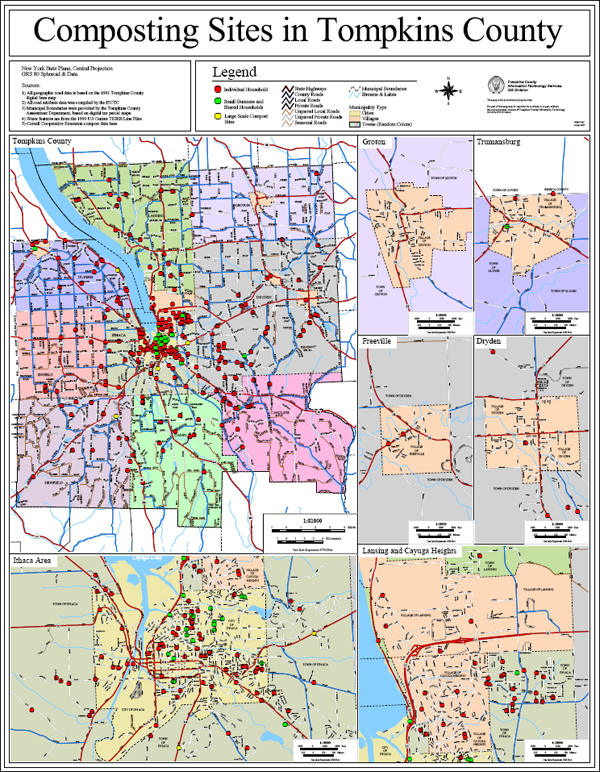
<p>The accompanying map shows a pattern of land use that conforms
to topography: the northern portion of the county, which is
composed of flatter land and relatively more of the better soils
for agricultural use, has a greater percentage of acreage in
cultivated cropland and pasture, while the southern, hillier
portion of the County is more densely wooded.</p>

<p><a href="/images/map.pdf"><img src= "/images/mapA.jpg" title="Click for larger PDF version"  alt="Tompkins County Map" /></a></p>

<h3>Organizing for Local Energy Production and Consumption of Biomass</h3>

<p>&ldquo;Eat your landscape&rdquo; implies sustainability.  A
bountiful landscape might continue to provide food over decades,
centuries, even millennia if it were properly managed and
husbanded. &ldquo;Burn your landscape&rdquo; has none of the
overtones of sustainability&mdash;it seems, rather, cataclysmic: a
landscape devoid of living things.</p>

<p>There are other options, however.  An actively managed forest
or hayfield can continue to produce biomass for combustion
purposes over a long period of time if attention to the ecosystem
allows for the return of depleted soil nutrients through ash
spreading and the building of fertility through support of various
plant and animal communities.  Woodlands actively managed for
sustainable harvest of woody biomass could provide plant and
animal habitat, sequester carbon, and produce some hardwood lumber
as well.  The key here is <i>the way in which natural resource
lands are managed.</i> Under some systems of management, carbon
sequestration and selection to impede the advance of invasive
species are optimized, creating a forest that is more hospitable
to native flora and fauna and more able to ameliorate the excess
atmospheric carbon than the previous unmanaged woodland.  However,
such management systems are not the most economically viable under
current market structures.</p>

<p>Current economic structures, if left unchecked, could cause
cataclysmic environmental damage as harvested biomass becomes less
costly than oil.  Clear-cutting woodlands, while devastating to
natural communities and water quality, is the cheap way to amass a
large tonnage of biomass in an area like Tompkins County. Utility
companies buy wood-chip tonnage to co-fire with coal from low
bidders, developing an industry built around mechanized, invasive
forest destruction.  Environmental regulation has proven to be a
weak tool for controlling industries that have a market incentive
to use forests or grasslands as a short-term, rather than
permanent, resource.  An example is the Catalyst Energy/Treesource
Solutions biomass aggregation facility in nearby Burdett, Schuyler
County, which is offering loggers one low price for biomass
tonnage to be used as wood chips to heat and power the US Salt
plant in Watkins Glen.</p>

<p>On an individual scale, landowners who use firewood for heat
are likely to take the long view of their investment in their land
and do their best to manage their woods to maintain sustained
production as well as multi-functionality (use of the woodlands
for additional purposes, such as wildlife habitat, hunting, nature
appreciation, privacy).  When surveyed, owners of rural acreage in
Tompkins County were amenable to seeing their underutilized
parcels of land produce an income stream&mdash;but very few had
either time or capital to devote to this.[9]</p>

<p>Several local initiatives in Tompkins County have sprung up to
test structures that might become a part of a third burning
transition here.  In the Town of Danby, landowners have come
together to market the biomass from their properties (as well as
potentially other land-based products) as a group. This
organization of owners of fallow fields and under-managed woodlots
is based on the producer-coop configuration that has been
successful in some agricultural areas.[10]</p>

<p>Another effort, spearheaded by Anthony Nekut, is intended to
draw together investors and entrepreneurs with the purpose of
developing a medium-scale pellet production facility in the
county.  Tony would like such a plant to have the capacity to
palletize both woody and grassy biomass, and he envisions both
local sourcing of biomass and local sales of pellets for home and
business heating. <i>[An article by Tony is scheduled for future
publication on tclocal.org.&mdash;Ed.]</i></p>

<p>A third approach to using biomass to supplant some of the
fossil fuels used for home heating in Tompkins County is Abbot
Development&rsquo;s initiative to develop Cornell University workforce
housing on a Danish-style district heating model, with a combined
heat and power plant as an integral feature of the development.
This plan is currently in concept development stage, but it could
easily be implemented if chosen by Cornell as the model for their
new housing development.  Again, the technology is available and
ready to use; it is the commercial market structures that require
some developmental attention to establish such a project in this
country.</p>

<p>A fourth local project focuses on commercial combined heat and
power along with a managed woody-biomass plantation scheme: RPM
Ecosystems, a Dryden company involved in the production of
fast-growing nursery stock for reforestation projects worldwide,
has worked with Congressman Michael Arcuri to obtain federal
funding for a demonstration project.  The project involves a
wood-fired combined heat and power plant that would provide heat
for the greenhouses and offices of the nursery along with
sufficient electrical power to operate the facility.
Additionally, plantations of RPM Ecosystems trees would be
established with a goal of producing some biomass along with some
hardwood lumber while maximizing forest canopy (and carbon
sequestration) throughout the growth and development of the tree
farm.</p>

<p>One approach that is not currently in evidence in Tompkins
County, but might be worth investigating, is the
&ldquo;CSE.&rdquo; CSE stands for &ldquo;Community Supported
Energy,&rdquo; and it is modeled on the successful CSA (Community
Supported Agriculture) structure.  This is something of a consumer
cooperative: energy consumers that would like to use local
resources to produce energy band together, and, through pooling
investment funds, establish critical mass to bring a production
facility on-line, which they pledge to support through their
energy purchases.  This model was first promoted by environmental
advocate Greg Pahl, and has been tried with some success in
Vermont.[11]</p>

<h3>Conclusion</h3>

<p>The above examples merely scratch the surface of possible
structures for relocalizing our heat and energy markets.  And the
traditional approach should not be ignored, either: use of
cordwood for home and business heating has increased markedly as
fossil fuel prices increase and can be expected to continue to
increase, particularly in rural areas of the county.  More people
now make a main business or a profitable sideline of harvesting
firewood, or buy less fossil fuel because they harvest some
firewood for their own use. Several local retail outlets and
service businesses sell and/or install combustion equipment, and
technology refinements have made cordwood burning cleaner and more
efficient than it was in the past.</p>

<p>A third burning transition&mdash;based on community development
and economic innovation&mdash;is needed if we are to avoid the
worst potential effects of global climate change and post-peak-oil
economic instability.  In the first burning transition, fire
changed humankind; in the second, humankind using fire changed the
world until disaster threatened.  In the third burning transition,
humankind must organize new structures of production and exchange
to socially contain the power that unlimited individual fire-use
unleashes on the world, to protect both the species and the
environment on which it depends.  In the future, the structures so
organized can be again transformed, in a fourth burning
transition, to non-carbon-based feedstocks such as the sun&rsquo;s
direct energy, geothermal heat, and wind and wave energy.</p>

<h3>Notes</h3>

<p>[1] &ldquo;Direct combustion&rdquo; refers to biomass burned as
a solid fuel, not a liquid or gas fuel product or fuel
additive.</p>

<p>[2] New York: Basic Books, 2009.</p>

<p>[3] Localized or regional deforestation should not be
underestimated in its capacity to decimate human, animal, and
plant communities, including driving some species to extinction.
It does not, however, represent a pattern of world-wide changes,
despite its severe impact on circumscribed areas.</p>

<p>[4] Cronon, William. <i>Changes in the Land, Revised Edition:
Indians, Colonists, and the Ecology of New England.</i> New York:
Hill and Wang, 1983.</p>

<p>[5] Biomass/ethanol/biodiesel schemes dependent upon
intensively cultivated food crops like soy or corn fail to break
the connection between the oil market and alternative fuel if a
system of petro-chemical input dependent agriculture is used.
They also raise grave ethical concerns, commonly referred to as
the &ldquo;food-fuel controversy.&rdquo;</p>

<p>[6] While current average distributional losses for electrical
energy are in the range of seven percent, biomass resources, like
solar resources, may be located at a greater distance from
urbanized areas than existing power plants, resulting in even
larger distributional losses or larger amounts of transportation
energy to move the raw material closer to the point of use.</p>

<p>[7] More on the international market volatility of wood pellets
is available in the <i>Renewable Energy World</i> magazine article
&ldquo;Time for Stability: An Update on International Wood Pellet
Markets,&rdquo; Feb. 4, 2008.  Available at <a
href="http://www.renewableenergyworld.com/rea/news/article/2008/02/time-for-stability-an-update-on-international-wood-pellet-markets-51584"
>http://www.renewableenergyworld.com/rea/news/article/2008/02/time-for-stability-an-update-on-international-wood-pellet-markets-51584</a></p>

<p>[8] See The Asset-based Community Development Institute at <a
href="http://www.abcdinstitute.org/"
>http://www.abcdinstitute.org/</a> or Wikipedia on Asset-based
Community Development at <a
href="http://en.wikipedia.org/wiki/Asset-Based_Community_Development"
>http://en.wikipedia.org/wiki/Asset-Based_Community_Development</a></p>

<p>[9] Cail, Krys. <i>Tompkins County Landowners Survey.</i>
Report for Cornell Cooperative Extension of Tompkins County on the
results of a mail survey of owners of large parcels of rural land
in Tompkins County undertaken by the Green Cities class of Cornell
University&rsquo;s City and Regional Planning Department in 2005.</p>

<p>[10] Begun as a project for Elizabeth Keokosky&rsquo;s masters degree
in City and Regional Planning at Cornell University, this
initiative has progressed to the point of establishing a local
steering committee and is in the process of drawing up
incorporation documents.</p>

<p>[11] Pahl, Greg. <i>The Citizen-powered Energy Handbook:
Community Solutions to a Global Crisis.</i> White River Junction,
Vt.: Chelsea Green Publishing, March 2007.  See also <i>Renewable
Energy World</i> magazine, &ldquo;Community-supported Energy
Offers a Third Way,&rdquo; Greg Pahl, March 12, 2007.  Available
at <a
href="http://www.renewableenergyworld.com/rea/news/article/2007/03/community-supported-energy-offers-a-third-way-47700"
>http://www.renewableenergyworld.com/rea/news/article/2007/03/community-supported-energy-offers-a-third-way-47700</a></p>
]]>
        
    </content>
</entry>

<entry>
    <title>Visioning County Food Production - Part Two: General Problem Areas in Sustainable Agricultural Design</title>
    <link rel="alternate" type="text/html" href="http://tclocal.org/2009/09/visioning_county_food_2.html" />
    <id>tag:tclocal.org,2009://16.5133</id>

    <published>2009-09-02T13:34:12Z</published>
    <updated>2009-09-03T01:52:52Z</updated>

    <summary>by Karl North In Part One of this series, I noted that providing for the local food needs of urban populations requires a design that integrates three overlapping categories of production systems: urban agriculture systems (many small islands of gardening...</summary>
    <author>
        <name>Simon St.Laurent</name>
        <uri>http://simonstl.com/</uri>
    </author>
    
    
    <content type="html" xml:lang="en" xml:base="http://tclocal.org/">
        <![CDATA[<p>by Karl North</p>

<p>In <a href= "http://tclocal.org/2009/07/visioning_county_food_producti.html" >Part One of this series</a>, I noted that providing for the
local food needs of urban populations requires a design that
integrates three overlapping categories of production systems:
urban agriculture systems (many small islands of gardening in the
city center), peri-urban agriculture (larger production areas on
the immediate periphery), and rural agriculture (feeder farms
associated with village-size population clusters in the hinterland
of the city but close enough to be satellite hamlets). In this
month&rsquo;s article, I will discuss four key issues that must be
addressed in order to envision these three systems: fertility,
energy, water, and pest control. But first, a word about the role
of species diversity in addressing these issues.</p>

<p>In an energy descent environment, agriculture that incorporates
the necessary diversity of species that are multifunctional
&mdash; providing both ecological and other services and food
&mdash; will gradually replace the current agriculture that
substitutes external inputs to solve these problems.</p>

<p>Some of the most durable and productive low input farming
systems in history are designed around animals that can accelerate
the growth and conversion of plants to fertilizer. Because they
are highly multifunctional, ruminant mammals rank highest among
these. Beyond their manure production function, they can consume
fibrous perennials unusable for human food. These perennials can
grow on hill land too rocky or too erodable for food
cropping. Used as work animals, ruminants multiply the energy
input from human labor many times. They provide a source of
concentrated protein food that can be conserved and stockpiled for
winter consumption. They provide hides and fiber for clothing as
well. Cattle, sheep, goats, alpacas, llamas and bison are
ruminants that we can most easily use in agricultural systems in
our environment.</p>

<p>A few other animals serve some of these functions and, properly
integrated, often are found enhancing these systems. Pigs and
poultry can do the hard labor of turning manure into compost, and
can thrive by consuming unused and pest species as well as waste
streams from farms and kitchens. They both can reduce a patch of
weeds to bare ground ready for planting, and pigs will perform
tillage as well. They will consume crop residues and garbage from
food preparation, and convert it to fertilizer as well as their
own production as food animals. Poultry will consume weeds and
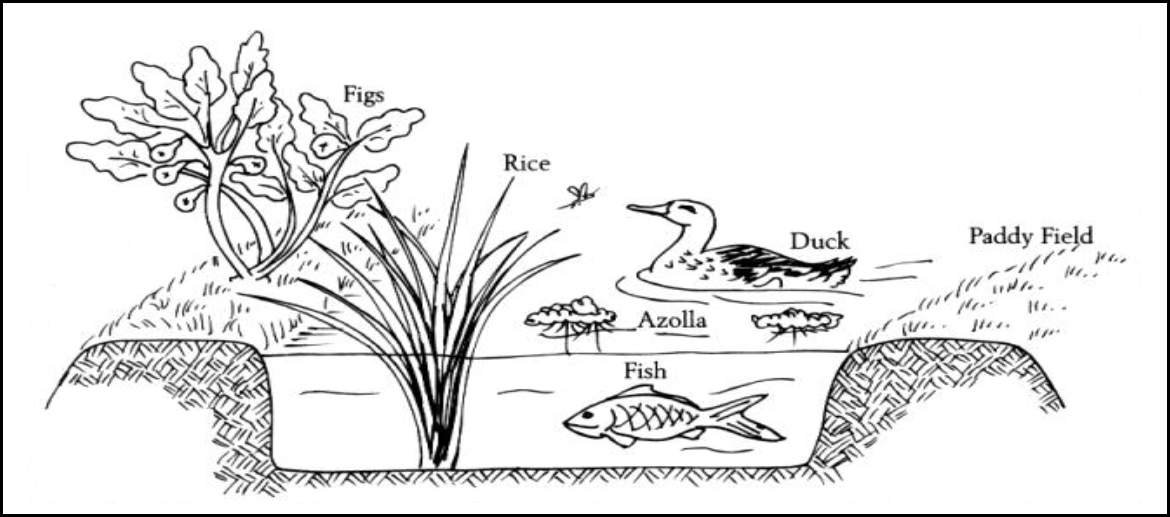
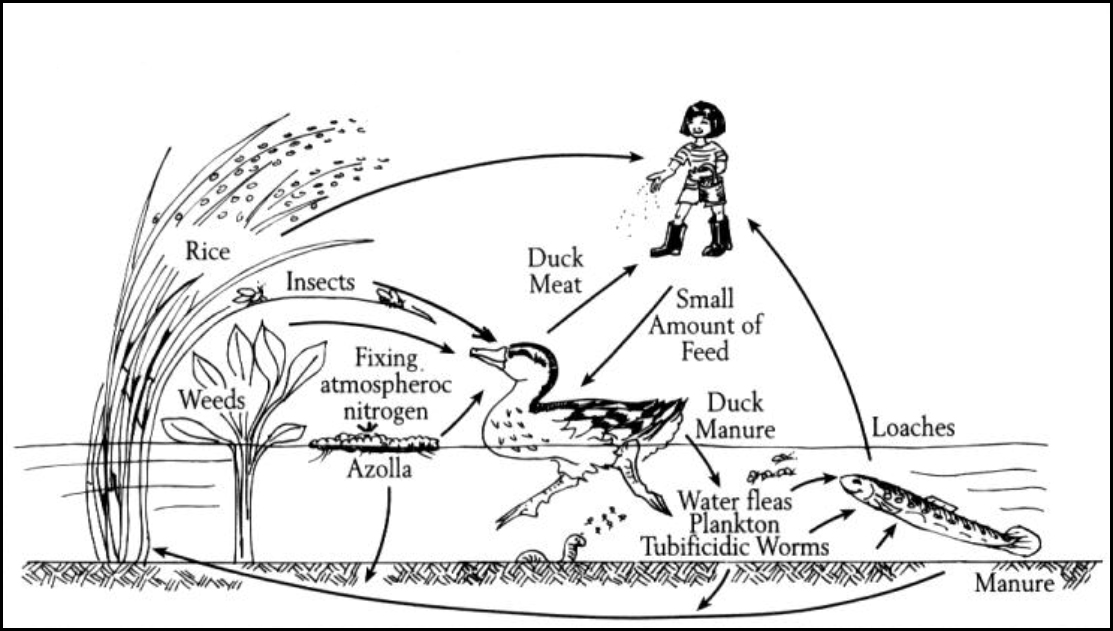
insect pests. Edible fish and other water animals like frogs and
snails can perform the same functions in aquatic systems. This map
of flows among components demonstrates the potential of integrated
systems (Figure 1). Notice that the flows may go in both
directions among all components:</p>

<img src="/images/dynamics.png">

<blockquote>
<i>Figure 1. Dynamics of a hypothetical sustainable system</i>
</blockquote>

<h2>1. Soil Fertility</h2>

<p>As energy descent deepens, two key fertility crutches of
industrial agriculture will become cost-prohibitive. Synthetic
nitrogen fertilizer production requires large quantities of
energy. The decreasing quality of phosphate deposits is already
driving up the price of phosphate fertilizer (up 700 percent in a
recent 14-month period) and production is estimated to peak within
20 years.[1] Moreover, the affordability of most off-farm sources
of fertility is derivative of cheap oil. But minerals essential to
farm fertility can be recirculated within farms or at least within
local food systems, and recirculation capacity will become
essential to sustainable design.</p>

<p><b>On-farm recycling.</b> Building high levels of soil organic
matter (SOM) will be central to agroecosystem design because SOM
is key to achieving not only fertility goals, but also healthy
water and mineral cycles, maximal photosynthetic energy capture
and use, and optimal biodiversity. Humid, temperate environment
soils are exceptional in their ability to store organic
matter. French scientist Andre Voisin demonstrated 50 years ago
that pulsed grazing (explained below) on permanent pasture is the
fastest soil organic matter building tool that farmers have, at
least in temperate climates like ours.[2]</p>

<p>The structural element historically proven to work best in
these environments is a grass/ruminant complex. This subsystem
works on the principle that manure from a portion of the farm
devoted to grazing animals will not only sustain the fertility of
their forage land, but generate a surplus that will sustain a
smaller acreage of annual crops (Figure 2). It can sustain
fertility well enough to have generated numerous historical models
around the world. The process was used in lowland northern Europe
and New England before the industrial age.[3] Cuban research into
its potential demonstrated the effective ratio of forage acreage
to support cropland fertility to be 3:1 in that environment. In
other words, the ruminant stock subsisting on three acres of
forage produced enough manure to sustain both the fertility of the
forage land and one acre of cropland. This conceptual model,
adapted for environmental differences, provides a basis for system
design here. Perhaps the most important design question for our
purposes is the ratio of forage to cropland that is sustainable in
our environment.</p>

<img src="/images/fertility.png">

<blockquote>
<i>Figure 2. Fertility subsystem conceptual model</i>
</blockquote>

<p>The full soil organic matter building process requires a design
focus on three crucial areas of the agroecosystem:</p>

<ul>

<li><p>Pasture management for a wide variety of productive,
palatable perennial forages, kept in a vegetative state (high
growth) by pulsed grazing (see below) throughout the growing
season to maximize biomass production;</p></li>

<li><p>Manure storage in a deep litter bedding pack under cover
during the cold season to maximize nutrient retention and
livestock health;</p></li>

<li><p>Conversion of the bedding pack to compost at a proper C/N
ratio during the warm season to maximize organic matter
production, nutrient stabilization, and retention;</p></li>

<li><p>Field application of the compost during the warm season as
well, to maximize efficient nutrient recycling to the
soil.</p></li>

</ul>

<p>Pulsed grazing is so important to the success of the soil
building subsystem that it warrants an explanation in some
detail. Pulsed grazing is a method of repeated grazing of paddocks
in a pasture that controls stock density and timing of stock
movement in and out of paddocks to maximize forage production over
the growing season. This in turn maximizes manure production to
build soil organic matter. Forage plants experience repeated
pulses of growth and removal of biomass, both above and below
ground, over the growing season. Key points :</p>

<ul>

<li><p>Stock enter a paddock before forage leaves its vegetative
stage and growth slows.</p></li>

<li><p>Stock leave a paddock while there is still sufficient
forage leaf area to jump-start regrowth.</p></li>

<li><p>Grazing causes forage roots to die back, which adds soil
organic matter from the dead root mass.</p></li>

<li><p>Stock return to the same paddock when leaf and root
regrowth have fully recovered vigor and abiity to recover from
another grazing.</p></li>

</ul>

<p><b>Recycling from Human Communities.</b> It should be clear
from the integrated model (Figure 1) that solving the fertility
problem must include repairing the broken nutrient cycle between
human excreta and the land. If this seems an insurmountable
challenge to modern urbanites, we need only recall from history
that whole societies including large cities have managed excellent
recycling of &ldquo;night soil.&rdquo; Among the numerous examples
is China, where until the 1950s, 98% of the fertilizer used to
grow food came from recycled and organic sources.[4]
Relocalization of food production is necessary to reduce the cost
of repairing the nutrient cycle. If Tompkins County exports milk
products to NYC, what will it cost to return the nutrients in the
exported milk to our farmland? In a more county-based food system,
methods for recycling humanure and other food garbage that are
appropriate to urban, peri-urban, and rural farming sites are more
feasible, and will be discussed in the sections devoted to these
production systems.</p>

<h2>2. Energy Capture</h2>

<p><i>Ancient</i> sunlight in fast-depleting, finite sources (oil,
gas, coal) presently supplies over 80% of the energy used in the
industrial form of agriculture that produces most of the food
consumed in the United States. Natural ecosystems consist of food
chains supported entirely by <i>current</i> sunlight, so it is
easy to design farming systems to work the same way, as was done
through most of agricultural history. Solar energy that is
accessible directly on farms comes in forms that are far less
concentrated than the fossil fuels that we are used to. Therefore
we need to design farms that can be productive on far less
energy. The challenge is to capture solar energy in as many places
as possible as it flows through the agroecosystem.</p>

<p>The carbon cycle is an important way solar energy flows through
our world. All metabolic processes in agriculture and other
biological systems release carbon to the atmosphere. Tillage that
stimulates activity in the soil food web, animal and human
digestion and composting are examples. But criticism of these
processes as feeding greenhouse gas build-up is mistaken. Biomass
conversion to food, fertilizer, or fuel is carbon-neutral over
time because its emissions, unlike those of fossil fuels, are part
of the biospheric carbon cycle. The important question here is how
to manage the carbon cycle to maximize long-term levels of soil
carbon sequestered as soil organic matter.</p>


<p><b>Animal Power.</b> Currently (2009) people tend think of
solar capture in terms of relatively high technologies like those
that convert wind and sunlight to electricity. Working models
exist of homesteads and even farms that are self-sufficient in
electricity using small-scale equipment of this sort. However,
most analyses of economic viability related to wind/solar
electricity production at any scale are based on current costs in
the manufacture and maintenance of these systems, all of which
still rely on cheap oil. These analyses fail to account for
already exponentially rising costs in raw materials and production
of the equipment. All production costs of such technologies will
rise in parallel with sharply increasing energy costs as the
fossil fuel era declines. Like oil, many raw materials used in
these technologies are finite resources already on the downside of
their historical production curve; they will become unaffordable
for many uses in the future. In sum, the window of opportunity
that makes these alternative energy technologies approach economic
viability now may close in the future as costs begin to rise more
sharply. A 10kw wind-electric rig that can power a small farm
costs about $70,000, and is usually economically unfeasible even
today without subsidies. What will it cost after 15 years of
rising manufacturing costs? What will it cost to replace it after
its 20-30 year lifetime?</p>

<p>However, there are ways of powering farm production that are
more reliably sustainable. Just as the same breeze or brook
flowing through a community might be tapped at a number of points
for wind or hydropower to run a mill or pump water, solar energy
can be captured to produce food or fuel by inserting species
appropriately into the farm food chain. Apart from wind and
flowing water, solar energy enters the farm ecosystem via
photosynthesis in green plants, and flows through the system as
one species feeds on another. Large herbivores tap immediately
into this chain by feeding on plants that are too fibrous for food
use. While they may produce food and fertility as previously
described, they will do double duty as work animals in the future,
thus replacing no longer affordable fossil-fueled machine labor.
</p>

<p>Fields that grow the forages that support work animals and
other grazing and foraging species will not compete with
cropland. On the contrary, forage fields will provide an essential
ecological service as the permanent cover necessary to sustain
soil health on all sloping land. Present hillside cropland is
always eroding and will be revealed as unsustainable when the
crutch of cheap synthetic fertilizer is no longer available. This
means that land use plans in hill country like ours will need to
include a mosaic of hillside forage land and relatively flat
cropland. Unless terraced, the hillsides will be most erosion-free
and productive when planned to mimic natural tree-dotted savannas,
as hay/pasture that includes fruit and nut orchards, for
example. The trees themselves will be multi-functional, producing
food or forage, improving the cycling of soil nutrients, providing
windbreaks, and shading the grazing animals.[5]</p>

<p>Integrated as described here, draft animals like oxen, mules,
and horses will optimize the health and productivity of the
agroecosystem.</p>

<p><b>Biofuels.</b> Energy for winter heating and for cooking is
almost as important as food production for survival in these
latitudes. As much as possible of that energy should come directly
from the sun, as in passive solar designs for both heating and
cooking. But rural land use will need to reflect increasing local
dependence on firewood for the rest. Sustainable forest
management and harvest will again become a significant share of
rural agricultural production, but serving local urban and village
communities not faraway paper mills. Forest conservation and
reforestation should start with places that need to be forested
for additional reasons, like ridge tops that protect water
catchments, and hedgerows that serve as shelterbelts and browse
for livestock.</p>

<p>Production of most other biofuels at any significant scale has
been criticized as unsustainable on many counts. One that may
prove sustainable is small-scale biogas generation on farms,
because it extracts methane from some of the farm&rsquo;s normal manure
production before it continues in the farm&rsquo;s nutrient cycling
loop, as in Figure 1. Most attempts at biogas generation on US
farms have been large-scale, high-technology projects aimed at
fixing the pollution problem caused by industrial scale dairy
farming. So far, farmer adoption of the expensive and complex
equipment has been poor, despite subsidies. Meanwhile, small scale
biogas generators aimed at producing light and cooking fuel in
Third World peasant communities have proliferated, because they
cost as little as $30.[6] Biogas production requires no separate
biofuel crop that might compete with food production, or
inefficient distillation process. For these reasons biogas
production at an appropriate scale merits consideration as a way
of capturing solar energy as methane fuel for limited use on farms
and perhaps even surrounding communities.</p>

<h2>3. Water Capture and Use</h2>

<p>We live in a climate that is wet yet subject to droughts during
the growing season. High productivity food production requires a
constant water supply to cover these gaps. Maximizing
productivity in the small areas devoted to urban agriculture is
especially important, because of their high value in a relocalized
food system. Sufficient water falls on urban areas and needs to be
conserved there. Barrels can catch only a fraction of roof runoff,
and will not be enough for the irrigation needs of a successful
urban and peri- urban agriculture. Small water catchment ponds
must become a normal part of both the public and residential urban
landscape. Pavement runoff will need to be directed to the larger
ponds, which might be located in parks and community gardens.</p>

<p>Rural agriculture will need more extensive water capture plans
to hold and use water for farms and whole watersheds. Such a
system should be gravity feed system, in order to avoid the
increasingly high cost of pumping. An example is the keyline plan
that traps some surface water in upper fields and directs the
excess into strategically located irrigation ponds.[7]</p>

<p>Our irrigation needs in New York may be intermittent but still
will require a lot of pipe and other delivery hardware when scaled
up to cover all food production land. Rising costs of current
irrigation delivery systems may become a limiting factor, forcing
the invention of ones that use cheaper materials. This has been
the experience in Cuba, whose year-round agriculture is heavily
dependent on irrigation. Cuba&rsquo;s artificially triggered
&ldquo;peak oil&rdquo; experience has been a bellwether and a
source of lessons for the rest of the world.</p>

<p>Ponds will be needed to serve numerous purposes, as in Figure
1. Basins to process biodigester outflow and other organic liquid
waste can grow algae and duckweed for animal feed, and then feed
the cleansed water into ponds for fish and other aquaculture, as
in Figure 3. They will attract aquatic life including species
useful for garden pest control, and enhance human quality of life
as they beautify places and improve microclimates.</p>

<img src="/images/mbtchart.png">

<blockquote>
<i>Figure 3. Facilities for bioconversion using the
UNU/IAS integrated biosystem at Montfort Boys Town, Suva, Fiji</i>
</blockquote>

<p>Wetlands abound in New York and are among the most productive
natural ecosystems. Because of their natural potential, they can
be harnessed for highly productive agricultural use yet be managed
to retain much of their natural function. Historical and
contemporary models include wetland systems that fed older
civilizations from the Aztecs to the Incas in Latin America, as
well as many parts of Southeast Asia today. Typically, as in the
Aztecan systems known as chinampas, farmers cut canals through the
wetland and use the soil to create beds raised above the water
level for agricultural use. The canal system is designed to allow
the water control that keeps the raised beds well watered without
being subject to undesirable flooding. Because of the ubiquitous
water, these wetlands are highly productive as both agricultural
and aquacultural systems. They produce so much biomass that they
tend to maintain their own fertility, dredged from the decomposing
detritus in canal bottoms.</p>

<p>One such wetland, adapted from lowland English agriculture,
became the core of a highly sustainable agricultural system that
supported the population of colonial Concord, Massachusetts for
many generations.[8] The Great Meadow that traversed the village
and all other nearby riverine flood plains was a swamp commons
that was first flooded to deposit silt, then partly drained and
reserved for pasture and hay as it dried out during the growing
season. As in parts of Europe, these well-watered riverine meadows
produced enough livestock feed, livestock, and manure to sustain
the fertility of the adjacent dry lands devoted to tillage
agriculture. Figure 4 shows that already by 1650 careful
allocation of land use had taken place on a functional level to
sustain the whole system. Historical models like these suggest
that we will want to regard modified wetlands as an important
agricultural asset in the energy descent era.</p>

<a href= "/images/meadow-hires.png" ><img src="/images/meadow.png"></a>

<blockquote>
<i>Figure 4. Concord, Massachusetts, 1652. From</i> The Great
Meadow: Farmers and the Land in Colonial Concord.
</blockquote>

<h2>4. Pest Control</h2>

<p>From a systems perspective, pest problems are
&ldquo;structural,&rdquo; hence best addressed by system design
rather than treatment with pesticides. In this section I will
summarize two main strategies addressed in order of importance: a
focus on the food species themselves, and then the layout of the
physical and biological environment as it affects these food
species.</p>

<p>Much as health care in humans requires preventive medicine, we
must grow healthy plant and animal species as a first step in pest
control. A primary structural problem is the genetic
industrialization of most agricultural plant and animal species,
which was gradually achieved in modern times by breeding processes
that prioritized productivity and short-term profit over other
genetic traits, like hardiness. Moreover, relying on pesticides,
even &ldquo;natural&rdquo; ones, to protect these weakened subspecies
inevitably fails over time because pests gradually adapt to
conditions and treatments that become heavy- handed and
routine. An example is parasite resistance in sheep, which has
been neglected and lost. The resulting industrial breeds must be
medicated so often that the parasites are gradually becoming
immune to most medications. To be sustainable, food production
systems will need to return to varieties and breeds that, while
sometimes less productive, have more genetic defenses. By genetic
selection farmers can rebuild hardiness in industrial breeds as
well.</p>

<p>The design of alternative environments uses three general
strategies of pest control: luring or driving them away with trap
or repellent species or physical barriers; creating species and
habitats that attract &ldquo;beneficials,&rdquo; species that prey on pests;
and continually altering the environment with crop and animal
rotations that shift them away from pests.</p>

<p>This last strategy points up a characteristic of the natural
world that needs to be taken into account: it is always
evolving. In the long run this means that pest control strategies
can never be permanent, but must always be evolving to stay a step
ahead of pests as the latter adapt to current controls. The
downfall of industrial pest controls is their heavy- handed
strategy of total pest elimination and routine
medication. Ironically this creates the environments most
conducive to genetic evolution in pest organisms toward immunity
from controls.</p>

<p>Recourse to medicinals and other treatments is a strategy of
last resort, indicating a design failure in the production system,
which must be addressed.</p>

<h2>Conclusion</h2>

<p>From the foregoing it seems clear that life after fossil fuels
will demand much reorganization of food production. To create a
local agriculture that feeds the county, the map of rural and
urban land use will change dramatically. In the countryside,
wetlands and floodplains, hillsides, flatlands, and woodlands will
have specific uses designed to maximize while sustaining the
productivity of whole agroecosystems. Essential rural land use
components might be:</p>

<ol>

<li><p>Hillsides in forage land sufficient to support cropland
fertility.</p></li>

<li><p>Flatlands in crop rotations.</p></li>

<li><p>Wetlands and floodplains development and water management
for high forage or crop production.</p></li>

<li><p>Sufficient forest for county firewood and basic
construction needs, managed for maximum regenerative capacity,
which requires fencing out livestock. Woodland regenerative
capacity equaling 1 cord/acre/year is a common rule of
thumb.</p></li>

</ol>

<p>Many uses of city land will no longer be economical in the
coming years. Land will need to be converted to food production
and its supporting functions, like composting and water
conservation. Prime candidates for conversion are the commercial
strips now inhabited by national corporate chain stores. Private
and public parking lots, which energy descent writer William
Kunstler sees as soon-to-be-dysfunctional &ldquo;missing teeth in the
urban fabric,&rdquo; are another example. During Cuba&rsquo;s artificially
triggered encounter with &ldquo;peak oil,&rdquo; public interest dictated that
a better use of resources was to raze ageing buildings to create
urban garden space, rather than to restore them.</p>

<p>In the integrated system approach described here, the functions
of plants and animals will undergo marked changes. The functions
of many species to facilitate tight nutrient cycling, labor, and
other services that underpin the health of the whole
agroecosystem, will become more important. In the case of some
animals, these functions will become primary, and food production
will become a secondary function, with numbers of animals on farms
directed to their primary functions. The result will be a general
production system model that aims for maximum sustainability,
remains within the carrying capacity of the natural resource base,
and within that framework, feeds the maximum number of people per
acre of land used.</p>

<h2>Notes</h2>

<p>[1] <i>Peak Phosphorus: The Sequel to Peak Oil</i>
<a href= "http://phosphorusfutures.net/index.php?option=com_content&task=view&id=16&Itemid=30" >http://phosphorusfutures.net/index.php?option=com_content&task=view&id=16&Itemid=30</a></p>

<p>[2] Voisin, André. <i>Grass Productivity,</i> 1959 (English
translation in 1988). Island Publishers, Washington, D.C.,
U.S.A.</p>

<p>[3] Donahue, Brian. 2004. <i>The Great Meadow: Farmers and the
Land in Colonial Concord.</i> New Haven:Yale University Press.</p>

<p>[4] <a href= "http://www.fairviewgardens.org/pub_next_frontier.html" >http://www.fairviewgardens.org/pub_next_frontier.html</a></p>

<p>[5] North, Karl. 2008. Optimizing Nutrient Cycles with Trees in
Pasture Fields. <i>LEISA Magazine,</i> 24 (2), March
2008. <a href= "http://www.ileia.org/index.php?url=magazine-list.tpl&p[source]=ILEIA" >http://www.ileia.org/index.php?url=magazine-list.tpl&p[source]=ILEIA</a></p>

<p>[6] Preston, T.R. 2005. Biodigesters in Ecological Farming
Systems. <i>LEISA Magazine,</i> 21 (1), March 2005. Also:
<a href= "http://www.ruralcostarica.com/biodigester.html" >http://www.ruralcostarica.com/biodigester.html</a></p>

<p>[7] <a href= "http://www.keyline.com.au/ad1ans.htm" >http://www.keyline.com.au/ad1ans.htm</a></p>

<p>[8] Donahue, <i>op. cit.</i>]]>
        
    </content>
</entry>

<entry>
    <title>Visioning County Food Production - Part One: Introduction</title>
    <link rel="alternate" type="text/html" href="http://tclocal.org/2009/07/visioning_county_food_producti.html" />
    <id>tag:tclocal.org,2009://16.5127</id>

    <published>2009-07-26T03:32:13Z</published>
    <updated>2009-07-26T03:57:11Z</updated>

    <summary><![CDATA[by Karl North Editor&rsquo;s Note: This article is the first in a three-part series. Part 2 will appear next month. In this paper I will attempt a preliminary vision of a relocalization of food production designed to feed the population...]]></summary>
    <author>
        <name>Simon St.Laurent</name>
        <uri>http://simonstl.com/</uri>
    </author>
    
    
    <content type="html" xml:lang="en" xml:base="http://tclocal.org/">
        <![CDATA[<p>by Karl North</p>

<p><i>Editor&rsquo;s Note: This article is the first in a
three-part series. Part 2 will appear next month.</i></p>

<p>In this paper I will attempt a preliminary vision of a
relocalization of food production designed to feed the population
of Tompkins County. A project of this scope implies a
reorganization of food processing and distribution that, while not
included in this first iteration, will need to be integrated in a
later, expanded overview.</p>

<p>My purpose is to explore the kind of local food system that
will be needed as this country faces sharply lower access to the
energy sources on which our present industrial form of agriculture
and food economy heavily depends. I will describe the types of
local farming enterprises, farming methods, resources, and land
use needed to confront a future of much lower energy use. A
documented baseline assessment of current food production and
county resources is not an objective of this essay, but will be
essential to a detailed planning effort. The picture presented
here is intended to be general enough to be useful in planning the
relocalization of foodsheds that include an urban center the size
of Ithaca, New York.</p>

<p>In these first few pages, I will set out my premises and
theoretical points of departure in some detail to explain the
fundamental changes in perspective I think are necessary to
envision how and where we produce food in the future.</p>

<p>This vision will rely on several critical premises:</p>

<ol>

<li><p>The premise underlying all work of TCLocal is that a
permanent decline in the availability and affordability of liquid
fuels and related rising costs of all energy sources will
inevitably lead to much lower energy use and increasing importance
of local scale in human affairs. The present long-distance food
economy will shrink, and consumers will need to rely increasingly
on local food production.</p></li>

<li><p>This &ldquo;energy descent&rdquo; will force the
transformation of food production toward low external input
systems that rely more on human labor and models of healthy,
highly productive ecosystem processes common in nature instead of
the high energy cost technological substitutes on which
agriculture, including most of organic agriculture, depends
today.</p></li>

<li><p>Our world is systemic in nature (parts are more or less
connected), and this has important implications for attempts to
change it. Problems we want to solve are, as the system analysts
like to say, &ldquo;structural,&rdquo; and require intervention in
several places. So the single-issue approach to any kind of change
is eventually bound to fail to meet expectations. For example,
dieting to solve weight problems never works for long if the
problem lies in the structure of our life. In addition to changing
what we eat, maybe trading the car in on a bike and some tools to
dig the lawn into a vegetable garden would produce better
results. <!-- By itself, widening Ithaca&rsquo;s commuter feeder roads
like Route 13 will not solve the traffic problem; the improved
highway only attracts more cars. But it might succeed if coupled
with a county tax on car ownership, a tax hefty enough to pay for
major improvements in public transportation. This would be
intervention in the very &ldquo;structure&rdquo; of the county
transportation system. --></p>

<p  style="margin: 10px; float: right; width: 400px; "><a href="http://tclocal.org/images/cause-effectB.png"><img title="click for larger image" src="http://tclocal.org/images/cause-effectA.png" alt="dominoes come around" width="400" /></a></p>

<p>Moreover, despite best intentions, in a systemic world we can
never make just the one change we aim for. Complex systems are
squishy like a balloon: squeezing just one end only makes the
balloon blow out in other unexpected places. Change agents need a
holistic approach that recognizes that consequences of any
interventions are multiple ripple effects that go distant in space
and time. This approach has important implications for design at
every level of scale.</p>

<p>At the garden or farm scale we want to build in
<i>multifunctionality,</i> where parts of the system serve more
than one purpose. Plants and animals that provide food, for
example, may also provide ecological services necessary for the
health and productivity of the whole. Ecological services are the
benefits arising from the functioning of the ecosystem, in
contrast to purchased inputs.</p>

<p>At the level of the <i>food system,</i> where different
elements of production, processing, and distribution can be
designed as a cooperating whole, we need to build in
<i>complementarity</i> as to what is produced, and services that
are shared among the different types of production units to be
described in this paper. Urban gardens may best serve the county
food system by growing fresh produce, thus complementing rural
farms that produce less perishable foods, for example.</p>

<p>At the community level, we need to view the reorganization of
the food system as affecting and affected by the reorganization of
all other infrastructure and institutions impacted by reduced
energy availability, e.g., industry, housing, markets,
transportation, sanitation, information flow, knowledge
production, etc.</p>

<p>Most important from a systems perspective, we need to regard
far-reaching changes like those to be proposed here as
experimental, and track for unintended consequences in time and
space. This approach, known to ecologists and other systems
thinkers as <i>adaptive management,</i> requires constant
monitoring and replanning in the face of uncertainty about
consequences.</p>

<li><p>The design of a relocalized agricultural system will need
to address root causes. For example, the <i>proximate causes</i>
of flooding may be failed riparian buffers and levees, but the
<i>root causes</i> are pavement, bare ground, and other surfaces
that create surface run-off, soils compacted and depleted of
water-holding organic matter, agricultural field drains, and
channeling that cuts streams and rivers off from their historic
flood plains. Attention to root causes forces the need for the
systems perspective outlined in premise #3. If, from the viewpoint
of sustainability, high-input, oil-dependent agriculture is now
revealed to be a design failure from the outset, little is gained
by piecemeal solutions like replacing chemical inputs with

&ldquo;natural&rdquo; ones. Rather than the input substitution
approach, efforts are better directed toward whole agroecosystem
design that integrates a diversity of spatial and temporal
elements.</p></li>

</ol>

<p><b>Understanding Sustainability.</b> In addition to working
from the stated premises, I want to ground the proposals in this
visionary project in a working concept of sustainability based on
ecological science. This is important at this historical juncture
for a couple of reasons. The common practice of confusing and
conflating sustainable agriculture and organic agriculture will be
counterproductive in the coming era when shrinking access to cheap
energy will reveal the unsustainability of most current forms of
agriculture, including organic. The flowering of the organic
farming movement, in which I have been a practitioner for 30
years, generated much innovation that will be useful in coming
years. But it also produced the delusion of a luxury version of
sustainability, because it occurred in and was shaped by an era of
cheap oil. Limited by economic forces and a focus mainly on
environmental issues, organic farming became more a matter of
substituting &ldquo;greener&rdquo; inputs for those of industrial
agriculture rather than seeking input independence through
systematic redesign. Awareness that many of the
&ldquo;greener&rdquo; inputs depend on fast-depleting, often
finite, soon-to-become-expensive resources still has not
penetrated the organic movement sufficiently to become a paramount
concern. A common practice in organic vegetable farming, for
example, is to import fertility in the form of compost from
factory-style dairy and poultry farms.</p>

<p>None of the above should be construed as an attack on the
organic farming movement, or a dismissal of its contributions to
the development of a truly sustainable agriculture. But we need a
more rigorous design tool than &ldquo;organic&rdquo; to select
from those offerings.</p>

<p><i>Sustainability means that local food production systems must
support the food and fiber needs of a given human population
without exceeding their carrying capacity (CC).</i> A working
definition of CC might be <i>the maximum indefinitely supportable
ecological load of an ecosystem or area.</i></p>

<p>We must be clear about what constitutes a <i>supportable
ecological load.</i> Depletion of a finite resource like copper or
phosphorus is not supportable unless we find a way to perfectly
recycle as much of it as is needed (not downcycle it as in plastic
bags --> park benches --> landfill). Petroleum products used for
fuel are not recyclable, and anything needing those fuels in its
production is therefore unsustainable. The supportable load on
renewable resources on which we depend is limited to their refresh
rate. The rate at which a farm consumes soil organic matter
depends on the capacity of the agroecosystem to rebuild it. Less
evident, but perhaps ultimately most important,is the load of work
we place on natural systems to absorb concentrations of substances
and handle imbalances that we create. That load can become
insupportable, either because it becomes too great or because we
weaken the ability of natural systems to do the work.</p>

<p>In short, the success and survival of all human activity rests
on and must be subordinate to the continuing health of the natural
resource base and the ecosystems that underpin it. Encapsulated in
the phrase, &ldquo;Mother nature bats last,&rdquo; this means that
any sacrifice of ecological health to advance human affairs
eventually results in losses to society. Economic profit gained in
the short term at the expense of the natural resource base and its
health leads inevitably to economic loss in the long term.</p>

<p>The CC of a specific farm or regional landscape at a given
historical moment may have eroded far below its
potential. Industrial agriculture has indeed damaged the CC of
much of the agricultural resource base. At present, technological
props based on cheap oil have created a temporary, artificially
higher CC that ecologist William Catton called &ldquo;phantom
carrying capacity.&rdquo;[1] Continued belief in this phantom can
prolong the overshoot and erosion of real CC long enough to cause
the population to collapse. Our present food system is operating
at phantom CC. This is due to a level of agricultural productivity
that is temporarily and artificially high because it relies on
fossil fuels and other raw materials that are finite and fast
depleting. Over 80 per cent of the energy on which our food system
runs comes from oil.  In practical terms this means that we are
feeding more people than is sustainable (at least on a global
basis), because human populations have ballooned in response to
rising food production. Equitable food distribution is an
essential response to the problem but is ultimately insufficient
unless agriculture itself can be organized on a sustainable
basis.</p>

<p  style="margin: 10px; float: right; width: 400px; "><a href="http://tclocal.org/images/overshootB.jpg"><img title="click for larger image" src="http://tclocal.org/images/overshootA.jpg" alt="overshooting carrying capacity" width="400" /></a></p>

<p>On the other hand, human intervention can often rebuild CC and
possibly improve it somewhat. Effective agroecosystem design can
improve farm sustainability, for example, by building in
sufficient species diversity to provide necessary farm inputs and
ecological services &ldquo;for free&rdquo; to replace
unsustainable external inputs to farms.</p>

<p>Finally, &ldquo;needs of a given human population&rdquo; is a
slippery term, the definition of which varies widely from one
culture to another. We need to ask: How much material consumption
does our quality of life really require? In regard to food, does
discretionary consumption exist which, if reduced, could allow
agriculture to feed more people?</p>

<p>Despite the complexity of these questions, thinking about
sustainable design to respect carrying capacity has effectively
focused the attention of ecological scientists on maximizing the
long-term health of four interrelated ecosystem processes in
agroecosystems:</p>

<ol><b>

<li><p>The mineral or nutrient cycle</p></li>

<li><p>The water cycle</p></li>

<li><p>The energy flow</p></li>

<li><p>The structure and interactions of the biological
community</p></li></b>

</ol>

<p>A focus on these four processes leads to the development of
principles or attributes of sustainable agroecosystem design
intended to maintain, or in many cases regenerate, the health of
these ecosystem processes. Some of the widely accepted principles
and their implications are:</p>

<ul>

<li><p><b>Low external inputs</b> &mdash; Input
self-sufficiency.</p></li>

<li><p><b>Low emissions</b> &mdash; Closed nutrient and carbon
cycles that avoid losses of valuable resources that eventually
cause environmental damage.</p></li>

<li><p><b>Stability &ndash; Resilience &ndash; Adaptive
Capacity</b> &mdash; These qualities of sustainability are all
necessary, but since they exist somewhat in tension, there must be
balance among them. Stability is the quality that produces
reliable results and minimizes risk, but in excess, stability can
become rigidity. However, a certain flexibility is required for
resilience, which is the ability to rebound from sudden change
like a dry period in the farming season. Adaptive capacity to
respond to slower changes like a gradually invasive plant disease
also requires flexibility. Reserves of material or energy,
overlaps, redundancy, or other slack in a system provide that
flexibility, but at the price of efficient use of
resources.</p></li>

<li><p><b>Knowledge intensity</b> &mdash; Reliance on technologies
that are powerful but derivative of a narrow, specialist knowledge
base will give way to a broader, more demanding knowledge of farms
as complex ecosystems of interdependent species, a knowledge that
enables the creation of biodiversity to capture synergies, to
biologically control pests, for example.</p></li>

<li><p><b>Management intensity</b> &mdash; Farming for input
self-sufficiency and low emissions will require more labor devoted
to management planning and monitoring to replace other resources
or use them more efficiently to maximize sustainable yield:
productivity per acre.</p></li>

<li><p><b>Local food self-sufficiency and national food
sovereignty</b></p></li>

</ul>

<p>These principles fit well with the design imperatives of a
future marked by gradual loss of sources of cheap energy. Aimed at
maximizing the ecosystem processes described before, these design
principles will guide the visioning effort.</p>

<p>The visioning process will draw on several main resource
areas:</p>

<ul>

<li><p>Known principles of agroecology and their relation to the
concept of sustainability as outlined above;</p></li>

<li><p>Historical knowledge of how production was achieved before
the era of cheap energy and other inputs &mdash; as late as the
early 20th century in some locations;</p></li>

<li><p>Subsistence and semi-subsistence farming systems in
agrarian communities on the periphery of the global industrial
economy, which have managed to escape the imprint of the current
system;[2]</p></li>

<li><p>Contemporary models of large-scale conversion from
industrial agricultural systems to localized, low input
agricultural systems as in Cuba,[3] the resources of the
Permaculture[4] and Transition Towns[5] movements, and some of the
more sustainable design efforts to develop very low external input
systems in the organic agriculture movement.</p></li>

</ul>

<p>From these resources I will attempt to extract and introduce a
set of general food production system design strategies that
follow principles already outlined above. Many of their elements
have in common the goal of designing for food and other species
that are multifunctional, delivering ecological services presently
provided by the external inputs in our industrialized food system
that will become prohibitively expensive in the future. Elements
of these food system design strategies include:</p>

<ol>

<li><p>Integration of crops and livestock</p></li>

<li><p>Animal, human- and small-scale wind, hydro, and solar as
the primary energy sources of agricultural production</p></li>

<li><p>Perennial crop polycultures, in particular,perennial
carbohydrate crops(nutritionally, hazelnuts can be seen as
equivalent to soy, chestnuts as an equivalent to corn)</p></li>

<li><p>Perennial forage polycultures under intensive management
(variations on an interdependent triad: grasses for bulk, legumes
for nitrogen, deep-rooted broad-leaf forbs for minerals)</p></li>

<li><p>Agroforestry and sylvopastoralism</p>

<ol type="a">

<li><p>Alley cropping/grazing within perennial
polycultures</p></li>

<li><p>Terracing, or return of perennials to erodable
slopes</p></li>

</ol></li>

<li><p>Intensive water management: capture and distribution
swales, rooftop capture, microclimate creation, ponds and filter
wetlands for storage, nutrient processing and aqua-ecosystem
development</p></li>

<li><p>Extended growing season and harvest technologies</p></li>

<li><p>Intensive nutrient management</p>

<ol type="a">

<li><p>Repairing and tightening broken and leaky nutrient cycles:
food = waste = food</p></li>

<li><p>Rotations that manage nutrient capture and use</p></li>

</ol></li>

<li><p>Intensive bed growing</p></li>

<li><p> Biocontrol of pests: pest predator production and
habitats, trap crops</p></li>

<li><p> Plant families designed for symbiosis</p></li>

<li><p> Stacked species for sunlight capture or shade or wind
protection: vertical plant growth &mdash; vine crop fences,
espalier</p></li>

<li><p> Cooperative management: neighborhood and community
gardens, revival of the commons</p></li>

</ol>

<p>Historical models of energy-efficient foodsheds that include an
urban population suggest the need to design a whole that
integrates three somewhat overlapping categories of production
systems:</p>

<ul>

<li><p><b>Urban agriculture</b> &mdash; many small islands of
gardening in the dense city center</p></li>

<li><p><b>Peri-urban agriculture</b> &mdash; larger production
areas in the immediate periphery</p></li>

<li><p><b>Rural agriculture</b> &mdash; feeder farms associated
with village-size population clusters in the hinterland of the
city but close enough to be satellite hamlets</p></li>

</ul>

<p>The design of each type of system will vary depending on its
available resources, its appropriate role in feeding the county
population, and its input support function for the other
production categories. In parts two and three of this paper I will
describe some general sustainable design considerations, and then
build on them to offer a vision of each of these three food
production systems. My effort is intended to build on earlier
TCLocal articles relating to land use and food production.[6]</p>

<p> It bears pointing out that the reintegration needed to
transform</p> our food system will force the solution to some of
our society&rsquo;s worst problems.  In addition to better food
quality, the reduction of agricultural and other pollutants, and
an increase in food security, the changes required for truly
sustainable food production will rebuild community and begin to
mend what Engels and Marx called the &ldquo;metabolic rifts&rdquo;
in both our farms (e.g., broken nutrient cycles) and our
communities (e.g., the broken connection between city and country,
man and nature). These systems thinkers saw that the notion of
metabolism that in biology refers to chemical processes and
transactions essential to maintain life has its counterpart in
ecosystems and social systems.</p>

<p><b>NOTES</b></p>

<p>[1] Catton, William R. Jr. <i>Overshoot: The Ecological Basis
of Revolutionary Change.</i> Urbana and Chicago: University
of Illinois Press, 1982.</p>

<p>[2] Bennholdt-Thomsen, Veronika, and Maria Mies. <i>The
Subsistence Perspective: Beyond the Globalized Economy.</i>
London: Zed Books, 1999.</p>

<p>[3] Funes, Fernando et al. <i>Sustainable Agriculture and
Resistance: Transforming Food Production in Cuba.</i> Oakland:
Food First Books, 2002.</p>

<p>[4] Mollison, Bill. 1997. <i>Permaculture: A Designer&rsquo;s
Handbook.</i> Tyalgum, Australia: Tagari Publications, 1997.
Examples: <a
href="http://www.youtube.com/watch?v=Bw7mQZHfFVE&NR=1"
>http://www.youtube.com/watch?v=Bw7mQZHfFVE&NR=1</a></p>

<p>[5] Hopkins, Rob. 2008. <i>The Transition Handbook.</i> White
River, Vermont: Chelsea Green Publishing, 2008.</p>

<p>[6] For a list, see the TCLocal archives (<a
href="http://tclocal.org/archives.html"
>http://tclocal.org/archives.html</a>).</p>
]]>
        
    </content>
</entry>

<entry>
    <title>Can New York State Feed Itself?</title>
    <link rel="alternate" type="text/html" href="http://tclocal.org/2009/06/can_new_york_state_feed_itself.html" />
    <id>tag:tclocal.org,2009://16.5119</id>

    <published>2009-06-16T23:48:43Z</published>
    <updated>2009-06-17T12:26:52Z</updated>

    <summary><![CDATA[by Jon Bosak, TCLocal Editor For someone who believes, as I do, that decreasing availability of cheap fossil fuel will eventually make the transportation of food over long distances economically unfeasible, the phrase &ldquo;local food&rdquo; acquires a special meaning beyond...]]></summary>
    <author>
        <name>Simon St.Laurent</name>
        <uri>http://simonstl.com/</uri>
    </author>
    
    
    <content type="html" xml:lang="en" xml:base="http://tclocal.org/">
        <![CDATA[<p>by Jon Bosak, TCLocal Editor</p>

<p>For someone who believes, as I do, that decreasing availability
of cheap fossil fuel will eventually make the transportation of
food over long distances economically unfeasible, the phrase
&ldquo;local food&rdquo; acquires a special meaning beyond the
usual lifestyle implications. It&rsquo;s less about maintaining
moral purity and more about whether we&rsquo;re going to have
enough to eat. Since I live in the state of New York, the question
becomes: could New York feed itself on what it produces?</p>

<p>A couple of years ago, I attempted a back-of-the-envelope sort
of calculation to answer this question from a &ldquo;peak
oil&rdquo; standpoint. To model the worst case, the one in which
it takes more energy to extract fossil fuel than the energy we can
get out of it, I put the question this way: if New York State
produced what it did a hundred years ago, before the arrival of
gasoline- and diesel-fueled equipment, could it feed its present
population?</p>

<p>The answer, based on New York State agricultural statistics
from the 1900 U.S. census, was rather depressing. Despite the fact
that New York back then was an agricultural powerhouse &mdash;
being, for example, far and away the number one state in potato
production &mdash; its 1900 output of food would barely keep its
current population alive.</p>

<p>Carbs weren&rsquo;t so bad; assuming, in round numbers, a state
population of 20 million (a little more than the current
estimate), NYS 1900 could annually provide each resident with 87
pounds of corn and wheat and 114 pounds of potatoes. But protein
was another story. NYS 1900 could provide each current resident
with just 16 pounds of beef and pork, 37 eggs, and half a chicken
per year. Dairy production, a historical strength in the state,
would provide each person now living here just 39 gallons of milk
per year, including an average six pounds of butter and seven
pounds of cheese. This is probably enough animal protein to
sustain life, but not remotely what we&rsquo;re used to.</p>

<p>NYS fruit wouldn&rsquo;t take up much of the slack, either; apples,
grapes, peaches, pears, and berries put together would only amount
to about 75 pounds per person. New York invented beans as an
article of commercial North American agriculture (the first
commercial bean crop on record was grown in 1836 in the Town of
Yates, in Orleans County), but each person in our current
population would only get about four pounds of them a year, plus a
little less than a pound of peas. The problem, of course, is that
in addition to cutting the fossil fuel input (including all the
natural gas we turn into fertilizer), we would be trying to feed
almost three times the number of people today that we supported in
1900.</p>

<p>Obviously this calculation was based on some very pessimistic
assumptions about available fuel. But it also contained some
extremely optimistic assumptions as well &mdash; most importantly
that we still had substantially more arable land than we actually
do now and also that we still had the vastly greater resources of
animal power available a hundred years ago.[1] While suggestive,
it wasn&rsquo;t a very precise way of assessing our current
resources.</p>

<h2>The Cornell studies</h2>

<p>Unknown to me, teams at Cornell University under the direction
of postdoctoral researcher Christian Peters were engaged in
sophisticated studies that would answer a more immediately
interesting question &mdash; not what would happen if the energy inputs
failed, but what the state&rsquo;s carrying capacity is now, given
current rates of production, and what our distribution system
would look like if food miles were reduced as far as possible.</p>

<p>The work undertaken so far by Peters et al. has been described
in two articles published in the journal <i>Renewable Agriculture
and Food Systems.</i> The first piece, from 2006,[2] investigated
the influence of diet on the demand for agricultural land and,
secondarily, the ability of New York State to reduce environmental
impacts by supplying food locally. The second study, from 2008,[3]
focused more closely on local food by developing and applying a
method for mapping NYS foodsheds. While preliminary, the results
of these studies pose serious questions for those who seek to
relocalize our diet, and they raise some significant issues for
planners attempting to grapple with the contraction of
agricultural supply chains due to rising fuel prices. The purpose
of this article is to make the key findings of these seminal
studies available to a larger audience.</p>

<p>The relatively short list of products actually produced in our
climate suggests that the answer to the question of how much of
our food needs can be supplied locally depends to some extent on
what kinds of foods we plan to eat. The 2006 study approaches this
issue by using USDA data to define 42 different nutritionally
complete diets supplying 2300 calories a day, calculating the
agricultural land requirements for each diet, and then calculating
the potential ability of NYS to supply that diet to each resident
based on recent estimates of available agricultural land (not land
currently in production, but land that could be). Each of the 42
diets is nutritionally complete but contains different proportions
of meat and eggs at rates from 0 to 12 ounces per day and
different proportions of calories from fat ranging from 20 to 45
percent of total calories. The average U.S. diet contains 5.8
ounces of meat or eggs per day and 41 percent of calories from
fat; Figure 1 shows where this average diet falls in the six by
seven matrix formed by the two variables.[4] While obviously
incomplete, the model does represent the range of common American
food consumption patterns from low-fat lacto-vegetarian to
high-fat, meat-rich omnivorous.</p>

<p><a href="/images/fig01.jpg" ><img src="/images/fig01B.jpg" alt="Figure 1. Matrix of 42 complete diets."  title= "Click for larger image."/></a><br /><em>Figure 1. Matrix of 42 complete diets. (Click for larger image.)</em></p>


<p>Land requirements for each diet are based on a division of
available agricultural land into three categories: harvested
cropland, cropland pasture, and permanent pasture.</p>

<p><a href="/images/fig02.jpg" ><img src="/images/fig02B.jpg" alt="Figure 2. Available agricultural land in New York
State."  title= "Click for larger image."/></a><br /><em>Figure 2. Available agricultural land in New York
State. (Click for larger image.)</em></p>

<p>Further methodology, detailed in the study, addresses the
interdependencies between perennial crops (grown mainly on
grassland) and annual crops (grown mainly on cultivated land), and
the calculation of carrying capacity employs a conditional
equation that determines which category of land is limiting to
food production. Figure 3 shows the results, with the seven levels
of meat consumption displayed across the bottom and the six levels
of fat consumption grouped within each meat consumption level. For
example, someone who ate 190 grams (6.7 ounces) of cooked meat
equivalents per day would require somewhere in the neighborhood of
0.45 hectares (about 1 1/8 acres) of combined annual and perennial
NYS crops for their sustenance if their entire diet came from
within the state.</p>

<p><a href="/images/fig03.jpg" ><img src="/images/fig03B.jpg" alt="Figure 3. Land requirements of complete
diets."  title= "Click for larger image."/></a><br /><em>Figure 3. Land requirements of complete
diets. (Click for larger image.)</em></p>

<h2>Effect of diet on carrying capacity</h2>

<p>Not surprisingly, the results show a nearly fivefold difference
in the amount of land needed per capita depending on the diet,
from 0.18 ha (0.44 ac) for a diet of 0 g meat and 52 g fat to 0.86
ha (2.12 ac) for a diet of 381 g meat and 52 g fat. As most
TCLocal.org readers are aware, animal products require much more
land per unit of edible energy than grains; in NYS this amounts to
3.3 to 6.3 times as much total land required for the animal
products other than beef and a whopping 31 times as much for
beef.</p>

<p>On the other hand, as shown in the figure, much of the
difference is in the amount of land devoted to perennial crops
rather than cultivated crops. If we consider just cultivated land
requirements, the clear animal products winner is whole milk (1.2
square meters of cultivated land per 1000 calories). This is just
slightly above the figure for grains (1.1 square meters per 1000
calories) and actually below the requirements per 1000 calories
for oils (3.2 square meters), pulses (2.2 square meters) and even
vegetables (1.7 square meters).</p>

<p>Beef is always presented as the bad boy in discussions of
agricultural requirements, but this seems to depend on where you
are. The fact is that a lot of the NYS agricultural land base is
not suitable for the production of annual crops but is great for
forage, which provides most of a ruminant&rsquo;s nutritional
needs. Grassland (I will note) also requires much less in the way
of fertilizer and energy inputs and helps to conserve topsoil and
nitrogen. Most other foods, including most other animal products,
require annual crops, the land for which is more limited in extent
and is therefore the limiting factor in the total NYS food
supply. Using NYS production figures, the study finds that beef
(all cuts) requires 5.3 square meters of cultivated land per 1000
calories, whereas pork (all cuts) requires 7.3 square meters and
chicken (all cuts) 9.0. The energy implications of these findings
are not brought to the fore in the articles under review here, but
clearly the effect on total production and energy requirements of
including various kinds of meat in the diet is to some extent
location-specific and not as straightforward as it&rsquo;s often
assumed to be.</p>

<p>Another nonobvious outcome that can be seen by studying the
different fat proportions for each meat consumption level in
Figure 3 is that increasing the amount of fat in the diet somewhat
reduces the amount of land required. As a result, the difference
in carrying capacity due to differences in diet is closer to
threefold rather than the fivefold difference suggested by Figure
3. This is summed up in Figure 4, which shows the potential
carrying capacity of the NYS agricultural land base for each of
the 42 diets. In general, the population supported by NYS
decreases with increasing fat in the no meat diet, reaches a peak
and then declines in the 63 and 127 g meat diets, and increases
with increasing fat in the 190-381 g meat diets. As indicated by
the grey shading, some diets with low to modest levels of meat
feed equal or greater numbers of people than lacto-vegetarian
diets with moderately high levels of fat.</p>

<p><a href="/images/fig04.jpg" ><img src="/images/fig04B.jpg" alt="Figure 4. NYS carrying capacity according to
diet."  title= "Click for larger image."/></a><br /><em>Figure 4. NYS carrying capacity according to
diet. (Click for larger image.)</em></p>

<p>One possibly unexpected implication of the study is that a
vegan diet does not support the maximum number of people, at least
not in the state of New York: &ldquo;[W]e conclude that the
inclusion of beef and milk in the diet can increase the number of
people fed from the land base relative to a vegan diet, up to the
point that land limited to pasture and perennial forages has been
fully utilized.&rdquo; Figure 5 shows what&rsquo;s meant by this;
even the diet with the highest proportion of meat still
doesn&rsquo;t exhaust the land available for forage.</p>

<p><a href="/images/fig05.jpg" ><img src="/images/fig05B.jpg" alt="Figure 5. Use of available NYS agricultural land by
diet."  title= "Click for larger image."/></a><br /><em>Figure 5. Use of available NYS agricultural land by
diet. (Click for larger image.)</em></p>

<p>In a passage sure to provoke some of our readers, the authors
continue: &ldquo;[T]he higher populations supported by lower fat,
non-vegetarian diets relative to higher fat, [lacto-]vegetarian
diets support the claims by animal scientists that the inclusion
of animal products in the diet can increase the amount of humanly
edible calories available in the food supply. Indeed, more
substantial differences may have been observed had a vegan diet
been included among the diet scenarios.&rdquo; The authors hasten
to add that this is not an endorsement of the average American
diet: &ldquo;Nonetheless, it is critical to note that the area of
overlap observed occurs between 63 g (2 oz) and 127 g (4 oz) of
meat, far below the 163 g daily consumption of the average
American.&rdquo;</p>

<p>Beyond these details, Figure 4 also provides the answer to my
original question: Can NYS feed itself? The answer is an
unequivocal No. Assuming that everyone gets a complete, balanced
daily diet that includes 190 g of meat and contains 30 percent
fat, the state could potentially feed about 21 percent of its
current population. Given a radical change in the average diet,
this proportion could, judging from Figure 4, rise to a little
over 30 percent, but it&rsquo;s clear that NYS will always be a
net importer of food. Since the cost of transporting food from
outside the state is certain to increase dramatically over the
next couple of decades, the effect on food prices can readily be
imagined. I think this also suggests that economic forces will
push back into production some land no longer considered
agricultural (golf courses, lawns, etc.).</p>

<p>A subsidiary but still interesting question for people living
out here in Tompkins County is whether the situation just
described is the same for all parts of the state; after all, a
basic (if mostly tacit) assumption of relocalization is that
things aren&rsquo;t going to be the same everywhere. Peters et
al. address this question in the second of the two articles
reviewed here.</p>

<h2>Foodsheds</h2>

<p>The 2008 paper takes on the question of what we mean by
&ldquo;local&rdquo; in an increasingly urban civilization.
&ldquo;To what degree <i>can</i> food be produced locally?,&rdquo;
the study asks. &ldquo;Moreover, should the meaning of
&lsquo;local&rsquo; be context specific?&rdquo; The method is
based on a relatively recent reintroduction of the concept of a
foodshed, first used by W.P. Hedden in 1929. Peters et al. define
a <i>potential local foodshed</i> as &ldquo;the land that could
provide some [specified] portion of a population center&rsquo;s
food needs within the bounds of a relatively circumscribed
geographic area,&rdquo; or more simply, &ldquo;the area of land
that feeds, or could potentially feed, a population.&rdquo;
Foodsheds provide a framework for analyzing the capacity to
produce food locally at the scale of an individual city, and a
principal goal of the 2008 study is to develop standard methods
for this kind of analysis.</p>

<p>The model created in support of this goal employs geographic
information systems (GIS) to estimate the spatial distribution of
food production capacity relative to the food needs of a given
population center and then applies optimization tools &ldquo;to
allocate production potential to meet food needs in the minimum
distance possible.&rdquo; The software implementing the model also
produces foodshed maps that aid in visualizing the geographic
extent of a food supply.</p>

<p>Assuming a constant basis in the land use data from NYS,
it&rsquo;s apparent that studies of this kind will produce
different results depending on the assumptions regarding
nutritional requirements and the algorithms built into the
foodshed optimization technique.</p>

<p>Since the focus in the second study is on foodsheds rather than
dietary variables, it holds those variables constant by using just
a single representative complete diet containing 6 ounces daily
from meat and eggs and 30 percent of calories from fat. A number
of other simplifying assumptions are needed to make it possible to
do the spatial modeling; for example, because the concept of a
foodshed is tied to population centers, rural NYS residents are
assumed to get their food from the nearest center. Also, and
crucially, the model seeks to find the minimum total distance food
would optimally travel throughout the state rather than optimizing
for an individual population center, since the most efficient
allocation for the whole state might require that land near one
population center be assigned to a more distant population center.
Due to matrix size constraints imposed by the spreadsheet
software, only 125 of the 132 statistical NYS population centers
could be included in the model, resulting in the elimination of
the seven smallest (totaling just 0.2 percent of the state&rsquo;s
population).</p>

<p>Even with these simplifications, the optimization model used to
calculate foodsheds is quite complex, and I&rsquo;ll have to refer
readers who want more details to the published study itself.</p>

<p>A selection of the output produced from the model for the
largest NYS population centers is shown in Figure 6.</p>

<p><a href="/images/fig06.jpg" ><img src="/images/fig06B.jpg" alt="Figure 6. Statewide maps of selected
foodsheds."  title= "Click for larger image."/></a><br /><em>Figure 6. Statewide maps of selected
foodsheds. (Click for larger image.)</em></p>

<p>These maps show foodsheds for food from annual crops and fruits
(on the left) and food from perennial forages (on the right) for
the six largest consumption zones in New York State: Buffalo,
Rochester, Syracuse, Albany, Poughkeepsie-Newburgh, and NYC.
These six foodsheds, indicated by the different colors, are
layered over greyscale shadings showing the capability of
different areas of the state to produce food. For example, the
completely black pixels in the map on the right show that the area
represented by those pixels in the original model (not necessarily
scaled the same as the pixels here) is potentially capable of
producing 1200 to 1800 metric tons (Mg) of food products annually
from perennial crops, chiefly pasture. HNE stands for &ldquo;human
nutritional equivalent,&rdquo; referring to a complex
submethodology for relating per capita nutrional requirements to
combinations of farm products.</p>

<p>As can be seen from these maps, the presence of a population
center much larger than the rest changes the shape of the other
foodsheds. For example, on the perennial forages map, the
Syracuse, Albany, and Poughkeepsie-Newburgh foodsheds extend
farther to the north and west than to the south and east because
the <i>overall</i> statewide food travel distance is shortened by
ceding the land to the south of these centers to the NYC
foodshed. This distortion takes an extreme form in the case of the
Poughkeepsie-Newburgh foodshed (yellow), which extends from the
population center as if it were being blown back by the enormous
NYC food demand. Conversely, when a population center is
relatively isolated, as in the case of Rochester and Buffalo, its
potential foodshed spreads more evenly because it is limited by
natural barriers rather than by competition with other cities.</p>

<p>This single example doesn&rsquo;t begin to do justice to the
resource provided by the model. I urge people interested in
exploring the model further to check it out online:</p>

<p><a
href="http://www.cals.cornell.edu/cals/css/extension/foodshed-mapping.cfm"
>http://www.cals.cornell.edu/cals/css/extension/foodshed-mapping.cfm</a></p>

<h2>Our local foodsheds</h2>

<p>Below are screen captures of two maps generated by the Cornell
tool for the Ithaca foodshed, one map for cropland (annual crops)
and one for grassland (perennial crops), with the outlines of the
corresponding Syracuse, Binghamton, and Elmira foodsheds shown for
comparison.</p>

<p>According to the model, in a distribution system that used all
available NYS agricultural land, provided a certain balanced diet
to everyone, and optimized statewide food distances, Ithaca&rsquo;s food
from cropland (Figure 7) would travel an average of just 11 miles,
and its food from grassland (Figure 8) would travel an average of
25. In neither case, however, would that locally sourced food
satisfy all the food needs of the Ithaca area population
(estimated at 95,000 persons, which includes the Ithaca Urbanized
Area plus nearby surrounding rural populations). The model shows
that the optimized locally sourced food from cropland would fully
supply the cropland component of the assumed diet for about 81
percent of the local population (76731/95000), whereas the locally
sourced food from grassland would supply only about 19 percent of
that dietary component (17965/95000). This illustrates in detail
the conclusion reached in the TCLocal.org article that Dr. Peters
published here in April: only about half of our food supply in
Tompkins County would come from local sources if food was
distributed in a way that minimized food miles for the entire
state.</p>

<p>The effect of the immense NYC demand for food on the shape of
our optimized foodshed is clear even at this distance from the
city; both of Ithaca&rsquo;s foodsheds lie entirely to the west
and north of the population center, extending in the case of
grassland across several adjacent counties. Also apparent from
these maps is the basis of the model on <i>potential</i>
agricultural land rather than the land that&rsquo;s in production
right now; anyone familiar with the areas included in these
foodsheds knows that in fact much of the land shown as the
potential source of our local food is not now actually in
production. The need to preserve currently idle agricultural land
north and west of Ithaca for future use has important implications
for zoning and land use policy in in our area; as the cost of
transportation grows, this is where much of our food will have to
come from.</p>

<p><a href="/images/fig07.jpg" ><img src="/images/fig07B.jpg" alt="Figure 7. Potential optimized Ithaca cropland foodshed."  title= "Click for larger image."/></a><br /><em>Figure 7. Potential optimized Ithaca cropland foodshed. (Click for larger image.)</em></p>

<p><a href="/images/fig08.jpg" ><img src="/images/fig08B.jpg" alt="Figure 8. Potential optimized Ithaca grassland foodshed."  title= "Click for larger image."/></a><br /><em>Figure 8. Potential optimized Ithaca grassland foodshed. (Click for larger image.)</em></p>

<h2>Where to be a locavore</h2>

<p>The table in Figure 9 below provides one answer to the
question, &ldquo;how much of New York&rsquo;s food can be provided
locally?&rdquo; The answer is: it depends on where you live.</p>

<p><a href="/images/fig09.jpg" ><img src="/images/fig09B.jpg" alt="Figure 9. Summary of model output."  title= "Click for larger image."/></a><br /><em>Figure 9. Summary of model output. (Click for larger image.)</em></p>

<p>The table lists three categories of NYS population centers
(using terminology from the U.S. Census) in order of the amount of
food in Tg (millions of metric tons) they receive within the
model. First, of course, is New York City, which is in a category
by itself. In this model &mdash; which, it must be remembered,
optimizes food distances for the whole state &mdash; NYC would get
just 2.2 percent of its total from food produced within the state,
and that food would have to come from an average of 264 km away.
The next biggest population centers, the &ldquo;urbanized
areas,&rdquo; would get 84 percent of their food from inside the
state, and that would come on average from 51 km away. And the
smallest population centers (excluding the seven very smallest, as
noted above), could get virtually all their food needs met from
within the state, and the food could come on average from just 25
km away.</p>

<p>Bottom line for the state as a whole: Given the diet assumed
for the study, if all agricultural land were in use, and food
distribution were optimized to minimize the total distance that
food travels, New York State could get 34 percent of its food
needs met from within the state, and that food would travel an
average distance of 49 km to each consumer.</p>

<p>You&rsquo;ll notice that the 34 percent figure differs a little from
the results of the 2006 study, due no doubt to differences between
the two studies in assumptions and methodology. The difference
isn&rsquo;t enough to change the basic picture and in fact reinforces it
by coming at it from a different angle, but it&rsquo;s obvious that the
results provided by a model like this depend to a large extent on
a complex set of assumptions. The authors point out several ways
in which the model does not take into account real-world factors
(geographic limitations, agricultural specialization, details of
the food processing workflow, economies of scale, etc.) and note
that optimizing for food miles does not necessarily optimize for
greenhouse gas emissions or energy inputs. Nevertheless, one
conclusion stands out fairly clearly. Outside of the NYC area,
most population centers in the state could meet all, or nearly
all, of their needs from food produced within the state. But NYC,
if it depended on food produced within the state, would go largely
unfed.</p>

<p>The study boils the results down to what I would call the good
news and the bad news. The good news is that &ldquo;NYS may be
able to significantly reduce the distance food travels&rdquo; to
an average far less than the 1300 miles often cited as the
distance from farm to consumer in the U.S. The bad news is that
&ldquo;feeding big cities may require food to travel great
distances.&rdquo;</p>

<p>Peters et al. don&rsquo;t draw out the implications of that
last point, but I will: People living in NYC are going to be
paying an awful lot more for food as we begin to move down the
energy descent slope, and it would be better for them if they
started to relocate back to the small towns upstate that have seen
their populations decline over the last half century. To rephrase
the old saying, NYC is a nice place to visit, but I wouldn&rsquo;t
want to try to survive there.</p>

<h2>Notes</h2>

<p>[1] Anyone who wants to check my figures or apply this method
to other states can find a scan of the entire 1900 census abstract
at http://www.ibiblio.org/tcrp/src/1900census.pdf (this 66 MB file
is best downloaded before viewing).</p>

<p>[2] Peters, C. J., J. L. Wilkins, and G. W. Fick. Testing a
complete-diet model for estimating the land resource requirements
of food consumption and agricultural carrying capacity: The New
York State example. <i>Renewable Agriculture and Food Systems</i>
22(2); 145-153.</p>

<p>[3] Peters, C. J., N. L. Bills, A. J. Lembo, J. L. Wilkins, and
G. W. Fick. Mapping potential foodsheds in New York State: A
spatial model for evaluating the capacity to localize food
production. <i>Renewable Agriculture and Food Systems</i> 24(1);
72-84.</p>

<p>[4] Except for two screen shots (Figures 7 and 8), all the
illustrations in this article come from a presentation given by
Dr. Peters at the conference &ldquo;Planning for Farms, Food, and
Energy in Central New York&rdquo; sponsored by the American
Farmland Trust 25 March 2009 in Syracuse. I am indebted to
conference organizer Judy Wright for a copy of the presentation
slides. Most of the figures can be magnified for a better view.  </p>]]>
        
    </content>
</entry>

<entry>
    <title>Examining the potential local foodshed of Tompkins County</title>
    <link rel="alternate" type="text/html" href="http://tclocal.org/2009/03/examining_the_potential_local.html" />
    <id>tag:tclocal.org,2009://16.5105</id>

    <published>2009-03-28T14:57:24Z</published>
    <updated>2009-03-28T14:58:40Z</updated>

    <summary><![CDATA[by Christian Peters Modern people in industrialized countries ask themselves a question that most people have not needed to ask over most of human history: &ldquo;Where does my food come from?&rdquo; The fact that the answer is not immediately obvious...]]></summary>
    <author>
        <name>Simon St.Laurent</name>
        <uri>http://simonstl.com/</uri>
    </author>
    
    
    <content type="html" xml:lang="en" xml:base="http://tclocal.org/">
        <![CDATA[<p>by Christian Peters</p>

<p>Modern people in industrialized countries ask themselves a
question that most people have not needed to ask over most of
human history: &ldquo;Where does my food come from?&rdquo; The
fact that the answer is not immediately obvious testifies to the
completeness of our transition from an agricultural society to an
industrial one. Food often travels great distances from the farm
field through processing facilities, distribution channels, retail
outlets, and ultimately to a person's plate. As a result, the
journey of food remains a mystery to most of us.</p>

<p>To some extent, this transition has been a success. For most of
the twentieth century, the principal goal of agricultural research
was to increase economic efficiency of production, thus making
food cheaper and more abundant. Trends in consumption and the
percent of disposable income spent on food show that these efforts
were effective. In the U.S., for example, the share of income
spent on food dropped from 24% in 1929 to 11% in 1998 (USDA
Economic Research Service, 2000). Food has become much more
affordable, but this transition has aggravated health problems
related to excessive consumption. In addition, the increased
intensity of agriculture necessary to enable this increase in
abundance has raised many issues about the environmental
sustainability of the food system.</p>

<p>Among the many sustainability issues surrounding the food
system, dependence on non- renewable energy sources and growing
concern about climate change present a clear challenge. Energy
consumption grew 20-fold between 1850 and 2000 (Holdren, 2008).
However, limitations to increasing the supply of fossil fuels or
regulations to reduce greenhouse gas emissions may cause this
trend to reverse in the twenty-first century. The possibility of
society entering a period of &ldquo;energy descent&rdquo; within
this century suggests that we learn more about the journey of food
from farm to plate. Specifically, we need to understand which
elements of our food system are most sensitive to changes in the
availability of energy so that society may plan strategically. One
course of action that has been proposed is to increase reliance on

&ldquo;local&rdquo; sources of food. This paper will address two
fundamental questions related to this strategy as it applies to
Tompkins County: &ldquo;How much food could Tompkins County
provide for itself?&rdquo; and &ldquo;What is the capacity of
other places in New York State?&rdquo; Answers to these questions
will begin to shed light on a larger issue &mdash; how much of our
food should be produced locally?</p>

<h2>How much could Tompkins County produce?</h2>

<p>One way to examine the capacity of Tompkins County to localize
food production is to estimate the number of people it could feed
based on the potential productivity of its agricultural land. On
one level, this is an elementary approach. It considers only the
nutritional needs of the population and the capacity of the
available soils and climate to produce food. The necessary human
capital and physical infrastructure for creating a local food
system are simply assumed to exist or to be possible to
develop. Nonetheless, calculating the capacity of land to meet
human nutritional needs is sufficiently complex to constitute a
valuable first step.</p>

<p>Such an analysis has been conducted for New York State. It
examined a wide range of possible diets and estimated both the
land requirements of each diet and the number of people that could
be fed from the agricultural land within the state (Peters et al.,
2007).  The methodology estimated food intake based on the
nutritional needs of the New York State population, preferences
for individual foods, and a range of assumptions about the amount
of meat and fat in the diet. Land requirements for the human diet
were calculated based on estimated food intake, adjustments for
losses and inedible portions, New York State crop yields, and
standard livestock feeding practices. The carrying capacity was
estimated based on the land requirements of each diet and the
amount of cropland and pasture available, with limitations placed
on the amount of land that can be tilled.</p>

<p>Given the complexity of the methodology, let us assume that
Tompkins County is just like New York State, only smaller. Thus,
the number of people that the county could feed
(P<sub>Tompkins</sub>) can be estimated as a simple product of the
total number that could be fed in the state (P<sub>New York
State</sub>) and the proportion of available agricultural land in
Tompkins County (A<sub>Tompkins</sub>) relative to that available
in New York State (A<sub>New York State</sub>):</p>

<blockquote>P<sub>Tompkins</sub> = P<sub>New York State</sub> ×
(A<sub>Tompkins</sub>/A<sub>New York State</sub>)</blockquote>

<p>For purposes of illustration, let's estimate capacity to feed
the population a diet with 6 ounces of cooked meat and eggs daily
and 30% calories from fat. This diet reflects the current American
preference for meat and eggs as a protein source yet adheres to
the recommended limit of no more than 30% of total calories from
fat. The statewide analysis estimated that New York could
theoretically feed 4.0 million people such a diet from its 5.0
million acres of harvested cropland, cropland pasture, and
permanent pasture (Peters et al., 2005; Peters et al.,
2007). According to the 2007 Census of Agriculture, Tompkins
County has 70,150 acres of land in harvested cropland, cropland
pasture, and permanent pasture (USDA National Agricultural
Statistics Service, 2009). Based on the equation above, the
agricultural land of Tompkins County could theoretically feed 56
thousand people &mdash; 56% of the estimated 2007 population for
the county (101,055, according to the U.S. Census Bureau,
2009).</p>

<p>This estimate should be taken with several grains of salt. It
is based principally on the capacity of the available land and
does not account for many of the social or economic factors, such
as <a
href="http://tclocal.org/2009/02/food_processing_in_tompkins_co.html"
>food processing infrastructure,</a> that might further limit the
capacity for Tompkins County to supply its own food. Nonetheless,
it provides a baseline estimate that could be adjusted to account
for changes in crop yields, availability of land, and different
diets. This baseline suggests that the agricultural land of the
county has significant potential to meet the food needs of the
county, but that the county could not be self-sufficient.</p>

<h2>Where would neighboring counties get their food?</h2>

<p>Of course, Tompkins County is not the only county in the state
that would like to be fed.  Thus, it is reasonable to consider a
more complex analysis that accounts for the needs of surrounding
population centers. Such an analysis has already been conducted
for New York State. The research attempted to map potential local
foodsheds, geographic areas that could theoretically provide the
food needs of a population center (Peters et al., 2009).  The
study used geographic information systems and optimization models
to determine how much food the major population centers of New
York could supply from within the state if all agricultural land
were used to feed people as &ldquo;locally&rdquo; as possible.</p>

<p>The foodshed model used the statewide analysis of the food
requirements of the human diet as a foundation. Food production
capacity was then estimated spatially based on the distribution of
agricultural land and the productivity of the underlying
soils. Food needs were also estimated over space based on the
location and population of the state's urban centers. This data on
potential food production capacity and estimated food needs were
organized in an optimization model that sought to minimize
&ldquo;food miles.&rdquo; In other words, it allocated the
available food production potential in the shortest possible
distance.</p>

<p>The analysis did not produce results specific to Tompkins
County, but the summary results provide the basic story. According
to the model, the larger cities of upstate New York (Ithaca
included) could theoretically supply 84% of their food needs
within an average distance of 32 miles from the city center
(Peters et al., 2009). The smaller cities fared even better and
could theoretically supply 98% of their needs within an average
distance of just 16 miles. In contrast, the model allocated New
York City (NYC) just 2% of its food needs even though it drew on
land an average distance of 165 miles from city center. Since the
greater NYC area contains the majority of the state's population,
this is a serious deficiency.</p>

<p>Again, these results should be interpreted with caution. The
analysis shows that with respect to food, the distribution of land
to people is nearly in balance in upstate New York. However, this
balance is upset once the population of NYC is included. This does
not imply that NYC cannot or should not obtain some of its food
from local sources.  Rather it points out that there is simply not
enough land to meet the food needs of all people in all cities of
New York State. The geographic area of analysis would need to be
much larger to see how &ldquo;local&rdquo; the NYC food supply
could be.</p>

<h2>Conclusions</h2>

<p>These two attempts to examine the food production potential of
Tompkins County should not be seen as immutable estimates. Rather,
they provide a quick estimate of the capacity of the county to
meet its food needs and a sketch of the thinking behind the
calculations.  The details of the analyses, while nuanced and
important, are covered in depth in the original publications. The
intent of this article is simply to initiate a larger
discussion.</p>

<p>Acknowledging these limitations, the two examples suggest that
while Tompkins County may have a significant land base relative to
its population, it is not an island. Rather, it is part of the
very populous Northeast U.S. region. In the context of planning
for energy descent, Tompkins County lies in the
&ldquo;backyard&rdquo; of the nation's largest city. Thus, local
needs for the county's agricultural land will have to be balanced
against the demands of this major metropolitan area. After all,
New York City already relies on upstate New York for its water
supply and many of the dairy products the city consumes.</p>

<p>Since all food cannot be local, we should think strategically
about which foods would be most important to provide locally. This
will vary from location to location and from one food to
another. For example, NYC is a major seaport with access to the
most energy efficient form of transport available (shipping over
water), whereas many towns and villages in New York are accessible
only by road. Similarly, grain is easy to store and can be
transported by slow, energy efficient methods, while fluid milk is
bulky and perishable. It needs to be moved quickly. Such issues
will clearly influence which foods are most important to supply
locally and which locations have the greatest need for access to
locally produced foods. We will need to think in this broader
context if we are to plan strategically about how to adapt our
food systems to the challenge of energy descent.</p>

<h2>References</h2>

<p>Holdren, J.P. 2008. Science and technology for sustainable
well-being. Science 319 (5862): 424-434.</p>

<p>Peters, C.J., Bills, N.L., Lembo, A.J., Wilkins, J.W., and
Fick, G.W. 2009. Mapping potential foodsheds in New York State: A
spatial model for evaluating the capacity to localize food
production. Renewable Agriculture and Food Systems 24 (1):
72-84.</p>

<p>Peters, C.J., Wilkins, J.L., and Fick, G.W. 2005. Input and
Output Data in Studying the Impact of Meat and Fat on the Land
Resource Requirements of the Human Diet and Potential Carrying
Capacity: The New York State Example [R05-1]. Department of Crop
and Soil Sciences, Cornell University, Ithaca, NY.</p>

<p>Peters, C.J., Wilkins, J.L., and Fick, G.W. 2007. Testing a
complete-diet model for estimating the land resource requirements
of food consumption and agricultural carrying capacity: The New
York State example. Renewable Agriculture and Food Systems
22(2):145-153.</p>

<p>U.S. Census Bureau. 2009. State and County QuickFacts for
Tompkins County, New York. Available at Web site: <a
href="http://quickfacts.census.gov/qfd/states/36/36109.html"
>http://quickfacts.census.gov/qfd/states/36/36109.html</a>
(verified 1 March 2009).</p>

<p>USDA Economic Research Service. 2000. Major trends in U.S. food
supply, 1909-99.  FoodReview 23(1): 8-15.</p>

<p>USDA National Agricultural Statistics Service. 2009. 2007
Census of Agriculture.  Available at Web site: <a
href="http://www.agcensus.usda.gov/Publications/2007/Full_Report/Volume_1,_Chapter_2_County_Level/New_York/index.asp"
>http://www.agcensus.usda.gov/Publications/2007/Full_Report/Volume_1,_Chapter_2_County_Level/New_York/index.asp</a>
(verified 1 March 2009).</p>

<h2>Additional Resources</h2>

<p>U.S. Food consumption data: <a
href="http://www.ers.usda.gov/Data/FoodConsumption/"
>http://www.ers.usda.gov/Data/FoodConsumption/</a></p>

<p>Census of Agriculture Query Tool <a
href="http://www.agcensus.usda.gov/Publications/2007/Online_Highlights/Desktop_Application/index.asp"
>http://www.agcensus.usda.gov/Publications/2007/Online_Highlights/Desktop_Application/index.asp
</a></p>

<p>Local Foodshed Mapping Tool <a
href="http://www.cals.cornell.edu/cals/css/extension/foodshed-mapping.cfm"
>http://www.cals.cornell.edu/cals/css/extension/foodshed-mapping.cfm
</a></p>]]>
        
    </content>
</entry>

<entry>
    <title>Food Processing in Tompkins County</title>
    <link rel="alternate" type="text/html" href="http://tclocal.org/2009/02/food_processing_in_tompkins_co.html" />
    <id>tag:tclocal.org,2009://16.5096</id>

    <published>2009-02-25T23:05:51Z</published>
    <updated>2009-02-25T23:07:03Z</updated>

    <summary>by Persephone Doliner What Is Processed Food? To process food is to make parts of plants and animals more edible than they would be in their unprocessed state. Manufactured products containing lots of chemicals and sweeteners, a class of processed...</summary>
    <author>
        <name>Simon St.Laurent</name>
        <uri>http://simonstl.com/</uri>
    </author>
    
    
    <content type="html" xml:lang="en" xml:base="http://tclocal.org/">
        <![CDATA[<p>by Persephone Doliner</p>

<h2>What Is Processed Food?</h2>

<p>To process food is to make parts of plants and animals more
edible than they would be in their unprocessed state. Manufactured
products containing lots of chemicals and sweeteners, a class of
processed foods, have given all processed foods a bad name. Other,
more basic foods are also processed: all food made of grain; milk,
butter, cheese, and meats; plant-based meat substitutes (tofu,
seitan, etc.); dried and canned fruit and vegetables; all
fermented foods; oils, syrups, even honey. Although all cooking
is food processing too, in this article, <i>food processing</i> refers to
the many other ways of transforming plants and animals into human
food: (1) techniques that get food ready to be cooked (e.g.,
cleaning and hulling grain, butchering animals), and (2)
techniques that preserve food, retarding spoilage for periods
ranging from a few weeks to many years (e.g., making cheese,
canning).</p>

<h2>Who Needs Processed Food?</h2>

<p>Most of us. Your diet probably has a large processed
component. Diet variety depends on eating some processed
foods. Otherwise food choices would be limited to what could be
raised, hunted, or foraged and eaten as is. In a sense, processed
food is civilized food.</p>

<p>If you live in Tompkins County, eating locally raised foods
year round requires eating stored or preserved foods, since the
local growing season ends with the cold weather. And of course
the universal need to eat processed foods such as grains and dairy
products applies in Tompkins. Overall, processed foods are an
important part of the local food supply.</p>

<h2>Technique and Scale</h2>

<p>A few words about two key dimensions of food processing are in
order, before discussion of its role in Tompkins under energy
descent conditions. The two key dimensions are technique and
scale, both of which take many different forms when people process
food.</p>

<p>Here is a list of 21 generic, common techniques used to process
food: baking, brewing, butchering, cleaning, confit, culturing,
curing, drying, fermenting, freezing, grinding, heating, hulling,
milling, pressing, pickling, refining, salting, smoking,
sterilizing, sugaring, vacuum packing. In general, each of these
food processing techniques is used for more than one type of
food. The equipment needed to carry out a technique is usually
specific to a food type, however. For instance, fruit and seeds
are both pressed to extract juice or oil, but the equipment needed
is not interchangeable. Grain for beer and cucumbers for pickles
are both fermented, but the procedures and set-ups used in the two
cases are quite different.</p>

<p>Like technique, the scale at which food processing can be done
also varies widely. The same technique can be applied in a home
kitchen, a small commercial facility, or a huge factory. The
procedures used at these three different levels may not be the
same, and the equipment certainly won&rsquo;t be the same at the
different scales. The machines that process our current
commercial food supply differ in design from those used in a
small-scale operation, and those in turn differ from the tools you
might use in your kitchen. For example, in large-scale commercial
flour production, grain is crushed under rollers; in small-scale
commercial production, it is ground in mills using large stones;
at home you can use a machine about the size of an automatic
coffee maker that grinds using metal or little stones.</p>

<p>A few modern techniques are strictly industrial processes
(e.g., aseptic packaging, which relies on heating to very high
temperatures and complex packaging). All types of food can,
however, be processed and preserved in some way at all of the
different scales. All foods can be processed in a home kitchen as
effectively as they can be processed in a small or large
factory.</p>

<h2>Processed Food Supply under Energy Descent</h2>

<p>Most of the processed food that Tompkins County currently
consumes comes from elsewhere. There is little commercial food
processing in the county. There are no large factories processing
food, and only a few small operations. At the other end of the
scale, home food processing appears to have recently gained in
popularity, yet most households in the county don&rsquo;t do any.</p>

<p>Large-scale commercial food processing is highly centralized.
For instance, over 90 percent of the canned tomato products
consumed in the U.S. come from California. Centralized food
processing depends on agriculture conducted on a very large scale
as the source of the food to be processed, on industrial
production and storage, and on nationwide distribution, largely
via trucking. If energy descent deprives this food processing
system of the sources and practices it relies on, it may become
less productive or even fail. Products will become scarcer and
more expensive and may vanish. Tompkins County will have unmet
processed food needs, and a need to supply itself with more of the
processed food it consumes .</p>

<p>What would a working local food processing system look like?
Under conditions of energy descent, could small-scale operations
supply enough processed food to feed TC? Many unknowables (how
much food can be grown, how many people need to be fed, how many
people are available to work, what equipment can be maintained,
how it can be powered, and what shape is society in) come into
play; answers are not within grasp here. Even if the answer to the
overarching question posed above (Could Tompkins adequately supply
itself with processed foods?) is ultimately no, food processed
locally will increase the county&rsquo;s food supply under energy
descent. More is better.</p>

<p>Given future uncertainty, the rest of this article mostly
concerns the effects of conditions as they exist today on local
food processing. What local conditions promote growth? What
conditions retard it?</p>

<h2>What Processed Foods Are Needed Most?</h2>

<p>The county would need to grow more food and different food than
it does now if it were trying to supply itself with processed
foods. Most of the human food produced here is fruit and
vegetables that are eaten fresh and unprocessed. Some grain,
beans, and meat are raised in the county, and contiguous counties
produce substantially more. Yet flour, cleaned grains, pasta,
packaged baked goods, milk, cheese, meats, plant-based meat
substitutes, and fats and oils all mostly come from outside the
county and the wider local area. These processed foods are the
staples of most diets; without them, people are hungry. If county
residents seek to supply themselves with processed food, they need
to produce these kinds of food. Processed fruits and vegetables
are important but not vital, as they can be replaced by stored raw
fruits and vegetables. If local food processing is to fill gaps
left by the withdrawal of out-of-area food, its focus must be on
processing grain, beans, nuts, seeds, meat, and dairy to produce
staples.</p>

<p>Can Tompkins sustainably grow enough food to supply itself with
foods to process? Another big question, again beyond the scope of
this article. One aspect of the issue that can be discussed a
little here is the relationship between production and
processing.</p>

<h2>The Chicken/Egg Conundrum for Growing and Processing</h2>

<p>Growth in local food production and growth in food processing
should go hand in hand, each promoting the other. A home jam
maker wants to make strawberry jam for himself and his friends; he
spends $30 on berries at a local U-pick, supporting their
business. An artisanal (i.e., small-scale commercial) jam maker
needs fruit; she buys the output of a half-acre each of
blueberries, raspberries, and strawberries, supporting local
agriculture on a larger scale. The big glitch in this picture of
simple mutual reinforcement between production and processing is
the chicken/egg problem: Which comes first? Dedicating farm
resources to a particular crop for a processor is a major decision
for a farmer. And, like a farm, starting and maintaining a
commercial food processing operation takes heaps of money,
knowledge, time, skill, siting, and equipment. Who is going to
invest in, say, a commercial oil press to make sunflower seed oil
if the supply of sunflowers is not at hand? But who is going to
grow sunflowers in the amounts needed to supply an oil producer if
the press isn&rsquo;t up and running and begging for seeds?</p>

<p>Processing food at home does not suffer much from the
chicken/egg problem. It&rsquo;s not too hard to get started; techniques
for preserving fruit and some vegetables at home are easy to learn
and do not require specialized tools. Other vegetable and fruit
methods a household can use, and techniques for processing grain,
nuts and seeds, dairy products, and meats call for special
equipment and more advanced skills &mdash; but nothing on the level of a
professional investment in learning, plant, and equipment. In
parallel, the potential contribution of home food processing to
boosting the demand for locally farmed foods is also far smaller
than the contribution that a commercial enterprise might make. But
widespread home food processing in the county would still increase
demand for locally raised food, perhaps significantly.</p>

<p>The producer-processor relationship is more complex for the
staple foods than for fruits and vegetables. Generally speaking,
this is because the staple foods need to undergo multiple types of
processing before they can be eaten. Stalks of grain-bearing
plants like wheat, oats, and barley do not go directly from field
to oven, for instance. They need to be threshed, cleaned, hulled,
and milled. Without facilities in place to handle these steps,
grain isn&rsquo;t usable. So neither consumers nor small-scale
commercial processors can buy directly from farmers.</p>

<h2>The Cost of Doing Business</h2>

<p>As noted above, setting up commercial food processing
operations takes money, knowledge, skill, and equipment. The last
three elements are technique-specific; a miller doesn&rsquo;t need the
same knowledge as a butcher, or the same tools. Deciding what
methods and machines to use in commercial processing is not
straightforward even once a potential processor is well-informed
and funded. Say you want to clean and hull grain commercially. You
have about a dozen different grain cleaners to choose from. You
have a range of choices in hullers too; a small impact huller will
cost you about $15,000; the next step up in size and efficiency,
about $23,000.</p>

<p>Food processing needs specialized, well-equipped facilities,
too, and these need to be licensed. (Licensing is discussed more
below.)</p>

<p>Storage of foods to be processed and of finished products also
takes substantial resources: clean, dedicated, appropriately
designed space; temperature control; and insect and rodent control
are some needs. Other elements of a commercial food business are
distribution and marketing; even at a small scale of commercial
food processing, some staff needs to work exclusively on
these.</p>

<h2>Fossil Fuel Dependence</h2>

<p>As with industrial scale food processing, everything that goes
into small-scale commercial food processing as it is practiced
today &mdash; agriculture, tools, equipment, facilities, and production,
storage, and distribution &mdash; uses fossil fuels. Scarcer energy may
make the methods and machines that are best to use now unusable in
the future. At the very least, planning for such a transition is
yet another consideration for a new food processing
enterprise.</p>

<h2>Legal Considerations for Commercial Food Processing</h2>

<p>Laws governing food processing are numerous; they are
(appropriately) different for different foods; and they exist at
various levels of government (e.g., county, federal). No processed
food product can be legally sold to the public without government
licensing of (at least) the place and methods of production. The
facility license and the product license are separate, and each is
managed by different authorities. Generally speaking, in Tompkins
the county regulates facilities, and the state regulates
products. If you wanted to produce tomato sauce to sell, for
example, you would need to go to the county health department for
a license for your facility, and you would need to go to the state
for your license to produce tomato sauce. For the latter, you
would obtain a &ldquo;20C&rdquo; processing license by submitting
and testing your recipe. For some foods, wholesaling to stores
requires a higher level of licensing &mdash; a federal license
rather than a state one, for instance &mdash; than direct selling
to the public.</p>

<p>Just as processing grains, dairy, fats, and meats is more
complicated than processing fruits and vegetables, regulations
surrounding production of these staple products is more
complicated, and licensing generally involves federal agencies in
addition to local and state ones.</p>

<p>In general, the regulations governing processed foods tend to
favor production on a large scale and to discourage small-scale
enterprises. Conforming with regulations may simply require
investments in plant and equipment too large for new
entrepreneurs. Inattention and confusion at regulatory agencies
can also pose problems. A fully equipped and ready-to-go small
meat packer, for instance, may be unable to get a license to
operate because it cannot get an appointment to be inspected.</p>

<p>Two more legal considerations food processors must address are
zoning and product liability. Zoning limits where food processing
facilities can be sited. Product liability limits where and
whether products can be sold. Commercial food processors need
insurance to sell legally.</p>

<h2>Local Commercial Food Processing in the Big Picture</h2>

<p>The existing international food supply and processing system
discourages new local food processing enterprises. Processed food
(even the &ldquo;good&rdquo; kind) is cheap and abundant under current
conditions of fossil fuel-supported agriculture, food
manufacturing, distribution, and marketing. Food produced and
processed locally on a small commercial scale usually costs more
than food produced on an industrial scale. Local food processing
enterprises won&rsquo;t succeed if people don&rsquo;t buy the products, so
they won&rsquo;t start up if a viable business looks unlikely. It&rsquo;s
another chicken/egg conundrum: Which comes first, the need for
locally processed food, or the production of that food?</p>

<p>Some aspects of energy descent may favor local food processing.
If products from far away become scarcer and more expensive, the
cost advantage may shift to local products. Surpluses of produce
that cannot be sold fresh because of transportation and storage
problems may be more saleable in processed form. An overall poor
economy and job loss may leave many people to work in local food
processing. Local knowledge and enthusiasm about alternative
energy may help keep food processing equipment up and running.</p>

<p>Energy descent is of course overall a limit to future local
food production and processing. To reiterate, the way farmers &mdash;
including small-scale organic farmers &mdash; grow food now depends
heavily on fossil fuels and on inputs from outside the county. The
equipment and methods used to process food now are similarly
dependent, and scarce energy may make them unusable. In the past,
people processed food using power from animals, wind, and
water. Using these again implies enormous relearning and
refitting, and scaling down output. On the plus side, Tompkins
has land well suited to grazing animals and pockets of wind and
water well suited to energy generation.</p>

<h2>Home Food Processing</h2>

<p>Processing food at home bypasses many of the difficulties
involved with commercial enterprises. Without major investment or
legal encounters, a household can supply itself with some or all
of its own processed foods. The work is satisfying, and in most
cases not too difficult. If you can follow a recipe, you can learn
and safely apply most techniques. Yet home food processing does
take time and effort. People learn by doing and by following
instructions precisely; they are not proficient the first time
around with a particular technique or food; care must be taken to
have the set-up and tools needed on hand; and, perhaps most
important for those with busy, heavily scheduled lives, several
sequential hours of time are needed to accomplish most food
processing activities.</p>

<p>Providing a household with all or most of the processed foods
it eats means committing a lot of time. Putting by enough fruit,
vegetables, and cheese, say, to last from one autumn until the
next summer will likely require daily work during the growing
season. Fortunately, home food processing/preserving is not an
all-or-nothing proposition. Assuming you are buying most of your
processed foods, and not trying to make everything yourself, you
can start small and stay small, and you can confine your efforts
to one technique or one product.</p>

<p>While knowledge about how to process food at home is not as
common as it once was, it&rsquo;s out there. People put up food all the
time only a generation ago in most families. Opportunities to
learn are at hand. The National Center for Home Food Preservation
(<a href="http://www.uga.edu/nchfp/index.html"
>http://www.uga.edu/nchfp/index.html</a>) offers comprehensive
information. Some useful books are the
<i>Ball Blue Book</i> (ISBN 0-9727537-0-2), the <i>Ball Complete
Book of Home Preserving</i> (ISBN-13 978-0-7788-0131-3), the
University of Georgia&rsquo;s <i>So Easy to Preserve</i>, and Rodale&rsquo;s

<i>Stocking Up.</i> If you consult books or pamphlets, be sure to
<i>use the most recent</i> (late 2000s) editions, as expert
recommendations for safe methods of food processing have changed
over time. A full list of sources of information on food
processing is available from Cornell Cooperative Extension (CCE),
which also conducts classes on many techniques.</p>

<p>Instruction may be as close as your next-door neighbor. Home
food preservers often like to share what they know. Joining
IthaCan, a local on-line network, is one way to connect with
mentors and people to learn and practice food processing with. You
can read about IthaCan and sign up as a member on the Prepared
Tompkins website (<a href="http://www.preparedtompkins.org"
>http://www.preparedtompkins.org</a>). Working in a group
on food processing is fun and practical; it smoothes the often
repetitive work, saves on energy costs, allows equipment sharing,
and builds relationships with like-minded others.</p>

<h2>Eaters, Processors, and Farmers</h2>

<p>Some local factors favor the development of local food
processing on both the home and small-scale commercial
scales. First, local small-scale agriculture, though limited in
its range of products, is strong. Organic farm start-ups are
frequent, and some small-scale organic farms now have
generation-long histories. Many other local farms have much
longer histories-some farms have even survived from pre-fossil
fuel days.</p>

<p>The county&rsquo;s geography could also favor local processing. With
the City of Ithaca and the county&rsquo;s several towns positioned very
close to farmland, food doesn&rsquo;t have to travel far to be processed
off-farm or to be sold.</p>

<p>County employment and incomes are relatively high, encouraging
many (though far from most) county residents to buy local fresh
food. The preference for local might extend to processed food,
given the &ldquo;right&rdquo; quality and price. Local processed commercial
products have had mixed success; some are established, while
others have failed.</p>

<p>Systems for marketing local food are also fairly
well-developed; the Ithaca Farmers&rsquo; Market is one of the largest
in the state, and local food is increasingly sold by local
retailers and by on-farm markets.</p>

<p>Formal relationships among growers, eaters, and processors
other than the basic retail relationship could foster local food
processing. One useful type of relationship is &ldquo;bespeaking&rdquo; foods
to be grown in quantity. A group that wants to freeze peas in July
might, for instance, talk to a farmer in January about growing and
selling them the food. Home food processors could readily organize
themselves to bespeak foods. Food salvage, or gleaning, is
another, more complicated farm-processor-consumer relationship;
under government regulation, farm donations are processed and
distributed, usually by a charitable agency. Tompkins does not
have such a system in place, though elements of it exist.</p>

<h2>Training and Support for Commercial Local Food Processing Enterprises</h2>

<p>Institutional support exists for beginning a local food
processing business. The Food Venture Center (<a
href="http://www.nysaes.cornell.edu/necfe"
>http://www.nysaes.cornell.edu/necfe</a>), located in Geneva, NY,
offers excellent information on getting started and ongoing help
with product development, business planning, licensing, and
marketing. The Tompkins County Health Department, which regulates
facilities, has a good reputation for helpfulness with some local
food entrepreneurs. The New York Small-Scale Food Processors
Association (<a href="http://www.nyssfpa.com"
>http://www.nyssfpa.com</a>) provides information and support
(e.g., newsletter, joint purchasing and distribution, nutrition
labeling) with membership, which costs about $40 yearly.</p>

<p>Tompkins does not have a food processing facility designed
specifically for rental to small-scale food processors &mdash; a common
model for starting and running artisanal food businesses. The
types of processed foods that can be made in an ordinary kitchen
can be produced for sale in any licensed commercial kitchen, and
these are abundant in the county, in restaurants, at caterers, and
in bakeries. The Women&rsquo;s Community Building in Ithaca rents a
licensed kitchen equipped with a jacket kettle for making large
batches of jams and sauces. The Varna Community Center also has a
rental kitchen. (A caveat: as described above, to be sold, each
food needs to have its own license, in addition to being made in a
licensed facility.)</p>

<p>Restaurant kitchens mostly have equipment that will be useful
only for processing fruits and vegetables, not grains, oils,
dairy, and meats. Small-scale equipment for processing the staple
foods may or may not be portable.</p>

<p>&ldquo;Copacking&rdquo; is another model for producing commercial food
products on a small scale. In this model, a producer hires a
processor and facility to make a product.</p>

<p>Finally, existing commercial food processors in Tompkins County
offer models for new businesses and may even offer advice. These
businesses include Eve&rsquo;s Cidery (soft cider), Bellwether Cider
(hard cider), Ithaca Soy (bean curd), MacDonald Farms (fermented
vegetables), Fingerlakes Farmstead Cheese, the Piggery, Purity Ice
Cream, Seven Mile Creek Winery, and more. Upstate New York beyond
county lines offers additional exemplars of small-scale enterprise
for Tompkins entrepreneurs. These include the Hawthorne Valley
Association (fermented vegetables), Hunger Action Network (jams),
Hudson Valley Foodworks (rental/copacking facility), Lakeview
Organics (grain cleaning), Martin&rsquo;s Kitchen (condiments;
copacking), Morrisville/Nelson Farms, the Schoharie Co-op Cannery
(in planning), and Wild Hive Farm (a mill and bakery).</p>

<h2>Yearning to &ldquo;Eat Local&rdquo;</h2>

<p>A big booster to small-scale local commercial food processing
may be that people in this county want local food, and they want
to see local food processing grow along with local
agriculture. Tompkins has people who like to buy local products;
these include members of the &ldquo;green&rdquo; community and gourmets, or
&ldquo;foodies&rdquo; (not mutually exclusive categories). The yearning for a
personal connection with what we eat is strong here.</p>

<p>The county also has many people who want to be in the food
processing business. Working with food appeals to many as a
socially useful and satisfying way to make a living. The combined
enthusiasm and energy of buyers and would-be producers of local
processed foods could go a long way toward making more local
small-scale commercial food processing businesses a reality.</p>

<p>To individually encourage the growth of food processing in
Tompkins, commit yourself to &ldquo;eating local&rdquo; to whatever extent you
can. Inform yourself by reading product labels and learning where
your food is coming from. Try and buy locally processed
products. Learn and practice personal food processing. Talk to
others about products you would like to see made locally. Work
toward local production of staples: grains, beans, nuts and seeds,
meat and dairy. Encourage young people to become food producers
and processors and promote needed education in schools. Consider
becoming a producer or processor yourself.</p>
]]>
        
    </content>
</entry>

<entry>
    <title>Wasting in the Energy Descent: An Outline for the Future</title>
    <link rel="alternate" type="text/html" href="http://tclocal.org/2009/01/wasting_in_the_energy_descent.html" />
    <id>tag:tclocal.org,2009://16.5084</id>

    <published>2009-01-26T19:57:35Z</published>
    <updated>2009-01-26T20:01:09Z</updated>

    <summary>by Tom Shelley Introduction Our current growth-based economic view is based on the continuous and ever-increasing use of energy and resources. This process generates solid waste, pollution, and greenhouse gases in enormous quantities. Despite international efforts to reduce waste, the...</summary>
    <author>
        <name>Simon St.Laurent</name>
        <uri>http://simonstl.com/</uri>
    </author>
    
    
    <content type="html" xml:lang="en" xml:base="http://tclocal.org/">
        <![CDATA[<p>by Tom Shelley</p>

<h2>Introduction</h2>

<p>Our current growth-based economic view is based on the
continuous and ever-increasing use of energy and resources. This
process generates solid waste, pollution, and greenhouse gases in
enormous quantities. Despite international efforts to reduce
waste, the amount generated continues to grow. </p>

<p>Eventually we will hit a collective wall, the bricks of which
will be environmental degradation, climate change disasters, and
the peaking of many resources. Properly prepared communities will
handle the triple crises of environment, energy, and economy
better than those that are not. Dealing with our wastes in a more
sustainable manner will help to ensure our survival in an energy-
and resource-constrained future. </p>

<p>In fact, if we radically reorient our world view, we can live
in a world of little or no waste. Biomimicry &mdash; following the
designs of nature and the paths of indigenous peoples &mdash; can
create a nearly waste-free economy. In an ideal world, as in
nature, there would be no wastes, only re-purposed resources.</p>

<p>Our present system of domestic waste disposal, in which we make
it &ldquo;go away&rdquo; by putting it on a truck and driving it
to the landfill, is resource intensive. Picking up waste,
processing it (including recycling), and hauling off the
landfilled wastes and the recycled materials requires lots of
energy, mostly in the form of fossil fuels or electricity
generated from fossil fuels. The same is true for the treatment of
sewage, animal wastes, and various industrial wastes. 
Fortunately, our diminishing consumption will mean a lot less
waste.<a href="http://tclocal.org/2009/01/wasting_in_the_energy_descent.html#1">[1]</a> Even if we follow the path of
biomimicry, we will still be left, as we always have been, with an
irreducible minimum that must be disposed of for various reasons. 
The following sections address specific waste streams and some
alternatives for managing each one as individuals and as a
community. Due to space limitations, this article is more of an
outline than a treatise, and many questions are posed for which
there are currently few, if any, answers.  Hopefully, the answers
will follow from our ingenuity at doing more with less as
energy descent unfolds.</p>

<h2>Human waste and domestic animal waste</h2>

<p>Human bodily waste, and that of our animals, would quickly
create a serious problem if it were not dealt with properly. In
the urban setting, our current method of mixing body wastes with
large amounts of expensive, purified drinking water, then
re-purifying the water and returning it to the original water
source is not a sustainable use of water, energy, or
energy-intensive chemical resources. Sewage disposal in suburban
and rural areas places an additional strain on resources and the
environment.  Many unanswered questions arise when considering
urban waste disposal:</p>

<dl>

 <dd><p><b>Infrastructure.</b> What is the age and life
 expectancy of the current sewer and septic systems? What are
 the expected maintenance requirements and fossil fuel
 dependencies of repair and replacement materials?  Will the
 required materials even be available in the future?</p></dd>

 <dd><p><b>City sewers.</b> How much energy does it take to run
 the City of Ithaca's sewage and treatment system?  Can we
 reduce that cost?  Can sewage treatment inputs be reconfigured
 to yield organic manures for local farming without
 contaminating sewage sludge?  How long can the current systems
 be sustained on emergency power?  Can emergency or even
 long-term power be supplied from local, City-owned
 hydropower?  Can currently flared methane be used to heat
 greenhouses or for other heat recovery uses?</p></dd>

 <dd><p><b>Septic systems.</b> Many people in Tompkins County
 depend on septic systems that need periodic cleaning. Local
 septic tank cleaning firms now take their &ldquo;product&rdquo; to
 the Ithaca Area Wastewater Treatment Plant for processing. How
 will we manage this waste with less energy for transport? 
 Will high costs of energy interfere with the processing load on
 the wastewater treatment plant if the volume of septic system
 effluent grows dramatically with population growth in areas not
 served by the plant itself? If this happens, what can we do
 about it?  Will septic systems as we know them need to be
 phased out or abandoned in favor of other systems?  Could we
 develop local or district sewage-to-methane facilities to
 relocalize the energy needed for heat and hot water using
 pumped septic tank effluent?</p></dd>

 <dd><p><b>Sustainable waste treatment systems.</b> Some experts
 believe that the way to approach sewage treatment is to stop
 using large amounts of water to process human waste and instead
 figure out ways to process it that yield fertilizer. Such an
 approach would reduce the energy consumed in the sewage treatment
 process; the chemical inputs, especially chlorine; and the need
 to maintain an extensive above ground and underground
 infrastructure. What would an alternative system look like?  How
 much would such a system actually cost? Could it be deployed on a
 mass basis?  How much will services deteriorate before local
 residents can be convinced to pay for and use alternative
 systems? Would more localized, small-scale processing be more
 energy efficient and cost effective?</p></dd>

 <dd><p><b>Examples of human waste disposal<a href="http://tclocal.org/2009/01/wasting_in_the_energy_descent.html#2">[2]</a></b></p>

 <dl>

 <dd><p><i>Household scale:</i> Small scale, aerobic, above ground
 composting (out of doors) with other organic materials could
 completely eliminate the septic tank system in rural and suburban
 areas. Most or all of the inputs are free, and there is no energy
 input other than human labor.<a
 href="http://weblife.org/humanure/">[3]</a> Dry and wet
 composting toilets provide an excellent solution in more densely
 populated areas, although they can be expensive and in some
 installations still require energy inputs. Many different
 commercial models are manufactured, and plans for homemade units
 are available. Envirolet is one popular commercial firm.<a
 href="http://www.envirolet.com/">[4]</a> There are  some
 manufacturers  whose products reclaim water as well as make
 compost. Healthyhouse is an example.<a
 href="http://healthyhousesystem.com/index.html">[5]</a>

 <i>Properly composted</i> human waste can be used for general
 purpose gardening, as it has been for thousands of years, but for
 safety reasons many composters believe that it is only suitable
 for orchards, field crops for domestic animals, etc. Human
 urine<a href="http://tclocal.org/2009/01/wasting_in_the_energy_descent.html#6">[6]</a> can go into greywater systems (see
 below) or compost piles, and it can  be directly applied to
 vegetable crops as a fertilizer, since  it is &ldquo;clean&rdquo;
 and provides carbon, nitrogen, and other essential elements for
 plant nutrition. See <i>Liquid Gold</i> for details.<a
 href="http://liquidgoldbook.com/">[7]</a> </p></dd>

 <dd><p><i>Urban scale:</i> The aerated sewage sludge from
 human wastes is composted and used on food and field crops
 in many urban areas. Even a city as far north as Fairbanks,
 Alaska, composts all of its sewage sludge all year round. 
 In Sweden, many communities collect human urine on a large
 scale and use it to fertilize field crops. Methane
 generated by the sewage treatment process or anaerobic
 digestion of human sewage is used to produce heat and hot
 water and the co-generation of significant amounts of
 electricity. The local sewage treatment plant uses about
 half of the gas it produces to generate some of the
 electricity that powers the plant. The plant&rsquo;s operation is
 detailed on the City of Ithaca&rsquo;s web site.<a
 href="http://tiny.cc/ueEzn">[8]</a></p></dd>

 <dd><p>Human wastes can be processed on a small scale to provide
 biogas for heating and co-generation of electricity (district
 heating) for a neighborhood or small village. We could heat our
 homes and read by the light generated by our own wastes.  The
 solid byproducts would be further composted and used to grow the
 food we eat. Although not based on human wastes, the plan
 developed for Linden Hills, Minnesota, explores some of the
 possibilities.<a
 href="http://www.lhpowerandlight.org/documents/Feasability%20Study,%20LHP&L.pdf">[9]</a></p></dd>

 </dl></dd>

 <dd><p><b>Examples of water reuse</b></p>

 <dl>

 <dd><p><i>Household or neighborhood:</i> Greywater is the
 waste water from any household source except toilets. 
 Greywater systems most frequently take the form of
 artificial wetlands, although there are many other designs. 
 This reuse of lightly used water from sinks, showers, or the
 laundry uses little or no energy and can remove a tremendous
 burden from our current home wastewater treatment systems. 
 At the same time, the biological cleansing and oxygenation
 provided by an artificial wetland can purify this lightly
 contaminated domestic water and return it to beneficial use,
 such as watering gardens. Greywater systems are easy to
 build and maintain and can be constructed to serve multiple
 households or small villages. For examples, see Art
 Ludwig&rsquo;s
 <i>Create an Oasis with Greywater.</i><a
 href="http://oasisdesign.net/greywater/createanoasis/index.htm">[10]</a></p></dd>

 <dd><p><i>Urban scale:</i> Large-scale greywater systems
 using artificial wetlands have already been developed in
 some urban areas. Some large-scale indoor systems using
 greenhouses have been developed as well. Reports from
 Australia and China detail large-scale greywater use.<a
 href="http://eprints.usq.edu.au/46/">[11]</a><a
 href="http://www.ecosanres.org/icss/proceedings/presentations/16--LIU-Shunyan--EN.pdf">[12]</a></p></dd>

 </dl></dd>

 <dd><p>Using a combination of the above methods, we could
 process all human bodily wastes in a beneficial manner, using
 comparatively little energy, and eliminate the need for
 traditional sewage treatment systems.</p></dd>

 <dd><p><b>Special Materials</b></p>

 <dl>

 <dd><p><i>Dog waste</i> can be processed in the same way as
 human waste. A composting project in Montréal at a single
 public dog run diverted over a ton of dog waste and at least
 7000 plastic bags from the city&rsquo;s landfill.<a
 href="http://cat.inist.fr/?aModele=afficheN&cpsidt=19893890">[13]</a></p></dd>

 <dd><p><i>Cat waste</i> carries more pathogenic bacteria, and
 when mixed with clay-based kitty litter, it is especially
 difficult to process in alternative systems. Using
 cellulose-based litter (wood shavings, processed newspaper, or
 other biowastes) or wheat-based or other compostable materials
 allows cat litter to be composted. However, the compost may
 only be used on non-food crops.<a
 href="http://www.greenstar.coop/greenleaf/all-greenleaf-articles/the-straight-poop-on-kitty-litter.html">[14]</a></p></dd>

 <dd><p><i>Fiber-based diapers</i>, with little or no plastic
 used in their manufacture,  can be composted
 commercially. Cloth diapers can be used repeatedly.</p></dd>

 <dd><p><i>Feminine hygiene products</i> and other materials
 contaminated with human blood or other body fluids, usually
 landfilled or processed by the Publicly Owned Treatment Works
 (POTW), may be compostable, depending upon composition and
 circumstances.</p></dd>

 <dd><p><i>Hospital waste streams</i>, both human and
 veterinary, are often difficult to handle due to their content
 of tissues, body fluids, plastics, radioisotopes, antibiotics,
 and various drugs. Incineration is the most often used disposal
 method along with various alternatives, such as alkali
 decomposition, autoclaving, etc. all of which are extremely
 resource and energy intensive. Any fiber-based materials may
 be composted in a commercial compost system.</p></dd>

 </dl></dd>

</dl>

<h2>Food waste, lawn debris, and other organic waste</h2>

<dl>

 <dd><p><b>Composting.</b> Along with many paper items, 100
 percent of home and restaurant  food wastes can be composted. 
 This would further reduce energy consumed in traditional waste
 processing, provide additional jobs, and generate soil amendments
 for organic gardens, at the same time reducing greenhouse gas
 emissions. Composting may be undertaken year round in commercial
 facilities. If done in greenhouses, it can be used to generate
 heat. &ldquo;Lawn waste&rdquo; of all kinds can be  composted
 into mulch. Animal bedding can be composted with plant remains,
 as is done at Cornell University. Some animal manures, such as
 chicken waste, can be either composted or turned directly into
 garden soil. Composting will have an increasingly important role
 in our energy- and resource-constrained future. For local sources
 of composting information, see the Cornell Cooperative Extension
 Compost Education Program<a
 href="http://counties.cce.cornell.edu/tompkins/compost/index.html">[15]</a>

 and Cornell Composting.<a
 href="http://compost.css.cornell.edu/Composting_homepage.html">[16]</a>
 Cayuga Compost runs an excellent local commercial composting
 operation.<a
 href="http://www.cayugacompost.com/">[17]</a></p></dd>

 <dd><p><b>Vermiculture.</b> A rich compost can be made using
 small red worms as the main decomposing organisms.  Vermiculture
 can be done inside during the winter, which is an advantage over
 most small home composting setups. It is even undertaken on a
 commercial scale.<a
 href="http://www.jgpress.com/BCArticles/2000/110051.html">[18]</a></p></dd>

 <dd><p><b>Chickens.</b>  Many kinds of food waste and composted
 food wastes can be fed to chickens, which in turn produce
 valuable fertilizer and eggs. Chickens eat garden pests and
 weeds as well. Interest is growing in allowing small numbers of
 chickens (hens) to be kept in the urban/suburban environment.<a
 href="http://www.backyardchickens.com/">[19]</a></p></dd>

</dl>

<h2>Other types of solid waste</h2>

<dl>

 <dd><p><b>Recycled materials.</b> Increased recycling of a wide
 variety of materials could reduce Tompkins County&rsquo;s energy
 requirements and our greenhouse gas emissions. It would be
 desirable to develop local recycling-based industries that use
 materials discarded in the County. As the cost of transporting
 materials grows, opportunities for &ldquo;green&rdquo; business
 development based on recycling and reuse will also grow. Tompkins
 County Solid Waste Division, an operation funded mostly by the
 County, already has one of the highest diversion rates in the
 U.S., nearly 60 percent. A wide variety of materials are taken
 for recycling in addition to the usual glass bottles, paper,
 newsprint, cardboard, and metal cans, including many fiber items,
 aseptic packaging, beverage cartons, clothing, and used motor
 oil.<a href="http://www.recycletompkins.org/">[20]</a> However,
 there are still many materials that aren&rsquo;t recycled or for
 which we could do a better job. For example, while most large
 supermarkets take back the plastic bags they dispense, most types
 of plastic packaging and other plastic items that are not bottles
 or food tubs still go to the landfill. Plastic waste is now a
 significant component of the average family&rsquo;s non-recycled
 waste stream.  Metals are a special case: there are traditional
 local purchasers of discarded metal plumbing components, roofing,
 structural steel, wire and cables, car parts, appliances,
 etc.</p></dd>

 <dd><p>Some materials have new markets due to the energy and
 greenhouse gas crises. Used cooking oil, for example, is now
 strained and used directly for motor vehicle fuel in converted
 engines. Vegpower<a href="http://www.vegpower.com/">[21]</a> and
 Liquid Solar<a
 href="http://www.creativefortwayne.net/archives/000179.php">[22]</a>
 are local examples. Used oil can also be converted into biodiesel
 and used in conventional diesel engines, as shown by Ithaca
 Biodiesel.<a
 href="http://www.ithacabiodiesel.org/faq.html">[23]</a> Such
 local sources of carbon based fuels will become increasingly
 important in the future. These products still produce greenhouse
 gases, but they are less polluting than traditional fossil fuels
 overall.</p></dd>

 <dd><p>"ICI" (institutional-commercial-industrial) is a
 specialized set of waste streams that can be recycled in bulk
 (metal turnings, plastic trimmings, packaging films, etc.) but
 not in traditional municipal solid waste systems. In our area,
 most of these materials must be transported to an urban market to
 find a buyer, often at an expense more than the value of the
 material to be recycled. These materials often end up in a
 landfill. IMEX, sponsored by the City of Seattle, is an example
 of a government-sponsored urban industrial materials exchange.<a
 href="http://www.govlink.org/hazwaste/business/imex/index.html">[24]</a></p></dd>

 <dd><p><b>Special Materials</b></p>

 <dl>

 <dd><p><i>Hazardous waste:</i>  Some spent hazardous
 materials can be locally processed or reused; for example,
 solvents can be distilled and used again. Strict state and
 federal regulations govern hazardous waste reuse. The
 Tompkins County Solid Waste Division hosts a very successful
 household hazardous waste program.<a
 href="http://www.recycletompkins.org/editorstree/view/166">[25]</a></p></dd>

 <dd><p><i>Construction debris:</i> The byproducts of construction
 and demolition are among the largest components of the municipal
 waste steam. Wood, sheetrock, masonry, and metal elements are
 heavy are and generated in large quantities.<a
 href="http://tclocal.org/2009/01/wasting_in_the_energy_descent.html#26">[26]</a> Some of these materials, especially metals,
 have traditionally been recycled. Large volumes of other
 materials have usually gone directly to the landfill. In recent
 years, with the increased cost of construction
 materials outstripping the increased cost of other
 materials by a wide margin, many other items are now reused or
 recycled. Old concrete is crushed and reused as aggregate;
 asphalt paving is milled, reconditioned and repaved; sheetrock is
 processed into an agricultural amendment; wood is shredded on
 site and used as mulch. In the future, fewer construction
 materials will be headed for the landfill.</p></dd>

 <dd><p><i>Composite materials:</i> Carpeting, mattresses,
 furniture, car and truck seats, and other composite materials are
 now increasingly recycled, mostly on an industrial
 scale.</p></dd>

 <dd><p><i>Glass:</i> Many kinds of glass cannot be reused to
 make containers or other items. Non-recyclable glass can be
 ground and used as filler in bricks and as aggregate in
 concrete and paving materials.</p></dd>

 <dd><p><i>Batteries:</i> Alkaline batteries can be broken
 down into their components and almost 100% recycled. All
 other types of batteries, especially lead-acid car
 batteries, can be recycled.</p></dd>

 <dd><p><i>Fluorescent bulbs:</i> Fluorescent bulbs of all kinds,
 along with some other specialty bulbs and light sources, should
 be recycled due to the mercury and other toxic elements they
 contain. Ordinary incandescent bulbs can be recycled for all of
 their components.</p></dd>

 <dd><p><i>Plastics:</i> Plastics that are not recycled in
 traditional residential curbside programs are increasingly
 recycled as plastic lumber, aggregate for concrete, and other
 products.</p></dd>

 <dd><p><i>E-Waste:</i> Computers, cell phones, and other
 electronics can be increasingly recycled or reused.  Take-back
 programs are now more common and effective and, in some
 instances, are mandated by state and local governments.</p></dd>

 <dd><p><i>Freon:</i> Many freons are severe ozone depleting
 chemicals, and their disposal is heavily regulated by the
 Federal and state governments. The Tompkins County Solid
 Waste Division charges $20 to remove the freon from air
 conditioners, refrigerators, freezers, and other
 equipment.</p></dd>

 </dl></dd>

 <dd><p><b>Reuse centers:</b> Thousands of consumer items can be
 successfully repaired, cleaned up and recirculated  back into the
 community instead of being recycled (down-cycled in many cases)
 or discarded in a landfill. This process <i>really</i> saves
 energy and dwindling resources of all kinds, limits the emissions
 of greenhouse and hazardous wastes, and generates jobs. As we
 prepare for energy descent, generic or specialized reuse centers
 will become central to our communities. Some local examples
 are:</p>

 <dl>

 <dd><p><i>Finger Lakes ReUse, Inc.</i>  This newly formed
 organization accepts used and surplus building materials,
 furniture, housewares, electronics, art and school supplies,
 and more for resale.<a
 href="http://www.fingerlakesreuse.org/">[27]</a></p></dd>

 <dd><p><i>Significant Elements</i> promotes the reuse of
 architectural elements.<a
 href="http://www.significantelements.org/">[28]</a></p></dd>

 <dd><p><i>RIBS</i> recycles bicycles and offers bike repair
 classes.<a href="http://velonet.org/ribs/">[29]</a></p></dd>

 <dd><p><i>Friends of the Library</i> recycles books and
 various non-print media.<a
 href="http://www.booksale.org/">[30]</a></p></dd>

 <dd><p><i>SewGreen</i> resells fabric, sewing machines, and
 sewing supplies and promotes sustainability in fiber, fabric, and
 fashion.<a href="http://www.sew-green.org/">[31]</a></p></dd>

 </dl></dd>

 <dd><p>There are also numerous used goods stores that promote
 the reuse of a wide variety of consumer items.</p></dd>

 <dd><p><b>Freecycle:</b> This is an electronic (mailing
 list-based) materials and consumer products recycling and reuse
 program that is completely free and has wide popular support. 
 Ithaca Freecycle<a
 href="http://groups.yahoo.com/group/IthacaFreecycle/">[32]</a> is
 a local branch of an international organization. Its only goal is
 to keep materials out of the landfill. As long as the internet or
 local networks survive, this forum will be an important part of
 our community's materials exchange.</p></dd>

 <dd><p><b>Farm animal wastes:</b> Since a mass transition to a
 vegan lifestyle does not appear imminent, the long-term
 handling and processing of farm animal wastes will be a
 substantial issue for the county and region. Ideally, all
 small-scale farm animal wastes will be composted or spread
 directly on productive farm land to return valuable nutrients
 to the land. Some animal wastes &mdash; rabbit and chicken
 droppings, for example &mdash; are composted and sold as garden
 fertilizer. For large-scale &ldquo;factory&rdquo; farming this is not
 an immediate option. Energy descent will eventually make such
 operations uneconomical, but in the meantime the waste disposal
 from factory farms must be handled appropriately to prevent
 environmental contamination. Although factory farm waste
 processing is heavily regulated in most states, it is still a
 major environmental concern in some local towns. In most
 instances, appropriate handling of large-scale animal waste
 streams can provide cost-effective benefits such as
 co-generated electricity and methane production for heating
 farm water and greenhouses.</p></dd>

 <dd><p><b>Storm Water:</b> Although not a &ldquo;waste&rdquo; in the
 usual sense, runoff rain water is often contaminated with a
 wide variety of hazardous or undesirable materials:  animal
 wastes, fertilizer, pesticides from farming and domestic
 sources, petroleum products from vehicles, sunscreen and other
 topical applications from humans and pets, a wide range of
 pharmaceuticals and antibiotics from human and veterinary use,
 copper and lead from roofing materials and gutter systems, and
 many other materials. Much storm water gets treated in
 publicly owned water treatment works, and some goes directly
 into bodies of water. Water from roofs can be collected and
 used to water gardens; properly collected and purified, it
 can be used for human consumption if necessary. Much work
 needs to be done to conserve and utilize this valuable
 resource.</p></dd>

</dl>

<h2>Conclusion</h2>

<p>The long-term goal should be to achieve &ldquo;Zero
Waste&rdquo; while expending as little energy as possible and
ensuring that little or no residue goes to long-term in-ground
storage, the air, or a body of water. Incineration, even to
generate electricity, should be avoided at all costs, as it
destroys valuable resources, severely contaminates the air, and
produces massive quantities of greenhouse gases. Manufacturers
must be required to reduce packaging, especially petroleum based
plastics, and take back products or their components that can&rsquo;t be
reused or recycled locally. Composting, recycling, reuse, and
repurchasing programs must be generated to cover all of our
resources. When energy and resources are scarce or no longer
attainable, nothing will go to waste.</p>


]]>
        <![CDATA[<hr />


<h2>Notes</h2>

<p><a name="1"></a>[1] In a recent two-month period, the amount of domestic waste
generated in the US dropped by 3 percent. This reflects the
recent sharp decline in the economy and the subsequent drop in
consumption as peoples&rsquo; purchasing ability declined.</p>

<p><a name="2"></a>[2] One serious obstacle to many alternative
waste disposal systems is that existing housing codes, building
codes, and zoning laws are historically conservative, based on
long-standing public health practices and traditionally difficult
to change. The pressures induced by energy descent should, in the
long run, hasten change.</p>

<p>[3] <a
href="http://weblife.org/humanure/">http://weblife.org/humanure/</a></p>

<p>[4] <a
href="http://www.envirolet.com/">http://www.envirolet.com/</a></p>

<p>[5] <a
href="http://healthyhousesystem.com/index.html">http://healthyhousesystem.com/index.html</a></p>

<p><a name="6"></a>[6] As with some animal wastes, human 
byproducts can be heavily contaminated with various synthetic
chemicals, some of which are cause for concern. Antibiotics, from
human waste and domestic animals &mdash; pets and non-organically
raised farm animals &mdash; are problematic, since they increase
the resistance of pathogenic bacteria to traditional antibiotic
treatment. Some chemicals in a wide variety of consumer products,
especially from cosmetics and drugs, are estrogen mimickers that
cause deleterious genetic/developmental changes in a variety of
organisms. This will be less of a problem as energy descent
proceeds, but is of some concern for the short-run disposal of
human wastes to the environment. Regardless of how the wastes are
treated before being released, many of these chemicals are not
caught by the standard sewage treatment process, let alone the
septic tank or compost pile.   </p>

<p>[7] <a
href="http://liquidgoldbook.com/">http://liquidgoldbook.com/</a></p>

<p>[8] <a
href="http://tiny.cc/ueEzn">http://tiny.cc/ueEzn</a></p>

<p>[9] <a
href="http://www.lhpowerandlight.org/documents/Feasability%20Study,%20LHP&L.pdf">
http://www.lhpowerandlight.org/documents/Feasability%20Study,%20LHP&L.pdf</a></p>

<p>[10] <a
href="http://oasisdesign.net/greywater/createanoasis/index.htm"
>http://oasisdesign.net/greywater/createanoasis/index.htm</a></p>

<p>[11] <a
href="http://eprints.usq.edu.au/46/">http://eprints.usq.edu.au/46/</a>
</p>

<p>[12] <a
href="http://www.ecosanres.org/icss/proceedings/presentations/16--LIU-Shunyan--EN.pdf"
>http://www.ecosanres.org/icss/proceedings/presentations/16--LIU-Shunyan--EN.pdf</a></p>

<p>[13] <a
href="http://cat.inist.fr/?aModele=afficheN&cpsidt=19893890"
>http://cat.inist.fr/?aModele=afficheN&cpsidt=19893890</a></p>

<p>[14] <a
href="http://www.greenstar.coop/greenleaf/all-greenleaf-articles/the-straight-poop-on-kitty-litter.html"
>http://www.greenstar.coop/greenleaf/all-greenleaf-articles/the-straight-poop-on-kitty-litter.html</a></p>

<p>[15] <a
href="http://counties.cce.cornell.edu/tompkins/compost/index.html"
>http://counties.cce.cornell.edu/tompkins/compost/index.html</a></p>

<p>[16] <a
href="http://compost.css.cornell.edu/Composting_homepage.html"
>http://compost.css.cornell.edu/Composting_homepage.html</a></p>

<p>[17] <a
href="http://www.cayugacompost.com/"
>http://www.cayugacompost.com/</a></p>

<p>[18] <a
href="http://www.jgpress.com/BCArticles/2000/110051.html"
>http://www.jgpress.com/BCArticles/2000/110051.html</a></p>

<p>[19] <a
href="http://www.backyardchickens.com/"
>http://www.backyardchickens.com/</a></p>

<p>[20] <a
href="http://www.recycletompkins.org/"
>http://www.recycletompkins.org/</a></p>

<p>[21] <a
href="http://www.vegpower.com/"
>http://www.vegpower.com/</a></p>

<p>[22] <a
href="http://www.creativefortwayne.net/archives/000179.php"
>http://www.creativefortwayne.net/archives/000179.php</a></p>

<p>[23] <a
href="http://www.ithacabiodiesel.org/faq.html"
>http://www.ithacabiodiesel.org/faq.html</a></p>

<p>[24] <a
href="http://www.govlink.org/hazwaste/business/imex/index.html"
>http://www.govlink.org/hazwaste/business/imex/index.html</a></p>

<p>[25] <a
href="http://www.recycletompkins.org/editorstree/view/166"
>http://www.recycletompkins.org/editorstree/view/166</p></a></p>

<p><a name="26"></a>[26] Great care must be taken with the
reclamation, reuse, and recycling of construction debris. 
Asbestos, lead, and other heavy metals in paints, glazes, glass,
and finishes, acidic and alkaline materials, etc. can be
hazardous, varying from simple skin irritants to outright
poisons. Some materials, such as clean, untreated wood free of
paints and other treatments, can be ground and used as
&ldquo;browns&rdquo; in composting operations.  Similarly, ground
sheetrock is widely reformulated as agricultural gypsum.  </p>

<p>[27] <a
href="http://www.fingerlakesreuse.org/"
>http://www.fingerlakesreuse.org/</a></p>

<p>[28] <a
href="http://www.significantelements.org/"
>http://www.significantelements.org/</a></p>

<p>[29] <a
href="http://velonet.org/ribs/"
>http://velonet.org/ribs/</a></p>

<p>[30] <a
href="http://www.booksale.org/"
>http://www.booksale.org/</a></p>

<p>[31] <a
href="http://www.sew-green.org/"
>http://www.sew-green.org/</a></p>

<p>[32] <a
href="http://groups.yahoo.com/group/IthacaFreecycle/"
>http://groups.yahoo.com/group/IthacaFreecycle/</a></p>
]]>
    </content>
</entry>

<entry>
    <title>Local and Urban Small Livestock and Poultry</title>
    <link rel="alternate" type="text/html" href="http://tclocal.org/2008/12/local_and_urban_small_livestoc.html" />
    <id>tag:tclocal.org,2008://16.5059</id>

    <published>2008-12-10T02:24:32Z</published>
    <updated>2008-12-10T02:34:00Z</updated>

    <summary>By Angelika St.Laurent Small livestock and poultry production could help Tompkins County address many of the food and materials challenges it will face as the cost of energy climbs. Benefits of local and urban small livestock and poultry production Today,...</summary>
    <author>
        <name>Simon St.Laurent</name>
        <uri>http://simonstl.com/</uri>
    </author>
    
    
    <content type="html" xml:lang="en" xml:base="http://tclocal.org/">
        <![CDATA[<p>By Angelika St.Laurent</p>

<p>Small livestock and poultry production could help Tompkins County address many of the food and materials challenges it will face as the cost of energy climbs.</p>


<h4>Benefits of local and urban small livestock and poultry production</h4>

<p>Today, most animal products come from the three species that are most easily confined in mass production units and can live on diets mostly consisting of corn, the grain most highly subsidized by government programs: cattle, pigs, and chickens, with turkeys a distant fourth. The products of other traditional livestock, such as rabbits, goats, geese, ducks, and sheep, have mostly disappeared from our plates. Exotic livestock, such as guinea pigs and emus, are even less present in our cuisine. Other animal products like wool and down in clothing and bedding are frequently replaced by synthetics.
</p><p>
This situation poses both a challenge and an opportunity. Products of lesser-known livestock have a smaller market, as many people are unaccustomed to different tastes and textures. On the other hand, there is less industrial competition for less popular livestock, which makes it easier to run a small business successfully. Moral concerns about animal well-being also benefit small-scale poultry operations, which run differently from factory farms and are closer to consumers who want to know about them. Several farms in Tompkins County already raise goats, sheep, alpacas, and free-range poultry. It is likely that under energy descent conditions, the prices for mass-produced animal products will increase, creating a wider market for alternative animal products.
</p><p>
Livestock and poultry provide us with easily digestible protein and fat; leather; fibers and feathers for clothing; manure for fertilizer; and last but not least, entertainment and enjoyment. Despite these benefits, opponents of animal-based agriculture often point out that a mostly plant-based diet feeds the most people on the least area of agricultural land. However, this requires that the agricultural soils are in good shape, and maintaining soil fertility in purely plant-based agriculture is time-consuming and dependent on fertilizer imports. Moreover, many soils in Tompkins County, especially in the south of the county, are shallow, sometimes poorly drained, acidic, and low in nutrient content. Raising animals is frequently the best use for these soils and is likely to result in long-term soil improvement. Small livestock in particular can safely and sustainably graze sloped areas that would erode under the hooves of cows or horses. The integration of animals in crop production helps maintain soil fertility and can reduce weed and pest pressure.
</p><p>
Some urban environments are too shady or otherwise unsuitable for crop or vegetable production but provide conditions good for raising rabbits or a small flock of chickens. Considering that a good laying hen produces four to seven eggs a week, even a small flock of five chickens can provide a household with all the eggs needed for their own consumption and some left over to sell. Urban animal husbandry could provide a valuable opportunity for low-income households to improve their diets and generate some extra income. Permitting small livestock in residential areas could help relieve poverty in times of economic hardship. Bedding for urban animal husbandry can partly be supplied by fall leaves; urban livestock owners eager to remove fall leaves from private gardens and public spaces could relieve town/village and garden owners of the responsibility.</p>

<h4>Difficulties of local and urban small livestock and poultry production</h4>

<p>In some urban and residential areas (for example, the City of Ithaca and the Village of Dryden), it is forbidden to keep any animals other than pets. Reasons for this general ban on livestock are concerns about noise, smell, rodents, and health issues. These are serious issues that need to be addressed if considering small-scale animal raising in residential areas.</p>

<p>In fact, small-scale animal husbandry is possible without causing these problems. Odor and rodent problems usually arise out of overcrowding, poor hygiene, or inadequate feed storage. Animal housing in sufficiently big coops and cages with regularly changed bedding does not stink, and feed storage in properly locking containers does not attract rodents. Hygienically kept animals are also healthy animals. It is in the interest of livestock and poultry owners to keep their animals under inoffensive, good, and hygienic conditions. Unfortunately, there are always some owners who lack this insight. Therefore, permitting livestock or poultry raising in residential areas requires some sort of supervision in order to protect neighbors and animals.</p>

<p>One possible way to insure hygienic livestock raising in residential areas and at the same time ease the development of small livestock businesses in rural areas would be to reinstate the position of County Veterinarian. A County Veterinarian could provide advice in difficulties, give seminars for aspiring livestock keepers, and inspect and judge facilities if neighbors raised concerns. The Cornell College of Veterinary Medicine could add the office of County Veterinarian to student rotations, which would provide more manpower for the job at hand and at the same time provide students the opportunity to become familiar with animals that are less prominent in the curriculum.</p>

<p>At present, only a small percentage of the population is familar with the how-tos of livestock raising, and the task of caring for an animal other than a pet might appear overwhelmingly difficult. Some hands-on experience for prospective livestock keepers could both develop a reasonable idea of the challenge and protect livestock from improper handling. The 4H program in Tompkins County already offers children and teens the opportunity to become familiar with livestock raising. Knowledge about raising small livestock could also be spread by integrating classes on animal husbandry in a degree program in sustainable agriculture at TC3. A K-12 program in livestock management for area schools could be developed at the New Roots School. And most small livestock owners are happy to share information and advise on a private level.</p>

<p>Unfortunately, raising animals, or food in general, on a home scale also carries a certain socioeconomic stigma as a sign of poverty. At present, this stigma creates a strong motivation to oppose animal husbandry in residential areas. Some private trend-setting is crucial to help overcome this perception. Every clean backyard chicken coop, every clutch of home-produced eggs or batch of locally-produced goat cheese brought to a potluck, every showing of crafts made from local wool is a step toward making small-scale animal husbandry fashionable.</p>

<p>Frequently, the cost of the animals' accommodations vastly exceeds the price of the livestock or poultry itself. While the first benefits of a small livestock or poultry operation can be reaped usually within a couple of months, breaking even on initial investments can take years. Allowing animals to forage for part of their food can bring down feed costs substantially, spare a fair amount of labor cleaning coops and cages, and improve the quality of the product. Nevertheless, fencing is essential for safekeeping of both animals and neighboring gardens. Good fencing material comes at a substantial price. Shelter is a second big unavoidable investment. Recycled old fencing and building material can bring costs down a bit. Sheds, garages, screened-in porches, and even old car bodies can all be turned into acceptable animal housing.</p>

<p>One additional difficulty in raising poultry close to old buildings is the potential lead contamination from old paint. Poultry can ingest lead-containing particles that make eggs and meat unfit for human consumption.</p>

<h4>Action items for local residents to increase local small livestock and poultry production:</h4>
<ul>
<li><p>Support your local farmers: Buy locally produced eggs, goat cheese, and meat.</p></li>
<li><p>Looking for gifts for the holidays? Consider mittens, scarves, or hats made out of local alpaca wool.</p></li>
<li><p>Be a trendsetter: Serve your guests a dish containing unusual animal products. They will be surprised how tasty your dishes are.</p></li>
<li><p>You have a big lawn and don't really like mowing it? Consider renting out the space to someone who keeps sheep.</p></li>
<li><p>Lobby for the right to keep chickens and other small livestock in residential areas.</p></li>
<li><p>Offer a chicken owner the opportunity to rake and take away your fall leaves.</p></li>
<li><p>You own an old barn/shed? Consider keeping it in shape, it might become useful once again.</p></li>
<li><p>Enroll your children in 4H livestock programs.</p></li>
</ul>
<h4>Action items for local governments to increase local small livestock and poultry production:</h4>
<ul>
<li><p>Consider reinstating the office of County Veterinarian. A County Veterinarian could be very helpful for starting up small farms.</p></li>
<li><p>Consider allowing poultry and small livestock in urban areas. Keep the ban on noisy poultry like roosters, guinea fowl, and peacocks.</p></li>
</ul>
<h4>Notes on particular livestock and poultry choices</h4>
<dl>
<dt>Rabbits</dt>

<dd><p>Rabbits are probably the livestock best suited for urban environments. They are winter hardy, do not require much space, and make very little noise. Rabbit manure composts easily and is far less smelly than that of poultry. Cages and hutches can be built cheaply, often with recycled materials. Being kept in cages, rabbits are not affected by heavy metal contamination in the soil. Rabbits are considered pets; thus, there are no legal restrictions on raising a small herd of rabbits for home consumption in an urban setting. Rabbit meat is very lean, and probably healthier than many other meat choices. The greatest challenge for a rabbit-raising business is that not many people are inclined to eat an animal they are used to considering a pet.</p></dd>

<dt>Chickens</dt>

<dd><p>Chickens are the classics in backyard poultry keeping. The time investment in a small flock of hens is about 10 minutes a day for feeding, watering, and egg collection, plus 30 minutes a week to clean the coop. Hens lay eggs without roosters, and egg production is therefore possible to accomplish without much noise. There are many elegant ways in which chickens can be incorporated into gardening (e.g., chicken tractors). Keeping chickens and other small livestock is currently not allowed in the City of Ithaca and the Village of Dryden. Also, lead contamination may make poultry keeping inadvisable in some gardens.</p></dd>

<dt>Ducks</dt>

<dd><p>Ducks grow very fast and have the most economic conversion ratio of feed into body mass. Even though they grow to a slaughterable age faster than chickens, their meat remains tender for much longer if slaughter is delayed. Smaller varieties also lay plenty of big eggs, which are excellent for baking. Ducks are very winter hardy, quiet, easily confined, and rarely bothered by diseases. Ducks are unique in their taste for slugs. (In slug-plagued northern Germany, <a href= "http://www.ecodesign-beispiele.at/data/art/184_2.php" >small businesses rent out ducks to "deslug" gardens</a>.) Compared to chickens, ducks are more labor-intensive, are more vulnerable to predators, need more space, and always require a source of liquid water.</p></dd>

<dt>Sheep and goats</dt>

<dd><p>Sheep and goats are too big to be kept in an urban setting, but a large suburban property could be big enough to accommodate them. Sheep and goats need substantial investments in barns and fencing. The time investment for a small flock can vary from 5 minutes a day (free roaming in a large garden during the summer) to an hour or more if animals are stabled. Besides the obvious products, they can contribute to landscaping as "lawnmowers." Many landowners like the view of closely cropped grass; with higher energy prices, sheep or goats grazing might become more appealing than the use of a riding lawn mower. Sheep and goats both feast on poison ivy, offering an option for environmentally sound weed removal.</p></dd>
</dl>]]>
        
    </content>
</entry>

<entry>
    <title>Health Care in an Energy-Constrained Environment (Part I)</title>
    <link rel="alternate" type="text/html" href="http://tclocal.org/2008/10/health_care_in_an_energyconstr.html" />
    <id>tag:tclocal.org,2008://16.5048</id>

    <published>2008-10-30T16:44:35Z</published>
    <updated>2008-10-30T16:46:00Z</updated>

    <summary> A Local Health Resource Assessment By Bethany Schroeder Through an ongoing application of fiscal resources, professional collaboration, and continuous assessment, the legislative, medical, and social work communities of Tompkins County have created a network of health services that largely...</summary>
    <author>
        <name>Simon St.Laurent</name>
        <uri>http://simonstl.com/</uri>
    </author>
    
    
    <content type="html" xml:lang="en" xml:base="http://tclocal.org/">
        <![CDATA[

<h3>A Local Health Resource Assessment</h3>

<p>By Bethany Schroeder</p>

<p>Through an ongoing application of fiscal resources,
professional collaboration, and continuous assessment, the
legislative, medical, and social work communities of Tompkins
County have created a network of health services that largely
complement one another. The degree to which the network remains
integrated as peak oil and climate change influence the region
will be a matter of planning, depending on the approach the
community and its formal and informal leaders take.
</p>

<p>The purpose of this overview is to describe broadly the
infrastructure available in the County, so as to quantify local
medical care, with a view to planning for access to services
despite fewer resources. If, as anticipated, travel from one part
of the County to another in the next 10 to 20 years becomes
increasingly expensive, planning alternatives to present
automobile-oriented patterns of care will be the best way to
assure a healthy community. Similarly, the cost of producing and
distributing required supplies at the end of long supply chains
may become prohibitive, either because of decreasing availability
of materials from which the supplies are made or because of the
cost of transporting them. In short, decisions about developing,
using, and husbanding local physical and human resources are
necessary if we are to provide health care to residents in an
energy-constrained environment.</p>


<p  style="margin: 10px; float: right; width: 400px; "><a href="http://tclocal.org/images/plasticB.jpg"><img title="plastics" src="http://tclocal.org/images/plasticA.jpg" alt="plastic supplies" width="400" /></a><br /><i>Almost all medical supplies rely on petroleum for
manufacture and transport.  Plastics are actually made out of
fossil fuels.</i></p>

<h2>Tompkins County
Medical Infrastructure and Human Resources</h2>

<p>With a population of just over 100,000 people, Tompkins County
supports myriad health services, many already integrated into a
system of referral sources organized to serve the needs of local
people.
</p>

<p>The largest health service is also the County&rsquo;s only
<i><b>hospital</b></i>, Cayuga Medical Center (CMC), which is also
one of the largest employers in the region. Over 250 physicians
have privileges at CMC, and they work with more than 1000 staff
members, including nurse practitioners (NPs), physician assistants
(PAs), registered and licensed vocational nurses, physical and
occupational therapists, nutritionists, radiological technicians,
and other healthcare professionals and support staff, just to give
a few examples. (Most of the 250 physicians noted above and many
of the 75 or more NPs in the County have local private or group
offices; a small number of physicians have private practices but
do not maintain privileges at CMC.) The hospital is licensed for
204 beds but has square footage for many more, even by modern
medical standards, and thus could accommodate more people in an
emergency. CMC and its outpatient offices report serving 150,000
patients annually, many of whom sought care outside the Finger
Lakes region until technological advances in diagnosis and
treatment became available at CMC. At present CMC provides general
and specialized care across the lifespan; through its multiple
affiliations with other medical facilities and schools, CMC can
claim with confidence the ability to treat a wide array of human
ailments.</p>

<p><i><b>Clinic </b></i>and <i><b>urgent care</b></i> services in
the County are available through Guthrie Medical Group, based in
Sayre, Pennsylvania; through CMC&rsquo;s urgent care offices; and
through the Ithaca Free Clinic (IFC).</p>

<p>The Guthrie Medical Group offers primary and specialty care;
diagnostics, including laboratory and radiology services; and
supplies, such as medical equipment and oxygen. Patients who
select Guthrie can opt for inpatient, outpatient, and emergency
care at Robert Packer Hospital in Pennsylvania; most Guthrie
physicians are affiliated with CMC as well.
</p>

<p  style="margin: 10px; float: left; width: 400px; "><a href="http://tclocal.org/images/guthrieB.jpg"><img title="plastics" src="http://tclocal.org/images/guthrieA.jpg" alt="plastic supplies" width="400" /></a><br /><i>Guthrie is an important local source of home medical
supplies.</i></p>

<p>CMC&rsquo;s Convenient Care Center provides urgent and surgical
care; radiological, laboratory, and imaging services; and sports
and rehabilitation medicine. The Center also contracts to provide
space to the Veterans Administration of Syracuse, which then
offers outpatient services to local veterans. Many of the
physicians who work at Convenient Care are affiliated with the
hospital and have admitting and attending privileges at CMC. Both
the Guthrie Clinic and CMC&rsquo;s Convenient Care employ dozens
of professional, ancillary, and support staff, including mid-level
providers such as NPs and PAs.
</p>

<p>At the other end of the technological spectrum is the Ithaca
Free Clinic, where the County&rsquo;s un- and under-insured
residents receive care three afternoons a week.  Staffed by
volunteer retired physicians and the occasional NP or PA, IFC
achieves its goals with the help of volunteer registered nurses,
nutritionists, occupational and physical therapists, and
administrative personnel. IFC is one of only two medically
integrated free clinics in the United States. Alongside
conventional or allopathic clinicians at IFC is a group of
volunteer complementary and alternative providers, including a
chiropractor, an herbalist, a licensed acupuncturist, and a
massage therapist. Apart from simple urinalysis, random blood
sugar analysis, and on-site electrocardiography testing, however,
IFC offers no technical diagnostic services.</p>

<p  style="margin: 10px; float: right; width: 400px; "><a href="http://tclocal.org/images/clinicB.jpg"><img title="plastics" src="http://tclocal.org/images/clinicA.jpg" alt="plastic supplies" width="400" /></a><br /><i>The Ithaca Free Clinic provides primary medical care for
more than a thousand uninsured local residents.</i></p>

<p>Additional resources are available through an array of
complementary and alternative medical (CAM) practitioners in the
County. Complementary care is designed to complete or to enhance a
person&rsquo;s state of well-being, especially from a holistic
point of view that considers the prevention of illness, the
promotion of healthy behaviors, and the use of alternative
products, such as herbs and oils. Local CAM practitioners include
more than 35 chiropractors and 15 acupuncturists. The services of
several herbalists are available to the community; others have
been trained, may practice informally, and continue to reside in
the area. Reflexologists, naturopaths, homeopaths, massage
therapists, and other CAM providers practice in various settings
in the area, although their numbers are difficult to
quantify. Many of these care givers support themselves by way of
other skills in order to make a living.</p>

<p>In addition to therapy services available in institutional
settings, occupational, physical, and speech therapists work in
private local offices. The services of audiologists and social
workers are available in the larger institutions and through
private offices as well. Similarly, several psychologists and
psychiatrists practice locally, some in collaboration with other
area programs, some in their own or shared offices. Nutritional
services are available privately, through the schools, and through
a variety of area programs, including Cornell Cooperative
Extension, which sponsors programs that provide counseling,
nutritional awareness, and basic education in food safety and
preparation.
</p>

<p>Cornell University and Ithaca College have student health
centers, where students can receive specific levels of care,
depending on the school&rsquo;s resources. Gannett Health Center
at Cornell offers medical care, including a full range of
diagnostic services, as well as physical and psycho-social therapy
services. The Hammond Health Center at Ithaca College provides a
similar level of primary care to students, including laboratory
and radiology services. Both health centers refer students to CMC
for inpatient care, and both have extensive collaborative
relationships with care providers in the larger community.</p>

<p>Several <i><b>skilled nursing facilities </b></i>(SNFs) give
medical and nursing care and shelter to more than 600 area senior
residents: Beechtree Care Center, Groton Nursing Facility, Kendal
at Ithaca, Lakeside Nursing and Rehabilitation Center, Longview,
and Oak Hill Manor. A number of houses for people, mostly seniors,
who have conditions that require specialized care include Bridges
Cornell Heights, Sterling House, and Claire Bridge. These
facilities offer <i><b>assisted living</b></i> to residents who
have functional limitations up to a specific level, at which time
patients might be transferred to other facilities with the
capacity to provide higher levels of care. Additional assisted
living services are available in Dryden, Newfield, and
Trumansburg. SNFs typically maintain most of the equipment needed
for basic care, including respiratory, intravenous, and
pharmaceutical supplies, whereas assisted living homes are
licensed to provide occasional help rather than full support to
residents. Housing primarily youngsters and adults with chronic
developmental conditions, at least nine Franziska Racker Centers
operate in Tomkins County. Limited unlicensed care is available 24
hours a day in these residential settings.</p>

<p>Two free-standing <i><b>home health programs</b></i> exist in
Tompkins County. The Tompkins County Public Health Department
(TCPHD) has programs in health promotion, communicable diseases,
immunization clinics, obstetrical and maternal services (MOMS),
home health care, and nutritional aid to woman and infants
(WIC). Several programs for children with special care needs are
available at TCPHD, along with bioterrorism preparedness, a flu
hotline, and departments of environmental health, health and
safety, and vital records. In total, the staff&mdash;registered
nurses, physical and occupational therapists, nutritionists, and
others&mdash;serve hundreds of patients in the community each
year. The second local licensed home health agency, Visiting Nurse
Services, also provides a range of intermittent services to
homebound patients; in addition, this agency has social workers
available to its patients. The county has one free-standing
licensed <i><b>hospice</b></i>, Hospicare. This agency offers home
visits and 24-hour care in its six-bed residential unit.</p>

<p>More than 60 <i><b>dentists</b></i> practice in the County,
including generalists, periodontists, orthodontists, and oral
surgeons. Dental hygienists and dental assistants are typically
employed in dental offices as well, and most dental practices have
most if not all of the equipment required for diagnosis and
treatment of dental conditions. Ithaca is also regularly visited
by American Mobile Dental, a dental van completely outfitted for
every manner of oral care. The service is particularly helpful to
people with Medicaid, since few area dentists take state insurance
reimbursements.
</p>

<p>Several <i><b>optometrists</b></i> and
<i><b>ophthalmologists</b></i> have offices in the County. Such
services are also featured in some of the larger retail
stores&mdash;especially the &ldquo;big box&rdquo; stores. At least
one area optometrist offers complementary services in his office,
and he is recognized among CAM practitioners for his work in
alternative therapies.
</p>

<p>Dozens of <i><b>human service organizations</b></i> operate in
the County.  As a rule, non-profit organizations are represented
by the Human Services Coalition (HSC), are listed in the local 211
directory, and use the HSC mail list to remain current on area
social services trends and issues. Referrals to the non-profit
social services come by way of service providers or the
Information and Referral network housed within HSC.
</p>

<p>The development of the HSC has resulted in a highly
collaborative model of care within the psycho-social and
public-resource oriented community, where the needs of the
area&rsquo;s most vulnerable residents are overseen and
addressed. Food insecurity; gaps in healthcare access; conditions
challenging to treat, such as addictions, traumatic stress, mental
illness, abuse, sexually transmitted diseases, unplanned
pregnancies, and AIDS are some of the problems these organizations
work to resolve. The agencies that serve the public at this level
rely on case management and care management skills to connect
people with resources, analyze systems to solve problems, and
consider problems and needs in the context of social
settings. Many of the organizations mentioned in this assessment
are members of the HSC.</p>

<h2>Assessment Implications</h2>

<p>Unlike some counties in upstate New York, Tompkins County
currently offers a wide array of health-related resources and has
the infrastructure and personnel to connect most people with the
services they need.  Nonetheless, according to recent census data,
up to 12,000 Tompkins County residents have no insurance, an
increase of 2,000 residents over the number just five years
ago. Some number beyond these have inadequate insurance, but at
the very least a safety net of state programs and a local
initiative in the form of the Ithaca Free Clinic are available to
them. Funding considerations at the state and federal levels may
impact the availability and delivery of care in the near term. As
the effects of peak oil and climate change unfold, transportation
from home to healthcare facility, as well as the equipment and
products available to support the treatment of diseases and
injuries, will likely become more difficult and expensive of
access. Speculation about the methods by which local health
providers and County leaders could address the need to integrate
preventive and treatment approaches to care and to consider
changes in the allocation of infrastructure and human resources
will be the subject of Part II in this series of articles.
</p>
<hr>

<h2>References</h2>

<p>Bednarz, G. (2005). Public health in a post-petroleum
world. Energy Bulletin.  <A
HREF="http://www.energybulletin.net/node/12158"
>http://www.energybulletin.net/node/12158</A>. Accessed March,
2008.</p>

<p>Bednarz, G. (2008). Rising costs and the future of hospital
work. Energy Bulletin. <A
HREF="http://www.energybulletin.net/43514.html"
>http://www.energybulletin.net/43514.html</A>.  Accessed May,
2008.</p>

<p>Community health assessment. (2005 &amp; 2007). Tompkins County
Health Department. <A
HREF="http://www.co.tompkins.ny.us/health/cha05/index.htm"
>http://www.co.tompkins.ny.us/health/cha05/index.htm</A>.
Accessed May, 2008.</p>

<p>McClure, L., &amp; Kaufman, M. (2006). Just health
care. 2<SUP><FONT SIZE=3>nd</FONT></SUP> Ed. Coalition for
Democracy of Central New York Health Care Committee.</p>

<p>Tompkins county health department annual report (2007).  <A
HREF="http://www.co.tompkins.ny.us/health/annual.htm"
>http://www.co.tompkins.ny.us/health/annual.htm</A>.  Accessed
March, 2008.</p>

</td>
</tr>
</tbody>
</table>
</body>
</html>
]]>
        
    </content>
</entry>

<entry>
    <title>Preparedness Basics</title>
    <link rel="alternate" type="text/html" href="http://tclocal.org/2008/09/preparedness_basics.html" />
    <id>tag:tclocal.org,2008://16.5039</id>

    <published>2008-09-27T19:47:28Z</published>
    <updated>2008-10-30T16:36:12Z</updated>

    <summary>By Katie Quinn-Jacobs Home preparedness is a complex subject. However, a simple way to approach it is to focus on four basic elements: energy, shelter, water and food. Individual circumstances for both the long and the short term vary, of...</summary>
    <author>
        <name>Simon St.Laurent</name>
        <uri>http://simonstl.com/</uri>
    </author>
    
    
    <content type="html" xml:lang="en" xml:base="http://tclocal.org/">
        <![CDATA[<p>By Katie Quinn-Jacobs</p>

<p><a href="http://tclocal.org/images/preparedness_basics.png"><img style="margin: 10px; float: right;" title="preparedness_basics" src="http://www.preparedtompkins.org/wp-content/uploads/2008/07/preparedness_basics-300x173.png" alt="Preparedness Basics" width="300" height="173" /></a>Home preparedness is a complex subject. However, a simple way
to approach it is to focus on four basic elements: energy,
shelter, water and food. Individual circumstances for both the
long and the short term vary, of course, but these core elements
will keep you centered on the most important things first. Whether
you live in an apartment, co-housing, the burbs or a spread in the
countryside, a complete preparedness plan will include all
four.</p>

<p>Our present culture is predicated on highly centralized
interdependencies, like just-in-time warehousing and
specialization of services, that are not easy to replicate or
extricate yourself from. Since our present lifestyles are products
of that system, it&rsquo;s going to be the rare household &mdash;
at this stage of the energy descent transition &mdash; that is
able to be entirely self-sufficient.</p>

<h2>Preparedness vs. Survivalism</h2>

<p>Individual household preparedness, constructed in a social
vacuum, isn&rsquo;t the most valuable long-term goal in any case;
building community preparedness based on vibrant and sustainable
social and economic structures is. Richard Heinberg&rsquo;s
article on resilient communities (<a
href="http://www.richardheinberg.com/museletter/192"
>http://www.richardheinberg.com/museletter/192</a>) discusses this
topic in more detail. Energy descent demands more individual
activism, but not a revisioning of the American rugged
individualist. A collective goal, mobilizing our community, is the
winning strategy. Attempting to be an island unto yourself, like
the &ldquo;beans, boots and bullets&rdquo; survivalists, not only
raises ethical issues but is impractical as well. Our very nature
is to be interdependent communal creatures. It&rsquo;s easy to be
discouraged or outright frustrated with transitioning the commons
(or Commons in Ithaca&rsquo;s case), but that&rsquo;s the task
ahead of us. &ldquo;We&rsquo;re all in this together&rdquo; is not
just happy talk; it&rsquo;s an accurate assessment of our
circumstances.</p>

<p><a href="http://www.preparedtompkins.org/wp-content/uploads/2008/07/long_short_necessities.png"><img style="vertical-align: middle; margin: 10px; display: block; margin-left: auto; margin-right: auto;" title="long_short_necessities" src="http://tclocal.org/images/long_short_term.png" alt="" width="425" height="156" /></a></p>


<p>Collective change and community preparedness are the long-term
necessities, yet it&rsquo;s also important to take a look at
short-term emergencies that volatility in the oil or gas markets
could engender.</p>

<h2>Short-Term Preparedness</h2>

<p>If there is a regional shortage of gas, or if grocery store
supply lines are disrupted or if the electric grid fails, you will
want to be prepared. In the event of one or more of these
scenarios, grocery stores and gas tanks will empty in a matter of
a few days, if not a few hours. The systems that depend on fossil
fuels in your home and community will be compromised in short
order.</p>

<p><a href="http://www.preparedtompkins.org/wp-content/uploads/2008/07/us-oil-supply1.gif"><img title="us-oil-supply1 full size" style="vertical-align: middle; margin: 10px; display: block; margin-left: auto; margin-right: auto;" src="http://tclocal.org/images/us_oil_supply.gif" alt="US Crude Oil Supply" width="350" height="226" /></a></p>


<p>Most households in our area could be prepared to provide their
own stored heat, water and food and could have an evacuation plan
in place. Such emergency planning has not been a priority in
Tompkins County, where floods and earthquakes are rare. And
although we, like the rest of the country, are precariously
perched on a complex system that requires numerous high-tech,
fossil-fuel-powered elements to function properly, we don&rsquo;t
spend much time on contingencies because, for the most part,
Tompkins County has been isolated from disaster. Even though many
warning signs exist (see <a href="http://www.postcarbon.org/"
>http://www.postcarbon.org/</a>), we are no more ready for an
abrupt oil or gas shortage than we were for the failure of the
levees protecting New Orleans.</p>

<p>But your household can be ready to ride out a short-term
emergency. By focusing on the basics &mdash; energy, shelter,
water and food &mdash; you&rsquo;ll develop a solid preparedness
plan. FEMA (<a href="http://www.fema.gov/areyouready/index.shtm"
>http://www.fema.gov/areyouready/index.shtm</a>) recommends
three-week supplies of energy, food, and water. These
recommendations are based on how long it takes (on average) for
relief efforts to reach victims, but you may find it prudent to
prepare for a longer period.</p>

<h2>Energy</h2>

<p>Assess your energy situation first. Identify what critical
systems (heat, refrigeration, water) in your home are dependent on
electricity and strategize how best to deliver those systems off
the grid or think about how you can live without them. If you
can&rsquo;t live without them, then you&rsquo;ll need to evacuate
your home. Many utility appliances, such as heating systems, even
if they are oil based and your tank is full, cannot run without
electric igniters, fans or pumps.</p>

<p><a href="http://www.preparedtompkins.org/wp-content/uploads/2008/07/solar_rack.jpg"><img  style="margin: 10px; float: right;" title="solar_rack" src="http://tclocal.org/images/solar_rack.jpg" alt="Solar panels" width="240" height="180" /></a>If you can generate your own electricity, how long will your
system sustain your home? If you rely on a generator, how many
hours of fuel do you have? If you are plugged in to alternative
energy, how long can you keep critical systems (heat,
refrigeration, water) going? How much of your usage will you need
to curtail and how long will your batteries hold out?</p>

<p>Test your energy plan by simulating a power outage in your
home, then make corrections or enhancements to boost your
off-the-grid longevity.</p>

<h2>Shelter</h2>

<p>Historically, lack of heat is the number one reason people are
forced to evacuate their homes in the northeast, largely because
ice storms or heavy snows bring down power lines. However, fuel
shortages or electrical failures aren&rsquo;t seasonal, and in a
post-peak-oil world, we need to be prepared for these
infrastructure failures as well as natural disasters. Secondary
crises, such as social unrest, gas leaks, and water-borne illness
can also be potential concerns if the power outage or shortage is
prolonged, as it was in New Orleans in 2005.</p>

<p>Having alternative shelters identified ahead of time will
increase your chances of staying safe through the crisis. Assemble
a communication list with your family and neighbors, so you can
offer each other assistance if needed.  Keep a small hand crank
radio, so that you can hear public announcements and news
bulletins.</p>

<h2>Water</h2>

<p><img style="margin: 10px; float: left;" src="http://tclocal.org/images/15_gallon_stored_water.jpg" alt="" width="85" height="114" />After loss of heat, the next reason for evacuation is lack of
water. Storing water is as easy as it is essential. You&rsquo;ll
need to store 1-2 gallons/person/day for a minimum supply of 21
days, so that works out to be 21-42 gallons/person. (FEMA
recommends a gallon a day per person, but two gallons a day will
give you some cushion for the unexpected.) More information on how
to store water and where to obtain the needed supplies is
available at the PreparedTompkins.org post <i>2 Gallons A Day</i>
(<a href="http://www.preparedtompkins.org/?p=13"
>http://www.preparedtompkins.org/?p=13</a>).</p>

<p>Sanitation quickly becomes a significant issue, too. A simple 5
gallon bucket (like those used for drywall plaster) can be
converted into a toilet. Inexpensive snap-on toilet seats are
available through preparedness vendors, like Red Flare, for this
purpose. Small air-tight portable toilets with water reservoirs
are more expensive, but are also available. Work out where you
plan to safely dispose of your waste (this will undoubtedly
involve a shovel and an inquiry to your township&rsquo;s zoning
board) as part of your short-term plan.</p>

<p><img style="margin: 10px; float: right;" title="toilet-seat-snap-on" src="http://tclocal.org/images/toilet_seat_snap-on.jpg" alt="Emergency Snap On Toilet Seat " width="97" height="109" /></a>If you have a drilled well on your property, you may be able to
install a hand pump to use in emergencies. Hand pumps can be
installed on top of the well casing if the residual water level in
the well doesn&rsquo;t exceed approximately 100
feet. Lehman&rsquo;s has good information on installing a hand
pump on your well, including a how-to DVD. And Bison sells
stainless steel hand pumps that are manufactured in Maine. For
more information on installing a hand pump on your well, see
<i>Hand Pumps on Drilled Wells</i> (<a
href="http://www.preparedtompkins.org/?p=119"
>http://www.preparedtompkins.org/?p=119</a>).</p>

<h2>Food</h2>

<p>Storing food for short-term emergencies can be done in a number
of ways. <a href="http://tclocal.org/images/emergency_storage.jpg"><img class="alignleft size-medium wp-image-101" style="margin: 10px; float: left;" title="emergency_storage" src="http://www.preparedtompkins.org/wp-content/uploads/2008/07/emergency_storage-300x225.jpg" alt="Emergency Storage" width="300" height="225" /></a>Some people prefer to put aside a portion of their
grocery money to build a supply over time, or you can do it all at
once.   You can even purchase rations through preparedness vendors
online, which costs a bit more, but is a good choice for those
pressed for time. Use a food calculator (<a
href="http://www.preparedtompkins.org/?p=15"
>http://www.preparedtompkins.org/?p=15</a>) to estimate how
many pounds of each food group to put away. Also check out the
posts on the food section of PreparedTompkins.org (<a
href="http://www.preparedtompkins.org/?cat=4"
>http://www.preparedtompkins.org/?cat=4</a>),
including how to pack a &ldquo;superpail&rdquo; (<a
href="http://www.preparedtompkins.org/?p=49"
>http://www.preparedtompkins.org/?p=49</a>).</p>

<p>Rotate your stock and do an annual inventory. Pick a quiet time
of year (perhaps February?) and involve the entire household in
the exercise. Not only is it good to share the knowhow and have
help with the job of storing food, but if your are not at home
during a shortage, there will be at least one other person in your
home who understands your food storage system.</p>

<h2>Evacuation</h2>

<p>Like any part of preparedness planning, arrange for this
possibility ahead of time. Ideally, you&rsquo;ll work out at least
two different local scenarios and one outside our region (many
disasters are regional, and leaving the area, if possible, may be
the best course of action). Whether you plan to go to a
neighbor&rsquo;s, a family member&rsquo;s or a public space,
consider how you will get there.  Wherever you end up, it needs to
be accessible, safe and equipped with the basic necessities:
energy, shelter, water and food.</p>

<p>Have an Emergency Evacuation Kit (EEK) complete with a
communication list ready to go. Although your EEK can be made out
of almost any storage container, more often than not people use
backpacks for their EEKs (one for each member of the household),
since they are designed to store gear, are highly portable and
leave your hands free while you carry them. Putting these together
in advance is important: you&rsquo;ll be clearer-headed about what
to put in your EEK and who you need to add to your call list if
you&rsquo;re not embroiled in an ongoing emergency.</p>

<p>Make the go/no-go decision before the decision is made for
you. If you think you may need to evacuate your home, be sure not
to wait too long. You&rsquo;ll need time to secure your home
systems (drain water pipes, turn off gas valves, gather current
banking records, notify family members), and the longer you delay,
the more likely that your options may become limited: roads may
close or darkness may make leaving harder or you may face a
worsening security situation.</p>

<h2>New Interdependencies</h2>

<p>Preparedness, whether for the long or short term, is an
interconnected process that begins with individual awareness, but
it must be followed by concrete practical steps. We cannot think
our way out of the triple crises of energy, environment and
economy. Whatever anxieties preparedness can evoke, it also
bestows piece of mind once your plan is in place, and it will lead
you in new and unexpected directions along the way. Your
short-term plan may inspire you in ways you hadn&rsquo;t thought
about prior to doing this work and introduce you to people you
wouldn&rsquo;t have otherwise met.</p>

<p>Grassroots (bottom-up) change has the capacity to rework not
only our lives, but our larger community as well. As we put our
individual plans into action, our community begins to shift too:
grocery stores become accustomed to bulk buyers, green jobs in
alternative energy and building grow, humanure provisions work
their way into zoning laws, local farms and urban gardens
flourish, plumbers gain expertise at installing hand pumps,
schools teach preparedness planning in class, sewing (<a
href="http://www.sew-green.org/" >http://www.sew-green.org/</a>)
and food preservation groups (<a
href="http://www.preparedtompkins.org/?page_id=60"
>http://www.preparedtompkins.org/?page_id=60</a>) form, etc.</p>

<p ><a href="http://www.preparedtompkins.org/wp-content/uploads/2008/07/gears-preparedness.png"><img style="vertical-align: middle; margin: 10px; display: block; margin-left: auto; margin-right: auto;" title="gears-preparedness" src="http://tclocal.org/images/social_network_gears.png" alt="" width="434" height="327" /></a></p>


<p>Myriad networks of people pool their knowledge and resources to
create an interdependent lifestyle, not based on long distance
just-in-time warehousing (in big-box stores or at home) and
centralized specialization, but on local needs for goods and
services. Although we are very fortunate here in Tompkins County,
since this long-term process is already underway, we must not turn
a blind eye to the possibility of short-term emergencies during
these volatile times lest we find ourselves wanting.</p>]]>
        
    </content>
</entry>

<entry>
    <title>Post-Peak Land Use Part 2: The Country</title>
    <link rel="alternate" type="text/html" href="http://tclocal.org/2008/07/postpeak_land_use_part_2_the_c.html" />
    <id>tag:tclocal.org,2008://16.5025</id>

    <published>2008-07-28T16:51:13Z</published>
    <updated>2008-09-27T20:05:11Z</updated>

    <summary> [This is the second part of a two-part series. Post-Peak Land Use Part 1: Ecocities appeared previously. As usual, we invite your comments. A Land use glossary explains some of the terms used in these articles.] By Josh Dolan...</summary>
    <author>
        <name>Simon St.Laurent</name>
        <uri>http://simonstl.com/</uri>
    </author>
    
    
    <content type="html" xml:lang="en" xml:base="http://tclocal.org/">
        <![CDATA[<blockquote>

[This is the second part of a two-part series. <a href= "http://tclocal.org/2008/07/postpeak_land_use_part_1_ecoci.html" >Post-Peak Land
Use Part 1: Ecocities</a> appeared previously.  As usual, we
invite your comments.  A <a href="/land-use-glossary.html">Land use
glossary</a> explains some of the terms used in
these articles.]

</blockquote>

<p>By Josh Dolan</p>

<p>A sustainable city requires a balanced relationship with its
neighboring rural areas.  Moving toward a higher urban density
while achieving a lower overall regional density will require
transformation in both urban and rural areas. Food, fuel, and
other human uses are important factors when considering rural land
use. Housing and employment can be added in nodal developments
close to prime agricultural soils and diverse forests. </p>

<p>Our region is known for its diverse agricultural products,
including grapes, wine, orchard crops, dairy products, beef, and
organic vegetables.  Most agricultural land should shift away from
acre-hungry factory farm, feedlot-style beef, dairy, and corn
production toward more intensively managed field crops for human
consumption and grass-fed small-scale meat production. The goal
should be to sustainably produce as many calories per acre as
possible while increasing productivity and employment.  Many
historic farms and prime soils are underused. Undermaintained land
and agricultural buildings can be restored and brought back into
production. This will create new and revitalized spaces which can
be utilized as workshops to create diverse products.</p>

<p>Many of these farms can be updated for the 21st century by
integrating permaculture design with highly diverse and resilient
farm ecosystems. Diverse farm models can also be used to
revitalize the rural economy by creating many more niches for
humans within the landscape. As we shift from a high available
energy service-based economy to a low-energy material economy,
much of the energy currently gained through the use of fossil
fuels will have to be replaced with labor-intensive human power.
Systems should be created to link willing young farmers with land,
to incubate rural land-based businesses, and to assist groups
hoping to create cooperative farms and ecovillages.</p>

<p>Well-managed forests can provide a wide array of products.
Many area forests are lacking good management and as a result are
less healthy, more crowded, and less diverse than they could
be. Popular education for rural landowners and farmers can instill
better management practices, and cooperatively owned portable saw
mills and forestry tools can help them add value to wood from
their land. Programs to increase land access, especially access to
forested land, can link urban residents with land in the
country. Agroforestry techniques can increase diversity in forests
and produce an income from lumber, value-added wood products,
fruits and nuts, edible natives and fungi, and medicinal
products. </p>

<p>Recreational uses such as hiking, biking, hunting, and fishing
can help preserve rural land and important habitat. Riparian
buffers along streams and rivers can reduce turbidity, reduce soil
erosion, and integrate recreational uses. These buffers can also
provide forest products, habitat, and wildlife corridors. Buffers
of a minimum of one hundred feet are highly recommended for all
creeks, but depending on soils and slopes, buffers could be much
wider. Buffer strips can be managed by farmers and community
projects. Steep slopes currently tilled annually should be
converted to permanent cover such as nutteries and orchards, as
well as coppice crops such as willow and poplar for biomass
fuel.</p>

<h2>The Conservation Village</h2>

<p>The basis of rural life should be conservation villages:
ecovillages from 50 to 200 households in size. </p>

<blockquote>
<a href="http://www.cascadeagenda.com/strategies/conservationvillages"
>www.cascadeagenda.com/strategies/conservationvillages</a>
</blockquote>

<p>These villages should be located within a ten-minute walk of
major transit stops and should be designed using the same
principles as urban environments.  Higher density rural deveopment
will also mean more feasible car sharing.  Rather than the
suburban model of development &mdash; which has an extremely low
density, energy-wasting housing, and high dependence on auto-based
transportation &mdash; these new developments should be urban and
walkable in character, they should feature energy-conserving
naturally built housing, and residents should work on site as much
as possible.  By retrofitting and reusing existing buildings,
their embodied energy will be preserved.  </p>

<p><a href="http://tclocal.org/images/enfield-redevelopment.jpg" ><img src="http://tclocal.org/images/enfield-redevelopmentA.jpg" alt="Possible Enfield redevelopment patterns."  title= "Click for larger image."/></a><br />
<em>The dark green of streams and wetland areas forms the
backbone of the new landuse pattern.  Nestled between the fingers
of naturalized riparian corridors lies the productive landscape of
forests, agroforestry plantings, grazing land and other farm
fields.  Farms are scattered throughout the landscape and,
finally, villages are layed out along the dark purple fixed
transit line and the light purple cirulator bus corridor.  Pink
pedestrian and bicycle trails connect the villages to each other
and with the landscape.</em></p>


<p>Applying compact nodal development patterns greatly contracts
overall development and, thus, fuel and energy use. Again, nodal
development should always be linked with fixed transit and should
occur in existing major transit corridors.  Compact development
would include multi-family housing with live-work
features. Natural building techniques, proper placement and
orientation of new buildings, and culturally sensitive design will
create timeless and efficient towns that will be more desirable to
live in, while efficiently sheltering residents. Energy-sucking
low-density housing can gradually be dismantled or integrated into
new village centers; using Transfer of Development Rights,
financial and lifestyle incentives, and taxation, county policy
can shift residential land use into a much more environmentally
sound pattern. Farm land can be freed up and many forests allowed
to grow back, becoming a source for sustainable energy far into
the future.  Here is an image of the Chrysalis Concordium (<a
href="http://chrysalisconcordium.org"
>chrysalisconcordium.org</a>), a car-free village concept from Rob
Morache.</p>

<p><a href="http://tclocal.org/images/enfield-redevelopment.jpg" ><img src="http://tclocal.org/images/carfree-village.jpg" alt="Car-free Village."  title= "Click for larger image."/></a><br />
<em>The car-free village nestled within the farm landscape. (Image by Rob Morache)</em>


<p>Zonation, a common design consideration in permaculture,
orients high-activity gardening and vegetable farming close to
each of the conservation villages. Orchards and grazing are
slightly farther away and forestry operations farther still, along
with irrigation and aquaculture ponds. Land of high biological
diversity and health surrounds the village, with some land
remaining wild and used for wildlife and low-impact
recreation.</p>


<p><a href="http://tclocal.org/images/conservation-village.jpg" ><img src="http://tclocal.org/images/conservation-villageA.jpg" alt="Possible conservation village design."  title= "Click for larger image."/></a><br />
<em>The Conservation Village assists in the preservation
of both wild land and farm land, nestled in the midst of both.  By
putting the village back in the context of the country, residents
are put in direct proximity of a productive landscape.  This
allows for a return to a material-based economy.  Notice how the
village integrates the existing built environment into its fabric
and how solar aspect and landform play into village sites.</em></p>

<p>Efficient water catchment and conservation will be a high
priority. Protection of creeks, riparian habitat, slopes and
sensitive environmental features, wildlife corridors, and
greenbelts allows for a large increase in many under-recognized
and underappreciated natural services such as climate control and
erosion control as well as the well-being provided to humans by
intact natural areas. Public access with bike and hiking paths can
allow any resident easy access and potential fitness benefits.</p>

<p>Ponds can catch and store water, and thus energy, high in the
landscape. Through contouring and land-forming techniques such as
keyline, water can be evenly distributed throughout the
landscape. Pervious pavements and surface drainage within the
conservation village will solve most conventional drainage
problems and create beautiful water features within the
residential area. Greywater can be treated on-site in constructed
wetlands and living machines, then recycled in orchards and woody
biomass plantings. </p>

<p>Energy can be produced entirely on site with a surplus for
export to the city. Active solar should be an element on each
building. Higher elevations are best for wind turbines and for
storing water. Developments that straddle rivers and streams can
take advantage of small-scale electrical hydropower and mechanical
hydropower for milling wood, grinding grain, and other
uses. Biofuels have multiple uses on the farm and in the village,
many of which could be extracted from long-lived and productive
crops such as nut trees. Wood can be used efficiently in the home
and can also be used in gasification to produce natural gas for
cooking; the char by-product can be used as a soil amendment that
traps carbon in the soil for centuries.  Wood can also boil water
to create steam in a boiler facility that is then distributed to
heat the entire development; this is called district
heating. Wire, water pipes, tools, and vehicles will all be used
more efficiently in the compact development. The total energy
savings resulting from better development will be substantial and
come from many sectors.</p>

<p>Each of the towns in Tompkins County would feature new nodal
developments surrounding an enhanced, higher density town
center. A transit connection in the town center would connect the
rural population to downtown Ithaca and the University, College,
downtown jobs, and downtown culture. The opportunity to develop a
craft-based utilitarian economy would arise from villages'
proximity to the land. Farmers' and crafters' markets in the
centers will be the cornerstones of local life and generate
significant tourism.  Public-private partnerships can be created
to establish not-for-profit business incubators, which will help
to develop the physical infastructure of the village center and
the village economy itself.</p>

<p>As we face the challenges of climate change and peak oil, we
would do well to remember that all changes are not necessarily
bad. The potential to transform our society for the better is at
hand. By working together, we can do our part to reduce American
energy consumption. </p>

<p><i>Previous article: <a href= "http://tclocal.org/2008/07/postpeak_land_use_part_1_ecoci.html" >Ecocities</a>.</i></p>


<h3><a href="/land-use-glossary.html">Land use glossary</a></h3>
<h3><a href="/land-use-bibliography.html">Land use bibliography</a></h3>
<h3><a href="/land-use-resources.html">Land use resources</a></h3>

]]>
        
    </content>
</entry>

<entry>
    <title>Post-Peak Land Use Part 1: Ecocities</title>
    <link rel="alternate" type="text/html" href="http://tclocal.org/2008/07/postpeak_land_use_part_1_ecoci.html" />
    <id>tag:tclocal.org,2008://16.5022</id>

    <published>2008-07-16T01:50:48Z</published>
    <updated>2008-07-28T17:05:40Z</updated>

    <summary>By Josh Dolan [This is the first part of a two-part series. Post-Peak Land Use Part 2: The Country will appear in two weeks. As usual, we invite your comments. A Land use glossary explains some of the terms used...</summary>
    <author>
        <name>Simon St.Laurent</name>
        <uri>http://simonstl.com/</uri>
    </author>
    
    
    <content type="html" xml:lang="en" xml:base="http://tclocal.org/">
        <![CDATA[<p>By Josh Dolan</p>

<blockquote>

[This is the first part of a two-part series. <a href= "http://tclocal.org/2008/07/postpeak_land_use_part_2_the_c.html" >Post-Peak Land
Use Part 2: The Country</a> will appear in two weeks.  As usual,
we invite your comments.  A <a href="/land-use-glossary.html">Land
use glossary</a> explains some of the terms used in these
articles.]

</blockquote>

<p><i>As we build, so shall we live.</i> &mdash; Richard Register</p>

<p>As we look for answers to the twin crises of peak oil and
climate change, as well as the widespread symptoms of social decay
and collapse such as elevated crime, degraded communities, and
broken families, urban design and land use must be one of the
central ways that we reform our way of life if we hope to
survive. Carbon-neutral cities and towns have the potential to
heal our broken culture and create a more desirable, more
comfortable, more creative, more healthy, and less stressful
civilization. By rethinking and redeveloping our cities, towns,
and villages, we can put more people back in touch with the land
while freeing them from the shackles of car culture. </p>

<h2>Ecocity Principles</h2>

<p>The ecocity concept is changing the dialog between the social
justice and environmental movements; one ideal must not
necessarily be sacrificed for the other. The ecocity movement
offers many tools and formulations which can serve to drastically
reduce our physical footprint on the earth and thus our carbon
footprint.  In both the rural setting and the urban, these
concepts can be used to create a more fulfilling life for people
of all means and backgrounds and greater flexibility in terms of
lifestyle choices, residential choices, occupational choices, and
transportation choices. Three key principles underlie this
shift.</p>

<h3>Principle 1: Reversal of the transportation infrastructure
hierarchy</h3>

<p>cars--->transit--->bikes--->pedestrians</p>

<p>pedestrians--->bikes--->transit--->cars</p>

<p>In order to fully take responsibility for energy security, we
must look at one of our major uses of energy:
transportation. Private automobiles are the primary means of
transportation and by far the most inefficient. By creating
conditions in our built environment favorable to walking, biking,
and public transportation and by restricting access to private
autos, we can take back our public space and reduce our energy
consumption significantly. </p>

<p>Auto restrictions have successfully transformed many cities
into healthier and wealthier communities. Limited auto access
neighborhoods use barriers, parking restrictions, traffic calming,
and slow streets to reduce car travel. Narrower streets save money
and resources used in their upkeep, are safer by slowing traffic,
use less land that could be used as public space or for growing
food, reduce runoff, hold less heat and thereby reduce air
conditioning, and allow for a greater sense of community
ownership. An initiative to reduce paving and parking can
facilitate this transition, and tradable depaving credits for
private businesses and residents are a useful tool to further this
change. </p>

<p>A citywide 20mph speed limit both saves fuel and creates safer
conditions for pedestrians and bicyclists. Pedestrian areas can
demarcate neighborhood centers and can be used as a tool to
strengthen the local economy. This will become necessary for
continued access to essential goods and services as the failed big
box-model of business breaks down. Car-free housing can save
residents money and further reduce the total number of cars in the
city, also reducing the need for on-street parking. As fuel prices
rise, Ithaca residents will continue to seek formal and informal
car-sharing arrangements.  Minibuses, delivery vehicles, car
co-ops, and electric cars and trucks allow flexibility in moving
materials and in the transportation of elders and car-free
residents.  Tax breaks for car-free living and car sharing make
economic sense, especially if the city is able to receive carbon
credits for these practices.</p>

<p>As much as we reduce car use, we need to increase access to
other ways of getting around. Non-motorized modes such as walking,
biking, skating, pedicabs, and cargo bikes should get the
priority.  Where bike facilities are improved, ridership increases
greatly, so every effort should be made to allow access to both
urban and rural residents to these facilities.  Next comes fixed
rail transit powered by renewable energy; personal rapid transit,
trolleys, light rail, and traditional heavy rail are all forms
that this change could take. </p>

<p>Every effort should be made to restrict the use of private cars
in the city.  More ways to reduce downtown auto traffic include
car/van pools and park-and-riders, which should receive credits
from the city.  Public transit is subsidized enough to make it
more affordable than private cars.  Idealy, cars would be taxed if
they choose to enter the city center. </p>

<h3>Principle 2: Increasing density in walkable centers linked by
transit</h3>

<p>As the emphasis of our city moves away from car culture, the
opportunity arises to change the face of our neighborhoods for the
better. The first step is to identify neighborhood and municipal
centers that will serve as the nuclei for redevelopment.  We can
then create specific area plans via a consensus-based planning
process. Most medium density areas can be preserved while
increasing population in the two to three blocks around centers.
Centers themselves can be much denser and more diverse than
current neighborhood centers.  Clustered businesses and services
would line the streets, and essential services would also be
easily accessible at street level.  Dwelling clusters on the upper
floors would put many more people within the new center
itself. The public spaces of the center, including the street,
would create a maximum of usable, flexible space for neighborhood
residents. These neighborhood enhancements demonstrate access by
proximity; being there versus getting there.</p>


<p><a href="http://tclocal.org/images/state-street.jpg" ><img src="http://tclocal.org/images/state-streetA.jpg" alt="State Street."  title= "Click for larger image."/></a><br /><em>Car-Free State Street.  (Drawing by Rob Morache.) A car-free corridor would create a
backbone of pedestrian and bycicle connections through the center
of the city, melding the West End and Commons into a unified whole.
Notice the overhead rail of the PRT (personal rapid transit)
system, one possible form that a fixed transit network could take.
Infill development in current parking lots as well as added
stories would work together to create a much more densly populated
downtown within easy walking, biking, and transit distance from
anywhere in the city, filling the current need for more affordable
housing downtown. </em></p>


<p>All of these developments would be centered around a transit
stop, which would connect the neighborhood with the rest of the
city without the need for automobiles. This type of nodal
development can only be effective when linked by fixed transit
lines.  Transit would run throughout the city and connect rural
areas along major transit corridors.  Although questions exist
about how to pay for such a transportation system, we should
consider how much we spend collectively on private automobiles,
auto infrastructure, repairing the damage done to our bodies and
our communities by an auto-centric culture &mdash; not to mention
oil wars, accounting for cross-cultural costs that can only be
estimated.</p>

<p>These improvements can be created mostly by infilling where
parking lots currently exist and by enhancing public and
semi-public spaces such as front lawns, back yards, and
alleys. Existing structures can also be remodeled to accommodate
one or two extra floors for commercial spaces, apartments,
workshops, etc.  Spaces between buildings can be infilled to allow
even more diversity of smaller spaces for apartments, studios,
offices, etc. Rooftop gardens, cafes, and social spaces can use
utilize space that is normally inaccessible and create a more
three-dimensional usable space. All of this would be constructed
to harmonize with the current built environment.</p>

<p>As the city becomes denser, the amount of walking and cycling
to work increases, people are able to work much closer to where
they live, and transit ridership increases. Along with the reduced
reliance on private cars, air quality in the city will be greatly
improved and street congestion will decrease. The dense
neighborhood centers can be designed to conserve energy, allow
easier recycling and waste management, and allow urban
agricultural space.  Tools such as the city's comprehensive plan,
specific area plans, and neighborhood vision statements can all be
used to great effect in shifting development into neighborhood
centers.  Transfer of Development Rights, or TDR, has also been
used effectivly to encourage private developers to build where and
what residents want.  For more on TDR, see
<a href="http://www.cascadeagenda.com/tdr"
>www.cascadeagenda.com/tdr</a>.</p>

<h3>Principle 3: Urban cooperative blocks, eco-hoods, and village
clusters</h3>

<p>The last key principle of ecocity and energy descent crosses
from the physical sphere into the social.  Urban cooperative
blocks, or eco-hoods, are the reconfigured neighborhoods of a
low-energy future. Some of the main features of the cooperative
block are the common house, common yards and gardens, common
parking, common cooking and eating areas, and toolshares. Through
resource sharing, cooperative neighborhoods are able to reduce
energy consumption while maintaining their relative level of
comfort, creating and deepening community structures. There are
many models for achieving more cooperation and thus energy savings
in neighborhoods, including condominium corporations, non-profit
groups, mutual housing associations, limited equity cooperatives,
community land trusts, and more anarchic and informal cooperative
living situations. </p>

<p>Other ways exist to increase cooperation in neighborhoods. One
significant way to build community is to take down fences in
backyards to free up more area for other uses. Much wasted space
that could be used for growing food and community uses is locked
away in the back yards of our cities and largely forgotten.  By
removing these physical barriers, we also remove some of the
psychological barriers that prevent neighbors from approaching
each other. Traditional urban design elements that focus on the
community, including the zocolo or the piazza, can be forged from
the newly freed spaces and allow for natural cooperation and
togetherness. Vacant and underused lots can also be transformed
into community spaces such as playgrounds and gardens.  It must be
shown that these changes will benefit residents, encouraging them
to take part in the transformation.  Tax breaks for urban gardens,
city monies for new public spaces, and neighborhood-based
celebrations are just some of the possible incentives to induce
these changes.  We must create sites that demonstrate these
innovations now so that people can see the advantages and learn to
create them in their own back yards.</p>

<p>Here are some other ideas for creating deeper community
connections and energy savings:</p>

<p><b>Eco parks.</b> Parks can be transformed with the addition of
multi-use buildings, community gardens, edible landscaping, bike
street and transit connections, and natural wastewater treatment
and drainage. In addition, underused public and private spaces can
be converted to pocket parks. These should be as diverse as the
neighborhoods which they inhabit and should include BBQs,
playgrounds, smaller community gardens, basketball courts, and
other multi-use facilities. Major parks, such as Stewart Park, the
City Golf Course, Washington Park, Cascadilla Gorge, etc., could
each have their own theme. </p>

<p><b>Neighborhood consultas.</b> Neighborhood grassroots
governance, planning, and education. Facilitation training,
consensus planning, charrette-style development planning, classes
and internships for teens and low-income residents, eco-hood
programs.</p>

<p><b>Intersection repairs.</b> Piazzas can be created to calm
traffic and create community space. Using natural building and
public art, intersections become community spaces that knit
together the physical space of a neighborhood.  Each neighborhood
designs and builds its own piazzas.</p>

<p><b>Green clubs.</b> Building community and greening the
neighborhood; stream stewards, tree-lawn gardeners, community
garden co-ops, sew green, mutual aid networks, green workers
co-ops, bike clubs, food preservation groups, social clubs,
reading and learning circles.</p>

<p><b>Greenstreets and bikestreets.</b> A network of
pedestrian-only greenstreets can take advantage of underused
inter-block areas. The greenstreets should connect neighborhood
commercial centers, ecoparks, pocket parks, and community
gardens. Bikestreets can network between all neighborhoods and
parks, providing a sustainable and easy transit mode within reach
of all residents. Bikeways should spread out in all directions
from the city. All transit connections should have bicycle
lockups, bike racks, and special service for bikers to surrounding
towns. Example: Cascadilla greenway.</p>

<p><b>Neighborhood CSAs.</b> To produce a maximum amount of food,
open areas should be managed by a neighborhood CSA: a loose
coalition of gardeners, urban farmers, and youth program
participants. Fruit and nut trees, berry-producing shrubs and
canes, and other produce can be planted on every block, in every
tree lawn, and in all parks. Connections can also be made with
land outside of town that is within walking distance of bus routes
and bikeways. Modest housing facilities can enable part-time land
access to a wide spectrum of neighborhood residents. Some examples
of the neighborhood CSA would be a neighborhood farm at the Ithaca
Community Gardens and a neighborhood orchard at the Ithaca
Farmer's Market. </p>

<p><i>Coming next: <a href= "http://tclocal.org/2008/07/postpeak_land_use_part_2_the_c.html" >The Country</a>.</i></p>

<h3><a href="/land-use-glossary.html">Land use glossary</a></h3>
<h3><a href="/land-use-bibliography.html">Land use bibliography</a></h3>
<h3><a href="/land-use-resources.html">Land use resources</a></h3>
]]>
        
    </content>
</entry>

<entry>
    <title>Water treatment, water power</title>
    <link rel="alternate" type="text/html" href="http://tclocal.org/2008/05/water_treatment_water_power.html" />
    <id>tag:simonstl.com,2008:/tclocal//16.4980</id>

    <published>2008-05-19T00:04:44Z</published>
    <updated>2008-05-21T17:34:02Z</updated>

    <summary> Note: The following document was published in August 2007 on the old TCLocal web site. It was circulated to City government and announced to local sustainability groups, but the web site as implemented at that time did not provide...</summary>
    <author>
        <name>Simon St.Laurent</name>
        <uri>http://simonstl.com/</uri>
    </author>
    
    
    <content type="html" xml:lang="en" xml:base="http://tclocal.org/">
        <![CDATA[<p>
<em>Note</em>: The following document was published in August 2007 on the old TCLocal web site. It was circulated to City government and
announced to local sustainability groups, but the web site as
implemented at that time did not provide for publicly visible
input. We are republishing the report now to allow the community
to comment and to present these ideas to a broader audience.
</p>

<p>[Prepared by Jon Bosak, with input and discussion from TCLocal.]</p>

<p>
<b>To:</b>
Mayor and Common Council, City of Ithaca;
Board of Public Works, City of Ithaca
</p>

<p>
<b>CC:</b>
Superintendent of Public Works, City of Ithaca
</p>

<p>
<b>From:</b>
TCLocal (Jon Bosak, Chair)
</p>

<p>
<b>Date:</b>
5 August 2007
</p>

<p>
<strong>Revised TCLocal Statement on the City of Ithaca Water Plant
Decision</strong>
</p>

<p><strong>Background</strong></p>

<p>
The members of TCLocal believe that in the future, energy will
become increasingly expensive. At some point in the next 20 years,
geological limits on the rate at which fossil fuels can be
extracted will combine with global population growth and
development to create an ever-widening gap between global supply
and demand, causing the price of energy to rise continuously until
some completely new source of energy is discovered. We also
believe that climate change caused by the emission of greenhouse
gases such as CO2 is a real threat, to which we must respond by
using less energy or by getting our energy from a clean source. We
conclude that policy decisions should prefer choices that would
preserve current function while using as little dirty energy as
possible.
</p>

<p>
In March 2007, TCLocal submitted an opinion to the City of Ithaca
Board of Public Works on the City Water Treatment Plant
decision. That opinion favored the option of rebuilding the
existing water treatment plant over the option of becoming a
customer of an expanded Bolton Point plant. We recommended the
Rebuild option because of the savings in electrical use, greater
self-sufficiency, and greater system redundancy (three local water
source and treatment plants rather than two). The fact that
two-thirds of the City&rsquo;s water &ldquo;never sees a
pump&rdquo; but rather flows out to users by gravity made this an
easy call; at Bolton Point, all the water has to be pumped, and
adding the City&rsquo;s demand would roughly double the amount of
electricity consumed and CO2 produced there.
</p>

<p>
After submitting TCLocal&rsquo;s recommendation, we were asked to
reconsider our position based on data regarding chemical
use. Treating the relatively turbid water of Six Mile Creek
requires a substantially greater chemical input (chiefly to
precipitate suspended matter) than is required to treat the much
clearer water of Lake Cayuga, raising questions about the future
economics and energy use of chemicals.
</p>

<p><strong>Hydropower aspects of the Rebuild option</strong></p>

<p>
In the process of reconsidering our previous recommendation,
TCLocal became aware of a hydropower plan studied in the 1980s
that would use the water now flowing through Six Mile Creek to
generate electricity &mdash; enough to easily provide for the
electrical needs of the rebuilt water treatment plant with some
left over for other City uses. Substituting this clean, renewable
energy for some of what the City now buys from NYSEG would
simultaneously make the City&rsquo;s water supply independent of
fluctuations in the price of electricity while reducing the total
CO2 emissions due to City of Ithaca Operations.  We calculate that
this reduction would be equal to 60 percent of the CO2 reduction
the City has committed to achieving by 2020 under the Local Action
Plan.
</p>

<p>
The 1989 Van Natta&rsquo;s Dam proposal accompanying this
statement provides further detail on the power plant option. (Note
that the attachment, vannatta.pdf, contains just a small portion
of the many documents related to this plan that are still on file
with the City.)
</p>

<p>
Based on careful study at the time, and with due regard to
environmental concerns (which were found to be almost nonexistent,
the dam being located at the lowest part of the watershed that is
considered environmentally sensitive), it was determined in 1989
that rehabilitation of the old turbine facilities at Van
Natta&rsquo;s Dam would enable the flow of water past the existing
dam to generate a calculated 1.42 million kWh per year. If we
generously allow for 5 percent downtime, this nets out to 1.35
million kWh per year.
</p>

<p>
In 2006, the last year for which figures are available, the City
water treatment plant used 634,500 kWh of electricity, or about 47
percent of the total annual output of the proposed power
plant. Thus, rehabilitation of the Van Natta&rsquo;s Dam
powerhouse as described in the 1989 proposal would not only make
the City&rsquo;s existing water treatment system (aside from
chemical inputs) completely energy-independent, but it would also
make over 700,000 kWh of virtually free, zero-emission energy
available every year for other purposes. A rebuilt water treatment
plant might or might not use more electricity than the existing
one; there still seems to be some uncertainty about this. But even
under the most pessimistic estimate, which projects an additional
45 kW average continuous demand, the electrical needs of the
rebuilt water treatment plant (about 1.03 million kWh per year)
would still be comfortably accommodated by the projected output of
the power plant.
</p>

<p>
At a current rate of 10 cents per kWh, a power plant at Van
Natta&rsquo;s Dam would yield a savings to the City of about
$135,000 annually, which is certain to increase substantially as
electricity becomes more expensive. Equally important, the CO2
contribution due to use of electricity in City Operations (which
would otherwise be supplied almost entirely by burning coal at the
Milliken plant) would be reduced by about 1,300 metric tons a
year, or 60 percent of the target reduction of 2,180 tons of CO2
specified in the Local Action Plan to Reduce Greenhouse Gas
Emissions for City of Ithaca Government Operations adopted by the
City in 2006.
</p>

<p>
While there is little doubt that the cost of chemicals will rise
in the future, there is no reason to assume that their price will,
over the long run, rise any faster than the price of electricity,
so the anticipated run-up in savings on electricity can be
considered a hedge against increases in the cost of chemicals. And
if we are considering a doomsday scenario where the national
infrastructure fails entirely, we think it better to have a
guaranteed supply of gravity-fed water that may need to be boiled
for some relatively small percentage of uses rather than to have
cleaner water sitting in the lake with no way to distribute it.
</p>

<p>
Rehabilitating Van Natta&rsquo;s Dam will obviously cost much more
now than the projected one million dollars it would have cost in
1989; a safe guess in advance of an expert reappraisal might be in
the neighborhood of three million dollars. If electricity prices
were to remain what they are now for the next 25 years,
that&rsquo;s about how long it would take for the project to pay
for itself. With proper care, the plant would then continue to pay
off for centuries by producing electrical power of increasing
value, so 25 years is not a bad payoff for this essential piece of
civic infrastructure; but actually, it&rsquo;s exceedingly
unlikely that the cost of electricity will remain flat over that
length of time. The likelihood is exactly the opposite, and the
odds are that the project would pay for itself more quickly.
</p>

<p>
It seems to us that the hydropower possibilities put the Rebuild
option for the water treatment plant in a new light. The need to
develop as many local sources of renewable energy as possible and
the imperative to reduce our production of greenhouse gases are
excellent reasons &mdash; reasons we understand much better now
than we did back in 1989 &mdash; to seriously consider the Van
Natta&rsquo;s Dam rehabilitation plan on its own merits,
independent of the water treatment plant. But if the Van
Natta&rsquo;s Dam plan were to be implemented, the Creek
maintenance needed to support a rebuilt water treatment plant
would come for free, because the expensive part &mdash; the system
of dams &mdash; would be the same for both the drinking water
supply and the power supply. So it&rsquo;s our conclusion that the
Rebuild option should not be considered in isolation but rather as
a way to enable the construction of a new hydropower plant using
the same basic infrastructure as the water treatment plant.
</p>

<p><strong>Environmental concerns: the big picture</strong></p>

<p>
Such a plan would, of course, be subject to the same aesthetic
concerns that have been expressed regarding the Rebuild option as
currently proposed. As people who are convinced that we and our
descendants will have to make do with what we can find just a
short distance from where we live, the members of TCLocal are as
anxious as any City residents to preserve the beauty of the Six
Mile Creek Natural Area. But it seems clear from the description
of impacts in the current Draft Scoping Document (attached as
draft-scope.pdf) that these aesthetic concerns have been
overstated. Most if not all of the maintenance needed to keep the
dams operational will be required for safety reasons anyway, even
if the City abandons its water plant and does nothing with its
hydropower potential; compare the &ldquo;Impact on Aesthetic
Resources&rdquo; of rebuilding the water plant (page 12 of the
Scoping Document) with the virtually identical &ldquo;Impact on
Aesthetic Resources&rdquo; of not rebuilding the water plant (page
13 of the Scoping Document).
</p>

<p>
It&rsquo;s also clear from the Scoping Document that the
environmental impact of the construction needed for the Bolton
Point option would be at least as great as the impact of the
construction needed to rebuild the existing water treatment
plant. In fact, given that maintenance of the Six Mile Creek
system will need to be carried out in any case, the net
environmental impact of the Bolton Point option appears to be
considerably greater than the net environmental impact of the
Rebuild option.
</p>

<p>
We believe that the minimal impact of maintaining Six Mile Creek
as a critical part of our civic infrastructure poses no meaningful
threat to enjoyment of this resource and is a small price to pay
given the urgent need for energy independence and a reduction in
greenhouse gas emissions. The integrity of the Six Mile Creek
Natural Area is threatened much more by climate change caused by
GHG emissions than by any carefully executed maintenance of the
City water system that has shaped the beauty of the watershed for
the last century.
</p>

<p><strong>Conclusion</strong></p>

<p>
It is our considered opinion, based on the information currently
available and attached to this statement, that the hydropower
potential of a rebuilt City water treatment plant makes the
Rebuild option a clear long-term winner in terms of finances,
environmental impact, GHG reduction, and energy independence. We
urge the City to carefully consider the combined benefits of a
rebuilt water treatment plant and a rehabilitated power plant
before it throws away a valuable piece of our local infrastructure
and a once-in-a-century chance to do the right thing for our
community and the larger world.
</p>

<p><strong>Attachments</strong></p>

<p>
Van Natta Dam Water Power Rehabilitation Project
</p>

<blockquote><a href="http://ibiblio.org/tcrp/policy/wtp/vannatta.pdf"
>http://ibiblio.org/tcrp/policy/wtp/vannatta.pdf</a></blockquote>

<p>
Draft Scope Document
</p>

<blockquote><a href="http://ibiblio.org/tcrp/policy/wtp/draft-scope.pdf"
>http://ibiblio.org/tcrp/policy/wtp/draft-scope.pdf</a> </blockquote>
]]>
        
    </content>
</entry>

</feed>